

If you’ve ever paused over who’s and whose, you’re in good company. These two words look almost identical, but they perform completely different jobs in a sentence.
The confusion usually comes from the apostrophe. In many English words, an apostrophe can signal possession, such as Sarah’s book or the dog’s collar. With who’s, however, the apostrophe does not show possession.
Here’s the key distinction:
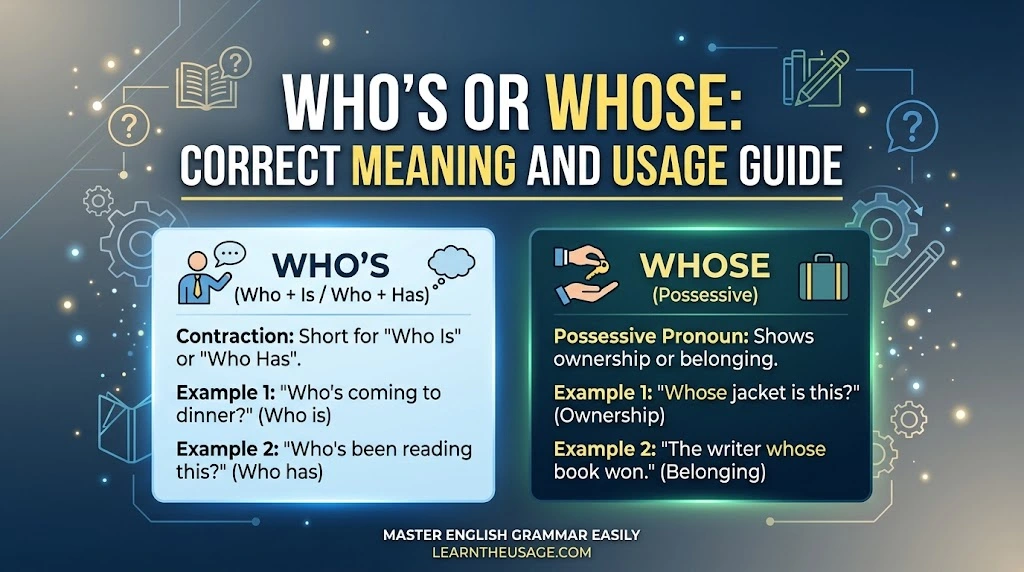
- Who’s means who is or who has.
- Whose expresses possession, ownership, relationship, or association.
For example:
Who’s calling?
Whose phone is ringing?
In the first sentence, who’s means who is. In the second, whose asks who the phone belongs to.
Once you understand that difference, choosing between them becomes much easier.
Who’s vs. Whose: The Quick Answer
The simplest way to distinguish who’s or whose is to expand the word.
| Word | Meaning | Function | Example |
| Who’s | Who is | Contraction | Who’s coming tonight? |
| Who’s | Who has | Contraction | Who’s finished the work? |
| Whose | Belonging to whom | Possessive word | Whose coat is this? |
| Whose | Of whom or associated with whom | Possessive relative word | The student whose laptop broke left early. |
Try replacing who’s with who is or who has.
If the sentence still works, who’s is probably correct.
For example:
Who’s at the door?
Becomes:
Who is at the door?
The meaning stays intact. Therefore, who’s is correct.
Now consider:
Whose jacket is this?
You can’t replace whose with who is:
Who is jacket is this? ❌
The sentence asks about ownership. That makes whose the correct choice.
The fastest rule
Who’s = who is / who has
Whose = possession or association
That one distinction solves most who’s vs. whose questions.
What Does “Who’s” Mean?
Who’s is a contraction. A contraction combines two words and uses an apostrophe to replace omitted letters.
In standard English, who’s has two main meanings:
- who is
- who has
The surrounding sentence tells you which meaning applies.
Who’s = Who Is
The most common use of who’s is as a contraction of who is.
Consider these examples:
Who’s at the door?
This means:
Who is at the door?
Another example:
Who’s responsible for this report?
This means:
Who is responsible for this report?
You can also use who’s in statements:
I know who’s coming to dinner.
Here, who’s means who is.
More examples include:
- Who’s your teacher?
- Who’s ready to leave?
- Do you know who’s in charge?
- She knows who’s responsible.
- I wonder who’s calling.
- Tell me who’s available tomorrow.
In every case, the apostrophe marks a contraction.
Who’s = Who Has
Who’s can also contract who has.
This use often appears with a past participle.
For example:
Who’s finished the assignment?
Expand it:
Who has finished the assignment?
Another example:
Who’s seen my keys?
That means:
Who has seen my keys?
Here are several more examples:
| Contraction | Expanded form |
| Who’s finished? | Who has finished? |
| Who’s eaten already? | Who has eaten already? |
| Who’s seen this movie? | Who has seen this movie? |
| Who’s taken my pen? | Who has taken my pen? |
| Who’s forgotten the password? | Who has forgotten the password? |
The who has test works particularly well when a past participle follows the word.
How to Tell Which Meaning “Who’s” Has
Look at the word or phrase that follows who’s.
If the sentence describes a current state or action, who’s often expands to who is:
Who’s ready?
→ Who is ready?
If it refers to something completed or experienced, it may expand to who has:
Who’s finished?
→ Who has finished?
Context ultimately determines the meaning.
What Does “Whose” Mean?
Whose is a possessive word. It asks or tells you who something belongs to or is associated with.
For example:
Whose car is parked outside?
The question asks about the car’s owner.
You could answer:
It’s Maria’s car.
Or:
The car belongs to Maria.
That’s why whose works in the original question.
Other examples include:
- Whose phone is this?
- Whose shoes are by the door?
- Whose idea was that?
- Whose responsibility is it?
- Whose keys did you find?
- Whose name appears on the document?
Notice something important: whose does not contain an apostrophe.
That’s true even though it expresses possession.
English doesn’t use an apostrophe simply because a word indicates possession. The grammar of whose developed as a possessive form of who, while who’s developed as a contraction.
Whose as a Possessive Word
Whose commonly appears before a noun.
For example:
Whose book is this?
Here, whose modifies book.
The same pattern appears in:
Whose car did you borrow?
Whose laptop is on the desk?
Whose jacket is hanging there?
Whose idea was it?
The basic structure is:
whose + noun
That makes whose easy to recognize in many sentences.
Whose Can Show More Than Ownership
Possession isn’t always literal ownership.
Whose can also express a relationship or association.
For example:
The woman whose son won the scholarship looked delighted.
The son doesn’t belong to the woman in the same way a book belongs to someone. Instead, whose identifies a relationship.
Similarly:
We hired a designer whose work impressed the entire team.
The designer doesn’t “own” the work in the simple sense. Whose connects the designer with their work.
This broader idea of association explains many uses of whose in relative clauses.
Whose as a Possessive Pronoun
Whose can also appear without a noun immediately after it.
For example:
Whose is this?
The implied noun is understood from context.
You might answer:
It’s mine.
Or:
It’s David’s.
Another example:
Whose did you take?
The missing noun is understood from the surrounding conversation.
You could mean:
Whose book did you take?
or
Whose jacket did you take?
depending on the context.
So don’t assume whose must always sit directly before a noun. It can function independently when the meaning is clear.
Whose Can Refer to People and Things
A common misconception is that whose only refers to people.
That’s too narrow.
In standard English, whose can introduce a relative clause describing people, animals, organizations, and sometimes inanimate things.
For example:
The company whose website crashed apologized to customers.
Here, whose refers to the company.
Another example:
We visited a museum whose collection includes ancient artifacts.
And:
The dog whose owner was missing had been waiting outside.
These constructions are grammatically standard.
The important relationship is not simply human ownership. Whose establishes a possessive or associative connection.
Who’s or Whose: The Main Difference
The easiest way to understand who’s vs. whose is to focus on what each word replaces.
Use “Who’s” for “Who Is”
If who’s can become who is, use who’s.
Who’s coming with us?
→ Who is coming with us?
Who’s responsible?
→ Who is responsible?
I know who’s available.
→ I know who is available.
The sentence remains grammatical and keeps its meaning.
Use “Who’s” for “Who Has”
If who’s can become who has, use who’s.
Who’s finished?
→ Who has finished?
Who’s seen the message?
→ Who has seen the message?
Who’s already left?
→ Who has already left?
Again, the contraction simply shortens the two-word expression.
Use “Whose” for Possession
Use whose when you’re asking or describing who something belongs to or is connected with.
Whose wallet is this?
Whose opinion matters here?
Whose car are we taking?
The employee whose desk is upstairs called.
None of these sentences can use who’s correctly.
Who’s vs. Whose Examples Side by Side
Seeing the words together makes the distinction clearer.
| Sentence with who’s | Sentence with whose |
| Who’s calling? | Whose phone is ringing? |
| Who’s coming tonight? | Whose car are we taking? |
| Who’s responsible? | Whose responsibility is this? |
| Who’s ready? | Whose turn is it? |
| Who’s finished? | Whose work is finished? |
| Who’s using the computer? | Whose computer is this? |
| Who’s at the meeting? | Whose meeting notes are these? |
Look at the first column.
Each who’s can expand to who is or who has.
Now look at the second column.
Each whose relates to possession, ownership, relationship, or association.
How to Remember Who’s vs. Whose
You don’t need to memorize dozens of grammar rules. A couple of quick tests will handle most situations.
The “Who Is” Test
When you see who’s, replace it with who is.
Who’s coming?
becomes:
Who is coming?
It works.
Therefore:
Who’s coming? ✓
Now try the same test with a possessive sentence:
Who’s jacket is this?
Replace who’s:
Who is jacket is this?
That doesn’t work.
The correct sentence is:
Whose jacket is this? ✓
The “Who Has” Test
Sometimes who is won’t fit, but who has will.
Consider:
Who’s taken my notebook?
Try:
Who has taken my notebook?
That works.
So who’s is correct.
The same applies to:
Who’s already eaten?
→ Who has already eaten?
Who’s seen the new schedule?
→ Who has seen the new schedule?
The Ownership Test
If you’re asking “belonging to whom?”, choose whose.
For example:
Whose umbrella is this?
The underlying question is:
This umbrella belongs to whom?
Another example:
Whose decision was it?
The question concerns whose decision or authority is involved.
That points directly to whose.
Why Does “Who’s” Have an Apostrophe?
The apostrophe in who’s indicates missing letters.
Who’s comes from:
who + is
or:
who + has
The apostrophe signals that part of the original expression has been omitted.
This is the same basic principle seen in contractions such as:
- it’s = it is / it has
- he’s = he is / he has
- she’s = she is / she has
- they’re = they are
- we’re = we are
However, whose isn’t a contraction.
That’s why it doesn’t need an apostrophe.
Why “Whose” Has No Apostrophe
The absence of an apostrophe often confuses writers because whose expresses possession.
English has several different ways to express possession. An apostrophe isn’t required in every possessive construction.
Compare:
The first uses an apostrophe because John’s is a possessive form of a proper noun.
The others use possessive words or pronouns.
Therefore, this is correct:
Whose car is this?
This is not:
Who’s car is this? ❌
The apostrophe doesn’t belong there.
Common Who’s and Whose Mistakes
“Who’s Book” vs. “Whose Book”
This is one of the most common errors.
Incorrect:
Who’s book is on the table?
Correct:
Whose book is on the table?
Why?
Because the question asks who owns or is associated with the book.
The who is test exposes the mistake:
Who is book is on the table?
That construction doesn’t work.
“Who’s Phone” vs. “Whose Phone”
Incorrect:
Who’s phone keeps ringing?
Correct:
Whose phone keeps ringing?
The phone belongs to someone. Therefore, whose is required.
Using “Whose” for “Who Is”
Incorrect:
Whose coming to the party?
Correct:
Who’s coming to the party?
Expand the contraction:
Who is coming to the party?
Perfect.
Using “Whose” for “Who Has”
Incorrect:
Whose already finished?
Correct:
Who’s already finished?
Expand it:
Who has already finished?
The meaning becomes obvious.
Who’s vs. Whose in Questions
Questions often create the most confusion because both words naturally appear at the beginning of questions.
Compare:
Who’s your manager?
and:
Whose manager is he?
These aren’t interchangeable.
The first asks for someone’s identity.
Who’s = who is
Who is your manager?
The second asks about a relationship or association.
Whose manager means the manager belonging to or associated with whom.
Consider another pair:
Who’s driving?
Whose car are you driving?
The first asks which person is driving.
The second asks which person’s car is being used.
A single apostrophe changes the grammatical function completely.
Who’s vs. Whose in Relative Clauses
Whose becomes especially useful in longer sentences.
A relative clause adds information about a noun.
For example:
The student whose laptop broke left the classroom.
The phrase whose laptop broke tells you which student you’re talking about.
Another example:
I met a writer whose books have sold millions of copies.
Here, whose books connects the writer with the books.
Why “Who’s” Doesn’t Work Here
Consider:
The student who’s laptop broke left.
It might look plausible at first glance. However, who’s means who is or who has.
Try expanding it:
The student who is laptop broke left.
That doesn’t make grammatical sense.
The intended meaning involves possession or association:
The student’s laptop broke.
Therefore:
The student whose laptop broke left.
is correct.
Whose With Organizations and Things
Relative clauses can also use whose with nonhuman nouns.
For example:
The company whose products dominate the market released a new model.
Here, whose products means the products associated with that company.
Another example:
We found a website whose information was easy to understand.
And:
The building whose roof collapsed has been closed.
These examples show why defining whose only as “ownership” can be limiting.
A better explanation is possession or association.
Who’s vs. Whose in Formal and Informal Writing
Both who’s and whose are standard English forms. The choice depends on meaning rather than formality.
In conversational writing, contractions are extremely common:
Who’s coming to the meeting?
In formal writing, you can sometimes use the expanded form:
Who is coming to the meeting?
That doesn’t make who’s incorrect. It simply creates a different level of formality.
By contrast, whose remains whose regardless of whether the writing is casual or formal.
For example:
Whose proposal received approval?
There is no formal alternative involving an apostrophe.
A Useful Style Comparison
| Casual | More formal |
| Who’s responsible? | Who is responsible? |
| Who’s attending? | Who is attending? |
| Who’s finished? | Who has finished? |
| Whose proposal is this? | Whose proposal is this? |
The distinction is grammatical, not simply stylistic.
Who’s, Whose, and Whom: How They Differ
These three forms can appear together in grammar discussions, but they have different roles.
| Word | Main function | Example |
| Who | Subject | Who called you? |
| Whom | Object in formal usage | Whom did you call? |
| Whose | Possession or association | Whose bag is this? |
| Who’s | Contraction | Who’s calling? |
The apostrophe is the giveaway for who’s.
It tells you that you’re looking at a contraction rather than a possessive form.
Consider:
Who’s whose?
This sentence can actually be grammatical in the right context. For example, someone might use it when trying to determine which person owns which item.
The first who’s means who is.
The second whose indicates possession.
Context does the heavy lifting.
Who’s or Whose in Everyday Writing
The distinction matters in everyday communication.
Text Messages
You might write:
Who’s coming tonight?
But:
Whose jacket did I leave in my car?
Workplace Emails
You could write:
Do you know who’s handling the account?
But:
Do you know whose account this is?
School Assignments
A student might ask:
Who’s responsible for this section?
Another question might be:
Whose research did you cite?
Social Media
You might see:
Who’s ready for the weekend?
Or:
Whose dog is this?
The same grammatical rule applies everywhere.
A Practical Who’s vs. Whose Editing Checklist
When you’re unsure, run through these questions.
Can “who’s” become “who is”?
If yes, use who’s.
Who’s there?
Who is there?
Can “who’s” become “who has”?
If yes, use who’s.
Who’s finished?
Who has finished?
Does the sentence involve possession or association?
If yes, use whose.
Whose bag is this?
Does “whose” introduce a noun?
That’s often a strong clue:
whose car
whose idea
whose phone
whose responsibility
Does the apostrophe actually represent missing letters?
If not, don’t automatically add one.
This last point matters because writers often assume an apostrophe means possession. With who’s, it doesn’t.
Who’s or Whose: Examples With Explanations
Here are several examples that cover common situations.
“Who’s waiting outside?”
Correct: Who’s waiting outside?
Why: Who’s means who is.
Who is waiting outside?
“Whose bag is this?”
Correct: Whose bag is this?
Why: The sentence asks who the bag belongs to.
“Who’s already eaten?”
Correct: Who’s already eaten?
Why: Who’s means who has.
Who has already eaten?
“Whose idea was it?”
Correct: Whose idea was it?
Why: The question concerns the person associated with the idea.
“Do you know who’s calling?”
Correct: Do you know who’s calling?
Why: Who’s means who is.
Do you know who is calling?
“Do you know whose phone this is?”
Correct: Do you know whose phone this is?
Why: The question asks who owns the phone.
“The woman whose car was damaged filed a report.”
Correct: The woman whose car was damaged filed a report.
Why: Whose connects the woman with her car.
“Who’s taken my notebook?”
Correct: Who’s taken my notebook?
Why: Who’s means who has.
Who has taken my notebook?
“Whose turn is it?”
Correct: Whose turn is it?
Why: The sentence asks which person’s turn it is.
“I know who’s responsible.”
Correct: I know who’s responsible.
Why: Who’s means who is.
“I know whose responsibility it is.”
Correct: I know whose responsibility it is.
Why: Whose indicates association or responsibility belonging to someone.
“Who’s using my computer?”
Correct: Who’s using my computer?
Why: Who’s means who is.
“Whose computer are you using?”
Correct: Whose computer are you using?
Why: The question concerns ownership.
A Mini Case Study: One Apostrophe, Two Different Meanings
Consider this short exchange:
Sam: Who’s coming to the office?
Alex: I think Maria is coming.
Sam: Whose laptop is she bringing?
Alex: I think it’s hers.
The first question asks about identity.
Who’s = Who is
The second asks about possession.
Whose = belonging to whom
Nothing else about the sentence needs to change. The grammatical purpose changes because the question changes.
This is why learning the meaning is more reliable than simply memorizing spelling.
A Simple Diagram for Who’s vs. Whose
You can think of the decision like a small grammatical fork in the road:
WHO’S or WHOSE?
|
———————–
| |
Can it mean Does it show
“who is” or possession/
“who has”? association?
| |
YES YES
| |
WHO’S WHOSE
For example:
Who’s coming?
↓
Who is coming?
↓
WHO’S
But:
Whose coat is this?
↓
Who does the coat belong to?
↓
WHOSE
It’s a simple test, but it works remarkably well.
Common Questions About Who’s or Whose
Is “who’s” the same as “whose”?
No.
Who’s is a contraction meaning who is or who has.
Whose indicates possession or association.
Is “who’s” possessive?
No.
The apostrophe in who’s indicates a contraction. It doesn’t indicate possession.
Who’s coming? = Who is coming?
For possession:
Whose coat is this?
Can “whose” refer to things?
Yes.
Whose can establish a possessive or associative relationship with things, organizations, animals, and people.
For example:
The company whose website crashed responded quickly.
Can “who’s” mean “who has”?
Yes.
For example:
Who’s finished?
means:
Who has finished?
Is “whose” a contraction?
No.
Whose is a possessive form related to who. It isn’t a shortened form of two words.
Why doesn’t “whose” have an apostrophe?
Because it isn’t a contraction.
The apostrophe in who’s represents omitted letters from who is or who has.
Which is correct: “who’s phone” or “whose phone”?
Whose phone is correct when asking about ownership or association.
Whose phone is ringing?
The sentence asks who the phone belongs to.
Which is correct: “Who’s coming?” or “Whose coming?”
Who’s coming? is correct when you mean Who is coming?
Who’s coming to dinner?
Whose coming would require a possessive context, such as a noun afterward:
Whose coming surprised everyone?
Even then, the construction means something different. Here, whose identifies the person associated with the “coming.”
Who’s or Whose: Quick Reference Table
| Meaning you intend | Correct form | Example |
| Who is | Who’s | Who’s at the door? |
| Who is | Who’s | Who’s responsible? |
| Who has | Who’s | Who’s finished? |
| Who has | Who’s | Who’s seen my keys? |
| Belonging to whom | Whose | Whose bag is this? |
| Associated with whom | Whose | Whose team is playing? |
| Possessive relative clause | Whose | The man whose car broke down called. |
Who’s vs. Whose Cheat Sheet
When you’re writing quickly, remember these two lines:
WHO’S = WHO IS / WHO HAS
WHOSE = POSSESSION / ASSOCIATION
Then use the substitution test.
If you can write:
Who is…
or:
Who has…
use who’s.
If you’re asking:
Belonging to whom?
use whose.
For example:
Who’s at the door?
Who is at the door?
Who’s finished the project?
Who has finished the project?
Whose project is this?
The project belongs to whom?
That distinction covers the vast majority of everyday cases.
Final Takeaway: Who’s or Whose?
The difference between who’s and whose looks small on the page, but the grammar behind it is straightforward.
Who’s is always a contraction of either who is or who has.
Whose expresses possession, ownership, relationship, or association.
The apostrophe doesn’t mean possession in who’s. It represents missing letters.
So when you’re stuck, don’t guess. Expand the word.
Who’s = who is / who has
Whose = belonging to whom
Consider the final example:
Who’s at the door, and whose package are they holding?
The first word means who is.
The second asks about possession.
Once you spot that difference, who’s or whose becomes much easier to get right.
