

Breath or breathe? If these two words regularly trip you up, you’re not alone. They look almost identical, share the same basic idea, and differ by only one letter. Yet they don’t work the same way in a sentence.
The easiest distinction is this:
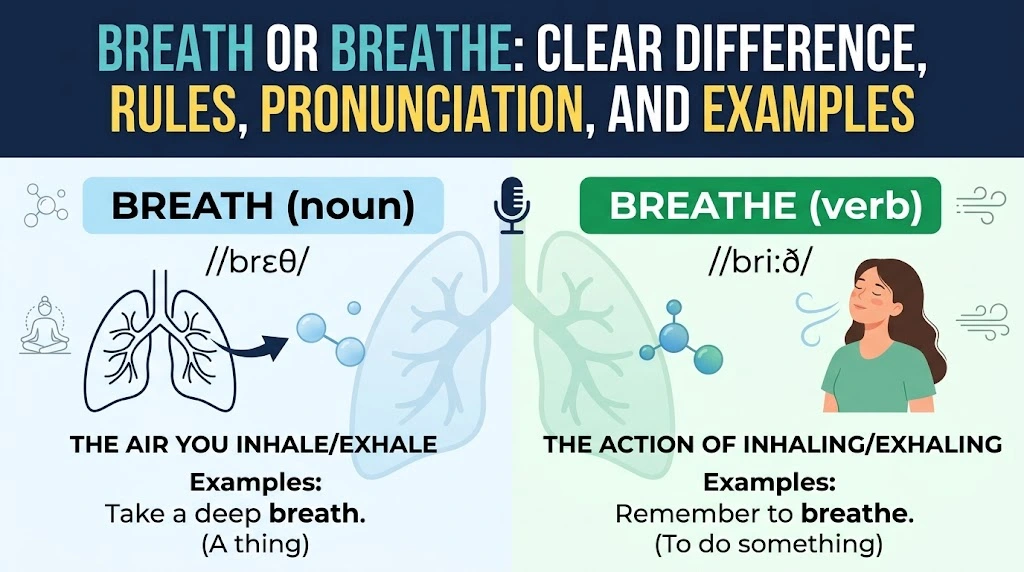
Breath is a noun. Breathe is a verb.
You take a breath, but you breathe slowly. You can hold your breath, but you can’t correctly say “hold your breathe.” Likewise, you can tell someone to breathe deeply, but “take a deep breathe” is incorrect.
That small spelling difference creates a surprisingly large number of mistakes.
This guide explains breath vs. breathe in plain English. You’ll learn what each word means, how to pronounce them, which grammar rules apply, why common mistakes happen, and how to remember the difference without second-guessing yourself.
Breath vs. Breathe: The Quick Difference
Here’s the distinction at a glance:
| Word | Part of Speech | Meaning | Example |
| Breath | Noun | Air taken into or released from the lungs | “Take a deep breath.” |
| Breathe | Verb | To take air into the lungs and release it | “Breathe slowly.” |
| Breathed | Verb | Past tense of breathe | “She breathed deeply.” |
| Breathing | Verb/noun | The act or process of breathing | “His breathing was steady.” |
Think of it this way:
- Breath is something you take, hold, catch, or lose.
- Breathe is something you do.
For example:
- “Take a breath before you speak.”
- “Breathe deeply before you speak.”
- “She held her breath.”
- “She breathed deeply.”
- “He is breathing normally.”
Once you recognize the grammatical role, the choice becomes much easier.
What Does “Breath” Mean?
Breath is a noun. It refers to the air you take into or release from your lungs. It can also describe a single act of inhaling or exhaling.
Consider this sentence:
“She took a deep breath before answering.”
The word breath names the thing she took. It doesn’t describe the action itself.
You can use breath with common determiners such as a, your, his, her, or their:
- “Take a breath.”
- “Hold your breath.”
- “I could smell his breath.”
- “She caught her breath.”
- “They were out of breath.”
The word can also describe the air itself:
“His breath appeared as a faint cloud in the freezing air.”
Here, breath refers to the air coming from his lungs.
Breath as a Noun
Because breath functions as a noun, it commonly appears after verbs such as:
- take
- hold
- catch
- lose
- save
- draw
Examples include:
- “Take a breath.”
- “Hold your breath.”
- “She caught her breath.”
- “He lost his breath while running.”
- “The swimmer held his breath underwater.”
- “She drew a slow breath.”
Notice the pattern. The sentence needs a thing, not an action.
Common Expressions With “Breath”
English has dozens of established expressions containing breath. Learning them helps you recognize the noun naturally.
“Take a breath”
This means to inhale, pause, or regain composure.
“Take a breath and try again.”
“Catch your breath”
This means to recover normal breathing after physical exertion or surprise.
“Give me a minute to catch my breath after that run.”
It can also describe emotional reactions.
“The view was so beautiful that it took my breath away.”
“Hold your breath”
Literally, this means to stop breathing temporarily.
“Hold your breath while you go underwater.”
It also appears figuratively:
“Don’t hold your breath waiting for an immediate answer.”
In that context, the expression suggests that something may take a long time.
“Out of breath”
Someone who is out of breath has difficulty breathing normally after exercise or exertion.
“I was out of breath after climbing the stairs.”
“Under your breath”
This means speaking so quietly that other people may barely hear you.
“He muttered something under his breath.”
“A breath of fresh air”
This expression describes something pleasantly new, refreshing, or different.
“Her practical approach was a breath of fresh air.”
The expression doesn’t necessarily involve literal breathing.
What Does “Breathe” Mean?
Breathe is a verb. It describes the action of taking air into the lungs and releasing it.
For example:
“Try to breathe slowly.”
The word breathe tells us what the person should do.
You can use breathe in several grammatical forms:
- breathe — present/base form
- breathes — third-person singular present
- breathed — past tense and past participle
- breathing — present participle/gerund
Examples:
- “I breathe slowly.”
- “She breathes deeply.”
- “He breathed a sigh of relief.”
- “They are breathing normally.”
Common Uses of “Breathe”
You often see breathe followed by an adverb or a preposition.
Examples include:
- breathe deeply
- breathe slowly
- breathe normally
- breathe in
- breathe out
- breathe easily
- breathe fresh air
For example:
“Breathe in through your nose and breathe out slowly.”
Both instances use breathe because they describe actions.
Breath or Breathe: The Grammar Rule
The most useful grammar rule is simple:
Use “breath” when you need a noun. Use “breathe” when you need a verb.
A noun names a person, place, thing, or idea. A verb describes an action or state.
That gives you a quick test.
Use “Breath” When You Need a Noun
Look at these sentences:
- “Take a breath.”
- “She held her breath.”
- “I could smell his breath.”
- “He was short of breath.”
- “The cold air made his breath visible.”
In each example, breath acts as a noun.
Use “Breathe” When You Need a Verb
Now compare them with these examples:
- “Try to breathe slowly.”
- “I can’t breathe through my nose.”
- “She breathes deeply during meditation.”
- “He breathed a sigh of relief.”
- “The runner stopped to breathe.”
In each sentence, breathe describes an action.
Breath or Breathe: A Simple Sentence Test
When you’re unsure, ask yourself:
Can I put “a,” “your,” “his,” or “her” before the word?
If yes, you probably need breath.
- “Take a breath.” ✓
- “Hold your breath.” ✓
- “I could smell his breath.” ✓
Now try another test:
Can I put “to” before the word?
If yes, you probably need breathe.
- “Remember to breathe.” ✓
- “Try to breathe slowly.” ✓
- “It’s difficult to breathe here.” ✓
This isn’t merely a memorization trick. It works because the two words belong to different grammatical categories.
Breath or Breathe: Pronunciation Difference
Spelling isn’t the only difference. Breath and breathe also have different pronunciations.
In standard American English:
- breath is pronounced /brɛθ/
- breathe is pronounced /briːð/
The final th sounds differ.
How “Breath” Sounds
The final sound in breath is the unvoiced /θ/ sound. It’s the same basic sound you hear in words such as:
- think
- thick
- math
- both
So breath sounds roughly like breth.
How “Breathe” Sounds
The final sound in breathe is the voiced /ð/ sound. You hear that sound in words such as:
- this
- that
- these
- those
The vowel also changes. Breathe has a long ee sound.
So the two words aren’t pronounced identically:
| Word | IPA | Approximate Sound |
| breath | /brɛθ/ | breth |
| breathe | /briːð/ | breedh |
The difference can feel subtle at first. Listen for the long ee sound in breathe and the shorter vowel in breath.
Why Does “Breathe” Have a Different Vowel Sound?
The spelling pattern ea doesn’t always produce the same sound in English. That’s one reason English pronunciation can feel like a maze with a few unexpected turns.
Compare:
- breath — /brɛθ/
- breathe — /briːð/
The final e in breathe helps signal the long vowel sound.
You can see a similar spelling relationship in some other word pairs, although English spelling patterns don’t always behave perfectly.
The important point is practical: don’t rely only on spelling when distinguishing these words aloud. Their pronunciation also separates them.
Breath vs. Breathe Examples
Seeing the words in context makes the difference much easier to remember.
Examples With “Breath”
- “Take a deep breath.”
- “He held his breath underwater.”
- “She was completely out of breath.”
- “I could see my breath in the cold morning air.”
- “The runner stopped to catch his breath.”
- “His breath smelled strongly of garlic.”
- “She whispered the words under her breath.”
- “The news left everyone holding their breath.”
Examples With “Breathe”
- “Try to breathe slowly.”
- “She breathes through her nose.”
- “He couldn’t breathe comfortably in the smoke.”
- “Remember to breathe during the exercise.”
- “The doctor told him to breathe deeply.”
- “The baby was breathing normally.”
- “She breathed slowly before giving her speech.”
- “Open the window so we can breathe some fresh air.”
Breath or Breathe: Common Mistakes
These words create several predictable spelling errors.
“Take a Breathe” Is Incorrect
You may see:
“Take a breathe.”
That’s incorrect in standard English.
The correct sentence is:
“Take a breath.”
Why? Because the sentence needs a noun after take.
You take a breath.
You don’t take a breathe.
“I Can’t Breath” Is Incorrect
Another common mistake is:
“I can’t breath.”
The correct version is:
“I can’t breathe.”
Here, can’t is followed by a verb. The sentence describes an action that the subject cannot perform.
You can:
- walk
- run
- speak
- breathe
Therefore:
“I can’t breathe.”
“Hold Your Breathe” Is Incorrect
The correct phrase is:
“Hold your breath.”
Your is a possessive determiner, and the phrase refers to the noun breath.
You hold your breath.
“Breathe Deep Breath” Needs Correction
A sentence such as:
“Breathe deep breath.”
doesn’t work naturally.
Depending on what you mean, you could write:
“Breathe deeply.”
Or:
“Take a deep breath.”
The first sentence focuses on the action. The second focuses on the noun.
Breath vs. Breathe in Different Tenses
Because breathe is a verb, it changes form depending on tense and grammatical construction.
| Form | Word | Example |
| Base form | breathe | “I breathe slowly.” |
| Third-person singular | breathes | “She breathes deeply.” |
| Past tense | breathed | “He breathed deeply.” |
| Present participle | breathing | “They are breathing normally.” |
Breath doesn’t work as the verb in these constructions.
For example:
- “She breathes slowly.” ✓
- “She breaths slowly.” ✗
- “She breaths slowly.” is not the standard verb form.
- “She breathes slowly.” is correct.
That extra e matters.
Breathe, Breathed, and Breathing
Once you understand breathe, its other forms become easier.
Breathe
Use breathe for the base form.
“Try to breathe normally.”
Breathes
Use breathes with a singular third-person subject in the present tense.
“The sleeping child breathes quietly.”
The spelling retains the e before the s.
Breathed
Breathed is the past tense and past participle of breathe.
“She breathed deeply before speaking.”
The ending changes the spelling and pronunciation.
Breathing
Breathing describes the ongoing action or can function as a noun.
“His breathing became slower.”
It can also modify another noun:
“She practiced breathing exercises.”
Breath vs. Breathe in Common Phrases
Learning common collocations gives you another shortcut.
| Expression | Correct Word | Example |
| Take a ___ | breath | “Take a breath.” |
| Hold your ___ | breath | “Hold your breath.” |
| Catch your ___ | breath | “I need to catch my breath.” |
| Out of ___ | breath | “She was out of breath.” |
| Under your ___ | breath | “He spoke under his breath.” |
| ___ deeply | breathe | “Breathe deeply.” |
| ___ in | breathe | “Breathe in slowly.” |
| ___ out | breathe | “Breathe out gently.” |
| Remember to ___ | breathe | “Remember to breathe.” |
These phrases are useful because English speakers tend to learn common word combinations as units.
Breath or Breathe in Figurative Language
Both words appear in figurative expressions. Their meanings can move beyond literal respiration.
“A Breath of Fresh Air”
When something is described as a breath of fresh air, it brings a welcome change.
“The new design was a breath of fresh air.”
The phrase uses breath because the expression treats the refreshing change as a noun.
“With Bated Breath”
With bated breath means waiting with intense anticipation.
“The audience waited with bated breath for the announcement.”
Notice that bated isn’t the same as baited. The expression comes from an older sense related to restraining or holding.
“Breathe New Life Into”
To breathe new life into something means to make it feel fresh, active, or useful again.
“The renovation breathed new life into the old building.”
Here, breathed is the past-tense form of the verb breathe.
“Don’t Hold Your Breath”
Literally, holding your breath means stopping your breathing temporarily.
Figuratively, don’t hold your breath suggests that something may not happen soon.
“If you’re waiting for an immediate response, don’t hold your breath.”
The phrase uses breath because it refers to the noun.
Breath or Breathe in Everyday Writing
The distinction matters in texts, emails, school assignments, articles, and professional communication.
A single extra letter can change the grammatical role of the word.
Consider:
“Before the presentation, take a deep breath.”
This sounds natural because the speaker recommends an action involving a noun.
Now compare:
“Before the presentation, breathe deeply.”
This is also correct. However, the grammatical structure has changed.
The first sentence tells you to take something.
The second tells you what to do.
That’s the core difference.
A Practical Comparison: Breath vs. Breathe
| Feature | Breath | Breathe |
| Part of speech | Noun | Verb |
| Main idea | Air or an instance of respiration | The action of respiration |
| Example | “Take a breath.” | “Breathe slowly.” |
| Can follow “a”? | Yes | No |
| Can follow “to”? | No | Yes |
| Pronunciation | /brɛθ/ | /briːð/ |
| Past form | Not applicable | breathed |
| -ing form | Not applicable | breathing |
This table gives you the entire distinction in one place.
A Quick “Thing or Action?” Test
When you hesitate between breath and breathe, ask one question:
Am I naming something, or am I describing an action?
If you’re naming something, choose breath.
If you’re describing an action, choose breathe.
For example:
Naming something:
“I took a deep breath.”
Describing an action:
“I breathed deeply.”
Here’s another pair:
“She held her breath.”
versus
“She tried to breathe slowly.”
The first sentence identifies what she held. The second identifies what she tried to do.
A Simple Memory Trick for Breath vs. Breathe
Here’s an easy way to remember the difference:
You take a breath, but you breathe.
That sentence captures the basic grammar perfectly.
Another useful trick is to connect each word with a common phrase:
- a breath
- your breath
- take a breath
- hold your breath
versus:
- to breathe
- breathe deeply
- breathe slowly
- breathe in
- breathe out
If you can remember just those patterns, most everyday choices become automatic.
Breath, Breathe, and Related Words
The word family contains several forms that are worth learning together.
Breathing
Breathing describes the process of taking air in and releasing it.
“His breathing was calm and regular.”
It can also modify another noun:
“Breathing exercises can help you focus.”
Breathed
Breathed is the past form of breathe.
“She breathed a sigh of relief.”
The phrase breathe a sigh of relief is especially common.
It can describe the feeling of becoming less worried after uncertainty ends.
Breathless
Breathless means unable to breathe normally or extremely excited, amazed, or eager.
Literal example:
“He was breathless after sprinting uphill.”
Figurative example:
“The performance left the audience breathless.”
Breathable
Breathable means allowing air to pass through, particularly when discussing materials.
“The shirt uses a lightweight, breathable fabric.”
This word is common in clothing, footwear, outdoor gear, and textile descriptions.
Breath vs. Breathe: Mini Case Study
Imagine someone writing a fitness instruction:
“Take a deep breathe before starting the exercise.”
The sentence contains the classic error.
The corrected version is:
“Take a deep breath before starting the exercise.”
Why?
Because take needs a noun in this construction.
Now suppose the instruction says:
“Remember to breath during the exercise.”
That’s a different error.
The correction is:
“Remember to breathe during the exercise.”
Here, to introduces the base form of a verb.
Finally, consider:
“Take a deep breath and breathe slowly.”
This sentence correctly uses both words.
Breath names the thing you take. Breathe names the action you perform.
That’s a perfect example of how both words can appear naturally in the same sentence.
Breath vs. Breathe: Common Sentence Pairs
| Incorrect | Correct | Why |
| “Take a deep breathe.” | “Take a deep breath.” | Breath is the noun. |
| “I can’t breath.” | “I can’t breathe.” | Breathe is the verb. |
| “Hold your breathe.” | “Hold your breath.” | Breath follows possessive “your.” |
| “Remember to breath.” | “Remember to breathe.” | To is followed by the base verb. |
| “She breaths slowly.” | “She breathes slowly.” | Third-person singular form is breathes. |
| “He took a breathe.” | “He took a breath.” | Took takes the noun breath. |
How to Choose the Correct Word Quickly
When editing your writing, don’t stare at the spelling and hope the answer jumps out.
Use this quick process:
Look at the word before the blank.
If you see:
- a → likely breath
- your → likely breath
- his/her → likely breath
- take → often breath
- hold → often breath
- catch → often breath
- to → breathe
- can/can’t → breathe
- should → breathe
- will → breathe
For example:
“You should ___ slowly.”
The answer is breathe because should is followed by a base-form verb.
“Take a deep ___.”
The answer is breath because the sentence needs a noun.
Why These Words Are So Easy to Confuse
The confusion isn’t surprising.
Both words:
- begin with breath-
- relate to respiration
- appear in similar contexts
- differ by only one written letter
- have related pronunciation
- belong to the same word family
English contains many word pairs like this. Similar spelling doesn’t guarantee identical grammar.
The safest strategy isn’t to memorize every sentence individually. Instead, learn the grammatical function.
Breath = noun.
Breathe = verb.
Once that distinction clicks, the rest falls into place.
Frequently Asked Questions About Breath or Breathe
Is “breath” a noun or a verb?
Breath is a noun. It refers to the air taken into or released from the lungs or a single act of inhaling or exhaling.
“She took a deep breath.”
Is “breathe” a noun or a verb?
Breathe is a verb. It describes the action of inhaling and exhaling.
“Try to breathe slowly.”
What is the difference between breath and breathe?
Breath is a noun, while breathe is a verb.
You take a breath.
You breathe.
Is “take a breathe” correct?
No. The standard form is:
“Take a breath.”
The word breath functions as the noun after take.
Is “I can’t breath” correct?
No. The correct sentence is:
“I can’t breathe.”
The modal verb can’t takes the base form breathe.
Is “hold your breathe” correct?
No. Write:
“Hold your breath.”
The phrase refers to the noun breath.
How do you pronounce “breath”?
In standard American English, breath is pronounced /brɛθ/.
The final consonant is the unvoiced th sound found in think.
How do you pronounce “breathe”?
In standard American English, breathe is pronounced /briːð/.
It has a long ee vowel and the voiced th sound found in this.
What is the past tense of “breathe”?
The past tense is breathed.
“He breathed deeply.”
Is “breathing” related to “breathe”?
Yes. Breathing is the present participle of breathe, and it can also function as a noun.
“Her breathing was steady.”
Can “breath” and “breathe” appear in the same sentence?
Absolutely.
“Take a deep breath and breathe slowly.”
That’s one of the clearest examples of their different grammatical roles.
Breath or Breathe: Final Cheat Sheet
Keep this compact guide handy:
| If you mean… | Use |
| A single intake or release of air | breath |
| Air coming from the lungs | breath |
| Something you can take | breath |
| Something you can hold | breath |
| The act of inhaling and exhaling | breathe |
| Something you can do | breathe |
| The past action | breathed |
| An ongoing action | breathing |
The fastest reminder is:
Take a breath. Breathe slowly.
If you’re talking about the thing, choose breath.
If you’re talking about the action, choose breathe.
Conclusion: Breath or Breathe?
The difference between breath and breathe is small in spelling but important in grammar.
Breath is a noun. It refers to air from the lungs or an instance of inhaling or exhaling.
Breathe is a verb. It describes the action of taking air into the lungs and releasing it.
A few examples make the distinction stick:
- Take a breath.
- Hold your breath.
- Catch your breath.
- Breathe deeply.
- Breathe slowly.
- Remember to breathe.
When you’re unsure, don’t rely on the spelling alone. Check the sentence’s grammar.
Ask yourself whether you’re naming a thing or describing an action. Then use the simple rule: you take a breath, but you breathe.
That one sentence can save you from most breath or breathe mistakes.
