

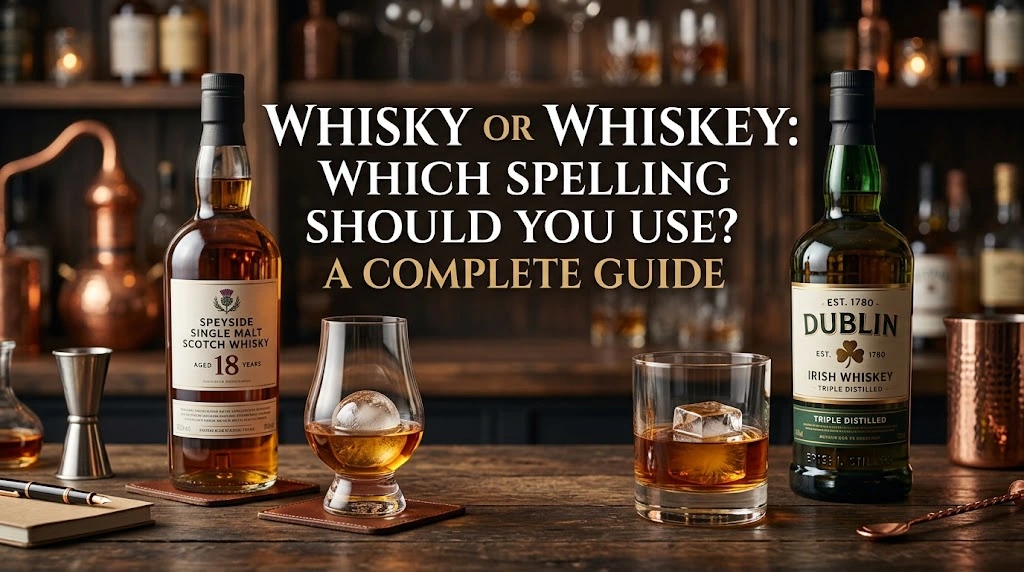
Have you ever wondered whether you should write whisky or whiskey? You’re not alone. Both spellings appear on bottles, restaurant menus, liquor store shelves, and in articles about this popular spirit. So, which one is correct?
The answer is simple: both whisky and whiskey are correct spellings. The difference usually comes down to geography, tradition, and the name a distillery gives its product.
In Scotland, Canada, and Japan, producers generally use whisky. In Ireland and the United States, whiskey is more common. However, some brands follow their own naming traditions, so a few exceptions exist.
Understanding these differences helps you write accurately, recognize regional traditions, and avoid common spelling mistakes. Whether you’re discussing Scotch, Irish whiskey, American bourbon, or Japanese whisky, knowing which spelling to use makes your writing clearer.
This guide explains the difference between whisky and whiskey, explores their historical origins, compares regional conventions, and provides practical examples to help you choose the right spelling every time.
Whisky vs. Whiskey: What Is the Difference?
The main difference between whisky and whiskey is the spelling, not the basic type of drink. Both words describe a distilled alcoholic spirit generally made from fermented grain mash and aged in wooden containers when required by the relevant production rules.
The spelling often reflects the country or tradition associated with the spirit. It doesn’t automatically tell you how the drink tastes, how old it is, or which grains the producer used.
For example, Scotch whisky and Irish whiskey have distinct production traditions. However, those differences involve ingredients, distillation methods, maturation rules, and regional standards rather than the extra letter alone.
Here’s a quick comparison:
| Feature | Whisky | Whiskey |
| Common regional usage | Scotland, Canada, Japan | Ireland, United States |
| Famous examples | Scotch whisky, Canadian whisky, Japanese whisky | Irish whiskey, bourbon, Tennessee whiskey |
| Correct spelling? | Yes | Yes |
| Does the spelling determine quality? | No | No |
| Does the spelling guarantee a particular flavor? | No | No |
These are general conventions rather than universal rules. Individual brands may use different spellings, and some countries have more than one established style.
Why Does Whiskey Have an Extra E?
The extra letter reflects historical spelling conventions that developed differently across English-speaking regions. Over time, whisky became established in Scotland and several other whisky-producing countries, while whiskey became common in Ireland and the United States.
Writers sometimes explain the distinction by saying that countries with an “e” in their names use whiskey, while countries without one use whisky. This is a memorable trick, but it isn’t a reliable historical rule. The United States and Ireland fit the pattern, yet the explanation oversimplifies a much older and more complicated naming history.
The safest approach is to learn the conventional spelling for each style and follow the producer’s official name.
Does Whisky Taste Different From Whiskey?
Not because of the spelling itself.
Flavor depends on several factors, including the grain recipe, fermentation, distillation, cask type, maturation period, climate, and blending decisions. A whisky aged in heavily charred oak may develop notes of vanilla, caramel, or spice. Another made with different grains and casks may taste fruity, smoky, floral, or earthy.
Scotch whisky can have smoky flavors associated with peat, although many Scotch whiskies aren’t smoky at all. Irish whiskey often offers smooth, fruity, or cereal-like notes, but its flavor varies by style and producer. American bourbon commonly develops rich vanilla, caramel, and oak notes from its new charred oak barrels.
These are broad tendencies, not strict rules. Spelling tells you something about naming tradition; production details tell you much more about the spirit itself.
Whisky or Whiskey: Which Countries Use Each Spelling?
Geography offers the easiest way to choose between whisky and whiskey. Although producers don’t follow one universal rule, several countries have well-established spelling preferences.
The Scotch Whisky Association explains that Scotch and Irish spirits are commonly distinguished by their spelling. American whiskey usually follows the spelling with an “e,” while Japanese and Canadian producers generally use whisky. Scotch Whisky Association provides further information in its official Scotch whisky FAQs.
Scotch Whisky Association
Scotland: Whisky
Scotland uses whisky, as seen in the established term Scotch whisky. The spirit must meet specific production requirements to qualify as Scotch, including distillation and maturation in Scotland for at least three years.
Example: “The distillery produces single malt Scotch whisky.”
Scotch Whisky Association
Ireland: Whiskey
Irish producers generally use whiskey. The spelling appears in the familiar term Irish whiskey and in the names of many Irish distilleries and brands.
Example: “Irish whiskey has a long distilling tradition.”
United States: Usually whiskey
American English generally favors whiskey, especially when discussing bourbon, rye whiskey, and Tennessee whiskey. However, some American producers deliberately use whisky.
Example: “Kentucky is famous for bourbon whiskey.”
Canada: Whisky
Canadian producers generally follow the spelling without an “e.” Canadian whisky has its own production traditions and labeling conventions.
Example: “Canadian whisky is produced in Canada.”
Japan: Whisky
Japanese producers generally use whisky, reflecting the terminology associated with Scotch and other international whisky traditions.
Example: “Japanese whisky has gained international recognition.”
The Quick Rule for Regional Spelling
If you need a simple reference, use this table:
| Country or style | Preferred spelling | Example |
| Scotland | Whisky | Scotch whisky |
| Ireland | Whiskey | Irish whiskey |
| United States | Usually whiskey | Bourbon whiskey |
| Canada | Whisky | Canadian whisky |
| Japan | Whisky | Japanese whisky |
| England | Usually whisky | English whisky |
| Wales | Usually whisky | Welsh whisky |
| Australia | Usually whisky | Australian whisky |
These spellings reflect common usage rather than an exception-free international law. If a particular producer uses a different spelling, its official product name takes priority.
Why Is Whisky Sometimes Spelled Whiskey?
The story behind whisky and whiskey involves language, regional identity, and centuries of distilling history. The extra “e” didn’t appear because someone decided that one drink needed a different recipe.
Both spellings ultimately trace back to Gaelic expressions meaning “water of life.” The Irish Gaelic form is commonly written as uisce beatha, while the Scottish Gaelic form is uisge beatha. Over time, English speakers adapted these expressions into forms that eventually became whisky and whiskey.
Scotch Whisky Association
+1
How the Two Spellings Developed
Early written references didn’t follow today’s neat regional divisions. Historical documents from different parts of Britain and Ireland used varying spellings, and the extra “e” appeared inconsistently.
During the nineteenth century, the spelling whiskey became increasingly associated with Ireland. Some Irish producers wanted to distinguish their products from Scotch whisky, particularly during a period when the two industries competed for customers and reputation.
However, this explanation doesn’t account for every historical example. Irish producers sometimes used whisky, while Scottish writers occasionally used whiskey. The distinction became more standardized over time, especially during the late nineteenth and early twentieth centuries.
Scotch Whisky
How Irish Whiskey Influenced American Usage
Irish immigration helped bring Irish cultural traditions, including distilling knowledge, to North America. As whiskey production developed in the United States, the spelling with an “e” became widely established.
American spelling conventions also played a role. Just as American English often uses color rather than British colour, American publications increasingly favored whiskey when discussing domestic spirits.
Still, the explanation isn’t as simple as saying that Irish immigrants introduced one spelling and everyone else copied it. American writers and distillers historically used both forms, and some American brands continue to use whisky today.
When Did the Spellings Become Standard?
There wasn’t one worldwide date when the spelling changed. Instead, regional conventions became more settled over several generations.
Today, the naming tradition is strong enough that changing the spelling can make a product description look unfamiliar. Most readers expect Scotch whisky and Irish whiskey, even though both words describe closely related categories of distilled spirits.
The lesson is straightforward: historical usage explains why the spellings differ, but modern regional conventions tell you which spelling to use.
Whisky or Whiskey in American English
In the United States, whiskey is the usual spelling in everyday writing. You’ll commonly see it in discussions of bourbon, rye whiskey, Tennessee whiskey, and American whiskey in general.
For example:
- “The restaurant offers a selection of American whiskey.”
- “Bourbon whiskey develops flavor during barrel aging.”
- “Irish whiskey is available at the specialty store.”
- “The bartender used rye whiskey in the cocktail.”
However, American usage includes an important exception: some domestic producers spell the word whisky.
American Brands That Use Whisky
The spelling on a bottle isn’t always the spelling you might expect from an American dictionary or newspaper style guide.
For instance, Maker’s Mark and George Dickel use whisky in their product naming. Their choices reflect brand traditions and preferences rather than a simple rule that American spirits must contain an “e.”
There’s another interesting detail. U.S. federal regulations use whisky as the heading for the legal category while recognizing both spellings as acceptable. The regulation states that the word may be spelled either “whisky” or “whiskey.”
LII / Legal Information Institute
The United States also established a specific standard for American single malt whisky, effective January 19, 2025. The designation has defined requirements covering the grain, distillation, location of production, and oak-barrel storage. This official terminology demonstrates that whisky isn’t limited to imported products.
TTB
How to Use the American Spelling Correctly
When writing for an American audience, follow these guidelines:
- Use whiskey for general references to American whiskey unless a style guide says otherwise.
- Write bourbon whiskey and rye whiskey when following conventional American terminology.
- Use Scotch whisky when discussing Scotch.
- Preserve whisky when it’s part of a producer’s official name or product designation.
- Don’t change the spelling in a quotation or product description simply to match your preferred style.
For example, a sentence about American spirits might read:
“American whiskey includes several styles, such as bourbon and rye whiskey, while American single malt whisky follows its own defined standard.”
That sentence uses both spellings correctly because each matches the relevant naming convention.
Whisky or Whiskey in British English
British English generally uses whisky for the spirit as a broad category. This is especially important when discussing Scotch, which has a well-established spelling protected by specific regulations.
For example:
- “The distillery produces Scotch whisky.”
- “Japanese whisky has its own production traditions.”
- “Canadian whisky is available in several styles.”
- “Irish whiskey is made according to Irish production requirements.”
Notice the final example. British English doesn’t require writers to remove the “e” from every occurrence of the word. When the established name is Irish whiskey, that spelling remains appropriate.
Why Scotch Whisky Uses No E
The spelling Scotch whisky is firmly established in the product’s legal and commercial identity. Scotch must meet specific requirements concerning its production, location, and maturation.
According to the Scotch Whisky Association, Scotch whisky must be distilled and matured in Scotland for at least three years and bottled at a minimum alcoholic strength of 40% alcohol by volume. The category also has defined ingredients and production rules.
Scotch Whisky Association
+1
This is why the phrase Scotch whiskey is usually inappropriate when referring to the protected Scotch category. Although a reader will understand what you mean, the wording doesn’t match the established name.
What About English and Welsh Whisky?
England and Wales also have whisky producers, and their products generally use the spelling without an “e.”
For example, you might write:
“English whisky producers are developing distinctive styles using different grains, still designs, and maturation methods.”
Or:
“The Welsh distillery produces whisky using its own approach to distillation.”
These examples follow the usual regional convention without implying that every producer must follow the same branding choice.
British English Doesn’t Mean One Spelling for Everything
A common mistake is to treat whisky as the only correct British spelling. That approach overlooks the importance of national origin and established terminology.
If you’re writing about Scotland, use Scotch whisky. If you’re writing about Ireland, use Irish whiskey. If you’re describing spirits from multiple countries, retain the spelling associated with each category.
That approach is both accurate and easy for readers to follow.
Whisky vs. Whiskey: Examples in Sentences
Sometimes the easiest way to understand a spelling difference is to see it in context. The following examples show how to use both words naturally in everyday writing.
Examples Using Whisky
Use whisky when referring to Scotch, Canadian, Japanese, or other products that traditionally use this spelling.
- Scotch whisky: “The distillery produces single malt Scotch whisky in Scotland.”
- Canadian whisky: “Canadian whisky is known for a range of blended styles.”
- Japanese whisky: “The guide explores the history of Japanese whisky.”
- English whisky: “English whisky producers are creating distinctive expressions.”
- Whisky tasting: “The hotel organized a whisky tasting for its adult guests.”
In each sentence, the spelling follows the product’s established name or the general terminology used for that style.
Examples Using Whiskey
Use whiskey for Irish whiskey and most references to American whiskey.
- Irish whiskey: “Irish whiskey has a long history of traditional distilling.”
- Bourbon whiskey: “Bourbon whiskey must meet specific American production requirements.”
- Rye whiskey: “Rye whiskey often features spicy or peppery notes.”
- Tennessee whiskey: “Tennessee whiskey has its own established production traditions.”
- Whiskey cocktail: “The bartender prepared a whiskey cocktail for the customer.”
These examples reflect common usage. A particular brand or official product designation may use a different spelling.
Common Sentences With Both Spellings
Here are a few examples that demonstrate how both forms can appear in the same paragraph.
Example one:
“Scotch whisky and Irish whiskey have different production traditions, although both belong to the wider family of grain-based distilled spirits.”
Example two:
“American whiskey is commonly spelled with an ‘e,’ but some American producers use the word whisky on their labels.”
Example three:
“Japanese whisky follows the spelling convention commonly associated with Scotch, while Irish whiskey retains the additional letter.”
The important point is consistency within each reference. You don’t need to force every instance into one spelling when you’re discussing products from different countries.
Whisky, Whiskies, Whiskey, or Whiskeys?
Choosing between whisky and whiskey is only part of the challenge. You also need to know how to form their plurals.
The usual plural of whisky is whiskies. The usual plural of whiskey is whiskeys.
| Singular | Plural | Example |
| Whisky | Whiskies | “The shop stocks several Scotch whiskies.” |
| Whiskey | Whiskeys | “The menu features several Irish whiskeys.” |
Both plural forms are correct. The choice depends on the singular spelling you’re using.
When Should You Use Whiskies?
Use whiskies when you’re referring to multiple products that use the spelling whisky.
For example:
- “The tasting included three Japanese whiskies.”
- “The store carries several Canadian whiskies.”
- “Scotch whiskies vary widely in flavor and aroma.”
The word can refer to different bottles, expressions, or styles within the category.
When Should You Use Whiskeys?
Use whiskeys when referring to multiple products that use the spelling whiskey.
For example:
- “The collection includes several Irish whiskeys.”
- “American whiskeys vary in grain composition and production methods.”
- “The restaurant offers a selection of bourbon whiskeys.”
Although whiskeys is the expected plural of whiskey, you may encounter different choices in informal writing. For professional articles, follow the relevant spelling convention and use it consistently.
Is Whiskys Ever Correct?
In standard English, whiskies is the conventional plural of whisky. Therefore, avoid whiskys in ordinary prose.
Similarly, whiskeyes isn’t the standard plural of whiskey. Use whiskeys instead.
A simple way to remember the difference is to compare the words with other English nouns that change y to ies, such as country and countries. The spelling pattern isn’t universal across English, but it works for whisky.
Common Mistakes When Using Whisky or Whiskey
Even experienced writers sometimes mix up these terms. Fortunately, a few simple checks can prevent most errors.
Assuming One Spelling Is Always Wrong
The first mistake is believing that whisky is correct and whiskey is incorrect, or vice versa.
Both spellings are accepted in English. The choice depends on context, regional usage, and the product’s established name.
Incorrect claim: “Whiskey is always a misspelling of whisky.”
Better explanation: “Whisky and whiskey are both correct, but different countries and producers favor different spellings.”
Writing Scotch Whiskey Instead of Scotch Whisky
Scotch whisky is the established term for whisky produced in Scotland under the relevant rules.
If you’re writing about the protected Scottish category, use Scotch whisky. The spelling isn’t simply a matter of personal preference.
Preferred: “The distillery produces Scotch whisky.”
Avoid: “The distillery produces Scotch whiskey.”
Writing Irish Whisky Instead of Irish Whiskey
Irish producers generally use whiskey, so Irish whiskey is the conventional term.
Although a reader can understand Irish whisky, it doesn’t follow the standard spelling used for the category.
Preferred: “Irish whiskey is produced in Ireland.”
Less conventional: “Irish whisky is produced in Ireland.”
Changing a Brand’s Official Spelling
Brand names deserve special attention because their spelling may differ from regional conventions.
For example, Maker’s Mark uses whisky, even though American English generally favors whiskey. Changing its spelling in an article would misrepresent the brand’s chosen name.
When discussing a particular product, check the official bottle label or the manufacturer’s website.
Confusing Spelling With Production Rules
The extra “e” doesn’t tell you whether a spirit is made from barley, corn, rye, or wheat. It also doesn’t establish the drink’s age, price, or quality.
For example, bourbon has specific requirements under U.S. regulations, including a mash bill containing at least 51% corn and storage in new charred oak containers. Those requirements—not the spelling alone—define important aspects of bourbon production.
LII / Legal Information Institute
+1
A bottle labeled whisky isn’t automatically older, smoother, or more authentic than one labeled whiskey. Evaluate the product according to its ingredients, production method, maturation, and verified labeling.
Whisky or Whiskey: Quick Comparison Table
If you need a quick reference while writing an article, editing a product description, or preparing a school assignment, use this table.
| Question | Answer |
| Is whisky correct? | Yes. |
| Is whiskey correct? | Yes. |
| Which spelling is common in Scotland? | Whisky. |
| Which spelling is common in Ireland? | Whiskey. |
| Which spelling is common in the United States? | Usually whiskey. |
| Which spelling is common in Canada? | Whisky. |
| Which spelling is common in Japan? | Whisky. |
| Is bourbon whiskey or whisky? | Usually bourbon whiskey, although U.S. regulations recognize both spellings for whisky as a category. |
| What is the plural of whisky? | Whiskies. |
| What is the plural of whiskey? | Whiskeys. |
| Does spelling determine flavor? | No. |
| Should you change a brand’s spelling? | No. Use its official name. |
Keep this table handy if you regularly write about spirits, food, beverages, or regional differences in English.
Which Spelling Should You Use in Your Writing?
The best spelling depends on what you’re describing and who will read your content. You don’t need to memorize every historical detail to make the right choice.
Instead, follow a few practical guidelines.
Follow the Product’s Country of Origin
When discussing a specific regional style, use its conventional spelling.
- Scotland: Scotch whisky.
- Ireland: Irish whiskey.
- United States: American whiskey, including bourbon and rye whiskey in common usage.
- Canada: Canadian whisky.
- Japan: Japanese whisky.
This approach works well for blog posts, product descriptions, educational materials, and general reference articles.
Match the Official Brand Name
If you’re writing about a specific bottle, use the spelling printed by the producer.
This matters especially when the brand uses an unusual spelling for its country. Don’t rewrite a brand name just to match your preferred dictionary or editorial style.
For instance, if a manufacturer calls its product whisky, retain that spelling even when writing for American readers.
Consider Your Audience
If you’re writing a general article for an American audience, whiskey will often feel most familiar. For a British audience, whisky is generally the more natural choice for broad references.
However, regional preference shouldn’t override a product’s proper name. An American article about Scotch should still say Scotch whisky, just as a British article about Irish products should use Irish whiskey.
Stay Consistent Within Each Context
Consistency makes your writing easier to read, but it doesn’t mean every instance must use the same spelling regardless of meaning.
For example, an article comparing Scotch whisky with Irish whiskey should preserve both spellings. For a general article about American whiskey, use whiskey throughout unless you’re discussing a product that officially uses whisky.
When working with a company style guide, follow its rules for generic references while preserving official names and established regional terminology.
A Practical Case Study: Editing a Whisky or Whiskey Article
Imagine you’re editing a blog post about three products: a Scotch single malt, an Irish whiskey, and an American bourbon.
Your first draft says:
“The whiskey selection includes Scotch whiskey, Irish whiskey, and bourbon whiskey.”
The sentence is understandable, but it doesn’t use the conventional spelling for Scotch.
A more accurate version would read:
“The selection includes Scotch whisky, Irish whiskey, and bourbon whiskey.”
Why is the second version better?
- Scotch whisky follows the established Scottish spelling.
- Irish whiskey follows the conventional Irish spelling.
- Bourbon whiskey follows common American usage.
Now imagine that the bourbon brand’s official label uses whisky. In that case, preserve the product’s exact name when referring to that bottle.
This small editing decision illustrates a useful principle: accuracy comes from recognizing the context rather than applying one spelling mechanically.
Frequently Asked Questions About Whisky or Whiskey
Is whisky or whiskey correct?
Both are correct English spellings. Whisky is common in Scotland, Canada, and Japan, while whiskey is common in Ireland and the United States. Individual brands may follow different conventions.
Why does Scotch use whisky without an E?
Whisky is the established spelling in Scotland. The form developed through historical usage and became standardized in the Scottish whisky industry.
Is American whiskey always spelled with an E?
No. American English generally favors whiskey, but some American producers use whisky. U.S. federal regulations recognize both spellings.
Is bourbon whiskey or whisky?
Bourbon is commonly called bourbon whiskey in American English. However, U.S. federal regulations permit either whisky or whiskey as the spelling of the broader category.
Do whisky and whiskey mean the same thing?
Generally, yes. Both refer to the same broad family of grain-based distilled spirits. Their production methods and legal definitions depend on the specific style and location.
What is the plural of whisky?
The standard plural is whiskies. For example: “The shop offers several Scotch whiskies.”
What is the plural of whiskey?
The standard plural is whiskeys. For example: “The collection includes several Irish whiskeys.”
Does the spelling affect taste or quality?
No. The spelling itself doesn’t determine flavor, age, ingredients, or quality. Those characteristics depend on the spirit’s production, maturation, and other factors.
Should I write whisky or whiskey in an SEO article?
Choose the spelling that matches your target audience and search intent. If you’re writing about Scotch, use Scotch whisky. If you’re discussing Irish whiskey, use Irish whiskey. Use the official spelling for named products.
You can also include the alternative spelling naturally when it helps readers understand the distinction. Avoid repeating both versions unnaturally just to target extra keywords.
Is whiskey an American spelling and whisky a British spelling?
That’s an oversimplification. American English generally prefers whiskey, and British English generally favors whisky for broad references. However, the country of origin and established product name are more important than the reader’s location.
Conclusion: Whisky or Whiskey?
So, should you write whisky or whiskey? Both spellings are correct, but the right choice depends on regional tradition and context.
Use Scotch whisky for the Scottish spirit and Irish whiskey for the Irish category. In American English, whiskey is the usual choice for bourbon and other domestic styles, although some producers use whisky. Canadian and Japanese products generally follow the spelling without an “e.”
Remember these three rules:
- Follow regional conventions when discussing a particular style.
- Preserve official brand names rather than changing their spelling.
- Stay consistent when writing about the same category.
Once you understand these conventions, choosing between whisky and whiskey becomes straightforward. Instead of worrying about which word is universally correct, focus on using the spelling that accurately represents the product you’re describing.
Further Reading
- Scotch Whisky Association: Frequently Asked Questions
- Scotch Whisky Association: Scotch Whisky Categories
- U.S. Alcohol and Tobacco Tax and Trade Bureau: American Single Malt Whisky Standard
- U.S. Federal Regulation: Whisky, 27 CFR § 5.143
