

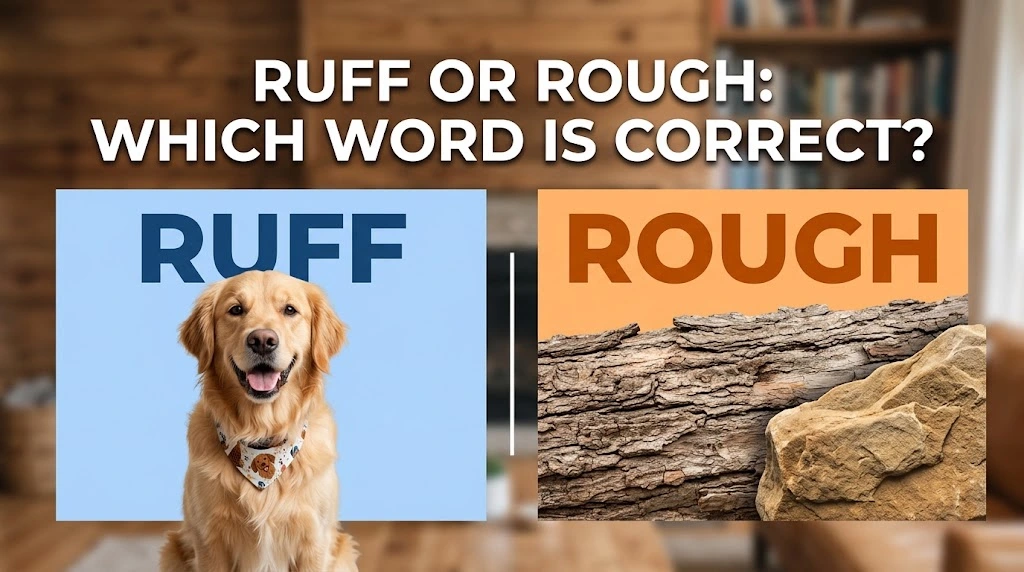
If you’ve ever paused while writing “rough” and wondered whether it should be spelled “ruff,” you’re not alone. The two words look and sound remarkably similar. Yet they don’t mean the same thing, and you generally can’t swap one for the other.
The good news is simple: rough is the word you want in most everyday situations. You write about a rough road, a rough day, rough weather, a rough surface, or a rough estimate.
Ruff is also a real English word. However, it belongs to several specific contexts, including historical clothing, birds, fish, and playful representations of a dog’s bark.
So, ruff or rough? The correct spelling depends on what you mean.
This guide explains the difference between ruff and rough, their meanings, pronunciations, grammatical uses, common mistakes, and the situations where each spelling belongs.
Ruff or Rough: The Quick Answer
Use rough for the ordinary English word describing something uneven, difficult, harsh, approximate, or unfinished.
Use ruff when you’re referring to a specific word with a specialized meaning, such as a historical collar, a bird’s neck feathers, a type of fish, or a playful dog-bark spelling.
| Word | Main meaning | Example |
| rough | Uneven, harsh, difficult, approximate, or unfinished | “The road is rough.” |
| ruff | A historical collar, neck feathers, a fish, or an informal bark representation | “The bird has a distinctive ruff.” |
The most important point is this:
Rough is the normal spelling for everyday meanings. Ruff isn’t simply an alternative spelling of rough.
That distinction clears up most of the confusion.
What Does “Rough” Mean?
Rough is a common English word with several related meanings. Its exact meaning depends on the sentence.
You might use it to describe something physically uneven. You might also use it for difficult circumstances, harsh treatment, an approximate figure, or an unfinished piece of work.
Here are the major uses.
Rough Means Uneven or Irregular
When something has an uneven or irregular surface, you can describe it as rough.
For example:
- The stone feels rough.
- The road became rough after the storm.
- Sandpaper has a rough surface.
- The wall has a rough texture.
In this sense, rough contrasts with words such as smooth, polished, and even.
Imagine running your hand over two pieces of wood. One feels silky and polished. The other catches slightly against your skin.
The second piece feels rough.
Rough Means Difficult or Unpleasant
You can also describe an unpleasant experience as rough.
For example:
- “I had a rough day at work.”
- “The family went through a rough year.”
- “She had a rough morning.”
- “The first few weeks were rough.”
Here, rough doesn’t describe a physical texture. Instead, it describes something challenging or unpleasant.
That’s why rough day is correct while ruff day is not.
Rough Can Describe Harsh Treatment
Rough can also describe behavior that isn’t gentle.
For example:
- “Don’t be rough with the puppy.”
- “The players got rough during the game.”
- “He handled the equipment too roughly.”
The word can describe physical force, behavior, or treatment.
The intended meaning remains connected to a lack of gentleness.
Rough Can Mean Approximate
Another important use appears in numbers and estimates.
A rough estimate isn’t an exact calculation. It’s an approximate figure based on available information.
For example:
“The project will take a rough estimate of three weeks.”
More naturally, you might say:
“My rough estimate is three weeks.”
You can also talk about:
- a rough calculation
- a rough figure
- a rough count
- a rough idea
- a rough approximation
In each case, rough means something close to the actual value rather than precisely calculated.
Rough Can Mean Unfinished
Writers, designers, architects, and other creative professionals frequently use rough to describe an early version.
A rough draft is an initial version of written work. It isn’t expected to be polished.
For example:
“I finished a rough draft of the article yesterday.”
A designer might create a rough sketch before producing a finished illustration.
Similarly, someone planning a presentation might prepare a rough outline before developing the final version.
These aren’t mistakes or informal shortcuts. They’re established uses of rough.
Rough as an Adjective
The most familiar grammatical role of rough is as an adjective.
An adjective describes a noun.
Consider these examples:
- rough road
- rough surface
- rough weather
- rough sea
- rough treatment
- rough draft
- rough estimate
- rough sketch
The meaning changes according to the noun that follows it.
| Phrase | Meaning |
| rough road | An uneven or difficult road |
| rough surface | A surface that isn’t smooth |
| rough weather | Stormy or unpleasant weather |
| rough day | A difficult or unpleasant day |
| rough estimate | An approximate calculation |
| rough draft | An unfinished first version |
| rough sketch | A preliminary drawing |
| rough treatment | Harsh or careless treatment |
This flexibility makes rough one of those deceptively simple English words that can carry several meanings.
Rough as a Verb
Rough can also function as a verb.
To rough something up means to treat it roughly, damage it, or physically attack someone in certain contexts.
For example:
“The old table was roughed up during the move.”
You may also encounter rough out, especially in creative or technical contexts.
To rough something out means to create an initial version without filling in all the details.
For example:
“The architect roughed out the basic design.”
The final version comes later.
Rough as a Noun
The noun rough appears in several established expressions.
In golf, for example, the rough refers to areas of longer grass bordering the fairway.
A golfer might say:
“My ball landed in the rough.”
In this context, rough doesn’t mean simply “difficult.” It refers to a specific part of a golf course.
The word also appears as a noun in other specialized contexts, including descriptions of unfinished or preliminary work.
Rough as an Adverb
You can also see rough used adverbially in expressions such as rough out and rough up.
However, don’t confuse this with roughly, which is often the more natural adverb when you’re talking about approximation.
For example:
“There were roughly 500 people there.”
That means the number was approximately 500.
What Does “Ruff” Mean?
Now we reach the other half of the question.
Ruff is a genuine English word. It simply doesn’t have the same everyday meanings as rough.
Several specialized meanings appear in dictionaries and established usage.
Ruff as a Historical Clothing Collar
One important meaning of ruff refers to a stiff, pleated collar that became fashionable in Europe during the 16th and 17th centuries.
Historical portraits often show people wearing elaborate ruffs around their necks.
These collars could become remarkably large and ornate. They formed a distinctive part of European fashion during the period.
For example:
“The portrait shows the nobleman wearing a large white ruff.”
In this sentence, ruff is absolutely correct.
Spelling it rough would change the meaning entirely.
Ruff as Feathers Around a Bird’s Neck
Ruff can also refer to a distinctive arrangement of feathers around the neck of certain birds.
The term has a straightforward descriptive connection to the historical collar.
A bird with a conspicuous ring or mass of feathers around its neck may be described as having a ruff.
For example:
“The bird’s dark ruff contrasts with its pale chest.”
This is a specialized zoological use rather than the everyday word rough.
The Ruff Bird
There is also a bird species commonly known simply as the ruff.
Its scientific name is Calidris pugnax. It is a migratory shorebird known especially for the elaborate breeding plumage displayed by males.
Male ruffs can develop striking ornamental feathers around the neck during breeding season.
That makes the name particularly fitting.
The word isn’t a spelling mistake. Ruff is the bird’s established common name.
Ruff as a Type of Fish
Ruff also names a freshwater fish, commonly known as the ruffe in some contexts.
The European ruff, Gymnocephalus cernua, belongs to the perch family.
It occurs naturally across broad parts of Europe and Asia and has also been introduced into some other regions.
Again, rough would be incorrect when referring to this fish.
Ruff as a Dog’s Bark
You’ve probably seen ruff in cartoons, children’s books, memes, or playful writing.
A writer might represent a dog’s bark as:
“Ruff! Ruff!”
This use imitates the sound of a dog barking.
It’s informal and expressive rather than the standard spelling of a dog’s vocalization. Woof is another common representation.
For example:
“The puppy jumped around and shouted, ‘Ruff! Ruff!’”
Here, ruff works because the writer intentionally represents a sound.
That doesn’t mean ruff can replace rough in ordinary sentences.
You wouldn’t write:
“I had a ruff morning.”
Unless you’re deliberately making a joke or using wordplay, that’s simply the wrong spelling.
Ruff vs. Rough: Meaning and Usage
The easiest way to see the difference is to put the words next to each other.
| Feature | Rough | Ruff |
| Everyday adjective | Yes | No |
| Means uneven | Yes | No |
| Means difficult | Yes | No |
| Means approximate | Yes | No |
| Means unfinished | Yes | No |
| Historical collar | No | Yes |
| Bird feathers | No | Yes |
| Bird species | No | Yes |
| Fish | No | Yes |
| Playful dog bark | No | Yes |
| Common in everyday writing | Very common | Relatively uncommon |
The words overlap in sound, but their meanings don’t overlap in normal usage.
Ruff vs. Rough Pronunciation
Pronunciation creates much of the confusion.
In standard English, rough is generally pronounced /rʌf/.
Ruff is also generally pronounced /rʌf/.
In other words, they’re homophones: words that sound the same but have different spellings and meanings.
That makes them similar to pairs such as:
- right / write
- there / their
- flower / flour
- sea / see
You can’t always determine the spelling simply by hearing the word.
That’s why English spelling can feel like a minefield.
If someone says:
“It was a rough day.”
You hear /rʌf/. You don’t hear the letters ough.
The context tells you which spelling belongs on the page.
Why Do People Confuse Ruff and Rough?
The pronunciation is the obvious culprit.
Both words sound like “ruff.” If you’ve learned English mainly through conversation, you might naturally spell the sound as ruff.
There’s another complication: rough has an unusual spelling.
The letters ough appear in many English words but don’t have one consistent pronunciation.
Compare:
- rough — /rʌf/
- though — /ðoʊ/
- through — /θruː/
- thought — /θɔːt/
- cough — /kɔːf/
- bough — /baʊ/
That’s a lot of pronunciation variation for four letters.
No wonder learners sometimes hesitate.
A Simple Context Test
When you’re unsure about ruff or rough, ask:
Am I describing something uneven, difficult, harsh, approximate, or unfinished?
If the answer is yes, choose rough.
Examples:
- rough road
- rough water
- rough weather
- rough day
- rough treatment
- rough estimate
- rough draft
- rough sketch
If you’re talking about a collar, feathers, a particular bird, a fish, or a playful barking sound, ruff may be correct.
Common Ruff and Rough Mistakes
Because the words sound identical, spelling errors can appear surprisingly often.
Here are some common examples.
| Incorrect | Correct | Why |
| “I had a ruff day.” | “I had a rough day.” | The day was difficult. |
| “The road is ruff.” | “The road is rough.” | The road is uneven. |
| “Give me a ruff estimate.” | “Give me a rough estimate.” | The estimate is approximate. |
| “This is a ruff draft.” | “This is a rough draft.” | The draft is unfinished. |
| “The sea is ruff today.” | “The sea is rough today.” | The water is turbulent. |
| “The fabric feels ruff.” | “The fabric feels rough.” | The texture isn’t smooth. |
These mistakes usually don’t come from misunderstanding the meaning. They come from spelling the word according to its pronunciation.
Ruff or Rough in “Rough Day”
One of the most common questions involves the phrase rough day.
The correct expression is:
I had a rough day.
Here, rough means difficult, stressful, unpleasant, or emotionally challenging.
Ruff day isn’t the standard spelling.
A playful dog-themed joke could intentionally write ruff day, but that’s wordplay rather than standard English.
For example:
“It’s been a ruff day at the dog park.”
That sentence deliberately uses the dog-bark spelling as a joke.
In normal writing, however, stick with rough day.
Ruff or Rough in “Rough Estimate”
The correct expression is rough estimate.
For example:
“Can you give me a rough estimate of the repair cost?”
Here, rough means approximate.
You aren’t asking for a final, exact number. You’re asking for a useful figure based on what is currently known.
A rough estimate might later become more precise.
For instance:
Initial estimate: $2,000–$2,500
Final quote: $2,340
The first figure gives you a general idea. The second gives you a specific amount.
Ruff or Rough in “Rough Draft”
The correct phrase is rough draft.
A rough draft represents an early version of something you’re writing.
It might contain:
- incomplete sentences
- weak transitions
- repeated ideas
- missing evidence
- awkward wording
- notes for later revision
That’s normal.
The purpose of a rough draft isn’t perfection. It’s to get the core ideas onto the page.
A useful writing process often looks like this:
Idea → Rough outline → Rough draft → Revision → Editing → Final version
So if you’re describing an unfinished first version, use rough, not ruff.
Ruff or Rough in Common Expressions
The word rough appears in many established expressions.
Rough Around the Edges
Someone described as rough around the edges may have an unpolished manner or appearance.
For example:
“The new employee seems rough around the edges, but he’s friendly.”
The expression doesn’t necessarily mean someone is bad. It often suggests that a person lacks polish or refinement.
Rough and Ready
Rough and ready describes something basic, practical, or not carefully refined.
For example:
“The team built a rough-and-ready shelter.”
It can also describe a person or approach that is practical rather than polished.
Rough It
To rough it means to live with fewer comforts than you’re accustomed to.
For example:
“We decided to rough it for a few nights while camping.”
You might sleep in a tent, cook outdoors, and go without conveniences such as hotel service.
Rough Patch
A rough patch refers to a difficult period.
For example:
“The business went through a rough patch last year.”
The expression can apply to relationships, careers, finances, health, projects, or everyday life.
Rough Seas
Rough seas describe turbulent water with significant waves or movement.
For example:
“The boat struggled through rough seas.”
This usage returns to the physical meaning of rough: the water isn’t calm or smooth.
Specialized Uses of “Ruff”
While rough dominates everyday usage, ruff appears in several legitimate fields.
| Context | Meaning of “ruff” |
| Historical fashion | A pleated collar worn around the neck |
| Ornithology | A ring or arrangement of feathers around a bird’s neck |
| Bird name | The ruff, Calidris pugnax |
| Zoology | A freshwater fish called the ruff |
| Informal writing | A representation of a dog’s bark |
This explains why a dictionary may list ruff even though you rarely need it in everyday writing.
It’s not an incorrect version of rough. It’s a separate word.
A Closer Look at the Ruff Bird
The ruff is particularly interesting because the word refers both to the species and to the ornamental neck feathers associated with males during breeding.
The bird belongs to the sandpiper family.
Its scientific name is Calidris pugnax.
During breeding season, males can develop elaborate neck feathers and compete for access to females. Their plumage can vary considerably, which makes the species notable among shorebirds.
The name therefore connects neatly with another meaning of ruff: a collar-like arrangement of feathers.
This is a good example of why context matters.
Consider these two sentences:
“The road was rough.”
“The ruff displayed its breeding plumage.”
Both contain words pronounced /rʌf/. Yet the meanings couldn’t be more different.
Ruff and Rough: A Useful Memory Trick
Here’s an easy way to remember the distinction.
Think of rough as the word you use for things that aren’t smooth, easy, gentle, exact, or finished.
Rough can describe:
- rough skin
- rough roads
- rough weather
- rough behavior
- rough times
- rough estimates
- rough drafts
Think of ruff as a specialized word.
It connects with:
- ruff collars
- ruff feathers
- the ruff bird
- the ruff fish
- “ruff!” as a playful dog sound
A quick mental shortcut helps:
Rough = everyday descriptions.
Ruff = specific meanings and playful spelling.
It isn’t a perfect rule for every dictionary entry, but it works well for ordinary writing.
Ruff vs. Rough: Side-by-Side Examples
Seeing the words in context makes the difference easier to remember.
Rough
The mountain road was rough.
We experienced rough weather during the trip.
She had a rough week.
Please give me a rough estimate.
I’m still working on the rough draft.
The fabric feels rough against my skin.
Ruff
The historical portrait shows a man wearing a large ruff.
The bird developed a colorful ruff during breeding season.
The ruff is a migratory shorebird.
The cartoon dog shouted, “Ruff! Ruff!”
These examples show why substituting one spelling for the other can change the meaning.
Ruff vs. Rough vs. Similar Words
Understanding nearby words can make rough easier to use correctly.
| Word | Typical meaning | Example |
| rough | Uneven, harsh, difficult, approximate, unfinished | a rough road |
| coarse | Having a relatively harsh or large texture | coarse fabric |
| harsh | Severe, unpleasant, or cruel | harsh criticism |
| uneven | Not level or regular | an uneven surface |
| tough | Difficult, strong, or resilient | a tough assignment |
| approximate | Close to an exact amount | an approximate cost |
These words sometimes overlap, but they’re not interchangeable in every sentence.
For example, rough estimate is natural English.
Coarse estimate usually isn’t.
Likewise, rough fabric and coarse fabric can both work, but they can suggest slightly different textures and emphasis.
Context remains king.
Rough vs. Tough
Rough and tough are particularly easy to confuse because they can both describe difficult experiences.
Compare:
“It was a rough day.”
This emphasizes that the day was unpleasant or difficult.
“It was a tough assignment.”
This emphasizes the difficulty of completing the task.
You can sometimes use both words in related contexts, but they aren’t identical.
Rough vs. Coarse
Rough and coarse can describe physical texture.
However, coarse often emphasizes larger, less fine particles or fibers.
For example:
“The rope has a rough texture.”
“The fabric is made from coarse fibers.”
The first focuses on how the surface feels. The second highlights the nature of the material itself.
Rough vs. Harsh
Harsh often describes something severe or unpleasant.
For example:
- harsh criticism
- harsh light
- harsh conditions
- harsh words
Rough can cover some of the same territory, but its range is broader.
You can have a rough surface or rough sketch. Calling either one harsh would usually miss the intended meaning.
A Practical Case Study: Editing a Sentence
Suppose someone writes:
“The client had a ruff week and wanted a ruff estimate for the project.”
Two spelling errors appear in one sentence.
The corrected version is:
“The client had a rough week and wanted a rough estimate for the project.”
Why?
The first rough means difficult or unpleasant.
The second rough means approximate.
Neither sentence refers to a collar, bird, fish, or dog sound.
Now consider a different sentence:
“The dog gave a loud ruff when someone opened the door.”
Here, ruff can work because the writer is deliberately representing the dog’s bark.
The context changes the spelling.
Another Case Study: Historical Clothing
Imagine reading a museum description:
“The subject wears an elaborate white ruff around his neck.”
Changing ruff to rough would make the sentence nonsensical.
Ruff identifies a particular historical fashion item.
The distinction matters because specialized vocabulary often looks unfamiliar. An unusual spelling isn’t necessarily an error.
The same principle applies to scientific and technical terms.
Another Case Study: Bird Identification
Suppose a birdwatching guide says:
“The male ruff develops striking breeding plumage.”
Here, ruff refers to the bird species.
A reader unfamiliar with the term might assume it is a typo for rough. It isn’t.
The surrounding words provide the clue.
Whenever you encounter an unfamiliar spelling, check the context before correcting it.
How to Choose Ruff or Rough While Writing
When the spelling isn’t obvious, use this quick process.
Step one: Read the entire sentence.
Don’t decide based only on the sound.
Step two: Identify the intended meaning.
Are you describing a surface, experience, estimate, draft, or difficult situation?
If so, rough is probably correct.
Step three: Check whether you’re referring to a specialized noun.
Is it a collar, bird, fish, or feather structure?
If so, ruff may be correct.
Step four: Consider whether you’re writing a playful sound.
If you’re representing a dog’s bark, ruff can work as informal wordplay.
Step five: Read the sentence again.
The correct spelling should make sense with the surrounding words.
Ruff or Rough: Common Questions
Is “ruff” a real word?
Yes. Ruff is a legitimate English word with several established meanings.
It can refer to a historical collar, a bird’s neck feathers, a bird species, a fish, or an informal representation of a dog’s bark.
Is “ruff” another spelling of “rough”?
No. Ruff isn’t a standard alternative spelling of rough.
Although both words are generally pronounced /rʌf/, they have different meanings and spellings.
Is “ruff day” correct?
Not in standard everyday English.
The correct phrase is rough day when you mean a difficult or unpleasant day.
“Ruff day” can appear as a joke or dog-related pun.
Is “ruff estimate” correct?
No, not when you mean an approximate estimate.
The standard phrase is rough estimate.
Is “ruff draft” correct?
No. The standard phrase is rough draft.
A rough draft is an early, unfinished version of written work.
How do you pronounce rough?
Rough is generally pronounced /rʌf/.
It rhymes with tough, stuff, and enough in standard English pronunciation.
How do you pronounce ruff?
Ruff is generally pronounced /rʌf/, the same as rough.
The spelling differs even though the pronunciation is the same.
Why does rough have such a strange spelling?
English spelling reflects centuries of linguistic change. The spelling of rough developed from older forms of the word while pronunciation changed over time.
That’s why modern English contains many words whose spellings don’t perfectly reveal their pronunciation.
Can “ruff” mean a dog’s bark?
Yes. Ruff can be used informally to represent a dog’s bark, especially in children’s writing, cartoons, jokes, and playful text.
Woof is another common representation.
Ruff or Rough: Which Word Should You Use?
For everyday English, the answer is straightforward.
Use rough when you mean:
- uneven
- difficult
- unpleasant
- harsh
- approximate
- unfinished
- not smooth
- physically demanding
Use ruff when the context specifically refers to:
- a historical pleated collar
- feathers around a bird’s neck
- the ruff bird
- the ruff fish
- a playful representation of a dog’s bark
The words sound alike, but their jobs are different.
If you’re talking about a rough road, rough day, rough estimate, or rough draft, the spelling should contain -ough.
If you’re talking about a ruff collar or ruff bird, use ruff.
Final Takeaway: Ruff or Rough?
The ruff or rough question looks tricky because both words usually sound exactly the same. Their meanings, however, give you a reliable way to choose the spelling.
Rough is the everyday word. It describes uneven surfaces, difficult experiences, harsh conditions, approximate figures, unfinished work, and much more.
Ruff is a separate word with specialized meanings. It can describe a historical collar, bird feathers, a particular shorebird, a fish, or a playful dog bark.
So remember:
Rough road. Rough day. Rough estimate. Rough draft.
Ruff collar. Ruff bird. “Ruff!”
Once you connect each spelling with its meaning, the confusion largely disappears. The pronunciation may be identical, but context tells you which word belongs on the page.
