

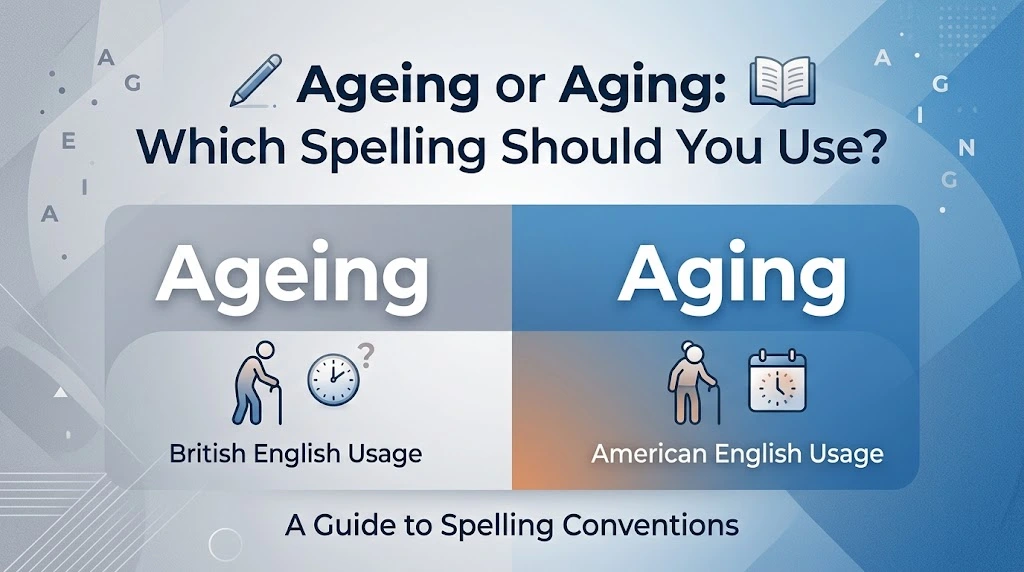
Ageing or aging is a classic British-versus-American English spelling difference. Both forms are correct. The choice depends mainly on which variety of English you’re using.
If you write in British English, use ageing. If you write in American English, use aging. The two words have the same basic meaning, the same pronunciation, and the same grammatical functions.
The difference is only one letter, but that letter can matter when you’re writing for a particular audience. A British newspaper may use ageing population, while an American publication will normally write aging population. Neither version changes the underlying idea.
This guide explains the difference between ageing and aging, shows how each form works in real sentences, and explains which spelling you should choose in academic, professional, business, and everyday writing.
Ageing or Aging: Quick Answer
Here’s the simplest way to remember the distinction:
| Spelling | Main English variety | Example |
| ageing | British English | The ageing population is growing. |
| aging | American English | The aging population is growing. |
Cambridge Dictionary identifies aging as the US spelling of ageing. Oxford Learner’s Dictionaries likewise distinguishes the British form from the North American spelling. (Cambridge Dictionary, Oxford Learner’s Dictionaries)
So, if you’re writing for readers in the United States, aging is generally the natural choice.
If your publication follows British English, ageing is the expected spelling.
Do Ageing and Aging Mean the Same Thing?
Yes. In ordinary usage, ageing and aging mean the same thing.
Both can describe:
- The process of becoming older
- Changes associated with growing older
- Something that has existed or operated for a long time
- Changes that occur in materials, equipment, systems, or technology
For example:
The ageing process affects everyone differently.
In American English:
The aging process affects everyone differently.
The meaning remains the same.
What Does “Ageing” Mean?
Ageing is the standard British English spelling for the process of becoming older.
It can function as a noun or adjective depending on how you use it.
As a noun, ageing refers to the process of growing older:
Ageing is a natural part of life.
As an adjective, it can describe a person, group, structure, or object that is becoming older:
The city needs to replace its ageing water pipes.
The word doesn’t necessarily imply that something is damaged or undesirable. Context determines the tone.
For instance, ageing gracefully usually carries a positive or neutral meaning. By contrast, ageing infrastructure may suggest that repairs or replacement are becoming necessary.
Examples of Ageing in British English
- The country has an ageing population.
- Scientists continue to study the ageing process.
- Regular exercise can support healthy ageing.
- The company replaced its ageing machinery.
- She believes in ageing naturally.
- The building’s ageing structure requires maintenance.
Notice that the spelling stays the same even though the word performs different grammatical jobs.
What Does “Aging” Mean?
Aging is the standard American English spelling of the same word.
It can also work as both a noun and an adjective.
For example:
Aging is a natural biological process.
Here, aging functions as a noun.
Now consider:
The factory needs to replace its aging equipment.
Here, aging functions as an adjective.
American dictionaries and style resources commonly use aging without the extra e. Cambridge labels aging as the US spelling of ageing. (Cambridge Dictionary)
Examples of Aging in American English
- The United States has an aging population.
- Researchers are studying the aging process.
- The program promotes healthy aging.
- The factory operates with aging equipment.
- The company needs to modernize its aging technology.
- Exercise can contribute to healthy aging.
These sentences communicate the same ideas that British writers express with ageing.
The Main Difference Between Ageing and Aging
The main difference is regional spelling, not meaning.
British English generally prefers ageing, while American English generally prefers aging.
That distinction becomes especially useful when you’re writing for a specific audience. English-language publications often establish a house style, and spelling consistency forms part of that style.
| Feature | Ageing | Aging |
| British English | Common | Less usual |
| American English | Less usual | Common |
| Meaning | Growing older | Growing older |
| Pronunciation | Essentially the same | Essentially the same |
| Grammatical use | Noun/adjective | Noun/adjective |
| Example | ageing population | aging population |
| Example | signs of ageing | signs of aging |
| Example | healthy ageing | healthy aging |
The important point is simple: one spelling isn’t replacing the other. They belong to different established varieties of English.
Why Does British English Spell It “Ageing”?
British English generally retains the e in ageing.
Oxford’s style guidance includes ageing among British spellings that retain the letter e. (University of Oxford)
English spelling, however, doesn’t operate according to one perfectly consistent formula.
That matters because writers sometimes try to create a universal rule from a single spelling difference. English rarely makes things that easy.
British English has several spelling conventions that differ from American English, including pairs such as:
- travelling / traveling
- labelled / labeled
- cancelled / canceled
- modelling / modeling
- jewellery / jewelry
However, ageing and aging should be learned as a regional spelling pair rather than treated as a rule that automatically applies to every word ending in -ing.
Why Does the Extra “E” Matter?
The e in ageing helps preserve the visual connection with the base word age.
You can see the relationship clearly:
age → ageing
American English uses:
age → aging
The pronunciation doesn’t change simply because the spelling does.
That’s why you shouldn’t try to pronounce the words differently just because one contains an additional letter.
Why Does American English Spell It “Aging”?
American English generally drops the final e before adding -ing in this word.
The result is:
age + ing → aging
This spelling has become standard in American dictionaries and general American writing.
The same broad spelling tradition appears in several other British-American differences, although the exact historical development varies from word to word.
For example:
| British English | American English |
| ageing | aging |
| travelling | traveling |
| labelled | labeled |
| modelling | modeling |
| cancelled | canceled |
There isn’t a single mechanical rule behind every pair. English spelling developed through a mixture of historical conventions, pronunciation changes, printing practices, dictionaries, and regional preferences.
American English spelling was also shaped by efforts to simplify certain British conventions. Noah Webster, whose dictionaries had enormous influence on American spelling, famously promoted forms that differed from British usage.
Still, it’s better to learn individual spelling differences than assume every word follows the same pattern.
Ageing or Aging as a Noun
Both ageing and aging can function as nouns.
As nouns, they describe the process of becoming older.
Ageing as a Noun
British English commonly uses ageing in expressions such as:
- the ageing process
- healthy ageing
- normal ageing
- ageing research
- biological ageing
- successful ageing
Example:
Healthy ageing involves maintaining physical, social, and mental well-being as people grow older.
Aging as a Noun
American English uses the same expressions with aging:
- the aging process
- healthy aging
- normal aging
- aging research
- biological aging
- successful aging
Example:
Healthy aging involves maintaining physical, social, and mental well-being as people grow older.
The grammar hasn’t changed. Only the regional spelling has.
Ageing or Aging as an Adjective
The word can also describe something that is becoming older.
For example:
The company invested heavily in replacing its ageing machinery.
American English would normally write:
The company invested heavily in replacing its aging machinery.
The adjective can refer to people, populations, buildings, machines, infrastructure, technology, and many other things.
People
British:
The ageing actor returned to the stage.
American:
The aging actor returned to the stage.
Populations
British:
An ageing population can affect healthcare demand.
American:
An aging population can affect healthcare demand.
Equipment
British:
The factory relies on ageing equipment.
American:
The factory relies on aging equipment.
Infrastructure
British:
The city is struggling with ageing infrastructure.
American:
The city is struggling with aging infrastructure.
The meaning depends on context. Aging equipment doesn’t necessarily mean equipment has stopped working. It simply indicates that the equipment has become older and may require attention.
Ageing or Aging in Common Phrases
Some phrases appear frequently enough that it’s useful to learn both versions.
| British English | American English |
| ageing population | aging population |
| ageing process | aging process |
| signs of ageing | signs of aging |
| healthy ageing | healthy aging |
| anti-ageing | anti-aging |
| ageing equipment | aging equipment |
| ageing infrastructure | aging infrastructure |
| ageing technology | aging technology |
| biological ageing | biological aging |
| normal ageing | normal aging |
This table reveals the central pattern.
The surrounding phrase doesn’t change. Only the regional spelling of the word changes.
That makes the distinction easier to handle in practice. Once you know which English variety you’re using, you can apply the appropriate spelling throughout your document.
Ageing or Aging Population
Ageing population is the British English form.
Aging population is the American English form.
The phrase refers to a population in which older people make up an increasing share of the overall population.
It’s common in demographic research, government reports, economics, healthcare discussions, and social policy.
For example:
The country must prepare for an ageing population.
An American publication would normally write:
The country must prepare for an aging population.
Neither phrase represents a different demographic concept.
Why This Phrase Matters
Population aging can influence many areas of society, including:
- Healthcare demand
- Pension systems
- Labor markets
- Housing
- Transportation
- Long-term care
- Retirement planning
- Social services
- Family structures
- Government spending
The spelling depends on the publication’s English variety. The demographic concept remains the same.
Ageing or Aging Process
The phrase ageing process is common in British English.
American English generally uses aging process.
Both describe the biological or broader process through which an organism changes as it grows older.
Examples include:
Researchers continue to investigate the ageing process.
American English:
Researchers continue to investigate the aging process.
In scientific writing, the surrounding terminology often determines the exact meaning. Aging can refer broadly to biological changes, while specialized research may examine particular cellular, molecular, or physiological mechanisms.
The spelling difference itself doesn’t alter the scientific meaning.
Ageing or Aging in Academic Writing
Academic writers should choose their spelling based on the required style.
If you’re writing an essay for a British university, ageing will generally fit British English conventions.
If you’re writing for an American institution or publication, aging will generally fit American English conventions.
However, there’s an important practical rule:
Follow the style guide before following personal preference.
A journal may specify American English even if the author’s first language uses British spelling. Another publication may require British spelling for every manuscript.
Keep Your Spelling Consistent
Imagine an academic paper that begins with:
The study examines the effects of aging on memory.
Several pages later, it says:
Researchers have identified several factors associated with ageing.
Neither spelling is inherently wrong. The problem is inconsistency.
A polished document should normally choose one regional convention and maintain it.
That principle extends beyond this single word.
If you’re using American English, you might also write:
- aging
- traveling
- labeled
- canceled
- center
- color
If you’re using British English, you might instead use:
- ageing
- travelling
- labelled
- cancelled
- centre
- colour
Not every British-American difference follows exactly the same pattern, but consistency helps readers recognize the intended variety.
Ageing or Aging in Business Writing
Business writers encounter both forms regularly.
Reports, websites, presentations, technical documents, marketing materials, and financial publications may use either spelling depending on their audience.
For example, a British company might write:
Our business strategy addresses the challenges of an ageing workforce.
An American company might write:
Our business strategy addresses the challenges of an aging workforce.
Both sentences work.
A Special Business Meaning of “Aging”
There’s another reason aging deserves attention in business writing.
In accounting, aging can refer to organizing accounts or receivables according to how long amounts have remained outstanding.
An accounts receivable aging report, for example, may divide unpaid invoices into periods such as:
| Age of receivable | Typical category |
| Current | Not yet overdue |
| 1–30 days | Recently overdue |
| 31–60 days | Moderately overdue |
| 61–90 days | Significantly overdue |
| 90+ days | Long overdue |
This use doesn’t create a different spelling rule. American business writing commonly uses aging report, while British organizations may use ageing report according to their house style.
The surrounding accounting terminology makes the intended meaning clear.
Ageing or Aging in Health and Scientific Writing
Both spellings appear in scientific and health-related literature.
British-oriented publications generally use ageing, while American publications generally use aging.
Common phrases include:
- biological ageing / aging
- healthy ageing / aging
- cellular ageing / aging
- normal ageing / aging
- age-related changes
- ageing-related research / aging-related research
The distinction becomes particularly important when searching academic databases.
A researcher who searches only aging might encounter a different set of results from someone searching only ageing, depending on database indexing and regional publication practices.
For comprehensive research, searching both variants can be useful.
Example Search Strategy
Instead of searching only:
aging population
you can search:
ageing population OR aging population
The same approach works for:
ageing process OR aging process
This matters when reviewing literature from both American and British sources.
Ageing or Aging in Online Content
Website owners often wonder which spelling they should use for SEO.
The practical answer is straightforward: write for your intended audience first.
If your website targets Americans, aging will generally feel more natural.
If your site primarily serves British readers, ageing may fit better.
Search engines understand spelling variations, but content quality still matters more than forcing both spellings into every paragraph.
Don’t write awkward sentences simply to repeat both versions.
Instead, use natural language and mention the spelling variation where it genuinely helps readers.
For example:
Ageing or aging is a regional spelling difference. British English generally uses ageing, while American English uses aging.
After explaining that distinction, the article can naturally follow the chosen variety.
Which Spelling Should You Use?
The easiest decision comes down to audience and style guide.
Use “Ageing” When:
Use ageing when:
- You’re writing in British English.
- Your readers primarily use British English.
- Your publication follows British spelling.
- Your organization uses British English conventions.
- Your academic institution requests British English.
Use “Aging” When:
Use aging when:
- You’re writing in American English.
- Your readers primarily live in the United States.
- Your publication follows American spelling.
- Your organization uses American English conventions.
- Your academic institution requests American English.
What If Your Audience Is International?
An international audience doesn’t necessarily require you to mix both forms.
Instead, choose the English variety that best matches your publication.
For an American-focused website:
aging
For a British-focused publication:
ageing
For a publication with its own editorial guide, follow that guide.
The key isn’t trying to make every reader see their preferred spelling. The key is producing clear, consistent English.
Is “Ageing” or “Aging” More Correct?
Neither spelling is universally more correct.
Ageing is an established British English spelling.
Aging is an established American English spelling.
Cambridge Dictionary explicitly identifies aging as the US spelling of ageing. Oxford Learner’s Dictionaries similarly records the regional distinction. (Cambridge Dictionary, Oxford Learner’s Dictionaries)
So calling one spelling “wrong” without considering regional English creates unnecessary confusion.
A British writer who uses ageing is following a standard convention.
An American writer who uses aging is also following a standard convention.
The better question is:
Which English variety are you using?
Once that question is answered, the spelling becomes easy.
Are Ageing and Aging Pronounced the Same?
Yes. Ageing and aging are generally pronounced the same way.
A simple approximation is:
AY-jing
The additional e in British ageing doesn’t create a separate syllable.
That means pronunciation won’t help you decide which spelling to use.
If you hear someone say:
“aging population”
you can’t determine from pronunciation whether the writer would spell it aging or ageing.
That’s why this is fundamentally a spelling and regional usage question, not a pronunciation question.
Common Mistakes With Ageing and Aging
The biggest mistakes usually involve regional consistency rather than grammar.
Mixing the Two Forms
Consider:
The study examines aging populations and the effects of ageing.
This isn’t necessarily grammatically incorrect. However, it creates an inconsistent spelling style if both forms appear simply because the writer switched between them.
A British version could use:
The study examines ageing populations and the effects of ageing.
An American version could use:
The study examines aging populations and the effects of aging.
Assuming “Aging” Is Always Wrong
This is a common misconception.
Aging isn’t a misspelling simply because British English uses ageing.
American dictionaries and publications use aging as the standard American form.
Assuming “Ageing” Is a Typographical Error
The opposite assumption causes the same problem.
If you see ageing in a British publication, the extra e isn’t an error.
It’s the expected British spelling.
Switching Regional Styles
A document becomes less polished when it jumps between regional spelling systems without a reason.
For example:
The aging population lives in city centres and uses public transportation.
This sentence combines American aging with British centres.
A fully American version would use:
The aging population lives in city centers and uses public transportation.
A British version would use:
The ageing population lives in city centres and uses public transport.
The issue isn’t that either variety is wrong. The issue is unplanned mixing.
Ageing or Aging Examples in Real Sentences
Side-by-side examples make the distinction much easier to remember.
| British English | American English |
| The ageing population needs new services. | The aging population needs new services. |
| Scientists study the ageing process. | Scientists study the aging process. |
| Healthy ageing remains an important topic. | Healthy aging remains an important topic. |
| The company replaced its ageing machinery. | The company replaced its aging machinery. |
| She wrote about the effects of ageing. | She wrote about the effects of aging. |
| The city faces ageing infrastructure. | The city faces aging infrastructure. |
| Signs of ageing can appear gradually. | Signs of aging can appear gradually. |
| The study focuses on biological ageing. | The study focuses on biological aging. |
The sentences remain almost identical because the meaning doesn’t change.
Only the regional spelling changes.
Ageing, Aging, Aged, and Age
These words are related, but they don’t perform exactly the same grammatical function.
Age
Age can function as a noun or verb.
Age can affect the way people experience change.
Buildings age over time.
Aged
Aged is the past participle or adjective associated with age.
The wine was aged in oak barrels.
It can also describe someone’s age:
The survey included adults aged 65 and older.
Ageing
Ageing is the British form of the present participle and gerund.
The machine is ageing quickly.
Ageing affects every generation differently.
Aging
Aging is the American equivalent.
The machine is aging quickly.
Aging affects every generation differently.
These distinctions matter because aged isn’t simply another spelling of ageing or aging.
How to Remember Ageing vs. Aging
A simple memory trick works well:
British English → ageing
American English → aging
Think of the extra e as part of the British spelling.
Then remember a few common phrases:
British:
- ageing population
- ageing process
- healthy ageing
- anti-ageing
American:
- aging population
- aging process
- healthy aging
- anti-aging
Once you learn those combinations, the difference becomes almost automatic.
A Simple Decision Guide for Writers
When you’re unsure which spelling to use, follow this sequence.
First, identify your audience.
Are you writing mainly for Americans, British readers, or an international audience?
Next, check the style guide.
If a publication, employer, university, or client specifies a variety of English, follow it.
Then, choose one spelling.
Use aging for American English or ageing for British English.
Finally, stay consistent.
Don’t switch forms randomly throughout the same document.
Quick Decision Tree
Ageing or Aging?
|
What English variety?
/ \
/ \
British English American English
| |
AGEING AGING
| |
ageing population aging population
ageing process aging process
healthy ageing healthy aging
This is one of those spelling questions that looks complicated until you know the regional distinction.
Frequently Asked Questions About Ageing or Aging
Is ageing or aging correct?
Both are correct. Ageing is standard British English, while aging is standard American English.
Is aging American English?
Yes. Aging is the standard American English spelling.
Is ageing British English?
Yes. Ageing is the standard British English spelling.
Should I use ageing in a UK essay?
Generally, yes, if the essay follows British English conventions. Always follow any specific style guide provided by your institution.
Should I use aging in an American essay?
Generally, yes. Aging fits standard American English conventions.
Do ageing and aging have different meanings?
No. They normally have the same meaning. The difference is primarily regional spelling.
Are ageing and aging pronounced differently?
No. They are generally pronounced the same way.
Is “ageing population” correct?
Yes. Ageing population is the standard British English form.
Is “aging population” correct?
Yes. Aging population is the standard American English form.
Is “ageing process” correct?
Yes. It’s the standard British English spelling.
Is “aging process” correct?
Yes. It’s the standard American English spelling.
Can ageing describe machines?
Yes. British English can use ageing to describe equipment, machinery, infrastructure, and other things becoming older.
Can aging describe technology?
Yes. American English commonly uses aging technology to describe technology that has become older or outdated.
Is “anti-ageing” British English?
Yes. Anti-ageing follows the British spelling.
Is “anti-aging” American English?
Yes. Anti-aging is the American spelling.
Can I use both spellings in the same article?
You can mention both when discussing the spelling difference. However, your main writing should normally follow one consistent English variety.
Which spelling should I use for an international website?
Choose the English variety that matches your primary audience or editorial policy. If your audience is largely American, aging is a natural choice. For a British audience, use ageing.
Final Takeaway: Ageing or Aging?
The ageing vs. aging debate has a surprisingly simple answer.
Both spellings are correct. The difference comes down mainly to regional English conventions.
Use ageing in British English.
Use aging in American English.
The words have the same basic meaning and are generally pronounced the same way. They can both function as nouns and adjectives, and they appear in the same expressions.
| If you’re writing for… | Use… |
| United States | aging |
| United Kingdom | ageing |
| British-style publication | ageing |
| American-style publication | aging |
| International audience | Follow your chosen style consistently |
The most useful rule is simple: match the spelling to your English variety, then stay consistent.
That approach works for blog posts, academic papers, business reports, websites, marketing copy, and everyday writing. Once you know the audience, the choice between ageing or aging becomes a lot less confusing.
