

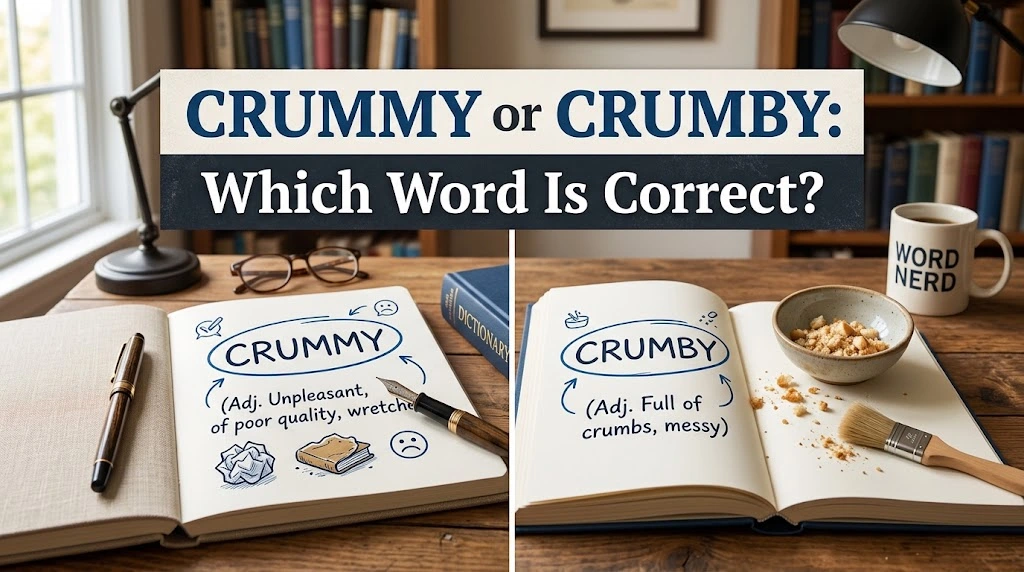
Crummy or crumby can look like a simple spelling question, but the two forms don’t always mean the same thing. If you type crumby when you mean “bad,” you may choose the wrong word. On the other hand, if you’re talking about a table covered in cookie crumbs, crumby can make sense.
The confusion gets even trickier because crumbly is another related word. It describes something that breaks apart into crumbs, while crumby can describe something associated with crumbs.
So, crummy or crumby—which should you use?
For the common meaning of bad, poor, unpleasant, or inferior, choose crummy. When you mean containing or covered with crumbs, crumby can be used. When you mean something that easily falls apart into crumbs, crumbly is usually the right choice.
Let’s break down the differences so you can choose the right word without second-guessing yourself.
Crummy or Crumby: Quick Answer
The easiest way to remember the difference is this:
Crummy = bad or unpleasant.
Crumby = related to crumbs.
Crumbly = easily breaking into crumbs.
Here’s the basic distinction:
| Word | Meaning | Example |
| Crummy | Bad, poor, unpleasant, or inferior | “We stayed in a crummy hotel.” |
| Crumby | Containing or covered with crumbs | “The table was crumby after breakfast.” |
| Crumbly | Easily breaking into crumbs | “The cookie has a crumbly texture.” |
In everyday American English, crummy is by far the word you’ll most often see when someone means “bad” or “low-quality.”
For example:
- “I had a crummy day.”
- “That’s a crummy excuse.”
- “The weather was crummy.”
- “He got stuck with a crummy job.”
None of these sentences should normally use crumby.
However, the situation changes when you’re talking about actual crumbs.
“There were crumbs all over the table, so the table looked crumby.”
That use focuses on crumbs, not poor quality.
What Does “Crummy” Mean?
Crummy is an informal adjective that generally means bad, unpleasant, inferior, disappointing, or of poor quality.
It often appears in casual American English when someone wants to criticize something without using especially strong language.
For instance:
“The room was pretty crummy.”
That sentence tells you the speaker didn’t think the room was good. Depending on context, crummy could refer to its cleanliness, condition, appearance, quality, or overall experience.
The word can describe both things and situations.
Examples of “Crummy”
Consider these examples:
- “The restaurant served crummy food.”
- “I had a crummy morning.”
- “They gave us a crummy seat.”
- “That’s a crummy way to treat someone.”
- “My old laptop was slow and crummy.”
- “The team had a crummy season.”
- “We got stuck in some crummy traffic.”
- “He lives in a crummy apartment.”
Notice something important. Crummy doesn’t literally have anything to do with crumbs in these examples.
The meaning is figurative.
When someone says, “This is crummy,” they’re usually saying, “This is bad,” “This isn’t very good,” or “This is disappointing.”
What Does “Crumby” Mean?
Crumby is an adjective connected to crumbs.
A crumb is a small piece that breaks off food or another crumb-producing substance. The adjective crumby can therefore describe something that contains crumbs or has crumbs scattered around it.
For example:
“The kitchen floor was crumby after the children ate cookies.”
Here, crumby has a literal connection to crumbs.
Another example:
“The counter gets really crumby when we make toast.”
The point isn’t that the counter is poor or unpleasant in some general sense. The point is that crumbs are present on the counter.
Is “Crumby” Common?
Not nearly as common as crummy.
That’s one reason the spelling can cause confusion. Most readers encounter crummy in the figurative sense much more often than they encounter crumby in a literal crumb-related sense.
In many situations, a writer may also choose a clearer expression instead of crumby.
For example:
- “The counter was covered in crumbs.”
- “The table had crumbs all over it.”
- “The floor was full of crumbs.”
These alternatives remove any possible ambiguity.
Crummy and Crumby Have Different Meanings
The spelling difference matters because it can change the meaning.
| Feature | Crummy | Crumby |
| Main idea | Bad or inferior | Related to crumbs |
| Typical tone | Informal | Literal and descriptive |
| Commonness | Common | Much less common |
| Used for quality | Yes | No, when standard meaning is intended |
| Used for crumbs | No | Yes |
| Example | “It was a crummy movie.” | “The table was crumby.” |
Imagine two people describing the same restaurant.
Person A says:
“The restaurant was crummy.”
That means the restaurant was poor, unpleasant, or low-quality.
Person B says:
“The table was crumby.”
That means the table had crumbs on it.
The words look almost identical. Their meanings aren’t.
That’s the heart of the crummy or crumby question.
Crummy: Meaning, Examples, and Usage
The word crummy works especially well in casual conversation.
It’s less formal than words such as inferior, substandard, or unsatisfactory. Because of that, it often sounds more personal and conversational.
Compare:
“The service was substandard.”
with:
“The service was crummy.”
The first sounds formal and detached. The second sounds like something you’d naturally say to a friend after a disappointing experience.
Crummy Can Describe Quality
One common use involves poor quality.
“The store sold crummy products.”
Here, crummy means the products weren’t good.
It can describe:
- products
- food
- clothing
- equipment
- buildings
- services
- accommodations
- jobs
Crummy Can Describe Experiences
The word also commonly describes unpleasant experiences.
“We had a crummy trip.”
That doesn’t necessarily mean every part of the trip failed. It simply expresses the speaker’s negative overall impression.
Similarly:
“I had a crummy day at work.”
The word carries an emotional tone without requiring a detailed explanation.
Crummy Can Describe Situations
You can also use crummy for circumstances.
“It’s a crummy situation.”
This usually means the circumstances are unfortunate, unpleasant, or unfair.
The exact meaning depends on context.
Crummy Can Describe People or Behavior
Crummy can sometimes describe someone’s behavior or treatment of another person.
“That was a crummy thing to do.”
Here, the speaker isn’t talking about physical quality. They’re criticizing the action as unpleasant, unfair, or mean.
This usage is common in informal speech.
Crumby: Meaning, Examples, and Usage
When crumby appears in its literal sense, the word relates to crumbs.
Imagine eating a slice of cake at a wooden table. Ten minutes later, the table has tiny bits of cake scattered across it.
You could say:
“The table is crumby.”
The adjective focuses on the presence of crumbs.
Examples of “Crumby”
Here are several examples:
- “The kitchen counter was crumby.”
- “My keyboard gets crumby when I eat at my desk.”
- “The picnic table was covered with food and looked crumby.”
- “The floor became crumby after the kids finished their crackers.”
- “Wipe the crumby surface before putting the plates down.”
These examples all involve physical crumbs.
Why “Crumby” Can Sound Unusual
Although crumby has a straightforward literal meaning, many readers may find covered in crumbs more natural.
For example:
“The table was covered in crumbs.”
This version is extremely clear.
By comparison:
“The table was crumby.”
The second sentence is shorter, but some readers may pause because crummy is much more familiar.
That doesn’t automatically make crumby wrong. It simply means context and audience matter.
Is “Crumby” a Misspelling of “Crummy”?
Not necessarily.
If you’re trying to write:
“The hotel was bad.”
then crummy is the appropriate word.
Writing:
“The hotel was crumby.”
would normally suggest a completely different idea: something involving crumbs.
The spelling crumby can be legitimate when the intended meaning relates to crumbs.
So the answer depends on what you’re trying to say.
If You Mean “Bad”
Use:
crummy
“That was a crummy movie.”
If You Mean “Containing Crumbs”
Use:
crumby
“The table was crumby after dinner.”
If You Mean “Breaking Into Crumbs”
Use:
crumbly
“The biscuit was crumbly.”
That three-word distinction solves most of the confusion.
Crummy vs. Crumby vs. Crumbly
This is where things get particularly interesting.
All three words look related because they share the crumb spelling pattern. However, they perform different jobs.
| Word | Core meaning | Example |
| Crummy | Bad, poor, unpleasant | “We had a crummy experience.” |
| Crumby | Having or containing crumbs | “The desk was crumby.” |
| Crumbly | Easily breaking into crumbs | “The pastry was crumbly.” |
Consider a cookie.
If the cookie tastes terrible, you could call it crummy in the informal sense of “bad.”
If crumbs cover your plate after eating it, the plate could be described as crumby.
If the cookie breaks apart easily when you touch it, you could call it crumbly.
One cookie can create all three contexts.
A Simple Comparison
Crummy cookie: A bad cookie.
Crumby plate: A plate with crumbs on it.
Crumbly cookie: A cookie that breaks apart easily.
That distinction is worth remembering.
Why Does “Crummy” Have Two M’s?
The spelling crummy follows an established English spelling pattern.
When certain words ending in a consonant take the suffix -y, the final consonant can double. This pattern appears in other words as well.
Examples include:
- run → running
- sun → sunny
- fun → funny
- mud → muddy
The spelling crummy also reflects the historical development of the word and its connection with crumb.
The important practical point is simple:
Don’t spell the common “bad” adjective as crumby.
If you mean poor quality or unpleasantness, write crummy.
Where Did “Crummy” Come From?
The history of crummy helps explain why the word developed its modern informal meaning.
English has long used crumb and related forms for small pieces or fragments. Over time, crummy developed an informal sense associated with something poor, inferior, or undesirable.
Modern dictionaries such as Merriam-Webster, Cambridge Dictionary, and Oxford English Dictionary document the word’s use and meanings.
Today, the most familiar everyday sense is the figurative one:
crummy = bad or unpleasant
The word has a distinctly informal flavor.
You’d commonly hear it in conversation, personal writing, reviews, or casual online communication.
Where Did “Crumby” Come From?
Crumby has a more direct connection to the noun crumb.
The basic idea is straightforward: something described as crumby has crumbs associated with it.
English regularly creates adjectives by adding -y to nouns.
For example:
- cloud → cloudy
- dirt → dirty
- dust → dusty
- mess → messy
Similarly, crumb gives rise to crumby.
However, spelling and pronunciation can make this family of words confusing because crummy developed a separate established meaning.
That’s why the two forms shouldn’t be treated as interchangeable spellings.
Crummy or Crumby in Everyday English
In everyday American English, crummy is the form you’ll usually want when describing something negatively.
Suppose your friend asks:
“How was your hotel?”
You might answer:
“Pretty crummy.”
That sounds natural.
If you instead say:
“Pretty crumby.”
your listener may wonder whether you mean the room had crumbs everywhere.
The context can rescue the sentence, but the spelling still matters.
Common Expressions With “Crummy”
You’ll often see crummy before nouns:
- crummy job
- crummy weather
- crummy hotel
- crummy apartment
- crummy excuse
- crummy service
- crummy food
- crummy situation
- crummy day
- crummy deal
These combinations make the intended meaning obvious.
Crummy or Crumby in Formal Writing?
Crummy is informal, so it isn’t always the best choice for professional or academic writing.
That doesn’t mean the word is incorrect. It means the tone may not fit the setting.
For example, a formal report might say:
“The equipment was unreliable and of poor quality.”
A casual conversation might say:
“The equipment was crummy.”
Both communicate a negative assessment. The register differs.
More Formal Alternatives to “Crummy”
Depending on the context, you could use:
- poor
- inferior
- substandard
- unpleasant
- unsatisfactory
- low-quality
- inadequate
- defective
- disappointing
Don’t automatically replace crummy with the fanciest word available. Choose the word that accurately describes the problem.
For example, defective suggests a technical fault. Unpleasant describes an experience. Inferior compares quality.
Context does the heavy lifting.
Common Mistakes With Crummy and Crumby
A few recurring mistakes cause most confusion.
Using “Crumby” to Mean “Bad”
Incorrect for the usual intended meaning:
“That was a crumby excuse.”
If the meaning is “That was a bad excuse,” use:
“That was a crummy excuse.”
Using “Crummy” for Literal Crumbs
If you mean that your desk has food crumbs on it, crummy may create the wrong impression.
Compare:
“My desk is crummy.”
This normally means your desk is poor, unpleasant, or in bad condition.
Now compare:
“My desk is crumby.”
This can mean crumbs are scattered across it.
An even clearer version is:
“My desk is covered in crumbs.”
Confusing “Crumby” With “Crumbly”
These words aren’t interchangeable.
“The cake is crumby.”
This can mean crumbs are present.
“The cake is crumbly.”
This means the cake tends to break into crumbs.
The difference is subtle but useful.
Crummy or Crumby: American English Usage
For American English readers, crummy is the important spelling to remember for the informal meaning “bad.”
Major American dictionaries recognize crummy as an informal adjective with meanings related to poor quality or unpleasantness.
Merriam-Webster defines crummy with senses including “of poor quality” and “inferior.” Merriam-Webster: crummy
Cambridge Dictionary similarly lists crummy as an informal word meaning bad or unpleasant. Cambridge Dictionary: crummy
That dictionary evidence matches ordinary usage.
If you’re writing a sentence such as:
“I had a crummy day.”
crummy is the standard choice.
Crumby in American English
Crumby has a narrower practical role.
When used literally, it refers to something characterized by crumbs.
However, writers often prefer more explicit wording because crumby isn’t nearly as familiar as crummy.
For example:
“The table was covered in crumbs.”
leaves little room for misunderstanding.
That can be especially useful in professional, instructional, or technical writing.
Still, informal writing can use crumby when the context makes the meaning obvious.
Crummy or Crumby: Which Should You Use?
Use this simple decision process.
Choose “Crummy” When You Mean:
- bad
- poor
- unpleasant
- inferior
- disappointing
- low-quality
- lousy
Example:
“The service was crummy.”
Choose “Crumby” When You Mean:
- containing crumbs
- covered with crumbs
- associated with crumbs
Example:
“The table was crumby after breakfast.”
Choose “Crumbly” When You Mean:
- easily broken into crumbs
- having a texture that falls apart
- tending to crumble
Example:
“The biscuit was crumbly.”
This quick test works in most everyday situations.
Crummy or Crumby Examples in Sentences
Seeing the words side by side makes the difference easier to remember.
| Sentence | Meaning |
| “We stayed at a crummy hotel.” | The hotel was poor or unpleasant. |
| “The hotel room was crumby after breakfast.” | The room had crumbs in it. |
| “The cookies were crumbly.” | The cookies broke apart easily. |
| “He gave me a crummy excuse.” | His excuse was poor or unconvincing. |
| “The kitchen table was crumby.” | Crumbs covered or littered the table. |
| “This pastry has a crumbly texture.” | It breaks apart into crumbs easily. |
| “The weather was crummy.” | The weather was unpleasant. |
| “The picnic blanket became crumby.” | Crumbs accumulated on the blanket. |
| “The topping was dry and crumbly.” | The topping broke apart easily. |
More Natural Examples
Here are additional examples using crummy:
“I can’t believe they gave us such a crummy room.”
“That was a crummy way to end the game.”
“My old headphones were pretty crummy.”
“We spent two hours waiting in crummy traffic.”
And here are examples involving crumby:
“The couch was crumby after movie night.”
“The kids left the kitchen floor crumby.”
“The picnic table became crumby after everyone ate.”
For crumbly:
“The shortbread was buttery and crumbly.”
“The dry soil had a crumbly texture.”
“The topping becomes crumbly as it bakes.”
A Practical Case Study: One Breakfast, Three Words
Imagine a family eating breakfast.
Someone burns the toast. It tastes terrible.
You could say:
“This toast is crummy.”
Now imagine crumbs have fallen across the kitchen counter.
You could say:
“The counter is crumby.”
Finally, imagine someone describes a biscuit that breaks apart with almost no pressure.
You could say:
“This biscuit is crumbly.”
The physical scene connects all three words, but each adjective tells the reader something different.
This is a useful way to remember the distinction because the meanings become visual rather than abstract.
A Quick Memory Trick for Crummy, Crumby, and Crumbly
Use the first idea associated with each word:
Crummy → lousy
Crumby → crumbs
Crumbly → breaks into crumbs
Think of it as a tiny three-step chain:
Bad → Crummy
Crumbs present → Crumby
Breaks into crumbs → Crumbly
Once that pattern sticks, the spelling becomes much easier.
Is “Crummy” a Real Word?
Yes. Crummy is a standard dictionary word.
It’s an informal adjective commonly used to describe something bad, unpleasant, inferior, or disappointing.
For example:
“The weather was crummy.”
It isn’t a misspelling of another word.
Its informal status simply means you should consider your audience and setting.
Is “Crumby” a Real Word?
Yes, crumby is also used as a word in English, particularly with a literal meaning connected to crumbs.
However, it’s much less common than crummy in everyday writing.
If you want maximum clarity, especially for a broad audience, phrases such as covered in crumbs or full of crumbs may communicate the idea more directly.
Is Crumby the Same as Crummy?
No.
The words can look like spelling variants, but they have different established meanings.
Crummy generally means bad, poor, or unpleasant.
Crumby relates to crumbs.
So these sentences communicate different ideas:
“The room was crummy.”
The room was poor or unpleasant.
“The room was crumby.”
The room had crumbs in it.
The surrounding context can make the intended meaning obvious, but the words themselves aren’t interchangeable.
Is Crumby or Crumbly Correct?
Both can be correct, but they describe different things.
Use crumby for something that has or contains crumbs.
Use crumbly for something that breaks apart easily into crumbs.
For example:
“The table is crumby.”
The table has crumbs on it.
“The cookie is crumbly.”
The cookie breaks apart easily.
If you’re describing texture, crumbly is generally the more precise choice.
Is Crummy Formal?
No. Crummy is informal.
It’s perfectly normal in casual speech and everyday writing. However, a formal report might use a more precise alternative.
For example:
Casual:
“The service was crummy.”
Formal:
“The service was unsatisfactory.”
The best replacement depends on exactly what you mean.
If the service failed to meet expectations, unsatisfactory works. If the service was objectively low-quality, poor may be better.
Why Do People Confuse Crummy and Crumby?
The confusion makes sense because both words begin with crum- and sound similar.
There’s also a deeper reason: both words have a relationship to crumb and developed adjective forms that look closely related.
Modern English contains plenty of pairs where tiny spelling differences signal different meanings.
Consider:
- affect / effect
- advice / advise
- breath / breathe
- loose / lose
- then / than
Crummy and crumby aren’t identical to those classic pairs, but they create a similar spelling trap.
One letter can send the reader in a different semantic direction.
How to Choose the Right Word Every Time
Before writing the word, ask yourself one question:
Am I talking about quality or crumbs?
If you’re talking about quality, and the quality is bad, use crummy.
“This is a crummy product.”
If you’re talking about crumbs, use crumby when that adjective fits naturally.
“The table is crumby.”
If you’re talking about something that breaks apart into crumbs, use crumbly.
“The cake is crumbly.”
That simple test eliminates most mistakes.
Crummy or Crumby: Final Verdict
The answer to “crummy or crumby?” depends on the meaning you want.
Crummy is the standard choice when you mean bad, poor, unpleasant, inferior, or disappointing. It’s an informal but well-established word in American English.
Crumby relates to crumbs. You can use it for something containing or covered with crumbs, although a phrase such as covered in crumbs can often sound clearer.
Crumbly describes something that breaks apart into crumbs easily, especially when discussing food or texture.
Keep this rule handy:
| If you mean… | Use… |
| Bad or unpleasant | Crummy |
| Covered with or containing crumbs | Crumby |
| Easily breaking into crumbs | Crumbly |
So, if you’re saying “That was a bad experience,” write “That was a crummy experience.”
If you’re describing the aftermath of eating a messy pastry, crumby may fit.
And if the pastry itself falls apart at the slightest touch, call it crumbly.
Three similar-looking words. Three distinct jobs. Once you connect each spelling to its meaning, the crummy vs. crumby confusion becomes surprisingly easy to solve.
