

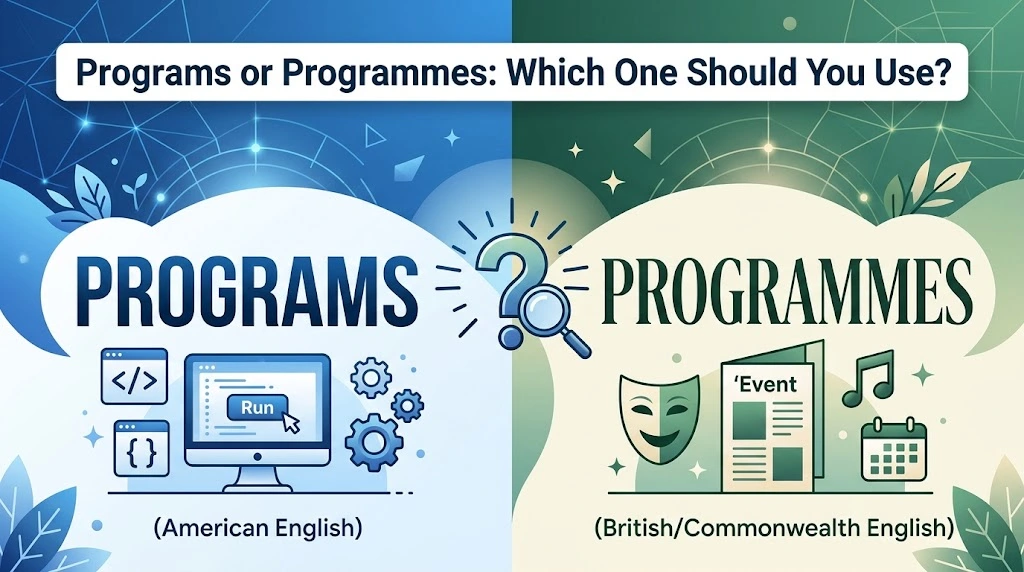
Programs or programmes is one of those spelling questions that can make an otherwise polished piece of writing look inconsistent.
The good news? Both spellings are legitimate.
The difference usually comes down to which variety of English you’re using and, in some cases, what you mean by the word. American English generally uses program, while British English uses programme for many meanings. However, British English normally keeps program for computing.
That small distinction explains why you might see a television programme in a British newspaper but a television program in an American one. You might also find a British technology publication talking about a computer program.
So, which spelling should you use?
If you’re writing in US English, use program and programs. If you’re following British English, use programme and programmes for the relevant non-computing meanings.
The key isn’t deciding that one spelling is universally correct. The key is choosing the spelling that matches your audience, meaning, and style guide.
Programs or Programmes: The Quick Answer
Here’s the simplest way to remember the difference:
| Situation | American English | British English |
| General plan or organized activity | program | programme |
| Educational offering | program | programme |
| Government initiative | program | programme |
| Training initiative | program | programme |
| TV or radio production | program | programme |
| Computer software | program | program |
| Computer programming | programming | programming |
For example:
- US: The university offers several degree programs.
- UK: The university offers several degree programmes.
- US: I watched a television program last night.
- UK: I watched a television programme last night.
- US: The developer wrote a computer program.
- UK: The developer wrote a computer program.
That last example is particularly important. British English doesn’t generally turn computer program into computer programme.
What Does Program Mean?
Program is a noun with several related meanings.
It can describe an organized plan, a series of activities, a scheduled event, a broadcast, or a piece of computer software.
For example:
The community launched a new recycling program.
Here, program means an organized initiative designed to achieve a particular goal.
The word also appears frequently in education:
She enrolled in a nursing program.
In broadcasting, American English uses program for television and radio content:
The news program starts at 7 p.m.
In computing, program has a more technical meaning:
The programmer created a program that processes customer orders.
The same spelling works across these meanings in American English.
What Does Programme Mean?
Programme is the traditional British English spelling for many of the meanings covered by program.
It can refer to an organized plan, educational course, government initiative, event schedule, or broadcast.
For example:
The university introduced a new training programme.
Or:
The documentary was an interesting television programme.
British English therefore makes a spelling distinction that American English generally doesn’t.
A British writer might use:
- education programme
- training programme
- government programme
- cultural programme
- television programme
- research programme
However, that same writer would normally write:
- computer program
- software program
- computer programming
- programming language
This computing exception is one of the most useful details to remember.
Programs or Programmes in American English
If you’re writing for an American audience, program is the standard spelling.
The plural is programs.
You’ll see it in virtually every major context:
- college programs
- government programs
- employee programs
- health programs
- education programs
- television programs
- loyalty programs
- training programs
- software programs
- research programs
For example:
The company created training programs for new employees.
American English doesn’t normally use programmes as an alternative spelling in these contexts.
This rule also applies to formal writing. Whether you’re writing an academic paper, business report, website, email, or newspaper article, program is the expected US spelling.
Examples in American English
The school offers several after-school programs.
The government expanded its assistance programs.
The streaming service added several new television programs.
The company runs employee wellness programs.
The university has international exchange programs.
Notice the pattern. The spelling stays the same even though the meanings differ.
Programs or Programmes in British English
British English generally uses programme when referring to organized activities or broadcasts.
The plural form is programmes.
For example:
The university offers several postgraduate programmes.
The organization launched new training programmes.
The channel broadcasts several documentary programmes.
The government introduced new support programmes.
This spelling is also common in formal British publications and institutional writing.
However, the word doesn’t change to programme in every situation.
The British computing exception
British English generally uses program when talking about computer software.
For example:
The developer wrote a computer program.
This program uses artificial intelligence to analyze images.
The software contains several programs.
That’s why the phrase computer programme can look unusual in standard modern British computing terminology.
The distinction becomes especially useful when writing technical content for an international audience.
Programs or Programmes for Television and Radio?
Broadcasting provides one of the clearest examples of the regional difference.
American English generally uses program:
What television program are you watching?
British English generally uses programme:
What television programme are you watching?
The meaning hasn’t changed. Only the spelling convention differs.
The same distinction applies to radio:
- American English: radio program
- British English: radio programme
This difference is especially visible in journalism, entertainment writing, television listings, and media discussions.
Side-by-side examples
| American English | British English |
| television program | television programme |
| radio program | radio programme |
| news program | news programme |
| documentary program | documentary programme |
| entertainment program | entertainment programme |
So, if you’re editing a British publication, television programme fits the expected convention. For a US publication, television program is the natural choice.
Programs or Programmes for Education and Training
Education is another area where the spelling changes according to regional English.
An American university might advertise:
Bachelor’s degree programs
A British university might write:
Bachelor’s degree programmes
Both expressions refer to an organized course of study.
The same pattern appears in professional development.
American English
- leadership programs
- training programs
- certification programs
- graduate programs
- internship programs
- exchange programs
British English
- leadership programmes
- training programmes
- certification programmes
- graduate programmes
- internship programmes
- exchange programmes
The difference becomes important when publishing university content online.
Suppose a British university changes its website to American spelling in one section but keeps British spelling elsewhere. Readers may notice the inconsistency even though every individual word remains understandable.
Consistency matters as much as correctness.
Programs or Programmes for Government and Public Services
Governments frequently use the word to describe organized initiatives.
American government agencies generally use program:
The agency administers several assistance programs.
British institutions generally use programme for comparable non-computing initiatives:
The department introduced several assistance programmes.
The distinction doesn’t mean the underlying policy is different. It reflects the spelling conventions of the language variety being used.
You’ll encounter the word in areas such as:
- public assistance
- employment
- education
- housing
- transportation
- environmental initiatives
- community development
- economic development
For writers, the practical lesson is straightforward: match the spelling to the English variety used by the organization and its audience.
Programs or Programmes in Business
Businesses use program or programme for organized initiatives, too.
For example, an American company might run a:
- customer loyalty program
- employee training program
- rewards program
- internship program
- leadership program
- referral program
A British company may use:
- customer loyalty programme
- employee training programme
- rewards programme
- internship programme
- leadership programme
- referral programme
Consider these two sentences:
The retailer launched a customer loyalty program.
The retailer launched a customer loyalty programme.
Neither sentence is inherently wrong. The appropriate choice depends on the English variety.
Why consistency matters in business writing
Imagine a company website that uses program on its homepage, programme on its careers page, and switches back to program in its customer documentation.
That inconsistency can create unnecessary friction.
A simple editorial rule can prevent it:
Choose your regional spelling before you begin and keep it consistent.
Programs or Programmes in Computing
Computing is where the programs-versus-programmes question gets more interesting.
Even British English normally uses program for computer software.
A computer program is a set of instructions that a computer executes to perform a task or set of tasks.
Examples include:
- word processors
- web browsers
- database applications
- utilities
- games
- operating-system components
- scientific software
You might therefore write:
The engineer developed a computer program to process the data.
A British writer would generally use the same spelling.
Related computing terms
The following forms normally use program regardless of whether the surrounding text follows American or British English:
- computer program
- software program
- program code
- programming
- programmer
- programming language
- program development
The spelling distinction is therefore not simply American versus British everywhere.
Context matters.
Program as a Verb
Program also works as a verb.
In American English, you can write:
She learned to program computers at school.
In British English, programme can sometimes appear as a verb in the general sense of arranging or scheduling something.
For computing, however, British English uses program:
He learned to program in Python.
This difference is worth remembering because it prevents a common overgeneralization.
A writer might learn that British English uses programme and then assume every occurrence must change. That’s not correct.
The word’s meaning and context determine the appropriate form.
Programs, Programmes, Program’s, and Programmes’
Plural and possessive forms can cause confusion.
Here’s a quick breakdown:
| Form | Meaning | Example |
| program | Singular | The program begins Monday. |
| programs | Plural | Several programs begin Monday. |
| programme | British singular | The programme begins Monday. |
| programmes | British plural | Several programmes begin Monday. |
| program’s | Singular possessive | The program’s schedule changed. |
| programmes’ | British plural possessive | The programmes’ schedules changed. |
The apostrophe changes the grammatical function.
For example:
The program’s schedule changed.
This means the schedule belongs to one program.
Meanwhile:
The programs’ schedules changed.
This means multiple programs have schedules that changed.
The spelling difference between programs and programmes shouldn’t distract you from the separate issue of possession.
Common Examples of Programs
American English uses programs in a huge range of everyday expressions.
Here are some common examples:
- after-school programs
- college programs
- degree programs
- training programs
- internship programs
- health programs
- fitness programs
- loyalty programs
- rewards programs
- government programs
- community programs
- television programs
- radio programs
- software programs
Example sentences
The school offers several after-school programs.
The company expanded its employee training programs.
Customers can earn points through the retailer’s loyalty program.
The university added two new graduate programs.
The station broadcasts several educational programs.
These examples all fit standard American English.
Common Examples of Programmes
British English commonly uses programmes for equivalent non-computing meanings.
Examples include:
- education programmes
- training programmes
- degree programmes
- government programmes
- community programmes
- cultural programmes
- research programmes
- television programmes
- radio programmes
- employment programmes
For example:
The college offers several degree programmes.
The charity runs youth development programmes.
The broadcaster produces educational programmes.
Again, the meaning hasn’t changed simply because the spelling has.
Programs vs. Programmes in Canada, Australia, and New Zealand
English outside the United States and United Kingdom doesn’t always follow a single simple rule.
Canadian English often combines features associated with both American and British English. Australian and New Zealand English generally follow British-derived spelling traditions while developing their own conventions.
That’s why a writer shouldn’t assume that every English-speaking country uses exactly the same spelling rules.
If your content targets a specific country, check the relevant local style guide.
For example, a Canadian government website may have editorial conventions that differ from an American company’s style guide. Likewise, an Australian university may follow conventions that aren’t identical to those used by a British publisher.
The safest professional approach is simple:
Know your audience before choosing your spelling.
Programs or Programmes in Formal Writing
Formal writing doesn’t change the basic rule.
If you’re writing in US English, use program.
If you’re writing in British English, use programme for the meanings where British spelling calls for it.
The same principle applies to:
- academic papers
- business reports
- websites
- government documents
- marketing materials
- books
- news articles
- technical documentation
However, organizations sometimes maintain their own editorial rules.
If you’re writing for a university, newspaper, company, or government agency, its style guide should take priority over personal preference.
A practical editorial checklist
Before publishing, check:
- Which country is the primary audience in?
- Does the organization use US or British English?
- Is the word referring to software?
- Does an institutional style guide specify a spelling?
- Have you used the same convention consistently?
Five minutes of checking can save hours of later editing.
Programs vs. Programmes: Quick Decision Guide
When you’re unsure, use this decision table.
| Your situation | Recommended spelling |
| Writing standard US English | program |
| Writing standard US English, plural | programs |
| Writing British English about an organized initiative | programme |
| Writing British English, plural | programmes |
| Writing about computer software | program |
| Writing about programming | programming |
| Writing about US television | program |
| Writing about British television | programme |
| Following a specific house style | Follow that style |
| Writing for an international audience | Choose one variety and stay consistent |
This covers most everyday situations.
Common Mistakes With Programs and Programmes
The biggest mistakes usually come from treating the distinction as more complicated than it is.
Mixing regional spellings
One paragraph might say:
The company offers several training programs.
The next might say:
These training programmes are available online.
If the document is supposed to use American English, the second form creates an unnecessary inconsistency.
The reverse is also true for British English.
Assuming “programme” is always British
This isn’t quite right.
British English commonly uses programme, but computing generally uses program.
So this distinction matters:
- British television programme
- British training programme
- British computer program
Assuming “program” is always American
That’s also too broad.
British English uses program in computing.
Therefore, seeing program in a British technical document doesn’t automatically indicate American spelling.
Changing spelling without checking the audience
Some writers use software tools to switch between American and British spelling.
That can help, but automated replacement isn’t perfect.
A blanket search-and-replace could incorrectly change a technical program into programme.
Human review still matters.
Programs or Programmes: Examples in Sentences
Side-by-side examples make the difference easier to remember.
| Meaning | American English | British English |
| Education | The college offers several programs. | The college offers several programmes. |
| Training | We created new training programs. | We created new training programmes. |
| Television | The network aired three programs. | The network aired three programmes. |
| Government | The agency runs assistance programs. | The agency runs assistance programmes. |
| Business | The company offers loyalty programs. | The company offers loyalty programmes. |
| Computing | The developer wrote several programs. | The developer wrote several programs. |
The table highlights the core rule: regional spelling changes in many general contexts, but computing stays with “program.”
Why Did Program and Programme Develop Differently?
The history of the word helps explain the modern spelling split.
The English word ultimately traces back through French and Latin forms associated with a written public notice, plan, or outline.
Over time, English developed different spelling conventions on opposite sides of the Atlantic.
American English favored the shorter program spelling.
British English retained programme for many general meanings, while program became established in computing.
Language isn’t a perfectly engineered machine. It evolves through usage, institutions, publishing, technology, and cultural contact.
That’s why spelling differences sometimes look irregular.
The important point for modern writers isn’t memorizing every historical stage. It’s understanding the conventions readers expect today.
Style Guides and Dictionaries
Dictionaries can help confirm spelling, but a dictionary isn’t always the final authority for a particular publication.
Major dictionaries often identify regional usage.
For example, Merriam-Webster lists program and its various meanings in American English.
The Cambridge Dictionary distinguishes program and programme, including regional usage.
The Oxford Learner’s Dictionaries also provides regional information useful to learners and writers.
For professional writing, combine dictionary evidence with the style guide required by your organization.
Common style resources include:
- The Chicago Manual of Style
- The Associated Press Stylebook
- Microsoft Writing Style Guide
- Oxford Style Manual
These resources can be particularly helpful when writing large websites or publications where consistency matters.
A Practical Case Study: One Website, Two Audiences
Imagine a software company operates websites for both the United States and United Kingdom.
Its US page says:
Explore our employee training programs.
Its UK page says:
Explore our employee training programmes.
That difference makes sense because each page targets a different English variety.
Now imagine both websites describe the company’s software:
Our computer program automatically organizes customer records.
The UK page can use program here without breaking its British spelling convention.
This example shows why context matters more than blindly replacing every occurrence.
A good localization process doesn’t simply swap letters. It considers meaning, audience, terminology, and consistency.
How to Choose Between Programs and Programmes
Choosing the correct form becomes easy once you follow a few steps.
Identify your audience
Are you writing primarily for readers in the United States?
Use program.
Are you writing primarily for readers who expect British English?
Use programme where appropriate.
Identify the meaning
Ask what program refers to.
Is it:
- a television broadcast?
- a training initiative?
- an educational offering?
- a government project?
- computer software?
This step matters because British English treats computing differently.
Check the style guide
If an employer, publisher, university, or client gives you a style guide, follow it.
House style can settle questions that general dictionaries leave open.
Keep your spelling consistent
Once you’ve chosen a convention, apply it throughout the document.
Consistency makes writing feel deliberate and polished.
Is Program or Programme Correct?
Both can be correct.
The correct choice depends primarily on regional English and context.
In standard US English, program is the normal spelling.
In British English, programme is generally used for organized activities, educational offerings, and television or radio broadcasts.
For computer software, British English normally uses program.
Is “Programmes” British English?
Yes.
Programmes is the standard British English plural form for many general meanings of programme.
For example:
The university offers several postgraduate programmes.
The broadcaster produces educational programmes.
However, British English uses programs when referring to computer software.
Is “Program” American English?
Yes.
Program is the standard spelling in American English across the major meanings of the word.
Americans write:
- educational programs
- government programs
- television programs
- training programs
- computer programs
The spelling doesn’t change simply because the meaning changes.
Do British People Say “Computer Programme”?
In standard modern British computing terminology, computer program is the usual form.
British English generally uses programme for many non-computing meanings while retaining program for computer software and programming.
Therefore:
computer program ✅
programming language ✅
computer programme ⚠️ generally not the standard computing term
Technical writing should follow established terminology rather than applying a general spelling rule mechanically.
Should You Use Programs or Programmes Professionally?
Use the form expected by your professional audience.
For US-facing content, programs is the appropriate standard.
For British-facing content, programmes usually fits non-computing contexts.
For software documentation, program remains standard even when the documentation follows British English.
The goal isn’t to make one spelling dominate everywhere. Professional writing works best when it respects the language variety and terminology of its readers.
Programs or Programmes: The Bottom Line
The programs or programmes debate becomes much simpler once you separate regional spelling from meaning.
American English overwhelmingly uses program and programs.
British English uses programme and programmes for many general meanings, including organized initiatives, educational offerings, and television or radio broadcasts. Yet British English normally uses program for computer software.
Remember these three rules
- US English: Use program and programs.
- British English: Use programme and programmes for most general, non-computing meanings.
- Computing: Use program and programs in both varieties.
The spelling difference is small, but getting it right can make your writing feel much more natural to its intended audience.
When in doubt, don’t ask which spelling is universally correct. Ask a better question:
Which English variety am I writing, and what does “program” mean in this sentence?
That question usually gives you the answer.
