

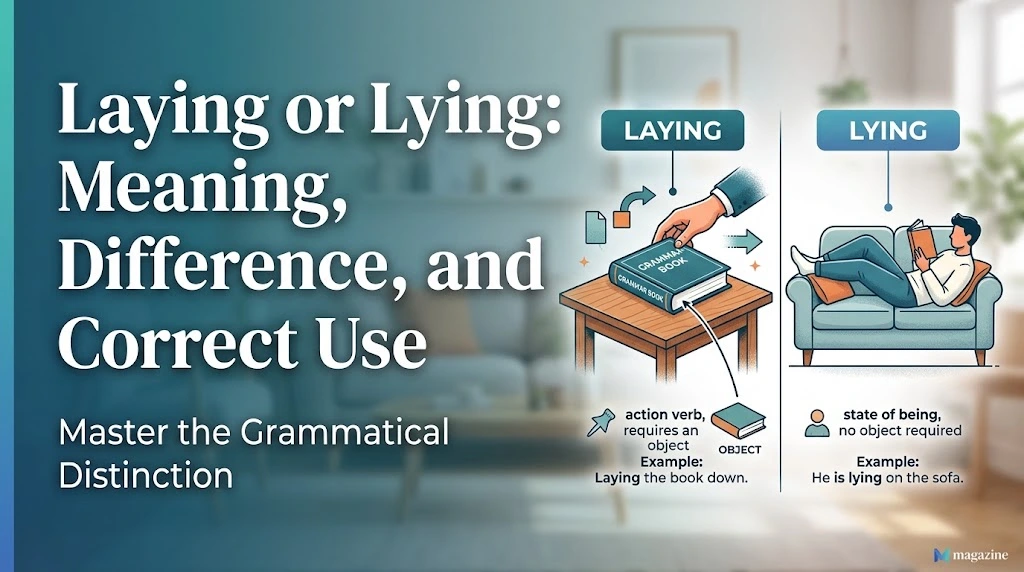
Laying or lying is one of those grammar questions that can make a simple sentence surprisingly tricky. Both words are correct. The problem is knowing when to use each one.
The confusion starts with the verbs lay and lie. Their forms overlap, especially in the past tense. For example, the past tense of lie is lay, while the past tense of lay is laid. That small difference causes plenty of everyday mistakes.
The basic distinction is easier than it looks:
- Laying usually means putting or placing something somewhere.
- Lying usually means resting, reclining, or remaining in a position.
- Lay normally takes a direct object.
- Lie normally doesn’t take a direct object when it means to recline or rest.
Consider these two sentences:
She is laying the blanket on the bed.
She is lying on the bed.
In the first sentence, she is putting the blanket somewhere. In the second, she is resting herself on the bed.
Once you understand that difference, the rest of the forms become much easier.
Laying or Lying: The Quick Answer
Use laying when someone is putting or placing something somewhere.
Use lying when someone or something is resting or remaining in a particular position.
| Word | Basic meaning | Example |
| Laying | Putting or placing something | She is laying the book on the desk. |
| Lying | Resting or reclining | She is lying on the sofa. |
A useful question can help you choose.
Is there an object being placed?
If yes, laying is often the right choice.
He is laying the keys on the counter.
If someone is simply resting or reclining, use lying.
He is lying on the couch.
The distinction isn’t based on whether the action happens horizontally. It depends primarily on what the verb is doing in the sentence.
What Does Laying Mean?
Laying is the present participle of the verb lay.
In its ordinary sense, lay means to put, place, or set something somewhere. Because it normally acts on an object, lay is a transitive verb in this use.
For example:
Maria is laying the dishes on the table.
The object is the dishes. Maria is placing them somewhere.
Another example:
The worker is laying bricks along the wall.
The object is bricks. The worker is placing those bricks into position.
You can find laying in many ordinary situations:
- laying a book on a table
- laying clothes on a bed
- laying a baby in a crib
- laying tiles on a floor
- laying a foundation
- laying eggs
- laying a cable underground
- laying flowers at a memorial
The meaning can become more figurative, too.
The company is laying the groundwork for expansion.
Here, the company isn’t physically placing an object on the ground. Laying the groundwork means establishing the basic preparation needed for something.
Laying Examples in Sentences
Here are several examples showing how laying works:
- She is laying the keys beside the door.
- We are laying new flooring this weekend.
- He was laying the papers on the desk.
- The hen is laying eggs.
- They are laying the foundation for the building.
- The crew is laying cables beneath the road.
- She is laying the baby in the crib.
Notice a pattern. In each example, something receives the action.
That object can be physical, as in the keys, or part of an established expression, as in the groundwork or the foundation.
What Does Lying Mean?
Lying is the present participle of lie when lie means to rest, recline, or remain in a particular position.
Unlike lay, this meaning of lie generally doesn’t take a direct object.
For example:
The dog is lying on the floor.
The dog isn’t placing something on the floor. The dog is simply resting there.
Likewise:
I am lying in bed.
The speaker is reclining or resting. There’s no direct object receiving an action.
Other examples include:
- She is lying on the couch.
- The child is lying under the blanket.
- He was lying on the grass.
- The cat is lying beside the window.
- The papers were lying on the floor.
- Snow is lying across the fields.
The word can also describe something that remains in a particular location.
The keys are lying on the table.
The keys aren’t necessarily moving or actively doing anything. The sentence simply describes their position.
Laying vs. Lying: The Core Difference
The easiest way to separate laying and lying is to look for the object.
Lay means putting something somewhere.
Lie means resting or being somewhere.
Compare these sentences:
She is laying the book on the table.
She is lying on the table.
The first sentence has an object: the book.
The second sentence doesn’t have an object. She is the one resting.
Here’s another pair:
Dad is laying the baby in the crib.
Dad is lying in the crib.
The first sentence says Dad is putting the baby into the crib. The second says Dad himself is resting there.
Laying vs. Lying at a Glance
| Feature | Laying | Lying |
| Base verb | Lay | Lie |
| Meaning | Put or place | Rest or recline |
| Usually takes an object? | Yes | No |
| Present participle | Laying | Lying |
| Example | She is laying the towel down. | She is lying down. |
| Object in example | The towel | None |
This distinction works in most everyday situations involving these two verbs.
Lay vs. Lie: The Verb Forms You Need to Know
The real source of confusion isn’t just laying versus lying. It’s the entire family of verb forms.
The two verbs have different patterns.
The Forms of Lay
For the meaning to put or place, the forms are:
| Tense/Form | Verb |
| Present | lay |
| Present participle | laying |
| Past | laid |
| Past participle | laid |
Examples:
I lay the book on the desk every morning.
I am laying the book on the desk.
Yesterday, I laid the book on the desk.
I have laid the book on the desk.
The past and past participle forms are both laid.
The Forms of Lie
For the meaning to recline or rest, the forms are:
| Tense/Form | Verb |
| Present | lie |
| Present participle | lying |
| Past | lay |
| Past participle | lain |
Examples:
I lie on the sofa after work.
I am lying on the sofa now.
Yesterday, I lay on the sofa.
I have lain on the sofa for an hour.
Here’s where things get messy.
Lay is both the present form of one verb and the past tense of another.
That’s why the sentence:
Yesterday, I lay on the couch.
is correct.
But:
Yesterday, I laid on the couch.
is not standard English when you mean that you reclined on the couch.
Why Are Lay and Lie So Confusing?
The confusion comes from overlapping forms.
Think about these four words:
lie → lay → lain → lying
and:
lay → laid → laid → laying
The two systems look similar but don’t behave the same way.
The most important difference appears in the past tense.
If you put something somewhere, you laid it there.
She laid the phone on the table.
If you rested somewhere, you lay there.
She lay on the sofa.
That difference feels backwards at first. With practice, however, it becomes much more predictable.
A Simple Timeline
For lay:
lay → laying → laid → laid
For lie:
lie → lying → lay → lain
The present participles make the distinction especially obvious:
- lay → laying
- lie → lying
That’s why “I am laying the book down” and “I am lying down” use different forms.
Laying Down vs. Lying Down
This is probably the most common real-world point of confusion.
Many people say:
I’m laying down.
when they mean:
I’m lying down.
In standard US English, “I’m lying down” is correct when you mean you’re reclining or resting.
Why?
Because you’re describing what you are doing with yourself. You aren’t placing an object somewhere.
I’m lying down because I’m tired.
However, laying down can be completely correct when an object follows.
I’m laying the baby down.
Here, the baby is the object. You’re placing the baby in a reclining position.
Another example:
She is laying the book down.
The book receives the action.
Compare:
She is lying down.
No object receives the action.
The Quick Test
Try adding something after the verb.
If the sentence naturally describes placing that thing somewhere, laying may be correct.
I’m laying the blanket down.
If you’re simply describing your own position, use lying.
I’m lying down.
This isn’t a perfect test for every meaning of lay and lie, but it works remarkably well for everyday usage.
Laying or Lying Eggs?
Laying eggs is correct.
A hen lays eggs because the eggs are the objects involved in the action.
The chicken is laying eggs.
You wouldn’t normally say:
The chicken is lying eggs.
That changes the grammatical structure and doesn’t express the intended meaning.
This example is useful because it removes the confusion surrounding physical posture. The bird isn’t necessarily reclining at all. Lay has nothing inherently to do with horizontal movement.
It means to put or produce something in a particular place or position in this context.
The same verb appears in phrases such as:
- lay an egg
- lay a foundation
- lay a carpet
- lay a tile
- lay a table
- lay a charge
- lay a plan
The exact meaning depends on context, but the transitive structure remains important.
Laying or Lying on a Bed
The bed example makes the difference especially clear.
She is lying on the bed.
She is resting there.
But:
She is laying the baby on the bed.
She is placing the baby there.
You can also say:
She is laying a blanket on the bed.
Again, a blanket receives the action.
The location doesn’t determine the verb. The grammatical role does.
Whether you’re talking about a bed, floor, sofa, beach, or grass, the same distinction applies.
Laying or Lying on the Floor
Consider these examples:
The child is lying on the floor.
The mother is laying a blanket on the floor.
The worker is laying tiles on the floor.
All three sentences involve the floor. Yet each sentence uses the verb differently.
In the first sentence, the child is resting.
In the second, the mother places a blanket.
In the third, the worker places tiles.
The phrase “on the floor” doesn’t decide whether you need laying or lying. The action does.
Laying or Lying a Book on the Table
Here’s another useful comparison:
She is laying the book on the table.
This is correct because the book is being placed on the table.
You could also use putting:
She is putting the book on the table.
That substitution can help you remember the meaning of laying.
Now consider:
She is lying on the table.
This means she is physically resting on the table.
The two sentences describe completely different actions.
Compare These Sentences
| Correct sentence | Meaning |
| She is laying the book on the table. | She is placing the book there. |
| She is lying on the table. | She is resting there. |
| She laid the book on the table. | She placed it there in the past. |
| She lay on the table. | She rested there in the past. |
The difference becomes much easier when you focus on the object rather than the location.
Laying vs. Lying in Different Tenses
The participles are only part of the story. Understanding the other forms prevents mistakes in more complex sentences.
Present Tense
For placing:
I lay the documents on the desk.
For reclining:
I lie on the sofa after dinner.
Present Continuous
For placing:
I am laying the documents on the desk.
For reclining:
I am lying on the sofa.
Simple Past
For placing:
I laid the documents on the desk yesterday.
For reclining:
I lay on the sofa yesterday.
Present Perfect
For placing:
I have laid the documents on the desk.
For reclining:
I have lain on the sofa for an hour.
That last form, lain, often looks strange because people don’t use it frequently in casual conversation. It’s nevertheless the standard past participle of lie in this sense.
Laying vs. Lying: Common Mistakes
A handful of mistakes appear again and again.
“I Am Laying Down”
When you mean that you’re reclining, standard US English uses:
I am lying down.
However, laying is correct when you include an object:
I am laying the baby down.
The missing object changes the grammar.
“She Is Lying the Book on the Table”
This is incorrect when you mean she’s placing the book there.
The standard form is:
She is laying the book on the table.
The book receives the action.
“I Laid on the Couch Yesterday”
If you mean that you rested on the couch, use:
I lay on the couch yesterday.
Remember that lay is the past tense of lie.
“I Have Lay on the Bed”
The past participle after have should be lain:
I have lain on the bed.
This form may sound formal or uncommon in everyday speech, but it’s grammatically standard.
“Layed”
Layed is not the standard past-tense form of lay in these ordinary meanings.
Use:
laid
For example:
She laid the clothes on the bed.
Not:
She layed the clothes on the bed.
When to Use Laying
Use laying when the sentence describes placing, putting, or arranging something.
Look for an object receiving the action.
Common examples
- laying the book on the desk
- laying the baby in the crib
- laying the clothes on the bed
- laying the tiles on the floor
- laying the foundation for a building
- laying eggs
- laying a cable
- laying flowers at a memorial
A useful replacement test is to see whether placing works.
She is laying the keys on the table.
becomes:
She is placing the keys on the table.
The meaning remains essentially the same.
That clue tells you you’re dealing with laying.
When to Use Lying
Use lying when someone or something is resting, reclining, or remaining in a position.
Examples include:
- lying on the bed
- lying on the floor
- lying under a tree
- lying beside the pool
- lying in the grass
- lying awake
- lying still
The verb doesn’t require an object in these constructions.
The dog is lying under the table.
The dog isn’t placing anything under the table. It’s simply there.
Likewise:
The phone is lying on the desk.
The phone is resting there.
Laying vs. Lying: Side-by-Side Examples
Paired examples make this distinction easier to remember.
Example: A Blanket
She is laying the blanket on the bed.
She is placing the blanket.
She is lying on the blanket.
She is resting on the blanket.
Example: A Baby
He is laying the baby in the crib.
He is placing the baby there.
The baby is lying in the crib.
The baby is already resting there.
Example: A Book
I am laying the book on the desk.
I’m placing the book.
The book is lying on the desk.
The book is resting there.
Example: A Person
She is laying the clothes on the chair.
She is putting the clothes there.
She is lying on the chair.
She is reclining there.
The pattern stays consistent even when the nouns change.
A Simple Trick to Remember Laying vs. Lying
Here’s a compact memory trick:
Lay = place something.
Lie = rest yourself.
Or think of the sentence:
Lay something down. Lie down.
The first phrase needs an object.
Lay the phone down.
The second doesn’t.
Lie down.
You can also remember the present participles:
Lay → laying
Lie → lying
If you’re talking about putting something somewhere, think laying.
If you’re talking about resting or reclining, think lying.
The Object Test
Ask:
“What am I laying?”
If you can answer that question naturally, laying may be correct.
What are you laying?
The towels.
But if the answer would be yourself, don’t use laying in this sense.
What are you lying?
That doesn’t make sense.
Instead:
I’m lying down.
This simple test catches many everyday errors.
Laying vs. Lying in American English
In standard American English, the distinction between lay and lie remains part of traditional grammar.
However, everyday speech doesn’t always follow the formal distinction perfectly. “Laying down” is common in informal conversation even when speakers mean lying down.
That doesn’t change the standard grammatical forms.
For formal writing, edited publications, school assignments, business communication, and professional documents, use the standard distinction:
I am lying down.
She is laying the baby down.
Context still matters. Some expressions use lay or lie in ways that aren’t captured by a simple physical-position rule.
Laying vs. Lying and the Word “Laid”
Laid belongs to the verb lay.
It is both the simple past and past participle:
She laid the book on the desk.
She has laid the book on the desk.
The important point is that laid requires the placing sense of lay in these examples.
Compare that with:
She lay on the bed yesterday.
Here, lay is the past tense of lie.
This produces a useful contrast:
| Meaning | Present | Past | Past participle |
| Put/place | lay | laid | laid |
| Rest/recline | lie | lay | lain |
This table is worth memorizing.
It solves a surprisingly large number of grammar problems.
Lay, Lie, Layed, and Lain: What’s Correct?
Four words often get mixed together:
lay, lie, laid, and lain.
There is also layed, which is usually an incorrect form when you’re talking about placing something.
Here’s the correct system:
- lay — present tense of lay
- laying — present participle of lay
- laid — past tense and past participle of lay
- lie — present tense of lie
- lying — present participle of lie
- lay — past tense of lie
- lain — past participle of lie
Examples make this clearer:
I lay the book down every evening.
I am laying the book down now.
I laid the book down earlier.
I have laid the book down already.
But:
I lie down every evening.
I am lying down now.
I lay down earlier.
I have lain down already.
The overlapping word lay is the troublemaker.
A Mini Case Study: “I’m Laying Down”
Imagine someone finishes work and says:
“I’m laying down for a few minutes.”
The intended meaning is obvious. The person means they’re going to rest.
In standard grammar, however, the preferred form is:
“I’m lying down for a few minutes.”
Now change the sentence:
“I’m laying the baby down for a few minutes.”
This is correct because the baby is the object being placed.
The difference is only a few words, but those words reveal the entire grammatical structure.
No object: lying.
Object: laying.
That’s why learning the rule through sentence structure works better than simply memorizing isolated words.
A Mini Case Study: “She Laid on the Couch”
Now consider:
“She laid on the couch all afternoon.”
Many speakers use this sentence in casual conversation. Standard grammar, however, calls for:
“She lay on the couch all afternoon.”
Why?
Because lie means to rest or recline, and lay is its simple past form.
If the sentence instead says:
“She laid the blanket on the couch.”
then laid is correct because the blanket is the object being placed.
The difference becomes obvious when you ask what received the action.
Laying vs. Lying: Quick Reference Chart
Keep this chart nearby if these verbs frequently trip you up.
| If you mean… | Use | Example |
| Put something somewhere | lay | Lay the book here. |
| Putting something somewhere | laying | She is laying the book here. |
| Put something somewhere in the past | laid | She laid the book here. |
| Rest or recline | lie | I lie down after lunch. |
| Resting or reclining | lying | I am lying down. |
| Rested or reclined in the past | lay | I lay down yesterday. |
| Have rested or reclined | lain | I have lain down for an hour. |
Frequently Asked Questions About Laying or Lying
Is it “laying down” or “lying down”?
When you mean reclining or resting, standard US English uses lying down.
I’m lying down.
Use laying down when an object follows:
I’m laying the baby down.
Is “laying” always wrong without an object?
No. The verb lay has several uses and established expressions. However, when lay means put or place, it normally takes a direct object.
For ordinary physical positioning, an object is the key distinction.
Is “lying” ever used with an object?
The lie meaning to recline or rest is normally intransitive. It doesn’t take a direct object in the same way lay does.
However, lie has other meanings. For example:
He is lying about his age.
Here, lying means telling an untruth, not reclining.
That’s an entirely different verb sense.
Is “layed” a word?
Layed isn’t the standard form for the ordinary verb lay meaning “put” or “place.”
Use laid instead:
She laid the book on the desk.
What is the past tense of lie?
When lie means recline or rest, its past tense is lay.
I lie down every afternoon.
Yesterday, I lay down after lunch.
What is the past participle of lie?
The past participle is lain.
I have lain in bed all morning.
It usually appears with auxiliary verbs such as have, has, or had.
What’s the difference between laid and lain?
Laid is associated with lay:
She has laid the clothes on the bed.
Lain is the past participle of lie:
She has lain in bed all morning.
The easiest way to remember them is:
lay → laid
lie → lain
Laying or Lying: The Most Important Rules
If you remember only a few things, remember these:
- Laying usually means putting or placing something.
- Lying usually means resting or reclining.
- Lay normally takes an object when it means “put.”
- Lie doesn’t take a direct object when it means “recline.”
- Laid is the past tense of lay.
- Lay is the past tense of lie.
- Lain is the past participle of lie.
- Layed isn’t the standard form for the ordinary placing sense of lay.
- “I am lying down” is standard when you mean you’re reclining.
- “I am laying the book down” is correct because the book is the object.
Final Takeaway: Laying or Lying?
The difference between laying and lying becomes much simpler once you stop focusing on how similar the words sound.
Ask what the verb means.
If you’re putting or placing something, use a form of lay:
She is laying the keys on the table.
If you’re resting, reclining, or remaining in a position, use a form of lie:
She is lying on the sofa.
The forms worth remembering are:
lay → laying → laid
and
lie → lying → lay → lain
The tricky part is lay, because it belongs to both systems. It’s the present tense of lay and the past tense of lie.
Once that overlap makes sense, sentences such as “I am lying down,” “She is laying the baby down,” “He lay on the couch,” and “She laid the book on the desk” stop looking like grammar traps.
The golden rule is simple:
Lay something. Lie down.
