

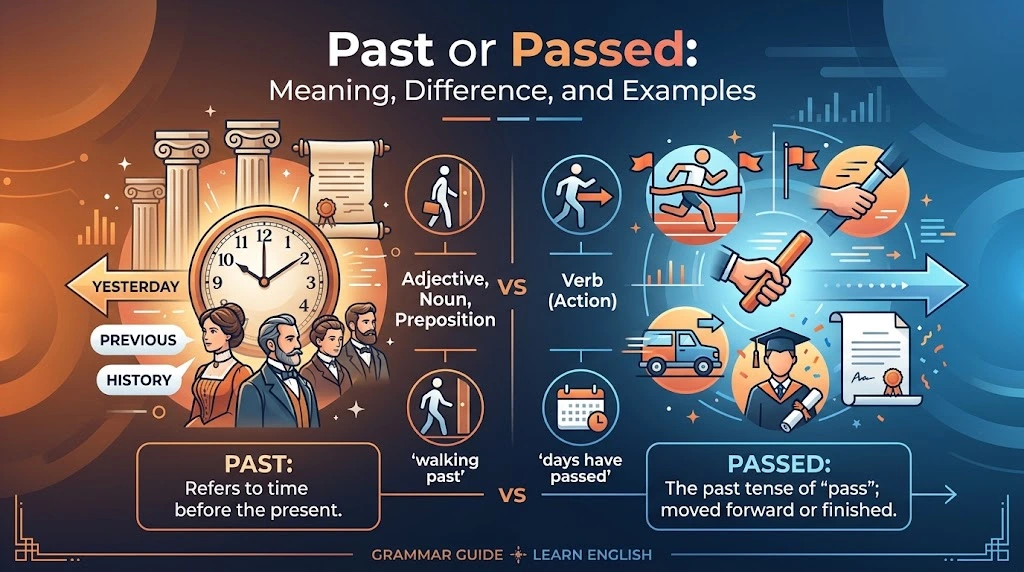
Past or passed? These two words sound the same in many varieties of English, but they don’t mean the same thing. One usually describes a previous time, position, or point beyond something. The other is the past-tense form of the verb pass.
That small spelling difference can completely change a sentence.
For example:
- She walked past the house.
- She passed the house.
Both sentences can be correct. In the first, past works as a preposition describing movement beyond the house. In the second, passed is the verb describing the action.
The confusion becomes even clearer in sentences such as:
- He passed the exam.
- He has past experience.
- We drove past the school.
- The years passed quickly.
Understanding the grammatical role of each word makes the distinction much easier.
Past vs. Passed at a Glance
Here’s the quickest way to separate past or passed:
| Word | Main role | Basic meaning | Example |
| past | Noun | A time that has already happened | We can’t change the past. |
| past | Adjective | Previous or former | She learned from past mistakes. |
| past | Preposition | Beyond a point or place | He walked past the store. |
| past | Adverb | Beyond a particular point | The train went past. |
| passed | Verb | Past tense of pass | She passed the test. |
| passed | Verb | Moved beyond something | The car passed our house. |
| passed | Verb | Handed or transferred something | He passed me the salt. |
A useful starting rule is simple:
Past usually describes a time, place, position, or something previous. Passed usually describes an action.
That rule handles most everyday cases.
However, English has enough twists to make a deeper look worthwhile.
What Does “Past” Mean?
The word past has several grammatical roles. It can function as a noun, adjective, preposition, or adverb.
Its meaning depends heavily on where it appears in the sentence.
Past as a Noun
As a noun, past refers to a period that has already happened.
For example:
- The past cannot be changed.
- She doesn’t like talking about her past.
- History helps us understand the past.
- His past shaped many of his decisions.
In these sentences, past names an earlier period or previous experiences.
You’ll often see it preceded by the:
the past
The phrase can refer to someone’s personal history or to earlier periods in general.
For instance, “in the past” means at an earlier time.
People communicated differently in the past.
Past as an Adjective
As an adjective, past modifies a noun and means previous, former, or earlier.
Common examples include:
- past experiences
- past mistakes
- past presidents
- past relationships
- past events
- past performance
- past customers
- past employees
Consider this sentence:
She learned from her past mistakes.
The word past tells you that the mistakes happened previously.
You wouldn’t write:
She learned from her passed mistakes.
That spelling is incorrect because passed doesn’t work as an adjective meaning “previous.”
Past as a Preposition
One of the most common uses of past appears with movement.
It can mean beyond a particular person, place, point, or object.
Examples include:
- We walked past the library.
- The bus went past my house.
- She ran past me.
- Drive past the intersection and turn left.
- He looked past the obvious answer.
Here, past connects the movement or action with something beyond which it occurs.
This is why walked past is correct.
She walked past the restaurant.
Not:
She walked passed the restaurant.
The second version incorrectly uses the past-tense verb passed where the preposition past is required.
Past as an Adverb
Past can also work as an adverb when it describes movement beyond a particular point.
For example:
The train went past.
I saw him drive past.
She walked past without saying anything.
In these sentences, past doesn’t directly introduce an object.
The surrounding context tells you what the person or thing moved beyond.
What Does “Passed” Mean?
Passed is the past tense and past participle of the verb pass.
That’s the key fact to remember.
The verb pass has many meanings. Consequently, passed appears in many different situations.
For example:
- She passed the exam.
- He passed the ball.
- The car passed us.
- Time passed quickly.
- They passed the message along.
- Congress passed the bill.
- She passed the salt.
- He passed away peacefully.
In each example, passed describes an action or state expressed through the verb pass.
Passed Means Moving Beyond Something
When someone or something moves ahead of another person or object, passed can describe that action.
The truck passed our car.
She passed me on the highway.
The runner passed two competitors.
Here, passed acts as the main verb.
Compare that with:
The runner walked past the spectators.
In this sentence, walked is the main verb. Past tells you where the movement occurred in relation to the spectators.
That’s an important grammatical difference.
Passed Means Succeeded
You also use passed when someone succeeds in a test, exam, inspection, or similar requirement.
- I passed my driving test.
- She passed the final exam.
- He passed the certification test.
- The building passed inspection.
The opposite is failed.
She studied all weekend and passed the exam.
You wouldn’t use past here because past isn’t the verb.
Passed Means Handed Something Over
Passed can describe transferring something from one person to another.
- Please pass the salt.
- He passed me the phone.
- She passed the note to her friend.
In the past tense:
He passed me the phone.
The action happened earlier, so pass becomes passed.
Passed Can Mean Approved or Accepted
You can also use passed when a group formally approves a proposal, law, motion, or resolution.
For example:
The committee passed the motion.
The legislature passed the bill.
Here, passed still comes from the verb pass.
The word doesn’t mean “previous” or “earlier.”
Past vs. Passed: The Core Difference
The simplest distinction is grammatical.
Past generally points to something that is previous, earlier, or beyond a point.
Passed generally expresses the action of passing.
Consider these examples:
| Sentence | Why it’s correct |
| I remember the past. | Past refers to an earlier period. |
| She passed the exam. | Passed is the verb pass in the past tense. |
| We walked past the bank. | Past means beyond the bank. |
| The car passed the bank. | Passed describes the car’s movement. |
| He has past experience. | Past means previous. |
| The years passed quickly. | Passed describes time moving forward. |
The most useful question is:
Is the word describing an action performed by someone or something?
If yes, passed may be the right choice.
If you’re referring to an earlier time, previous experience, or something beyond a location, past is often correct.
How to Tell Which Word You Need
When you’re stuck between past or passed, look at the sentence rather than the sound.
These words are homophones in many accents. Your ears won’t always help.
Grammar will.
Try the Verb Test
Ask whether you could replace the word with another form of pass.
For example:
She passed the test.
You can change it to:
She passes the test.
Or:
She is passing the test.
That tells you passed is functioning as a verb.
Now consider:
She walked past the store.
You can’t replace past with passes.
She walked passes the store.
That clearly doesn’t work.
Therefore, past is correct.
Try the “Previous” Test
If previous, earlier, or former makes sense, past is often the correct word.
past experiences
means:
previous experiences
Similarly:
past mistakes
means:
previous mistakes
But:
passed mistakes
doesn’t have that meaning.
Try the “Beyond” Test
If the word means beyond a particular point, use past.
Walk past the pharmacy.
The instruction means to move beyond the pharmacy.
Drive past the school.
Again, past indicates position or movement beyond a reference point.
“Passed” as a Verb: A Closer Look
Because passed has many meanings, it’s worth looking at its most common patterns.
Passed the House
The car passed the house.
Here, passed is the verb.
The car moved beyond the house.
You could also say:
The car drove past the house.
The meaning is similar, but the grammatical structure changes.
In the first sentence, passed carries the action.
In the second, drove carries the action and past describes the relationship to the house.
Passed the Exam
Maria passed the exam.
This means Maria achieved the required standard.
You can also say:
Maria passed her driving test.
Again, passed is a verb.
Passed the Ball
Sports provide another common use.
The quarterback passed the ball.
She passed the ball to her teammate.
The action involves transferring the ball.
Passed the Deadline
This expression can mean that someone moved beyond a deadline or that a deadline has elapsed.
For example:
The deadline passed yesterday.
Here, passed is the verb.
But:
The application is past the deadline.
Here, past describes a condition beyond the deadline.
The exact construction affects the word you need.
“Past” in Time Expressions
You’ll encounter past constantly when talking about time.
In the Past
People relied more heavily on newspapers in the past.
This means during an earlier period.
Past Few Years
The company has grown rapidly over the past few years.
Here, past means the years immediately preceding the present.
Past Midnight
It was already past midnight when they arrived.
The meaning is later than midnight.
Half Past Five
The meeting starts at half past five.
This means 5:30.
The phrase uses past because the time is measured as being beyond the hour.
You could say:
It’s half past five.
Not:
It’s half passed five.
The latter is incorrect.
Past or Passed for Movement and Location
Movement creates some of the most confusing examples.
Compare:
We walked past the museum.
and:
We passed the museum.
Both can describe the same general event.
However, their grammatical structures differ.
In “We walked past the museum,” the main verb is walked. Past acts as a preposition.
In “We passed the museum,” passed is the main verb.
Here’s another pair:
The cyclist rode past me.
The cyclist passed me.
Both sentences can describe the cyclist moving beyond you.
The first emphasizes the manner of movement: rode.
The second uses passed as the action itself.
Past or Passed in Common Sentences
Context often makes the distinction obvious.
| Correct sentence | Explanation |
| She walked past me. | Past means beyond me. |
| She passed me. | Passed means she moved beyond me. |
| He has past experience. | Past means previous. |
| He passed the exam. | Passed means succeeded. |
| We drove past the mall. | Past indicates location. |
| The car passed the mall. | Passed is the action. |
| The past few days were busy. | Past refers to recent previous days. |
| The days passed quickly. | Passed describes time moving. |
| She has a difficult past. | Past means previous history. |
| She passed the message along. | Passed describes transferring something. |
Common Expressions With “Past”
Some phrases make the correct spelling almost automatic.
Past Tense
Past tense refers to grammatical forms used to describe events that happened earlier.
Examples include:
- walked
- worked
- played
- studied
- passed
Notice something interesting: passed itself is a past-tense verb.
So you can correctly write:
“Passed” is the past tense of “pass.”
Past Due
Past due means something has gone beyond its required payment or completion date.
The bill is past due.
Past Experience
Past experience means experience gained previously.
Her past experience helped her solve the problem.
Past Mistakes
Everyone makes mistakes, but past mistakes can teach useful lessons.
Here, past modifies mistakes.
Look Past
Look past can mean to see beyond something literally or ignore a particular issue.
Try to look past the minor formatting errors.
Common Expressions With “Passed”
Because passed comes from pass, it appears in many phrasal verbs.
Passed Away
Passed away is a common euphemism for died.
Her grandfather passed away last year.
It refers to an event that occurred in the past.
Passed Out
Passed out can mean lost consciousness.
He passed out from the heat.
It can also mean distributing something:
The teacher passed out the worksheets.
Passed By
Passed by can describe movement or the progression of time.
The bus passed by without stopping.
Several months passed by.
Passed Down
Passed down means transferred from one generation or person to another.
The recipe was passed down through the family.
Passed On
Passed on can mean transferred information or an object.
She passed on the news to her colleagues.
It can have other meanings depending on context.
Passed Through
Passed through describes movement through a place or situation.
We passed through several small towns.
Past vs. Passed With “By”
The phrase passed by deserves special attention because it contains passed, not past.
The car passed by.
Here, passed is the verb.
By contrast:
The car drove past.
Here, drove is the verb and past describes movement beyond a point.
You can also use both in a single sentence:
The car passed by the house.
And:
The car drove past the house.
The structures differ, even though their meanings overlap.
Time Works the Same Way
Consider:
The years passed by quickly.
Here, passed is the verb.
But:
Over the past few years, the company expanded.
Here, past describes the previous few years.
That distinction is extremely useful.
Past vs. Passed in School and Work
Education and employment create plenty of opportunities to confuse these words.
Passed a Test
Use passed when someone succeeds:
James passed his math test.
She passed the licensing exam.
Past Performance
Use past when referring to earlier results:
The manager reviewed the employee’s past performance.
The difference becomes obvious when you compare the two:
She passed the test because of her past preparation.
The first word describes an action.
The second describes something previous.
Past Experience
His past experience made the transition easier.
Here, past modifies experience.
Never write:
His passed experience made the transition easier.
That doesn’t mean “previous experience.”
Past vs. Passed in Dates and Time
Time expressions are another reliable place to learn the difference.
Half Past
Half past six means 6:30.
The train leaves at half past six.
The word past tells you that 30 minutes have gone beyond six o’clock.
Ten Past Eight
The meeting started at ten past eight.
That means 8:10.
Past Midnight
They stayed awake past midnight.
This means they remained awake beyond midnight.
The Deadline Passed
Now compare:
The deadline passed at noon.
Here, passed is the verb.
The deadline reached its endpoint.
So:
- past midnight → past indicates a position in time
- midnight passed → passed describes an event or progression
Past or Passed: Common Mistakes
Mistake: “Walked Passed”
Incorrect:
She walked passed the store.
Correct:
She walked past the store.
Why? Walked already functions as the verb. Past indicates movement beyond the store.
Mistake: “Passed Experience”
Incorrect:
He has passed experience in sales.
Correct:
He has past experience in sales.
Why? The intended meaning is previous experience.
Mistake: “Past the Exam”
Incorrect:
She past the exam.
Correct:
She passed the exam.
Why? Passing an exam is an action. Passed is the past tense of pass.
Mistake: “Half Passed Five”
Incorrect:
It’s half passed five.
Correct:
It’s half past five.
The expression describes a time 30 minutes beyond five.
Mistake: “The Years Past Quickly”
Incorrect:
The years past quickly.
Correct:
The years passed quickly.
The word is the verb pass in the past tense.
Why “Passed” and “Past” Are Confused
The confusion comes largely from pronunciation.
In many varieties of English, past and passed are pronounced alike. That makes them homophones: words that sound the same but have different meanings, spellings, or grammatical functions.
English contains many such pairs:
- there / their / they’re
- to / too / two
- right / write
- flower / flour
- brake / break
The solution isn’t to rely on pronunciation.
Instead, identify the word’s grammatical job.
When you write, ask what the word actually does in the sentence.
Easy Memory Tricks for Past or Passed
A short memory trick can save you from many mistakes.
Remember: Passed = Pass
If you can connect the word to the verb pass, use passed for the past-tense action.
pass → passed
Examples:
- pass the test → passed the test
- pass the ball → passed the ball
- pass the house → passed the house
- pass the message → passed the message
Remember: Past = Previous or Beyond
Think of past as pointing backward in time or beyond a point.
- past mistakes = previous mistakes
- past experience = previous experience
- walk past the store = move beyond the store
- past midnight = beyond midnight
- the past = earlier time
One caveat matters: past can describe movement while passed can also describe movement. The sentence structure determines which one belongs there.
Past or Passed: Quick Decision Guide
Use this simple decision process whenever you’re unsure.
Past or Passed?
|
Is it an action?
/ \
Yes No
| |
Think “pass” Does it mean
| previous/earlier?
PASSED / \
Yes No
| |
PAST Does it mean
beyond a point?
/ \
Yes No
| |
PAST Check
context
For example:
She passed the exam.
It’s an action from pass.
She remembered her past achievements.
It means previous achievements.
She walked past the office.
It means beyond the office.
Past or Passed: Examples by Context
| Context | Correct example |
| Previous time | We learned this lesson in the past. |
| Previous experience | She has past experience in marketing. |
| Previous mistakes | Don’t repeat your past mistakes. |
| Movement | Walk past the bank. |
| Time | It’s ten minutes past noon. |
| Exam | He passed the exam. |
| Driving | She passed her driving test. |
| Racing | The runner passed two competitors. |
| Sports | He passed the ball. |
| Objects | She passed me the book. |
| Time progression | The afternoon passed quickly. |
| Approval | The committee passed the proposal. |
| Transfer | The tradition was passed down. |
| Death euphemism | His uncle passed away. |
Case Study: Why Both Words Can Appear Together
Consider this sentence:
After he passed the old store, he remembered his past visits there.
This sentence uses both words correctly.
Passed describes an action. He moved beyond the store.
Past refers to earlier visits.
Another example makes the distinction even clearer:
The years passed, but the memories of the past remained.
The first passed is a verb.
The second past is a noun referring to earlier time.
Once you identify each word’s role, the spelling becomes much easier.
A Useful Comparison: “Walk Past” vs. “Pass”
One of the most practical distinctions is between these structures:
Walk Past + Object
I walked past the library.
The verb is walked.
Past acts as a preposition.
Pass + Object
I passed the library.
The verb is passed.
The two sentences can describe essentially the same movement.
However, the first sentence emphasizes the manner of movement. The second uses pass as the movement verb itself.
You can apply the same pattern to other verbs:
In each case, past follows the movement verb.
Mini Practice Quiz: Past or Passed?
Choose past or passed in each sentence.
The answers appear below.
- She walked ___ the bakery.
- He ___ his final exam.
- We have learned from our ___ mistakes.
- The train ___ the station without stopping.
- It’s half ___ seven.
- Several years ___ before they met again.
- He has extensive ___ experience.
- The runner ___ me near the finish line.
- Drive ___ the gas station and turn left.
- The deadline ___ yesterday.
Answer Key
| # | Answer | Reason |
| 1 | past | It means beyond the bakery. |
| 2 | passed | It describes succeeding in an exam. |
| 3 | past | It means previous mistakes. |
| 4 | passed | It describes the train’s action. |
| 5 | past | This is a time expression. |
| 6 | passed | It functions as the verb pass. |
| 7 | past | It means previous experience. |
| 8 | passed | It describes overtaking or moving beyond someone. |
| 9 | past | It means beyond the gas station. |
| 10 | passed | The deadline is the subject performing the action of passing. |
Frequently Asked Questions About Past or Passed
Is “past” a verb?
Usually, no. In standard modern English, past commonly functions as a noun, adjective, preposition, or adverb.
For example:
The past is a noun.
Past experiences uses past as an adjective.
Walk past the store uses past as a preposition.
Is “passed” always a verb?
Passed is the past tense and past participle of pass, so it is fundamentally a verb form.
For example:
She passed the test.
The years have passed quickly.
Is it “past experience” or “passed experience”?
The correct expression is past experience when you mean previous experience.
She has past experience in customer service.
Passed experience doesn’t carry that meaning.
Is it “walked past” or “walked passed”?
The correct phrase is walked past.
We walked past the school.
Here, walked is the verb and past indicates movement beyond the school.
Is “half past” correct?
Yes.
Half past five means 5:30.
The phrase uses past, not passed.
Is “passed by” correct?
Yes.
The car passed by.
Here, passed is the verb.
You can also use past with another movement verb:
The car drove past.
Is “past due” correct?
Yes.
The payment is past due.
It means the payment has gone beyond its required due date.
Is “past tense” correct?
Yes.
Past tense is the standard grammatical term for forms that describe completed or earlier events.
For example:
Walked is the past tense of walk.
Interestingly, passed itself is a past-tense form:
Passed is the past tense of pass.
Past vs. Passed: Final Comparison
| If you mean… | Use | Example |
| An earlier period | past | The past can’t be changed. |
| Previous experiences | past | She has past experience. |
| Previous mistakes | past | Learn from past mistakes. |
| Beyond a location | past | Walk past the store. |
| Beyond a time | past | We stayed past midnight. |
| The action of passing | passed | He passed the store. |
| Succeeding | passed | She passed the test. |
| Moving ahead | passed | The runner passed me. |
| Transferring something | passed | He passed the note. |
| Time moving forward | passed | The years passed quickly. |
| Formal approval | passed | The committee passed the motion. |
The Bottom Line: Past or Passed?
The difference between past and passed becomes much easier once you stop listening to the pronunciation and start looking at the grammar.
Past commonly refers to an earlier time, a previous situation, or something beyond a point.
Passed comes from the verb pass and normally describes an action that happened or has been completed.
Remember these three examples:
I passed the test.
I walked past the school.
I learned from my past mistakes.
Each sentence uses a different grammatical role.
If you’re still unsure, ask yourself one simple question: Am I talking about the action of passing, or am I referring to something previous or beyond a point?
That distinction will solve most past or passed questions before they become a spelling headache.
