

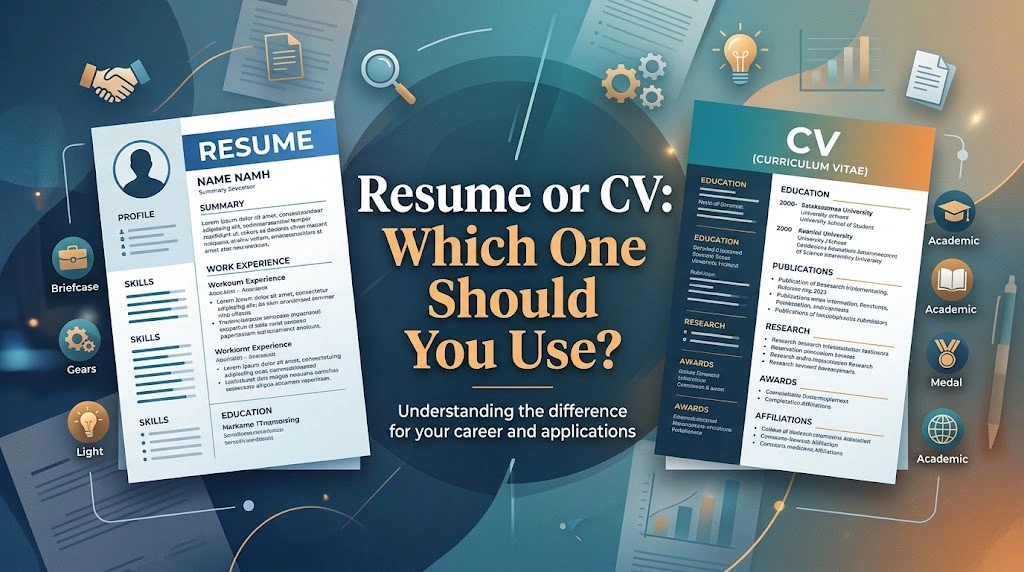
If you’re applying for a job, you’ve probably encountered two familiar terms: resume and CV. At first glance, they may seem interchangeable. In many situations, they are.
However, the difference becomes important when you apply across countries, industries, or career fields. A document called a CV in the United Kingdom may look much like what an American employer calls a resume. Meanwhile, an academic CV in the United States can be dramatically longer and more detailed than a typical job resume.
So, resume or CV—which one should you use?
The answer depends on several factors, including where you’re applying, what type of position you’re seeking, what your employer requests, and the conventions of your industry.
For most nonacademic jobs in the United States, a resume is the standard choice. For academic and research careers, a detailed CV is usually more appropriate. In many other countries, employers commonly use the word “CV” for a document that functions much like an American resume.
That distinction can save you from sending the wrong document to the right employer.
Resume vs. CV at a Glance
The easiest way to understand the difference is to look at the purpose of each document.
A resume is generally a concise, targeted summary of your qualifications for a particular job. It emphasizes the experience, skills, education, and accomplishments most relevant to that position.
A CV, short for curriculum vitae, traditionally provides a more comprehensive record of your academic or professional background. In the United States, an academic CV may include publications, research, teaching experience, presentations, grants, awards, professional memberships, and other scholarly activities.
Here’s the basic distinction:
| Factor | Resume | CV |
| Main purpose | Targeted job application | Comprehensive academic or professional record |
| Typical U.S. use | Most nonacademic jobs | Academic, research, medical, scientific, and specialized roles |
| Length | Usually concise | Often several pages |
| Content | Relevant qualifications | Detailed career or academic history |
| Customization | Usually highly customized | Usually more comprehensive |
| Publications | Usually limited or omitted | Often important |
| Research | Included when relevant | Often detailed |
| Teaching | Included when relevant | Can be a major section |
| Geographic usage | Common U.S. term | Common employment term in many countries |
| Best choice | Follow job and industry expectations | Follow field, institution, and country conventions |
The tricky part is that “CV” doesn’t mean exactly the same thing everywhere.
That’s where most of the confusion begins.
What Is a Resume?
A resume is a focused document designed to show an employer why you’re qualified for a particular position.
Think of it as a professional highlight reel.
You don’t usually include every job you’ve ever held, every course you’ve taken, or every accomplishment you’ve achieved. Instead, you select the information that helps demonstrate your suitability for the role.
A typical resume may contain:
- Contact information
- Professional summary
- Work experience
- Education
- Skills
- Certifications
- Relevant projects
- Awards or achievements
- Volunteer experience
- Professional affiliations
The exact sections depend on your background and the position.
For example, a software developer might emphasize programming languages, projects, technical achievements, and development experience. A marketing professional might highlight campaigns, revenue growth, conversion rates, content strategy, and analytics.
The document should answer a simple question:
Why should this employer consider you for this particular job?
That doesn’t mean your resume should become a sales brochure. It means every major section should earn its space.
Why Resumes Are Usually Shorter
Employers often review many applications for one opening. A concise resume makes relevant information easier to find.
That explains why strong resumes usually prioritize:
- Relevant experience
- Measurable accomplishments
- Job-specific skills
- Clear formatting
- Recent qualifications
- Easy-to-scan information
For example, this statement is weak:
Responsible for managing social media accounts.
A more informative version might say:
Managed five social media accounts and increased organic engagement by 42% over 12 months.
The second version gives the reader something concrete to evaluate.
What Is a CV?
A curriculum vitae literally means “course of life” in Latin.
In American academic and research settings, that description makes sense. An academic CV can document a person’s professional development over many years.
Instead of selecting only the most relevant accomplishments, a detailed CV may preserve a broad record of academic and professional activity.
Depending on the field, an academic CV can include:
- Education
- Academic appointments
- Research experience
- Teaching experience
- Publications
- Conference presentations
- Research grants
- Fellowships
- Awards
- Professional memberships
- Certifications
- Patents
- Editorial work
- Academic service
- Invited lectures
- Professional affiliations
A senior professor’s CV could therefore run dozens of pages.
That isn’t automatically a problem.
A 15-page academic CV may be perfectly normal when those pages document substantial research, teaching, publications, grants, and professional service. A 15-page resume for a typical corporate position would usually be unnecessarily long.
Length follows purpose.
Resume or CV: What’s the Difference?
The biggest difference isn’t simply the number of pages.
It’s the job the document performs.
A resume usually answers:
“What makes this applicant qualified for this particular position?”
A comprehensive academic CV answers something closer to:
“What has this person accomplished throughout their academic or professional career?”
That distinction affects nearly everything from content to structure.
| Characteristic | Resume | Academic CV |
| Focus | Specific opportunity | Comprehensive career record |
| Targeting | High | Generally lower |
| Work experience | Selected and relevant | Can be extensive |
| Publications | Usually limited | Often comprehensive |
| Presentations | Selected when relevant | Often listed |
| Grants | Selected when relevant | Frequently documented |
| Teaching | Relevant positions | Often detailed |
| Research | Relevant work | Usually extensive |
| Awards | Selected | Can be comprehensive |
| Page limit | Often concise | No universal maximum |
| Main audience | Hiring managers and recruiters | Academic committees, institutions, researchers |
Still, there’s an important wrinkle.
A CV in one country may essentially be a resume in another.
Resume or CV in the United States
In the United States, resume is the standard term for most nonacademic employment applications.
If you’re applying for a position as an accountant, software engineer, sales representative, project manager, graphic designer, customer service manager, or marketing specialist, you’ll generally prepare a resume.
The term CV usually appears in specific professional contexts.
These may include:
- University faculty positions
- Research positions
- Academic fellowships
- Graduate academic applications
- Scientific careers
- Medical careers
- Certain teaching positions
- Grant applications
- Academic awards
The exact requirements vary by institution and profession.
For example, a university may ask for a CV because the hiring committee needs to evaluate publications, research, teaching, conference presentations, and academic service.
A corporate employer hiring a sales manager usually doesn’t need that same level of detail.
What About Medical Professionals?
Medical careers can make the distinction more complicated.
Physicians, researchers, professors, and other medical professionals may maintain detailed CVs containing education, clinical appointments, research, publications, presentations, certifications, and professional memberships.
They may also use shorter resumes for certain nonacademic opportunities.
The employer’s instructions should take priority.
Resume or CV in Other Countries
The terminology changes dramatically around the world.
In the United Kingdom and many other countries, CV commonly refers to the standard document used when applying for jobs.
In that context, a CV may be relatively short and focused. It can look almost identical to what an American employer would call a resume.
This creates an easy trap.
An American applicant might hear “CV” and assume they need a 10-page academic document. A British employer may simply be asking for the standard job-application document.
That’s why geography matters.
Country-Specific Terminology
| Location or context | Common terminology | Typical meaning |
| United States, nonacademic jobs | Resume | Concise targeted job document |
| United States, academia | CV | Comprehensive academic record |
| United Kingdom | CV | Standard employment application document |
| Many European countries | CV | Standard employment application document |
| International academic applications | CV | Often detailed academic record |
| Scientific research | CV | Often comprehensive |
| Some specialized professions | Depends on employer | Follow application instructions |
These are broad conventions rather than absolute rules.
An employer can define its own requirements. If a job advertisement specifically asks for a resume, follow that instruction even if your country normally uses the word CV.
When Should You Use a Resume?
If you’re applying for a typical nonacademic position in the United States, a resume will usually be the appropriate choice.
Common examples include:
- Marketing manager
- Sales representative
- Software engineer
- Accountant
- Financial analyst
- Project manager
- Operations manager
- Human resources specialist
- Graphic designer
- Customer service manager
- Administrative assistant
- Business analyst
- Product manager
- Retail manager
The key isn’t the job title alone.
Look at what the employer asks for.
If the listing says “Submit your resume,” don’t overcomplicate the situation. Send a resume.
A Resume Should Prioritize Relevance
Suppose you’re applying for a digital marketing position.
You worked as:
- Digital marketing specialist
- Marketing coordinator
- Restaurant server
- Retail cashier
Your resume doesn’t necessarily need equal space for all four positions.
Your marketing experience probably deserves greater emphasis because it directly relates to the opening.
That is the central philosophy behind a targeted resume:
Relevance beats completeness.
When Should You Use a CV?
A detailed CV makes sense when the employer needs a comprehensive record of your academic or scholarly work.
This commonly includes:
- University faculty positions
- Research scientist positions
- Academic fellowships
- Postdoctoral applications
- Certain medical positions
- Research grants
- Academic promotions
- Scholarly appointments
An academic committee may want to know not only where you worked but also what you published, researched, taught, presented, and contributed to professionally.
A short resume wouldn’t provide enough context.
Academic CV Sections
A detailed academic CV might contain sections such as:
- Name and contact information
- Education
- Academic appointments
- Research interests
- Teaching experience
- Publications
- Book chapters
- Conference presentations
- Grants
- Fellowships
- Awards
- Professional memberships
- Editorial activities
- Academic service
- Invited talks
- Patents
- Languages
- References
You don’t need every possible section.
A physicist, historian, physician, and literature professor may structure their CVs quite differently.
What Goes on a Resume?
A good resume doesn’t need to contain every detail of your career.
Instead, build it around information that supports your application.
Contact Information
Include accurate professional contact details.
Depending on your circumstances, this may include:
- Full name
- Phone number
- Professional email address
- City and state
- LinkedIn profile
- Portfolio website
You generally don’t need to include unnecessary personal information.
Professional Summary
A summary can quickly explain who you are and what you offer.
For example:
Digital marketing specialist with six years of experience managing paid campaigns, SEO programs, and content strategy for B2B companies.
The statement gives the reader immediate context.
Work Experience
Focus on accomplishments rather than simply listing duties.
Compare these examples:
Weak:
Managed employees.
Stronger:
Led a 12-person operations team and reduced order-processing time by 18%.
Numbers give achievements more weight when they’re accurate and meaningful.
Education
List your relevant degrees and institutions.
For experienced professionals, education usually doesn’t need to dominate the page.
Skills
Include skills relevant to the position.
Avoid turning the section into a keyword warehouse.
If a job requires Excel, Salesforce, Python, SQL, Adobe Creative Cloud, or another specific tool, include it when you genuinely have that skill.
What Goes on an Academic CV?
An academic CV has a different information hierarchy.
Publications
Publications may become one of the most important sections.
Depending on the discipline, you might list:
- Peer-reviewed journal articles
- Books
- Book chapters
- Conference proceedings
- Reports
- Editorial publications
Use a consistent citation format throughout the document.
Research Experience
Explain research projects, institutions, responsibilities, and major findings when appropriate.
A researcher may also include:
- Research interests
- Laboratory experience
- Methodologies
- Fieldwork
- Collaborations
- Research funding
Teaching Experience
Academic CVs often provide more detail about teaching than ordinary resumes.
You might list:
- Courses taught
- Institutions
- Teaching roles
- Course development
- Supervision
- Teaching awards
- Curriculum work
Grants and Fellowships
For research careers, funding can demonstrate the ability to develop and support scholarly work.
List the grant or fellowship, awarding organization, year, role, and amount when relevant and appropriate.
Academic Service
This can include:
- Department committees
- Journal reviewing
- Conference organization
- Professional organizations
- Editorial responsibilities
- Community or scholarly outreach
The exact structure depends on the discipline.
Resume Length: How Long Should It Be?
There’s no universal rule saying every resume must fit on one page.
However, brevity matters.
A recent graduate with limited professional experience may have a strong one-page resume. An experienced executive may reasonably need two or more pages.
The better question is:
Does every section earn its space?
If removing a paragraph makes the document clearer without losing important evidence, remove it.
One-Page Resume
A one-page format often works well for:
- Students
- Recent graduates
- Early-career professionals
- Applicants with limited relevant experience
Two-Page Resume
Two pages may make sense when you have:
- Significant experience
- Multiple relevant positions
- Technical expertise
- Major achievements
- Leadership responsibilities
- Specialized certifications
- Substantial project experience
Don’t shrink your font to microscopic levels simply to force everything onto one page.
Readable beats cramped.
CV Length: How Long Should a CV Be?
Academic CVs don’t follow the same length expectations.
A researcher with 20 years of publications naturally has more to document than someone entering graduate school.
A CV may therefore grow from a few pages to many pages throughout a career.
That’s not a formatting failure.
It’s a reflection of accumulated professional work.
The important principle is organization.
Use clear headings, consistent formatting, dates, and logical sections so readers can navigate the document quickly.
Should You Tailor a Resume or CV?
Yes, but tailoring works differently.
A resume should usually be highly targeted.
If an employer emphasizes project management, stakeholder communication, budgeting, and Agile methods, those relevant qualifications should be easy to find.
That doesn’t mean copying the job description.
It means presenting genuine experience using terminology that accurately reflects the work you’ve done.
Example
Suppose the job description requests:
- Budget management
- Cross-functional leadership
- Risk assessment
- Agile project delivery
A candidate with those experiences should make them visible.
Instead of:
Worked with different departments on projects.
Use something more specific:
Led cross-functional Agile projects with six-figure budgets and tracked delivery risks across three business units.
Only use claims you can support.
Should You Tailor an Academic CV?
You usually won’t rewrite your entire academic history for every position.
However, you can organize the document so the most relevant qualifications receive appropriate attention.
For a teaching-focused position, teaching experience may appear prominently.
For a research-intensive position, research, publications, grants, and scholarly work may receive greater emphasis.
Resume vs. CV Formatting
Good formatting makes information easier to find.
It doesn’t need to look like a magazine cover.
Strong formatting usually includes:
- Clear section headings
- Consistent fonts
- Adequate white space
- Logical dates
- Consistent bullet styles
- Easy-to-read margins
- Clear hierarchy
- Consistent capitalization
Avoid unnecessary decoration that makes the document harder to scan.
A resume should communicate quickly.
A CV should communicate comprehensively.
Neither needs visual gymnastics.
Resume or CV and Applicant Tracking Systems
Many employers use applicant tracking systems (ATS) to organize applications and help recruiters search candidate information.
An ATS doesn’t mean you should fill your resume with every keyword imaginable.
Instead, use terminology that accurately reflects your qualifications.
For example, if the employer specifically requires “project management,” don’t rely exclusively on a phrase such as “project coordination” if your actual experience clearly involved project management.
At the same time, don’t claim skills you don’t possess.
ATS-Friendly Practices
Consider using:
- Standard section headings
- Readable fonts
- Simple layouts
- Consistent dates
- Text-based content
- Relevant keywords
- Clearly defined job titles
Be cautious with:
- Complex graphics
- Excessive columns
- Decorative text
- Information embedded entirely inside images
- Unusual section names
- Keyword stuffing
Always follow the employer’s submission requirements first.
Common Resume Mistakes
A resume can fail even when the candidate has excellent experience.
The problem often comes down to presentation.
Using the Same Resume Everywhere
A generic resume may not highlight the qualifications that matter most for each position.
Listing Duties Without Results
Hiring managers need evidence of impact.
Instead of describing only what you were responsible for, show what changed because of your work.
Writing Long Paragraphs
Dense blocks of text make resumes harder to scan.
Use concise bullets.
Including Irrelevant Information
More information doesn’t automatically make a resume stronger.
A 15-year-old unrelated job may need less space than a recent project directly connected to the position.
Using Vague Claims
Phrases such as “hard worker,” “team player,” and “results-oriented professional” aren’t very persuasive without evidence.
Show the result.
Common CV Mistakes
Academic CVs have their own problems.
Inconsistent Publication Formatting
If one publication uses one citation style and the next uses another, the document can become difficult to navigate.
Choose a consistent format.
Hiding Important Academic Work
If a position emphasizes research but your research experience appears near the bottom, readers may overlook it.
Organization matters.
Including Every Minor Detail
A comprehensive CV can still become cluttered.
The goal is to document your career clearly, not create an archaeological dig.
Forgetting Dates
Academic committees often need chronological context.
Use consistent years and date ranges.
What If a Job Posting Says “CV or Resume”?
This wording can be confusing.
Start by checking the context.
Ask yourself:
- Where is the employer located?
- What industry is this?
- Is the role academic?
- Does the posting provide a specific template?
- Does the employer describe publications or research?
- Does the application portal specify a document type?
If a U.S. technology company asks for a resume, use a resume.
If a U.S. university asks for a CV for a faculty position, prepare an academic CV.
If a British employer asks for a CV for a standard corporate position, they’re likely using “CV” to mean the standard employment document.
The employer’s instructions matter more than the label alone.
Can You Use a Resume as a CV?
Sometimes.
The answer depends on what the employer means by “CV.”
If a company in a country where “CV” means a standard job application document asks for your CV, a resume-style document may be exactly what they expect.
However, an American academic institution requesting a detailed curriculum vitae expects substantially more information.
That’s why saying “a CV is always longer than a resume” is too simplistic.
The terms have different meanings in different contexts.
Can a CV Be Short?
Absolutely.
A CV doesn’t automatically have to be ten pages long.
In many countries, a standard employment CV may be only one or two pages.
Meanwhile, an academic CV can be considerably longer.
The word itself doesn’t determine the appropriate length.
Purpose determines length.
This distinction is one of the most important things to understand about resume vs. CV terminology.
Resume or CV: A Practical Case Study
Consider two applicants named Alex.
Alex works as a software engineer in Chicago and has six years of industry experience.
Alex is applying to a private technology company for a senior software engineering position.
A targeted resume might emphasize:
- Programming languages
- System architecture
- Software projects
- Leadership
- Performance improvements
- Relevant employment
- Technical certifications
Alex doesn’t need several pages documenting every professional conference attended since college.
Now consider another Alex.
This Alex is a university researcher applying for a faculty position.
The relevant document might include:
- Academic appointments
- Research interests
- Publications
- Teaching experience
- Grants
- Conference presentations
- Awards
- Academic service
- Professional memberships
The two applicants could have equally impressive careers.
Yet they need different documents because their audiences need different information.
Resume or CV: A Quick Decision Checklist
Before sending your application, run through this checklist.
Choose a Resume When:
- You’re applying for most nonacademic jobs in the United States.
- The employer specifically requests a resume.
- The position emphasizes practical professional experience.
- The application focuses on targeted skills and achievements.
- You need to present a concise professional summary.
Choose a CV When:
- You’re applying for an academic position.
- The employer requests an academic CV.
- Research is central to the role.
- Publications matter to the selection process.
- Teaching history matters.
- Grants, fellowships, or scholarly presentations are important.
- The institution specifically asks for a curriculum vitae.
Check Local Conventions When:
- You’re applying internationally.
- The employer uses “CV” instead of “resume.”
- You’re applying in the UK or another country where CV is the standard employment term.
- You’re unsure whether the employer wants an academic CV or employment document.
Resume or CV: Which One Should You Use?
There isn’t one universal answer.
For most nonacademic jobs in the United States, a resume is the conventional choice.
For academic, research, and certain specialized careers, a comprehensive CV may be appropriate.
Outside the United States, the word “CV” often refers to the standard job-application document that Americans call a resume.
The safest approach is therefore to look beyond the title.
Consider four things:
- Country — What terminology does the local job market use?
- Industry — Is this a corporate, academic, scientific, medical, or research position?
- Employer instructions — What document does the organization explicitly request?
- Purpose — Does the employer need a targeted summary or a comprehensive career record?
When those four factors point in the same direction, the choice becomes much easier.
Resume vs. CV FAQs
Is a CV the same as a resume?
Not always.
In everyday employment contexts, the terms can refer to similar documents. In the United States, however, an academic CV usually means a much more comprehensive professional record than a standard resume.
Which is better, a resume or a CV?
Neither is universally better.
The appropriate document depends on the country, position, industry, and employer’s instructions.
Do employers prefer resumes or CVs?
It depends on the employer and location.
Most U.S. nonacademic employers generally request resumes. Academic institutions and research organizations may request CVs.
How many pages should a resume be?
There is no universal page limit.
A concise resume often works well for early-career applicants, while experienced professionals may reasonably need two or more pages.
Relevance and readability matter more than forcing everything into one page.
How many pages should an academic CV be?
There is no universal maximum.
Its length depends on the person’s academic career, publications, teaching history, research, grants, presentations, awards, and other accomplishments.
Do I need both a resume and a CV?
Some professionals maintain both.
For example, an academic researcher might maintain a comprehensive CV while also keeping a shorter resume for industry positions.
Should I put references on my resume?
Usually, you don’t need to list references unless the employer specifically requests them.
Follow the application instructions.
Should references appear on an academic CV?
That depends on the institution, discipline, and application requirements.
If references are requested, follow the specified format.
Does an ATS read CVs?
Applicant tracking systems can process many types of text-based application documents. However, the exact behavior depends on the software and employer configuration.
Use a clear, readable format and follow the employer’s submission instructions.
What is the difference between a CV and a resume in the USA?
In the United States, a resume typically serves as a concise job-application document. A CV generally refers to a more comprehensive academic or professional record, particularly in academia, research, and certain specialized fields.
What is the difference between a CV and a resume in the UK?
In the UK, “CV” commonly refers to the standard document used when applying for jobs. It can therefore resemble what American employers call a resume.
Should I use “resume” or “CV” in a job application?
Use the term and document type that matches the employer’s instructions and local convention.
Don’t choose solely based on which word sounds more professional.
The Bottom Line on Resume or CV
The resume vs. CV debate becomes much easier once you stop treating the words as universal definitions.
A resume generally gives an employer a focused picture of your qualifications for a specific job. An academic CV provides a broader record of scholarly and professional accomplishments.
But geography changes the terminology.
In the United States, “resume” commonly describes the standard document for nonacademic employment. “CV” often signals an academic or research-focused document.
In the UK and many other countries, CV commonly serves as the ordinary term for a job-application document.
So before you send anything, check the location, industry, position, and employer instructions.
Then build the document around what the reader actually needs.
A strong application isn’t the longest one. It isn’t the fanciest one, either.
It’s the one that makes the right qualifications easy to find, easy to understand, and relevant to the opportunity.
