

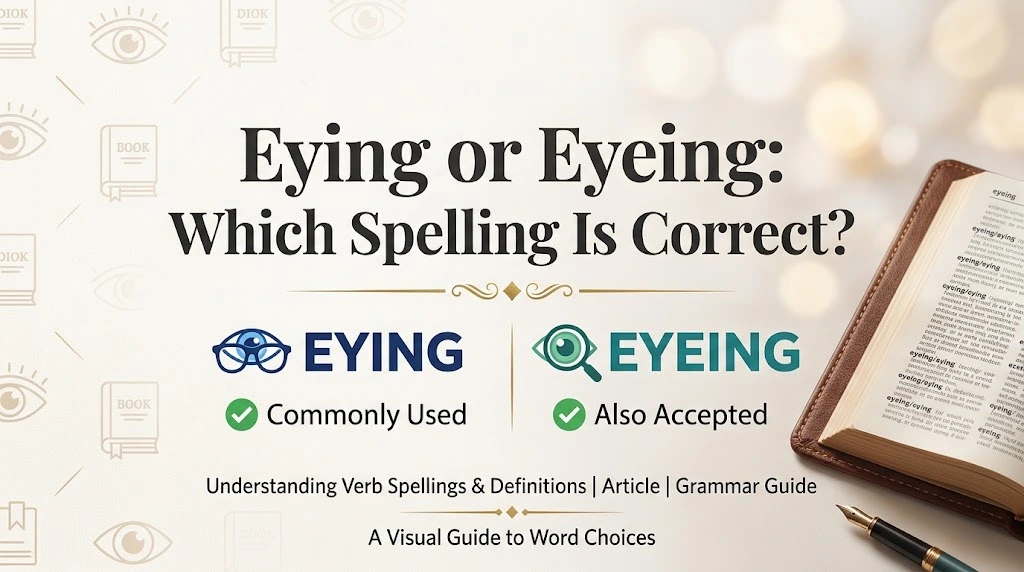
If you’ve ever stopped while typing “eying” or “eyeing,” you’re not alone. The two spellings look almost identical, sound the same, and refer to the same basic action. That makes the choice surprisingly easy to second-guess.
So, eying or eyeing—which spelling is correct?
The short answer is that both “eying” and “eyeing” are accepted spellings. However, “eyeing” is the more familiar form in modern American English, especially in general writing. The shorter form, “eying,” also appears in dictionaries and published English as a variant spelling.
The difference isn’t about meaning. Both forms come from the verb eye, meaning to look at someone or something closely, carefully, or with particular interest.
For most everyday US English writing, eyeing is the safer and more recognizable choice.
But there’s more to this spelling question than adding -ing to a three-letter verb. The unusual spelling comes from the way English handles the noun and verb eye when it takes an ending.
Eying or Eyeing: Quick Answer
Here’s the practical answer at a glance:
| Spelling | Correct? | Meaning | Commonness |
| eyeing | Yes | Looking at something closely or with interest | Very common |
| eying | Yes | Same meaning as eyeing | Less common |
| eye | Yes | To look at or watch closely | Base verb |
| eyed | Yes | Past tense of eye | Common |
If you’re writing for a broad American audience, eyeing will usually feel more natural to readers.
For example:
She was eyeing the last slice of pizza.
You could also write:
She was eying the last slice of pizza.
The meaning remains the same.
The important point is this: “eying” isn’t automatically a misspelling of “eyeing.” It is an established variant.
What Does “Eyeing” Mean?
The verb eye means to look at something deliberately or carefully. It often carries a little more meaning than simply look.
When someone is eyeing something, they may be:
- Looking at it closely
- Showing interest in it
- Considering taking or buying it
- Assessing it
- Watching it suspiciously
- Thinking about pursuing it
- Waiting for an opportunity involving it
Context determines the exact shade of meaning.
Consider these examples:
Marcus was eyeing the new laptop in the store window.
Here, eyeing suggests interest. Marcus isn’t merely noticing the laptop. He appears interested in it.
Now consider:
The security guard was eyeing the suspicious package.
This version suggests careful observation.
Another example:
She was eyeing the empty parking space.
That sentence suggests she wanted the space and was watching it closely.
The word can therefore carry an implied purpose. Someone who is eyeing something often has a reason for paying attention to it.
What Does “Eying” Mean?
Eying has essentially the same meaning as eyeing.
It comes from the same verb, eye, and functions in the same grammatical way.
For example:
He was eying the expensive watch.
This means the same thing as:
He was eyeing the expensive watch.
The spelling changes. The meaning doesn’t.
That distinction matters because many English spelling questions involve two forms where one is standard and the other is incorrect. Eying and eyeing aren’t quite that situation. Both forms have legitimate usage.
Still, frequency matters when you’re deciding which version to use.
If your audience consists mainly of American English readers, eyeing is generally the more familiar choice. It makes the relationship to the word eye immediately obvious.
Is “Eying” a Word?
Yes. Eying is a word.
Major English dictionaries recognize eying as a spelling variant associated with the verb eye. It isn’t simply a typo created by someone forgetting the second vowel.
That said, the form appears less often than eyeing in contemporary general writing.
This creates a common misconception.
A reader may see:
He was eying the door.
and assume the writer made a spelling mistake.
That assumption isn’t necessarily correct. The sentence can be grammatically sound.
The distinction becomes especially useful when you’re proofreading. If you encounter eying, you shouldn’t automatically replace it simply because eyeing looks more familiar.
Instead, consider your audience and the style of the publication.
Is “Eyeing” a Word?
Absolutely.
Eyeing is the present participle and gerund form of the verb eye.
It is also the spelling most readers are likely to recognize immediately.
Examples include:
She kept eyeing the clock.
The cat was eyeing the bird.
Investors are eyeing the company’s latest product.
He was eyeing an opportunity to negotiate.
In each case, eyeing describes an ongoing or developing action.
The word can also appear in headlines:
Retailers Are Eyeing Strong Holiday Sales
Companies Are Eyeing New Markets
Fans Are Eyeing the Championship
Here, eyeing often means considering, targeting, or hoping to obtain something rather than merely looking at it.
Why Are There Two Spellings?
The spelling becomes interesting when you start with the word eye and add -ing.
At first glance, the natural construction seems obvious:
eye + ing = eyeing
That’s the form most readers recognize.
But English spelling doesn’t always behave like a neat mathematical equation. Historical spelling patterns, pronunciation, dictionary conventions, and attempts to make words easier to read have all influenced forms such as eying.
The shorter spelling removes the second e before the -ing ending:
eye + ing → eying
This resembles other English spelling adjustments in which a word changes slightly when an ending is added.
However, eyeing retains the visual connection to the noun eye. That’s one reason it remains highly recognizable.
Think of it this way: English spelling sometimes keeps a word’s visual identity even when another form could work.
Eying or Eyeing in American English
For American English readers, eyeing is generally the most familiar spelling.
If you’re writing:
- A blog post
- A business report
- An email
- A school paper
- Marketing copy
- A news article
- Website content
- Social media content
Eyeing is usually the straightforward choice.
For example:
The company is eyeing expansion into three new markets.
That sentence looks completely natural to most American readers.
The alternative is also understandable:
The company is eying expansion into three new markets.
However, some readers may pause because the shorter spelling is less familiar.
That doesn’t make it wrong. It simply means frequency and familiarity can affect how smoothly a word reads.
When clarity is your main goal, the more familiar form often wins.
Eying or Eyeing in British English
British English also recognizes both forms, although dictionary preferences and usage frequencies can vary.
This is a useful reminder that English doesn’t have one universal spelling authority controlling every variety of the language.
Different dictionaries document different usage patterns. Regional publications may also follow their own style preferences.
Therefore, it’s better to think of eying vs. eyeing as a question of accepted variation rather than a simple right-versus-wrong battle.
If you’re writing specifically for a publication, follow its house style.
If no style guide applies, eyeing provides a clear and widely recognizable choice.
Eye + -ing: How the Word Is Formed
Understanding the base word makes the spelling easier to remember.
The base verb is:
eye
Its common forms include:
| Verb form | Example |
| eye | I eye the new model carefully. |
| eyes | She eyes the dessert. |
| eyed | He eyed the package suspiciously. |
| eyeing | They are eyeing the property. |
| eying | They are eying the property. |
The form eyeing creates no change in pronunciation that would help you choose between the two spellings.
That’s part of the problem.
You hear essentially the same word whether the writer uses eying or eyeing. You therefore have to remember the spelling rather than rely on pronunciation.
Eyeing as a Verb Form
Eyeing functions as the present participle of eye.
It commonly appears with forms of be to create progressive constructions:
She is eyeing the promotion.
They were eyeing the vacant building.
We are eyeing several possible locations.
It can also function as a gerund:
Eyeing the competition won’t help you improve your product.
Here, the entire eyeing phrase functions as a noun-like subject.
The grammatical role changes slightly depending on the sentence, but the spelling remains the same.
What Does “Eyeing” Suggest in Context?
One reason eyeing appears frequently in journalism and business writing is that it can express more than simple visual attention.
For example:
The company is eyeing international expansion.
Nobody necessarily means company executives are literally staring at another country.
Instead, eyeing means the company is considering or targeting international expansion.
Similarly:
The team is eyeing another championship.
This usually means the team hopes to win another championship.
The word can therefore work as a compact alternative to phrases such as:
- Considering
- Targeting
- Pursuing
- Looking toward
- Hoping to obtain
- Planning for
That’s why you’ll often see eyeing in business and sports writing.
Examples of “Eyeing” in a Sentence
Here are several natural examples:
Everyday situations
The dog was eyeing the sandwich on the table.
Mia kept eyeing the jacket in the store window.
He was eyeing the empty chair across the room.
Business
The retailer is eyeing smaller cities for its next expansion.
Several investors are eyeing the startup.
The company is eyeing a larger share of the market.
Sports
The team is eyeing its third straight victory.
The runner is eyeing the national record.
The club is eyeing a place in the final.
Suspicion or caution
The detective was eyeing the suspect carefully.
The guard kept eyeing the unattended bag.
Desire or interest
She was eyeing the last piece of cake.
He had been eyeing that motorcycle for months.
Notice the pattern. Eyeing often implies intention, interest, or assessment.
Examples of “Eying” in a Sentence
Because eying is an accepted variant, you can use it in similar contexts:
The dog was eying the sandwich.
She was eying the new shoes.
Investors are eying the company.
The team is eying another title.
He kept eying the exit.
Each sentence has the same basic meaning when you replace eying with eyeing.
For example:
The dog was eying the sandwich.
and:
The dog was eyeing the sandwich.
The difference is spelling rather than meaning.
Eying vs. Eyeing: Side-by-Side Examples
A direct comparison makes the distinction especially clear.
| With eyeing | With eying |
| She was eyeing the new car. | She was eying the new car. |
| They are eyeing the property. | They are eying the property. |
| He kept eyeing the door. | He kept eying the door. |
| Investors are eyeing the stock. | Investors are eying the stock. |
| The team is eyeing a victory. | The team is eying a victory. |
There is no meaningful change in these sentences.
The key difference is reader familiarity.
Eyeing visually connects to eye immediately. Eying looks more compact but may cause a momentary pause for some readers.
Eyeing vs. Looking: Are They the Same?
Not exactly.
Looking is a broad word. It can describe almost any act of directing your eyes toward something.
Eyeing usually adds a sense of deliberate attention.
Compare these:
She was looking at the dress.
She was eyeing the dress.
The first sentence simply tells you where she directed her attention.
The second suggests she was examining the dress with interest. Perhaps she wanted to buy it.
Here’s another pair:
He was looking at the door.
He was eyeing the door.
The first could describe an ordinary glance.
The second may suggest that he was considering the door as an exit.
That extra sense of purpose gives eyeing its distinctive flavor.
Eyeing vs. Watching: What’s the Difference?
Watching often emphasizes continued observation.
Eyeing tends to emphasize deliberate attention or assessment.
For example:
She was watching the children.
This suggests she was observing them over a period of time.
Now consider:
She was eyeing the children.
That could suggest she was assessing them, observing them carefully, or wondering what they were doing.
The words overlap, but they aren’t perfect substitutes.
A useful shortcut is:
- Looking = directing your eyes somewhere
- Watching = observing something over time
- Eyeing = looking closely or with particular interest
Context can blur these boundaries, but the distinction remains useful.
Common Mistakes With Eying and Eyeing
The biggest mistake is assuming that eying must be wrong.
It isn’t.
Another common mistake involves using eyeing when the writer actually means something different.
For example:
I was eyeing at the painting.
That construction is usually unnecessary.
The verb eye can take a direct object:
I was eyeing the painting.
You don’t normally need at after eye in this sense.
Compare that with:
I was looking at the painting.
The two verbs follow different patterns.
Common error patterns
| Incorrect or awkward | Better |
| I was eyeing at the car. | I was eyeing the car. |
| She was eyeing at the door. | She was eyeing the door. |
| He eyeing the food. | He was eyeing the food. |
| They are eying on the property. | They are eying the property. |
The issue in these examples isn’t the spelling eying. It’s the sentence structure.
Is “Eying” a British Spelling?
Calling eying simply a “British spelling” would be too broad.
The form appears in English usage beyond one particular national variety. Dictionary records treat it as a variant of eyeing.
Likewise, eyeing isn’t restricted to American English.
English spelling often contains variants that cross national boundaries. Usage frequency can differ between regions without creating an absolute grammatical divide.
If you’re writing for an international audience, eyeing may offer greater immediate familiarity.
If you’re following a specific editorial style, use the spelling that style recommends.
Is “Eyeing” More Common Than “Eying”?
In modern general writing, eyeing is generally more familiar than eying.
That’s an important practical distinction.
A spelling can be correct without being the spelling most readers expect.
Consider the difference between these two questions:
Is it correct?
Both forms can be correct.
Which form will most readers recognize immediately?
For broad US English audiences, eyeing is usually the safer answer.
That doesn’t make eying bad English. It simply makes eyeing the more recognizable choice.
Eying or Eyeing: Which Should You Use?
If you’re deciding which spelling to put on the page, consider three things.
Choose “eyeing” for broad US audiences
If you don’t have a specific reason to choose the shorter variant, eyeing is a strong default.
It is instantly connected to the word eye.
That visual connection helps readers process the word quickly.
Use “eying” when a style guide permits it
If your publication, editor, or dictionary preference accepts eying, you can use it.
The form is not inherently incorrect.
The main concern is consistency.
Don’t switch randomly between forms
A polished article shouldn’t jump back and forth without a reason.
For example, this looks inconsistent:
The company is eyeing expansion. Later, executives discussed eying new markets.
Unless you’re discussing the spelling itself, pick one form and stick with it.
Consistency makes writing look deliberate.
Eying or Eyeing in Formal Writing
Formal writing rewards clarity.
That doesn’t mean every less-common spelling is unacceptable. It means you should consider how quickly your audience will understand the word.
For most formal US English writing, eyeing is a sensible choice.
Imagine you’re writing a report:
The company is eyeing expansion into the Midwest.
The sentence is clear and familiar.
Using eying isn’t necessarily grammatically wrong:
The company is eying expansion into the Midwest.
However, if your goal is maximum familiarity, eyeing has an advantage.
This is especially relevant in professional communication. You rarely want a reader wondering whether you’ve made a typo.
Grammar Rules for Eying and Eyeing
A few simple rules will keep your usage clean.
Rule one: Both forms relate to the verb “eye.”
The base verb is eye.
Rule two: Both forms can describe an ongoing action.
She is eyeing the menu.
She is eying the menu.
Rule three: Both can take a direct object.
He was eyeing the prize.
Not:
He was eyeing at the prize.
Rule four: Context determines the meaning.
Eyeing can mean literally looking at something. It can also mean considering or targeting something.
Rule five: Follow your publication’s preferred spelling.
If no style guide tells you otherwise, eyeing is generally the more familiar choice for US readers.
Related Forms of the Verb “Eye”
The verb has several useful forms.
| Form | Example |
| eye | I eye the opportunity carefully. |
| eyes | She eyes the dessert. |
| eyed | He eyed the package. |
| eyeing | They are eyeing the property. |
| eying | They are eying the property. |
The past tense deserves special attention.
The past tense is eyed:
She eyed the strange object suspiciously.
You don’t write eyed as eyed with an extra vowel. The spelling stays compact.
That makes the present participle particularly interesting because eyeing and eying coexist.
Why “Eyeing” Can Look Strange
English readers are accustomed to many verbs that drop a final silent e before -ing:
- make → making
- write → writing
- hope → hoping
- use → using
So when they see eyeing, they may wonder why the spelling doesn’t become something like eying.
The reason is that eye is an unusual word.
Its spelling represents the noun and verb eye, which has a distinctive visual form. Keeping the extra e helps preserve that recognizable connection.
English has many words that don’t behave exactly like the patterns learners memorize in grammar textbooks.
That’s why spelling rules are useful guides rather than perfect machines.
A Simple Memory Trick for “Eying or Eyeing”
Here’s an easy way to remember the common spelling.
Think:
eye → eyeing
The word eye stays visible inside eyeing.
You can mentally picture:
EYE + ING = EYEING
That shortcut makes the spelling easier to recall.
If you encounter eying, remember that it is an accepted variant rather than automatically treating it as an error.
Case Study: A Business Sentence
Consider this sentence:
The retailer is eyeing expansion into smaller cities.
What does eyeing communicate?
It suggests more than simple observation.
The retailer is likely considering or targeting expansion.
Now substitute looking at:
The retailer is looking at expansion into smaller cities.
This is perfectly understandable, but the tone changes slightly.
Eyeing feels more concise and purposeful.
It often works well in headlines because it compresses a larger idea into one word.
For example:
Retailer Eyeing Expansion Into Smaller Cities
That headline doesn’t mean executives are staring at a map all day. It means expansion is under consideration.
This illustrates an important point: context can turn a visual verb into a strategic one.
Case Study: An Everyday Sentence
Now consider:
Daniel was eyeing the last slice of pizza.
Most readers immediately understand what is happening.
Daniel isn’t simply looking at the pizza. He probably wants it.
Perhaps he’s waiting for someone to offer it. Maybe he’s deciding whether to grab it. The sentence leaves the exact intention unstated while making the interest obvious.
You could write:
Daniel was looking at the last slice of pizza.
That’s grammatically correct, but it loses some of the implied desire.
The word eyeing carries extra information without adding extra words.
That’s good writing economy.
What Dictionaries Say About Eying and Eyeing
English dictionaries are useful when spelling questions become murky because they document established usage rather than relying on intuition alone.
For this question, reputable dictionary resources include:
- Merriam-Webster: eye
- Merriam-Webster: eyeing
- Cambridge Dictionary: eye
- Collins Dictionary: eye
- Oxford Learner’s Dictionaries: eye
These resources help demonstrate why you shouldn’t automatically mark eying as a typo.
Dictionary entries can differ in exactly how they label or prioritize variants. That difference reflects the broader reality of English: spelling conventions aren’t always perfectly uniform.
Eying or Eyeing: A Practical Style Guide
When you’re editing your own writing, use this quick checklist:
- Writing for general US readers? Prefer eyeing.
- Following a house style? Follow that style.
- Found “eying” in a published text? Don’t automatically call it wrong.
- Writing about the spelling itself? Explain that both forms exist.
- Trying to maintain consistency? Pick one form within the same piece.
- Using the verb with an object? Write eyeing the object, not usually eyeing at the object.
- Need the past tense? Use eyed.
This approach keeps the issue simple.
Eying or Eyeing: Frequently Asked Questions
Is “eying” correct?
Yes. Eying is an accepted spelling variant of eyeing. It has the same basic meaning and grammatical function.
Is “eyeing” correct?
Yes. Eyeing is a standard and widely recognized spelling of the present participle of eye.
Which is correct, eying or eyeing?
Both can be correct. For general American English writing, eyeing is usually the more familiar choice.
Is eying a misspelling?
No. Eying isn’t automatically a misspelling. It is an established variant spelling.
Is eyeing more common than eying?
In contemporary general writing, eyeing is generally more common and more familiar, particularly for broad American English audiences.
What does eyeing mean?
Eyeing means looking at someone or something closely, carefully, or with interest. Depending on context, it can also mean considering or targeting something.
What is the past tense of eye?
The past tense is eyed.
Example:
She eyed the unfamiliar package carefully.
What is the present participle of eye?
The common present participle is eyeing. Eying is also an accepted variant.
Can you say “eying at”?
Usually, no. The verb eye normally takes a direct object.
Use:
He was eyeing the car.
rather than:
He was eying at the car.
If you want at, use looking:
He was looking at the car.
Does eyeing mean staring?
Not necessarily.
Eyeing can involve close or deliberate observation, but it doesn’t always mean staring. The exact intensity depends on context.
Is eyeing formal or informal?
Eyeing works in both everyday and formal writing. It’s common in journalism, business writing, sports reporting, and ordinary conversation.
Can eyeing mean considering something?
Yes.
For example:
The company is eyeing a move into Europe.
Here, eyeing means considering or targeting the move.
Should you use eying or eyeing in an essay?
For a general US English essay, eyeing is usually the more recognizable option. If your instructor or style guide specifies another form, follow that preference.
Eying or Eyeing: Final Verdict
So, eying or eyeing—which spelling should you use?
Both eying and eyeing are accepted spellings connected to the verb eye. They carry the same basic meaning and perform the same grammatical function.
However, eyeing is generally the better default for modern US English because readers are more likely to recognize it immediately.
Use eyeing when you want the clearest, most familiar form:
The company is eyeing a new market.
She was eyeing the last piece of cake.
The team is eyeing another championship.
Don’t assume eying is wrong, though. It remains an accepted variant:
The company is eying a new market.
The most important lesson is simple: this isn’t a case where one spelling is correct and the other is simply a typo. Both have a legitimate place in English.
For everyday American writing, eyeing is the practical choice. When you encounter eying, however, there’s no need to reach for the red pen immediately.
Quick Takeaway
| Question | Answer |
| Is eyeing correct? | Yes |
| Is eying correct? | Yes |
| Which is more familiar in US English? | Eyeing |
| Do they have different meanings? | No |
| Can both function as the present participle of eye? | Yes |
| Does eyeing mean looking closely? | Yes |
| Can eyeing mean considering or targeting something? | Yes |
| What is the past tense of eye? | Eyed |
| Should you use “eyeing at”? | Generally no |
| Best default for broad US readers? | Eyeing |
When in doubt, remember the simplest version:
Eye → eyeing.
That spelling is familiar, clear, and easy for most readers to recognize. Eying is valid too, but eyeing is usually the smoother choice for general American English.
If needed, this article can also be adapted into a more aggressively SEO-focused version with a stronger featured-snippet structure, keyword clusters, semantic terms, and additional FAQ coverage.
