

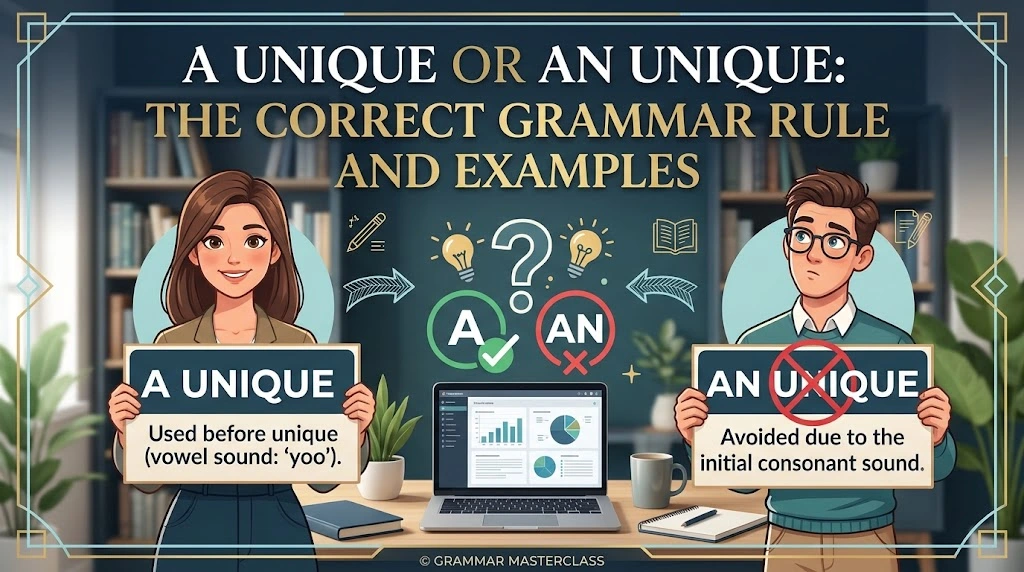
Is it “a unique” or “an unique”?
The correct choice in standard modern English is “a unique.” You write “a unique idea,” “a unique opportunity,” and “a unique experience.”
The reason has nothing to do with the letter u by itself. English uses a and an according to the sound that follows the article, not simply the first letter of the next word.
That small distinction explains why we say “a unique product” but “an unusual product.” Both words begin with u in writing, yet their opening sounds differ.
This guide explains the rule in detail, shows real examples, compares similar words, and covers the mistakes that commonly cause confusion.
A Unique or An Unique: Which Is Correct?
“A unique” is the standard grammatical form.
For example:
- a unique idea
- a unique opportunity
- a unique design
- a unique experience
- a unique solution
- a unique approach
- a unique product
- a unique situation
The phrase “an unique” is generally considered nonstandard in contemporary English.
Consider these sentences:
The company developed a unique solution to the problem.
She had a unique opportunity to study abroad.
The restaurant offers a unique dining experience.
In each case, a is correct because unique begins with a consonant sound.
The spelling can make this rule look strange at first. After all, unique begins with the vowel letter u. However, English articles don’t simply follow letters.
Pronunciation decides the article.
Why Is “A Unique” Correct?
The pronunciation of unique begins with the sound /juː/.
That opening sound is similar to the beginning of the word you.
Say these words aloud:
- you
- unique
- university
- uniform
- useful
- user
They all begin with a /y/ sound before the vowel sound that follows.
Because that opening sound functions as a consonant sound, English uses a:
- a unique idea
- a university
- a uniform
- a useful tool
- a user account
The pronunciation, rather than the spelling, controls the choice.
The pronunciation of “unique”
The word unique is commonly pronounced:
/juːˈniːk/
The first sound is /j/, the consonant sound heard at the beginning of you.
You can think of the word as starting approximately like this:
you + neek
That isn’t a spelling guide. It’s simply a pronunciation reminder.
So:
a + unique → a unique
Not:
an + unique → an unique
The Basic Rule for A and An
The easiest way to understand a unique or an unique is to learn the broader article rule.
Use a before a consonant sound.
Use an before a vowel sound.
Examples with “a”
- a book
- a car
- a teacher
- a house
- a university
- a useful idea
- a unique opportunity
Examples with “an”
- an apple
- an orange
- an umbrella
- an hour
- an honest person
- an unusual event
- an urgent request
Notice something important.
The first written letter doesn’t always tell you which article to use.
For example:
a university
The word university starts with u, but its pronunciation starts with /j/.
Now consider:
an umbrella
Umbrella also starts with u, but it begins with a vowel sound.
That’s why the articles differ.
| Word | Opening sound | Correct article | Example |
| unique | /j/ | a | a unique idea |
| university | /j/ | a | a university |
| useful | /j/ | a | a useful tool |
| uniform | /j/ | a | a uniform |
| umbrella | vowel sound | an | an umbrella |
| unusual | vowel sound | an | an unusual event |
| urgent | vowel sound | an | an urgent matter |
| ugly | vowel sound | an | an ugly mistake |
This sound-based rule solves most article questions immediately.
Why “An Unique” Is Usually Incorrect
The mistake happens because people often learn a simplified rule:
“Use an before words beginning with a vowel.”
That explanation isn’t complete.
A better rule is:
Use “an” before a word that begins with a vowel sound.
The difference matters.
The first letter of unique is u, but its first sound is /j/.
The first letter and first sound don’t match.
That’s common in English.
Consider university. Its spelling begins with u, but we pronounce it approximately as yoo-ni-ver-si-ty.
Therefore:
a university
not:
an university
The same pattern applies to unique.
a unique opportunity
not:
an unique opportunity
A quick comparison
Unique
- Spelling: starts with u
- Pronunciation: starts with /j/
- Article: a
- Correct: a unique
Unusual
- Spelling: starts with u
- Pronunciation: starts with a vowel sound
- Article: an
- Correct: an unusual
That’s the key distinction.
A Unique vs. An Unique Examples
Seeing the rule in complete sentences makes it easier to remember.
Correct examples with “a unique”
- The artist created a unique painting.
- She proposed a unique solution.
- We found a unique way to solve the problem.
- The hotel offers a unique experience.
- He has a unique perspective on the issue.
- The company developed a unique product.
- This city has a unique character.
- The program provides a unique opportunity for students.
- They designed a unique logo for the brand.
- The museum contains a unique collection of artifacts.
Incorrect in standard modern usage
These forms should normally be changed:
- an unique idea ❌
- an unique opportunity ❌
- an unique product ❌
- an unique solution ❌
- an unique experience ❌
Use:
- a unique idea ✅
- a unique opportunity ✅
- a unique product ✅
- a unique solution ✅
- a unique experience ✅
The reason remains the same in every example: unique begins with a consonant /y/ sound.
The Real Grammar Rule: Sound, Not Spelling
This is the most useful lesson behind a unique or an unique.
English articles respond to pronunciation.
They don’t mechanically respond to the first written letter.
That’s why these combinations are perfectly normal:
- a university
- a European country
- a uniform
- a useful feature
- a unique design
The words European and unique are especially helpful examples because their spelling can tempt writers to choose an.
Compare these pairs
| Correct phrase | Why? |
| a unique product | /j/ sound at the beginning |
| an unusual product | vowel sound at the beginning |
| a European company | /j/ sound at the beginning |
| an excellent company | vowel sound at the beginning |
| a useful feature | /j/ sound at the beginning |
| an urgent feature request | vowel sound at the beginning |
| a university student | /j/ sound at the beginning |
| an undergraduate student | vowel sound at the beginning |
The spelling can look similar. The pronunciation makes the difference.
Why the “U” in Unique Doesn’t Take “An”
The letter u can represent several different sounds in English.
That’s why you can’t apply one article rule to every word beginning with u.
For example:
“U” with a /y/ sound
Words such as these commonly begin with a /j/ sound:
- unique
- university
- union
- uniform
- unit
- useful
- user
- usual
They take a when a singular count noun phrase requires an indefinite article:
- a unique feature
- a university
- a union
- a uniform
- a unit
- a useful method
- a user
- a usual practice
“U” with a vowel sound
Other words beginning with u start with a vowel sound:
- umbrella
- uncle
- unusual
- urgent
- ugly
- unexpected
These take an:
- an umbrella
- an uncle
- an unusual situation
- an urgent request
- an ugly building
- an unexpected result
So the letter u doesn’t determine the article.
The sound does.
A Unique and the Pronunciation of “You”
One of the simplest memory tricks is to connect unique with you.
Say:
you
Then say:
unique
Both start with the familiar /y/ sound.
That sound behaves as a consonant at the beginning of the word.
Therefore:
a unique
The same idea explains:
a useful tool
The beginning of useful sounds like yoo-.
It also explains:
a user account
Again, user begins with a sound like yoo-.
This isn’t about whether the letter u is technically a vowel. It is. The issue is the sound produced when the word begins.
A Unique vs. An Unusual
This pair causes frequent confusion because both words begin with u.
However, their opening sounds differ.
Unique
unique → /juːˈniːk/
The beginning sounds like “yoo.”
Therefore:
a unique opportunity
Unusual
unusual → /ʌnˈjuːʒuəl/
The word begins with the vowel sound /ʌ/.
Therefore:
an unusual opportunity
The contrast becomes obvious when you say both phrases aloud:
a unique opportunity
an unusual opportunity
The articles sound natural because they match the pronunciation.
More examples
- a unique problem
- an unusual problem
- a unique design
- an unusual design
- a unique situation
- an unusual situation
- a unique experience
- an unusual experience
The noun doesn’t control the article. The next spoken sound does.
More Words That Take “A” Before a U
Once you understand unique, several other examples become easy.
A university
Correct:
She attends a university in California.
Not:
She attends an university in California.
The opening sound resembles yoo.
A uniform
Correct:
The employee wears a uniform.
The word begins with the /j/ sound.
A useful tool
Correct:
This is a useful tool for students.
Again, useful begins with the sound yoo.
A user account
Correct:
You need a user account to access the platform.
The same pronunciation pattern applies.
A European country
Correct:
France is a European country.
European begins with a sound like yur-, which starts with a consonant /j/ sound.
These examples reinforce the same principle without requiring you to memorize every phrase separately.
Words Beginning With U That Take “An”
Now compare those examples with words whose opening sound is genuinely a vowel.
An umbrella
She carried an umbrella in the rain.
The word starts with the vowel sound /ʌ/.
An uncle
He visited an uncle during the holidays.
Again, the opening sound is a vowel.
An unusual idea
They suggested an unusual idea.
The initial sound in unusual is a vowel sound.
An urgent request
The manager sent an urgent request.
The word begins with a vowel sound.
An unexpected result
The experiment produced an unexpected result.
The opening sound is a vowel.
These examples show why the simple rule “u = an” doesn’t work.
A Unique or An Unique in Formal Writing
In formal writing, use a unique.
This applies to:
- academic essays
- business reports
- professional emails
- product descriptions
- websites
- research writing
- journalism
- marketing copy
- applications
- presentations
For example:
The study presents a unique perspective on consumer behavior.
Or:
The company developed a unique approach to reducing production costs.
Or:
The program gives participants a unique opportunity to gain practical experience.
These sentences follow standard English grammar.
If you’re editing an important document, replacing “an unique” with “a unique” is a straightforward correction.
A Unique in Academic and Professional Sentences
The phrase works naturally in serious writing.
Academic example
The research provides a unique perspective on how language changes across generations.
Here, unique modifies the singular count noun perspective. The correct article is a.
Business example
The company offers a unique service designed for small businesses.
The phrase sounds natural because unique begins with a consonant sound.
Product description
This device combines a unique design with practical features.
Again, a unique design is correct.
Report writing
The project created a unique opportunity for local businesses to collaborate.
The grammar remains the same regardless of the writing style.
A Unique Does Not Mean the Same Thing as “Unique”
Another useful distinction involves whether the noun needs an article at all.
Compare:
This is a unique solution.
with:
This solution is unique.
Both sentences can be correct, but their grammatical structures differ.
In the first sentence, unique modifies the singular count noun solution:
a unique solution
Because solution is a singular count noun, it needs a determiner. Here, that determiner is a.
In the second sentence, unique appears after the linking verb is:
This solution is unique.
No article appears directly before unique because the adjective is functioning as a subject complement.
Compare more examples
| With article | Without article |
| a unique idea | The idea is unique. |
| a unique product | The product is unique. |
| a unique approach | The approach is unique. |
| a unique opportunity | The opportunity is unique. |
| a unique experience | The experience is unique. |
This distinction helps prevent another common mistake: assuming unique always needs a.
It doesn’t.
The article depends on the grammatical structure as well as the pronunciation.
A Uniquely Designed Product vs. A Unique Product
Another interesting case appears when unique changes to the adverb uniquely.
Compare:
a unique product
and:
a uniquely designed product
Both can be correct.
The article remains a because the phrase ultimately contains a singular count noun, product, and the relevant opening sound after the article begins with the /j/ sound of uniquely.
However, the meanings differ.
A unique product describes the product itself as distinctive.
A uniquely designed product emphasizes the way the product was designed.
For example:
The company created a unique product for outdoor enthusiasts.
The company created a uniquely designed product for outdoor enthusiasts.
The second sentence focuses more strongly on the design process or characteristics.
Does “An Unique” Ever Make Sense?
For standard contemporary English, “a unique” is the form to use.
You may occasionally encounter “an unique” in older texts, historical material, nonstandard writing, or content produced by writers who apply the spelling-based rule incorrectly.
Seeing the phrase somewhere doesn’t automatically make it standard usage.
Modern English grammar follows pronunciation in this situation.
Therefore, if you’re writing today, choose:
a unique
For example:
- a unique opportunity
- a unique challenge
- a unique perspective
- a unique feature
- a unique experience
This is the form readers generally expect in polished English.
Common Mistakes With A Unique
Mistake: Choosing “an” because U is a vowel
This is the most common error.
Incorrect:
an unique solution
Correct:
a unique solution
The mistake comes from looking at the spelling instead of listening to the pronunciation.
Mistake: Applying the same rule to every U word
Words beginning with u don’t all behave alike.
Compare:
a unique idea
with:
an unusual idea
The spelling is similar. The pronunciation isn’t.
Mistake: Assuming every adjective beginning with U takes “an”
That’s also incorrect.
Compare:
- a unique opportunity
- a useful feature
- a universal rule
- a usual practice
- an unusual event
- an urgent request
- an unexpected result
The opening sound decides the article.
A Unique or An Unique: A Simple Decision Process
When you’re unsure, use this quick process.
Listen to the first sound
Don’t focus on the first letter.
Say the word aloud.
Ask whether it starts with a consonant sound
If it does, use a.
Examples:
- a unique idea
- a university
- a useful method
Ask whether it starts with a vowel sound
If it does, use an.
Examples:
- an umbrella
- an unusual idea
- an urgent request
Apply the rule to the phrase
The goal isn’t to memorize “a unique” as an isolated phrase.
Instead, understand why it works.
That knowledge transfers to hundreds of other words.
A Unique or An Unique: Quick Grammar Test
Test the rule with these examples.
- ___ unique solution
- ___ unusual solution
- ___ university student
- ___ umbrella
- ___ useful feature
- ___ urgent message
- ___ European company
- ___ unexpected result
- ___ uniform
- ___ unique opportunity
Answers
- a unique solution
- an unusual solution
- a university student
- an umbrella
- a useful feature
- an urgent message
- a European company
- an unexpected result
- a uniform
- a unique opportunity
The pattern becomes clear when you focus on pronunciation.
A Short Case Study: Why Spelling Causes the Mistake
Imagine someone learns this rule:
“Use an before a word beginning with a vowel.”
They see:
unique
The first letter is u, which is a vowel.
They then write:
an unique product
The problem is that the simplified rule ignores pronunciation.
Now imagine the same writer encounters:
university
They might also produce:
an university
Yet native English pronunciation makes the issue obvious:
a university
The more accurate rule solves both problems:
Use “a” before a consonant sound and “an” before a vowel sound.
Once that rule becomes familiar, unique stops being confusing.
A Unique vs. An Unique: Comparison Table
| Phrase | Correct? | Explanation |
| a unique idea | ✅ | unique begins with /j/ |
| an unique idea | ❌ | The opening sound isn’t a vowel sound |
| a unique experience | ✅ | /j/ sound |
| an unique experience | ❌ | Incorrect article in standard usage |
| a university | ✅ | /j/ sound |
| an university | ❌ | Incorrect article |
| an unusual experience | ✅ | Vowel sound |
| a unusual experience | ❌ | Incorrect article |
| an umbrella | ✅ | Vowel sound |
| a umbrella | ❌ | Incorrect article |
This table captures the whole rule in a few lines.
Why “A Unique” Sounds Natural to Native Speakers
English speakers don’t usually process articles by spelling each word mentally.
They hear the sound sequence.
Listen to:
a unique idea
The transition between a and unique feels natural because the article ends before the /j/ sound.
Now compare:
an unique idea
The combination introduces an before a consonant-like /j/ onset. That’s why it sounds unnatural in standard English.
This is one reason reading aloud can help with grammar.
If a phrase feels awkward, pronunciation can reveal the problem. It doesn’t replace grammar rules, but it can make those rules easier to recognize.
The Broader Lesson: English Articles Follow Pronunciation
The a unique or an unique question teaches a broader principle.
English spelling and pronunciation don’t always line up.
That’s why article choice can seem inconsistent if you look only at written letters.
Consider these examples:
- a house
- an hour
- a university
- an umbrella
- a European
- an honest person
- a unique idea
- an unusual idea
The letters alone don’t provide a reliable answer.
The first sound does.
This is especially important for words beginning with:
- h
- u
- eu
- one
- acronyms and initialisms
For instance:
an hour
The h isn’t pronounced.
But:
a house
The h is pronounced.
Likewise:
a unique idea
The opening /j/ sound matters.
A Unique With Different Nouns
The article doesn’t change simply because the noun after unique changes.
You can write:
- a unique idea
- a unique concept
- a unique strategy
- a unique method
- a unique feature
- a unique opportunity
- a unique challenge
- a unique advantage
- a unique perspective
- a unique experience
The adjective stays the same, and the article remains a.
Example paragraph
The company developed a unique strategy for reaching rural customers. The strategy combines a unique pricing model with a flexible delivery system. This approach gives the business a unique advantage in a crowded market.
The repeated structure is grammatically correct because unique consistently begins with the same consonant sound.
When You Should Avoid Repeating “Unique”
Although a unique is grammatically correct, strong writing shouldn’t rely on the word unique in every paragraph.
The word can become vague when writers use it as a general synonym for:
- interesting
- different
- creative
- unusual
- valuable
- innovative
For clearer writing, describe what actually makes something different.
Instead of:
The company offers a unique service.
You could write:
The company delivers custom orders within 24 hours.
The second sentence gives the reader concrete information.
However, when unique accurately describes something distinctive, the word works perfectly well.
For example:
The building has a unique architectural structure that combines traditional stonework with modern glass walls.
That’s much more informative because the sentence explains what makes the structure distinctive.
Is “Unique” Always Absolute?
Traditionally, unique means something is one of a kind or unlike anything else.
In everyday modern English, however, people also use unique more broadly to mean distinctive, unusual, or unlike typical examples.
This broader use appears frequently in advertising, journalism, and general conversation.
For precise writing, context matters.
If you mean literally one of a kind, say so when necessary:
The museum owns the only surviving example of this design.
If you mean notably different, unique can communicate that idea:
The company has a unique approach to customer service.
The important point is not to confuse this meaning issue with the article rule.
Whether unique means “one of a kind” or “distinctive,” the article remains:
a unique
Frequently Asked Questions About A Unique or An Unique
Is “a unique” grammatically correct?
Yes. “A unique” is the standard form in modern English.
For example:
She found a unique solution to the problem.
Is “an unique” correct?
In standard contemporary English, “an unique” is generally considered incorrect.
Use a unique instead.
Why do we say “a unique” instead of “an unique”?
Because unique begins with the consonant /j/ sound.
Its pronunciation begins approximately like “yoo.”
Therefore:
a unique
Is the U in “unique” a vowel?
The letter u is a vowel. However, article choice depends on the sound at the beginning of the word, not simply whether the first letter is a vowel.
Why do we say “a university”?
University begins with a /j/ sound, similar to “yoo.”
Therefore:
a university
Why do we say “an umbrella”?
Umbrella begins with a vowel sound.
Therefore:
an umbrella
Do all words beginning with U use “an”?
No.
Some use a, while others use an.
Compare:
- a unique idea
- a useful tool
- a university
- an umbrella
- an unusual event
- an urgent request
Is “a unique” appropriate in formal writing?
Yes. It is the standard choice in formal, academic, business, and professional writing.
What is the easiest way to remember the rule?
Remember this:
Articles follow sounds, not letters.
Then remember:
a unique
because unique begins with a “yoo” /j/ sound.
Final Answer: A Unique or An Unique?
The correct phrase is “a unique,” not “an unique,” in standard modern English.
The reason is straightforward:
Unique begins with the consonant /j/ sound.
So you write:
- a unique idea
- a unique opportunity
- a unique experience
- a unique solution
- a unique product
- a unique perspective
You don’t write:
The bigger grammar lesson is even more useful: choose “a” or “an” according to pronunciation, not simply spelling.
That’s why English uses a unique and a university, but an umbrella and an unusual event.
When in doubt, say the word aloud and listen to its opening sound. Once you hear the difference, the rule becomes much easier to remember.
