

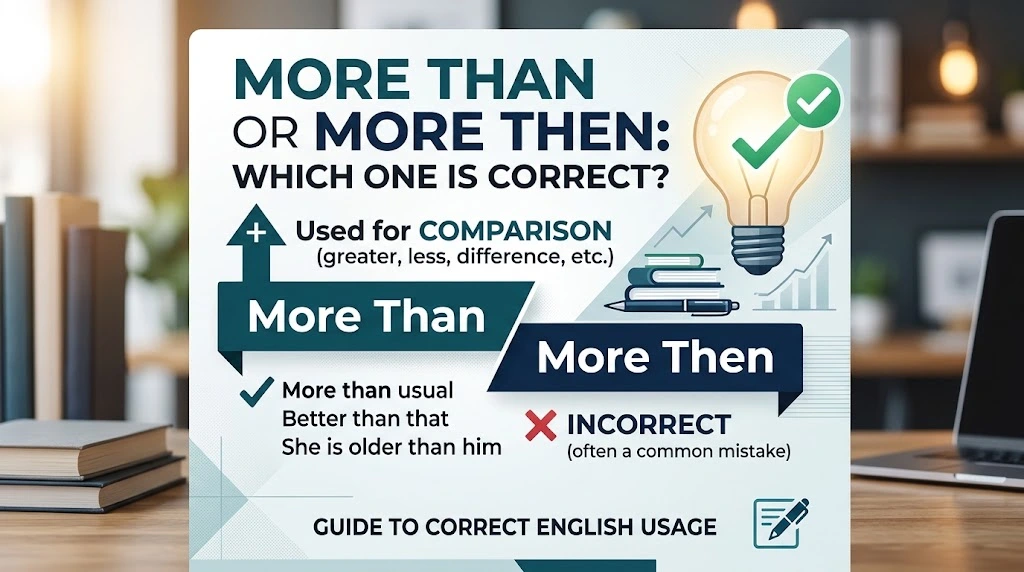
More than and more then look almost identical. They sound similar when spoken quickly, too. That small difference causes a surprisingly common writing mistake.
The correct phrase for comparisons, quantities, and degrees is more than.
For example:
She has more than 20 books.
This costs more than $50.
He is more than ready to help.
In each sentence, than introduces a comparison or expresses something beyond a particular amount or degree.
Then has a different job. It usually refers to time, sequence, or consequence:
We ate dinner, then watched a movie.
Back then, things were different.
If you finish your work, then you can leave.
The distinction becomes much easier once you connect than with comparison and then with time or sequence. This guide explains the difference in detail, shows common mistakes, and gives practical ways to choose the right word.
More Than or More Then: The Quick Answer
When you mean a greater amount, number, degree, or extent, use more than.
| Phrase | Correct? | Main use | Example |
| more than | Yes | Comparison, amount, degree | She owns more than 100 books. |
| more then | Usually no | Not a standard comparison phrase | ❌ She owns more then 100 books. |
| then | Yes | Time, sequence, consequence | We finished lunch, then left. |
| than | Yes | Comparison | This one is cheaper than that one. |
So if you’re writing “more than 50 people,” use than, not then.
A simple rule works in most situations:
If you’re comparing or exceeding an amount, choose “than.”
If you’re talking about what happens next or when something happened, choose “then.”
What Does “More Than” Mean?
More than indicates that something exceeds another amount, number, level, degree, or expectation.
The phrase can describe something concrete:
The store received more than 500 orders.
It can also describe something less tangible:
The experience was more than exciting.
The basic idea remains the same: something goes beyond a stated point.
More Than for quantities
You can use more than before a number or measurable amount.
Examples include:
- more than 10 miles
- more than 100 customers
- more than $500
- more than three hours
- more than 20 pages
- more than half the class
- more than enough food
Consider this sentence:
The concert attracted more than 10,000 people.
The phrase tells you that the attendance exceeded 10,000. It doesn’t necessarily tell you the exact number.
Likewise:
The repair took more than two hours.
The repair lasted longer than two hours.
More Than for comparisons
More than can also compare two things.
Sarah earns more than David.
This phone costs more than the older model.
The blue box weighs more than the red one.
Here, than introduces the thing being compared.
The pattern is straightforward:
more + adjective/adverb + than
For example:
This road is more dangerous than the old road.
She works more efficiently than I do.
The second option seems more practical than the first.
How “More Than” Works With Numbers
One of the most common uses of more than involves numbers.
You can place the phrase directly before a number when the actual amount exceeds that number.
Examples
More than 50 students attended the workshop.
The building is more than 100 years old.
He spent more than $200 on the equipment.
The journey took more than six hours.
More than 1,000 people visited the website.
In each case, than is correct because the sentence describes an amount exceeding a reference point.
“More than” doesn’t give an exact amount
If someone says:
The company sold more than 5,000 products.
That means the sales figure exceeded 5,000. It could be 5,001, 5,500, 6,000, or considerably higher.
This distinction matters in business reports, journalism, research, and everyday conversation.
Compare:
- Exactly 5,000 customers = the number is 5,000.
- At least 5,000 customers = 5,000 or more.
- More than 5,000 customers = above 5,000.
- Fewer than 5,000 customers = below 5,000.
Clear wording prevents readers from guessing what a number actually means.
More Than for Comparisons
The word than has a strong connection with comparison.
Whenever you compare one person, object, quantity, or situation with another, than often appears after a comparative expression.
For example:
My car is faster than yours.
This box is heavier than that one.
She is more experienced than her colleague.
Today’s weather is warmer than yesterday’s.
The same principle applies to more than.
This book has more pages than that one.
The new model uses more electricity than the old model.
He has more experience than I expected.
The phrase more than doesn’t change its spelling because the comparison involves a number, object, person, or abstract quality.
More Than as an Expression of Degree
Not every use of more than involves a simple mathematical comparison.
Sometimes the phrase means to a greater degree than expected or to an extent beyond something.
Consider:
She was more than happy to help.
This doesn’t necessarily mean someone compared her happiness with another person’s happiness. Instead, more than intensifies the statement.
Similarly:
The explanation was more than adequate.
He is more than capable of doing the job.
We have more than enough supplies.
The result was more than impressive.
These expressions communicate that something exceeds a particular level.
Common examples
More than enough means an amount greater than necessary.
We have more than enough food for everyone.
More than once means multiple times.
I’ve visited that museum more than once.
More than ever means to a greater extent than at any previous point.
People rely on online services more than ever.
More than likely means very likely.
She’s more than likely to arrive early.
More than willing means very willing.
I’m more than willing to explain the process.
These expressions appear frequently in everyday English.
More Than in Formal and Academic Writing
More than works naturally in formal writing because it provides precise comparisons and quantity statements.
You’ll see it in:
- academic papers
- business reports
- news articles
- government publications
- technical documents
- research summaries
- financial reports
- professional emails
For example:
The survey included more than 2,000 participants.
That’s concise and clear.
Another example:
The treatment reduced processing time by more than 30 percent.
Again, the phrase communicates that the result exceeded a stated threshold.
When precision matters, writers should avoid replacing a clear expression with vague language.
Compare:
The project cost a lot of money.
with:
The project cost more than $2 million.
The second sentence gives readers useful information.
More Then: Why Is It Usually Incorrect?
“More then” is not the standard phrase for expressing a comparison or an amount greater than something.
The confusion happens because than and then sound similar in many varieties of spoken English.
However, their meanings differ.
Use than for comparison:
She has more than five years of experience.
Use then for time or sequence:
She worked there for five years then moved to another company.
The first sentence compares an amount of experience with five years.
The second sentence describes what happened afterward.
Incorrect and correct examples
❌ He has more then 20 employees.
✅ He has more than 20 employees.
❌ This bag costs more then $100.
✅ This bag costs more than $100.
❌ She is more then capable of handling it.
✅ She is more than capable of handling it.
The mistake doesn’t change the intended meaning in most cases. Readers can usually understand what you meant. Still, standard written English requires than in these comparisons.
When “Then” Is Actually Correct
The fact that more then is usually wrong as a comparison doesn’t mean then is an incorrect word.
Far from it.
Then has several important uses.
Then for sequence
Use then when one action follows another.
First, wash the vegetables. Then, cut them into small pieces.
We had dinner and then went home.
She finished the report, then sent it to her manager.
The word tells the reader what happened next.
Then for time
Then can refer to a particular time, especially a time in the past or a previously mentioned period.
I was living in Chicago then.
Things were different back then.
The company was much smaller then.
Here, then refers to a time rather than a comparison.
Then for a consequence
You can also use then to show what follows from a condition.
If you’re ready, then we can begin.
If the price is too high, then choose another option.
If it rains, then we’ll stay inside.
In these sentences, then introduces the result or consequence.
Than vs. Then: The Key Difference
The easiest way to understand these words is to separate their jobs.
| Than | Then |
| Used for comparisons | Used for sequence |
| Indicates difference in amount or degree | Can refer to time |
| Often follows comparative words | Can indicate a consequence |
| More than 10 | First this, then that |
| Faster than me | Back then |
| Better than before | If so, then we’ll go |
Think of than as a comparison word.
Think of then as a time or sequence word.
That distinction handles most everyday cases.
More Than vs. More Then: Side-by-Side Examples
A quick comparison can make the difference obvious.
| Incorrect | Correct | Why |
| She has more then 10 dresses. | She has more than 10 dresses. | The sentence expresses quantity. |
| It costs more then $50. | It costs more than $50. | The price exceeds $50. |
| He is more then ready. | He is more than ready. | The phrase expresses degree. |
| We need more then five chairs. | We need more than five chairs. | The sentence describes quantity. |
| This is more expensive then that. | This is more expensive than that. | The sentence compares two things. |
| We ate, more than left. | We ate, then left. | “Then” shows sequence. |
| Back than, phones were different. | Back then, phones were different. | “Then” refers to a past time. |
The last two examples show why replacing every occurrence of then with than would create a different problem.
You need to understand the meaning, not simply memorize a spelling swap.
How to Remember Than vs. Then
A simple memory trick can save you from repeated mistakes.
Remember “than” for comparison
Words such as these often signal comparison:
- more than
- less than
- greater than
- smaller than
- faster than
- slower than
- older than
- younger than
- better than
- worse than
For example:
My new laptop is faster than my old one.
The sentence compares two laptops.
Remember “then” for sequence
Think about a timeline:
First → Then → Next → Finally
For example:
First, we checked the address. Then, we called the customer.
The word then moves the reader forward through events.
A compact memory rule
Than compares. Then proceeds.
It’s not a complete grammar rule for every possible sentence, but it’s a useful practical reminder.
More Than vs. Over
Writers sometimes wonder whether more than or over should come before a number.
Both appear widely in modern English.
For example:
More than 500 people attended.
Over 500 people attended.
Both sentences communicate that the number exceeded 500.
Traditional style guides have sometimes preferred more than for quantities and reserved over for physical position. Modern usage doesn’t consistently maintain that distinction.
For example:
The plane flew over the city.
Here, over clearly describes physical position.
But:
Over 500 people attended.
Here, over means more than 500.
If you want the clearest choice for a comparison involving a number, more than is straightforward and widely understood.
More Than vs. Greater Than
More than and greater than can overlap, but they aren’t interchangeable in every situation.
More than is common in ordinary English:
She has more than 10 years of experience.
Greater than sounds more technical and often appears in mathematics, statistics, science, and formal analysis.
For example:
The measured value is greater than 10.
In mathematics, the symbol > means greater than.
So:
8 > 5
means:
8 is greater than 5.
In everyday conversation, however, people commonly say:
8 is more than 5.
The context determines which expression sounds most natural.
Common Mistakes With “More Than”
Even when writers know that than is correct, other problems can appear.
Mistake: Writing “more then”
This is the central spelling error.
❌ The package weighs more then 10 pounds.
✅ The package weighs more than 10 pounds.
Mistake: Confusing “than” with “then”
This mistake often occurs because the words sound similar.
Proofreading helps, especially when writing quickly.
Mistake: Using vague quantities
Compare:
The event attracted a lot of people.
with:
The event attracted more than 3,000 people.
The second version gives readers a useful reference point.
Mistake: Creating an unclear comparison
Consider:
The new system is better than before.
The sentence is understandable, but before doesn’t identify exactly what you’re comparing.
A clearer version might be:
The new system is faster than the previous version.
Specific comparisons reduce ambiguity.
Common Expressions With “More Than”
You’ll encounter more than in many fixed or familiar expressions.
More than enough
We have more than enough time.
Meaning: We have plenty of time.
More than once
She has visited the museum more than once.
Meaning: She visited it multiple times.
More than ever
Customers expect faster service more than ever.
Meaning: The expectation is stronger now than previously.
More than anything
He wanted to help more than anything.
Meaning: Helping was his strongest desire.
More than likely
The meeting will more than likely finish early.
Meaning: It is very likely.
More than willing
The team is more than willing to help.
Meaning: The team is very willing.
More than happy
We’re more than happy to answer questions.
Meaning: We’re very willing or pleased to do so.
These expressions are common in both conversational and professional English.
A Practical Grammar Test for “Than” or “Then”
When you’re unsure, don’t stare at the spelling. Test the meaning.
Ask yourself:
Is the sentence comparing two things?
If yes, than is probably correct.
This car is faster than that one.
Is the sentence describing what happens next?
If yes, use then.
We finished the meeting and then went home.
Does the sentence refer to a past or future time?
Use then.
I didn’t know anyone then.
Does the sentence describe an amount exceeding a number?
Use than.
There were more than 100 guests.
Does the sentence express a consequence?
Use then.
If you agree, then we can proceed.
This quick test takes only a few seconds.
Case Study: Fixing “More Then” in Everyday Writing
Imagine a small business owner writing this sentence for a product description:
This fabric lasts more then five years with proper care.
The intended meaning is clear. The writer wants to say that the fabric can last beyond five years.
The corrected version is:
This fabric lasts more than five years with proper care.
Why?
Because five years provides a reference point. The sentence says the lifespan exceeds that point.
Now consider a different sentence:
We inspected the fabric and then packed it.
Here, then is correct because the sentence describes two actions in sequence:
- We inspected the fabric.
- We packed it afterward.
The two words may look similar, but their grammatical jobs are completely different.
Case Study: A Comparison in Professional Writing
Suppose a company reports:
The updated process takes less time than the old process.
Here, than introduces the comparison.
Now change the sentence:
The team tested the process and then approved it.
The meaning changes completely.
The first sentence compares time requirements.
The second sentence describes sequence.
This distinction becomes especially important in technical documentation because a single incorrect word can make instructions less precise.
“More Than” at the Beginning of a Sentence
You can begin a sentence with more than.
For example:
More than 500 customers visited the store last month.
This structure is grammatically normal.
You can also write:
More than half of the team supported the proposal.
Or:
More than 20 years ago, the company opened its first location.
Notice that the last example still uses than even though it refers to time.
The phrase more than 20 years describes an amount of elapsed time. It doesn’t turn into more then simply because time is involved.
That’s an important distinction.
Is “More Then” Ever Correct?
The exact sequence “more then” can theoretically appear when more and then belong to separate grammatical functions. However, it isn’t the standard way to express the common idea of “more than.”
For example, a sentence might contain more and then separately:
If you need more, then ask for another copy.
Here, both words are correct.
More means an additional amount.
Then introduces what should happen next or what follows from the condition.
But this is fundamentally different from:
❌ She needs more then five copies.
The intended comparison is more than five copies.
This distinction matters because the problem isn’t that then is always wrong after more. The issue is whether the sentence requires a comparison or a sequence marker.
More Than or More Then in Text Messages and Social Media
The mistake appears frequently in informal digital writing.
Why?
Because than and then are pronounced similarly in many accents. People also type quickly on phones and keyboards.
A rushed message might say:
I waited more then an hour.
The intended sentence is:
I waited more than an hour.
Texting may tolerate small errors that formal writing shouldn’t.
If you’re writing a resume, article, report, school assignment, business email, product description, or website copy, proofread these words carefully.
A two-second check can remove an obvious error.
More Than or More Then: Frequently Asked Questions
Is “more than” always correct?
More than is correct when you mean a greater amount, number, degree, or extent.
The store has more than 200 products.
Is “more then” grammatically correct?
Not when then is being used as a replacement for than in a comparison.
❌ More then 100 people attended.
✅ More than 100 people attended.
What’s the easiest way to remember the difference?
Remember:
Than = comparison.
Then = time, sequence, or consequence.
Is “than” only used after “more”?
No.
You can use than with many comparative structures:
- better than
- worse than
- faster than
- slower than
- less than
- greater than
- smaller than
- older than
- younger than
For example:
This route is shorter than the other one.
Can “then” refer to the past?
Yes.
Back then, we didn’t have smartphones.
Here, then refers to a particular time.
Can “more than” refer to time?
Yes.
The project took more than three months.
The phrase expresses an amount of elapsed time.
Is “over 100” the same as “more than 100”?
In many modern contexts, yes.
More than 100 people attended.
Over 100 people attended.
Both commonly mean that the attendance exceeded 100.
Is “more than enough” correct?
Yes.
We have more than enough supplies.
It means the available amount exceeds what is necessary.
Is “more than once” correct?
Yes.
I’ve read that book more than once.
It means the action happened at least twice.
Should formal writing use “more than” instead of “over”?
More than is a clear choice when expressing an amount that exceeds a number. Modern English also widely uses over in this context.
More Than or More Then: A Quick Reference
Keep this table handy when proofreading.
| If you mean… | Use | Example |
| A larger quantity | than | More than 50 people |
| A higher degree | than | More than enough |
| A comparison | than | Better than before |
| A greater amount of time | than | More than two hours |
| What happens next | then | Eat, then leave |
| A past time | then | Back then |
| A consequence | then | If so, then go |
| A sequence | then | First this, then that |
The key isn’t memorizing a long list.
It’s recognizing the role each word plays.
A Simple Editing Checklist
Before publishing or submitting your writing, scan for than and then.
Ask these questions:
- Does than introduce a comparison?
- Does more than describe an amount above a number?
- Does then describe what happens next?
- Does then refer to a particular time?
- Does then introduce a consequence?
- Did you accidentally type more then when you meant more than?
This small proofreading habit catches the error quickly.
The Bottom Line: More Than or More Then?
When you’re choosing between more than and more then, focus on meaning rather than pronunciation.
Use more than when you mean a greater amount, number, degree, or extent:
She has more than 10 years of experience.
The box weighs more than 20 pounds.
We received more than 500 orders.
Use then when you mean afterward, at that time, next, or as a consequence:
We finished dinner and then went home.
Things were different then.
If you’re ready, then let’s begin.
The easiest reminder is simple:
Than compares. Then proceeds.
Once you connect each word to its job, “more than or more then” stops being a tricky spelling question. The correct choice becomes almost automatic.
