

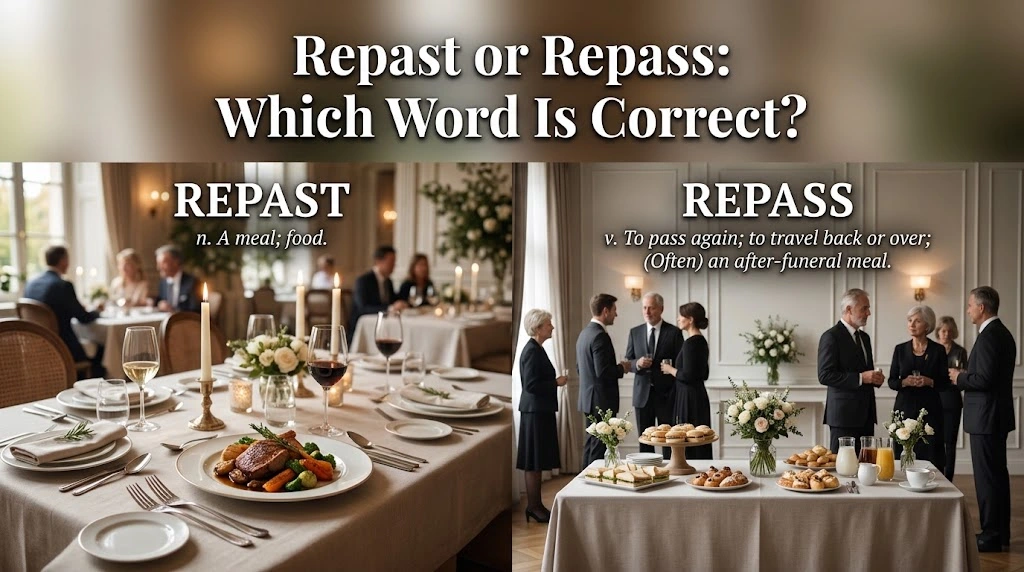
Repast or repass? These two words look remarkably similar, but they don’t mean the same thing. If you’re writing about food, a meal, or a formal gathering around food, repast is usually the word you want. If you’re describing someone passing through a place again, repass is the correct verb.
That one-letter difference matters.
The confusion often starts when someone hears repast instead of seeing it written. Because the pronunciation can resemble repass, the spelling isn’t always obvious. The problem becomes even trickier because both words are legitimate English terms.
The key is simple:
Repast = a meal.
Repass = to pass again.
Once you connect each spelling with its meaning, the distinction becomes much easier to remember.
Repast vs. Repass: The Quick Answer
Repast is a noun meaning a meal or an occasion of eating. The word often sounds more formal, literary, or old-fashioned than the everyday word meal.
Repass is a verb meaning to pass again. It can describe physically passing through a place, crossing something again, or moving past a particular point another time.
| Word | Part of speech | Main meaning | Example |
| Repast | Noun | A meal | “The guests enjoyed a hearty repast.” |
| Repass | Verb | To pass again | “They had to repass the checkpoint.” |
| Meal | Noun | Food eaten at a particular time | “We had a late meal.” |
| Pass again | Verb phrase | Move through or across again | “She had to pass through the gate again.” |
So, if you’re asking “repast or repass?”, don’t treat them as alternative spellings.
They represent two different words with two different meanings.
The easiest way to remember them
Think of the T in repast as part of the word’s connection to eating and a repast being something you sit down to enjoy.
For repass, focus on pass. The word literally contains pass, with re- indicating repetition.
Re + pass = pass again.
What Does “Repast” Mean?
Repast means a meal or an occasion when food is eaten.
It functions primarily as a noun. You can use it to describe breakfast, lunch, dinner, or another organized meal, although its tone often feels more formal than ordinary words such as meal or dinner.
For example:
“The travelers stopped at the inn for a warm repast.”
The sentence simply means that the travelers stopped for a meal.
However, repast adds a particular tone. It can make the meal sound formal, substantial, traditional, or literary.
Compare these sentences:
- “We had a meal after the meeting.”
- “We enjoyed a repast after the meeting.”
Both sentences can describe the same basic event. The second sounds considerably more formal.
Repast as a noun
The noun repast can refer to the food itself, the meal as an event, or the occasion of eating.
Consider these examples:
- “The family gathered for an evening repast.”
- “The travelers shared a simple repast.”
- “A generous repast awaited the guests.”
- “After the ceremony, everyone gathered for a repast.”
The word doesn’t automatically mean an extravagant feast.
That’s an important distinction.
A repast can be simple or elaborate. Context determines the character of the meal.
Is repast still used today?
Yes. Repast remains an English word, but it isn’t usually the first choice in casual American conversation.
Most people would naturally say:
“We had dinner at seven.”
They probably wouldn’t say:
“We had a repast at seven.”
That doesn’t make repast incorrect. It simply gives the sentence a different register.
You’ll encounter repast more readily in:
- Literary writing
- Historical descriptions
- Formal prose
- Religious contexts
- Descriptions of ceremonies
- Formal event descriptions
- Older texts
- Writing that deliberately uses elevated language
If you’re writing a casual text message, meal will usually sound more natural.
If you’re describing a ceremonial gathering in a historical novel, repast may fit beautifully.
Is “Repast” a Formal or Old-Fashioned Word?
Repast isn’t obsolete, but it can sound formal or somewhat old-fashioned.
That distinction matters.
An obsolete word has essentially disappeared from normal use. Repast hasn’t disappeared. Dictionaries still recognize it, and writers still use it.
However, everyday English has simpler alternatives.
Imagine someone saying:
“What did you have for your repast?”
That sounds noticeably more formal than:
“What did you have for dinner?”
The meaning remains understandable. The tone changes.
Why does repast sound formal?
English has accumulated many words from different historical periods and languages. Some survived in everyday speech while others became more common in formal or literary settings.
Meal became the ordinary everyday term.
Repast retained a more elevated flavor.
This is similar to the difference between:
- commence and start
- purchase and buy
- reside and live
- depart and leave
The more formal word isn’t necessarily better. It simply creates a different effect.
When should you use repast?
Use repast when its tone serves your writing.
It can work particularly well when you’re describing:
- A traditional gathering
- A formal dinner
- A historical scene
- A ceremonial meal
- A literary setting
- A substantial shared meal
For ordinary conversation, meal will usually be clearer and more natural.
What Does “Repass” Mean?
Repass is a verb meaning to pass again.
The word combines the prefix re-, meaning again, with pass.
So the basic construction is straightforward:
re + pass = pass again
For example:
“The hikers had to repass the same bridge on their way back.”
They crossed or passed the bridge again.
The meaning has nothing to do with food.
That’s the crucial difference between repass and repast.
How “Repass” Works in a Sentence
Because repass functions as a verb, it describes an action.
Examples include:
- “The driver had to repass the checkpoint.”
- “We may repass this location later.”
- “The travelers repassed the village on their return.”
- “She didn’t want to repass the narrow trail.”
- “The runners repassed the starting point.”
The exact situation varies, but the central idea stays the same:
Someone passes something again.
Why does repass sometimes feel unusual?
There’s a good reason.
In everyday American English, people often choose the phrase pass again instead.
For example:
“We had to pass the building again.”
That sounds more natural to many speakers than:
“We had to repass the building.”
Both can communicate repeated passage, but repass has a more specialized or formal feel in many contexts.
You may encounter it more often in formal writing, technical descriptions, historical prose, or contexts where concise wording matters.
Repast vs. Repass: Meaning and Usage Compared
The difference becomes much clearer when the words sit side by side.
| Feature | Repast | Repass |
| Word type | Noun | Verb |
| Core meaning | A meal | Pass again |
| Related everyday word | Meal | Pass again |
| Food-related? | Yes | No |
| Describes an action? | Usually no | Yes |
| Common in casual speech? | Less common | Less common |
| Typical tone | Formal or literary | Formal or specialized |
| Example | “They shared a repast.” | “They repassed the gate.” |
Now look at the difference in complete sentences:
The guests enjoyed a repast after the ceremony.
The guests ate a meal.
The guests had to repass the gate after leaving.
The guests passed through the gate again.
One letter changes the meaning completely.
Repast vs. Repass Pronunciation
Spelling causes much of the confusion, but pronunciation can contribute too.
Repast is commonly pronounced with the final syllable sounding like “past.”
Repass ends with the sound found in “pass.”
The exact pronunciation can vary somewhat by speaker and dialect, but the important distinction remains the final consonant sound.
A useful mental comparison is:
- repast → past
- repass → pass
That gives you another memory aid.
Why hearing the word creates confusion
Suppose someone hears a sentence containing repast without seeing it written.
They might think:
“Did that person say repass?”
That’s understandable. The words are visually similar and both contain the re- beginning.
This is especially likely when the speaker uses repast in a formal setting. Someone unfamiliar with the word may automatically connect it with the much more familiar verb pass.
The spelling becomes easier once the meaning is known.
Repast vs. Repass as Different Parts of Speech
Grammar provides another useful way to separate these words.
Repast is generally a noun.
Repass is a verb.
That distinction can help you identify the correct spelling even when you’re unsure.
Consider:
“The family prepared a ___ for their guests.”
You need a noun because the blank names something being prepared.
The answer is:
repast
Now consider:
“The travelers had to ___ the bridge.”
You need a verb because the blank describes an action.
The answer is:
repass
This simple grammar test won’t solve every possible sentence, but it works in many ordinary cases.
Repast: Example Sentences
Seeing a word in context often teaches more than a dictionary definition.
Here are several examples showing how repast works naturally.
Formal meal
“The hosts prepared an elegant repast for their visitors.”
Here, repast refers to the meal being served.
Family gathering
“The family gathered around the table for their evening repast.”
The word gives the sentence a somewhat formal or literary tone.
Historical setting
“After a long journey, the travelers stopped for a modest repast.”
The word fits the historical atmosphere.
Ceremony
“A communal repast followed the afternoon ceremony.”
This describes a shared meal after an event.
Literary description
“The weary travelers welcomed the warm repast waiting at the inn.”
The elevated vocabulary works naturally with the descriptive style.
Simple meal
“Their repast consisted of bread, fruit, and hot tea.”
Notice that repast doesn’t require an extravagant meal.
It can describe something very simple.
Repass: Example Sentences
Now compare those examples with sentences containing repass.
Passing through a gate again
“The travelers had to repass the gate before reaching the village.”
They passed through the gate another time.
Returning along a road
“On the way home, they repassed the same road.”
The action happened again during the return journey.
Crossing a bridge again
“The group would repass the bridge before sunset.”
Again, the word describes repeated movement.
Passing a checkpoint
“The driver had to repass the checkpoint after taking the wrong turn.”
The driver passed the checkpoint another time.
Repeated movement
“The procession would repass the square later that evening.”
The procession would pass through the square again.
The pattern remains consistent.
Repass describes repeated passage.
Common Confusion: Why Do People Write “Repass” When They Mean “Repast”?
The most common reason is simple: they’ve heard the word rather than read it.
English contains many words whose spelling isn’t immediately obvious from pronunciation. Repast creates an additional problem because repass is already a familiar-looking word.
Someone might hear:
“The guests gathered for a repast.”
Without knowing the vocabulary, they may assume the speaker said repass.
There’s another source of confusion, too.
People recognize pass as a common English word. They may therefore instinctively assume that repass is the appropriate spelling whenever they encounter the unfamiliar sound.
That reasoning makes sense on the surface.
It just leads to the wrong word when the intended meaning is meal.
The meaning test
When you’re unsure, don’t rely on sound.
Ask:
Is the sentence talking about food or eating?
If yes, repast is likely correct.
Is the sentence talking about passing through or across something again?
If yes, repass is likely correct.
That two-question test handles most cases.
“Repast” vs. “Meal,” “Feast,” and “Banquet”
Although repast means a meal, it isn’t interchangeable with every food-related word in every context.
The differences are mostly about meaning, scale, and tone.
| Word | Basic meaning | Typical tone or implication |
| Meal | Food eaten at a particular time | Neutral and everyday |
| Repast | A meal or occasion of eating | Formal, literary, or traditional |
| Feast | A large or special meal | Abundant, celebratory, or ceremonial |
| Banquet | A formal, often large meal | Highly organized or ceremonial |
| Dinner | A main meal, often evening | Everyday and common |
For example:
“We had a meal after work.”
This sounds completely ordinary.
“We enjoyed a repast after the ceremony.”
This sounds more formal.
“The wedding featured a lavish feast.”
This emphasizes abundance and celebration.
“The organization hosted a formal banquet.”
This emphasizes the organized event.
These words overlap, but their shades of meaning aren’t identical.
“Repass” vs. “Revisit,” “Return,” and “Pass Again”
Repass also overlaps with other expressions, but the differences matter.
| Expression | Main idea |
| Repass | Pass through or past something again |
| Pass again | Move past or through something another time |
| Revisit | Visit a place, idea, or subject again |
| Return | Go back to a previous place or state |
Consider these examples.
“We repassed the old bridge.”
The focus is on passing the bridge again.
“We revisited the old town.”
The focus is on visiting the town again.
“We returned to the old town.”
The focus is on going back.
The words can describe related situations without being exact substitutes.
Repass has a narrower action
If you want to emphasize the act of passing something again, repass can express that idea compactly.
However, pass again may sound more natural in everyday American English.
That’s an important point for writers.
Correct doesn’t always mean common.
A grammatically valid word can still sound unusual in casual conversation.
Can “Repast” Be Used as a Verb?
For contemporary standard English, repast is primarily used as a noun meaning a meal.
If you’re writing ordinary modern American English, use it as a noun.
For example:
“They enjoyed a repast.”
That’s straightforward.
You shouldn’t assume that because English has many noun-to-verb conversions, repast automatically works as an everyday verb.
If your intended meaning is eat, dine, or have a meal, choose the verb that actually expresses your meaning.
Why this matters
English contains historical and specialized usages that don’t necessarily belong in modern everyday writing.
When you’re writing for a broad audience, the clearest option usually wins.
Instead of forcing an unusual form of repast, write:
- “They ate together.”
- “They shared a meal.”
- “They dined together.”
Those choices immediately communicate the intended action.
Can “Repass” Be Used as a Noun?
Repass is principally a verb.
Its core function is to describe passing again.
For example:
“They repassed the checkpoint.”
Here, repassed is the past-tense form of the verb repass.
Don’t confuse that grammatical form with the noun repast.
This distinction becomes especially important when you’re proofreading because the two words can look almost interchangeable at a glance.
A quick grammar check can expose the mistake.
If the sentence needs something that names a meal, repast is the candidate.
If it needs an action involving passing again, repass may fit.
Repast or Repass in American English
In contemporary US English, meal is far more common in everyday speech than repast.
You’d normally hear:
“Let’s grab a meal.”
rather than:
“Let’s share a repast.”
The second version isn’t inherently wrong. It simply sounds more formal, literary, or stylized.
Likewise, many speakers would naturally say:
“We had to pass the gate again.”
instead of:
“We had to repass the gate.”
That makes repass less familiar to many readers too.
What should American writers choose?
Choose based on your context.
Use repast when:
- You want a formal tone.
- You’re writing literary prose.
- You’re describing a traditional meal.
- You’re discussing historical settings.
- You want a deliberate elevated style.
Use repass when:
- You specifically mean “pass again.”
- You’re describing repeated movement.
- The context calls for that concise verb.
If a simpler expression sounds better, use it.
Clear writing doesn’t require impressive vocabulary.
Repast or Repass in British English
The fundamental distinction remains the same in British English:
repast refers to a meal.
repass refers to passing again.
English varieties can differ in vocabulary preferences, pronunciation, and frequency of use. However, that doesn’t turn these two spellings into regional alternatives.
A British writer discussing a formal meal can use repast.
A British writer describing someone passing through a location again can use repass.
The central meanings remain separate.
Etymology: Where Did “Repast” Come From?
The history of repast helps explain why it has such a distinctive feel.
The word entered English through French and ultimately traces back to Latin roots associated with food and eating.
Its historical development connects it with the idea of a meal or refreshment.
That background also helps explain why repast has a more literary character today. English inherited many words through French after the Norman Conquest, while other everyday terms developed through Old English and Germanic roots.
Compare the feel of these words:
- meal
- food
- eat
- repast
The first three are deeply familiar in ordinary speech.
Repast carries more historical and literary weight.
That doesn’t make it superior. It simply reflects a different path through the history of English.
Etymology: Where Did “Repass” Come From?
Repass has a much more transparent structure.
The prefix re- commonly means again or back, while pass means to move past, through, or across something.
Put them together:
re + pass = pass again
This kind of construction is common in English.
Consider:
- rebuild = build again
- rewrite = write again
- reopen = open again
- revisit = visit again
- repass = pass again
The structure makes repass relatively easy to understand once you know the prefix.
Unlike repast, its meaning isn’t connected with eating.
A Simple Memory Trick for Repast vs. Repass
Here’s the fastest way to keep the two words apart.
Think about food
If you’re talking about eating, choose:
REPAST
The T helps you remember the word as the noun for a meal.
“They enjoyed a repast.”
Think about movement
If you’re talking about passing again, choose:
REPASS
The word literally contains PASS.
“They repassed the gate.”
So remember:
Repast = meal.
Repass = pass again.
That’s all you need in most situations.
Repast or Repass: Common Mistakes to Avoid
These mistakes are easy to make when the writer knows the meaning but not the spelling.
Mistake: “The guests enjoyed a repass.”
If the intended meaning is a meal, use:
“The guests enjoyed a repast.”
Mistake: “They had to repast the bridge.”
If the intended meaning is passing over the bridge again, use:
“They had to repass the bridge.”
Mistake: Treating them as alternate spellings
They aren’t.
Repast and repass are separate words.
Mistake: Assuming “repass” relates to food
The visible pass can be misleading.
Repass means passing again. It doesn’t mean eating again.
Mistake: Using repast in casual writing unnecessarily
You can use it correctly while still making your sentence sound unnatural.
Instead of:
“We went out for a repast.”
Most everyday readers would find this more natural:
“We went out for a meal.”
Context should guide vocabulary.
Repast vs. Repass in Real-World Writing
The right choice often depends on the type of writing you’re producing.
In casual conversation
Use meal more often than repast.
“We had a great meal.”
It’s simple and natural.
In historical fiction
Repast may work well.
“After the long march, the soldiers sat down for a humble repast.”
The vocabulary reinforces the historical atmosphere.
In formal event writing
Repast can also fit.
“Guests gathered for a communal repast following the ceremony.”
In travel descriptions
Either word may appear depending on the intended meaning.
“The travelers stopped for a repast.”
They stopped to eat.
“The travelers repassed the village.”
They passed the village again.
In technical or formal descriptions
Repass can describe repeated movement or passage.
“The vehicle must repass the inspection point.”
Here, the word clearly describes an action.
A Practical Case Study: One Letter, Two Completely Different Meanings
Consider a fictional travel story.
A group of hikers leaves a mountain village in the morning. Before departing, they eat breakfast at a small inn. Later, they return along the same trail.
You could write:
“The hikers stopped at the inn for a hearty repast.”
That tells readers they ate a meal.
Later:
“On their return, the hikers repassed the stone bridge.”
That tells readers they crossed or passed the bridge again.
Now imagine swapping the words:
“The hikers stopped at the inn for a hearty repass.”
The sentence no longer expresses the intended meaning.
And:
“The hikers repasted the stone bridge.”
That doesn’t communicate the intended action either.
The two words don’t trade places.
They belong to different semantic lanes.
Why Context Matters More Than Spelling
When two words look similar, writers often focus too heavily on their letters.
Meaning should come first.
Ask what the sentence is actually describing.
If the sentence involves:
- Eating
- Food
- Dinner
- Guests at a table
- A meal after an event
then repast may be appropriate.
If it involves:
- Walking through a location
- Crossing a road
- Passing a checkpoint
- Moving past a building
- Going through a gate again
then repass may fit.
This approach works because vocabulary is fundamentally about meaning.
Spelling simply records that meaning on the page.
Quick Comparison: Repast vs. Repass
| Question | Repast | Repass |
| What does it mean? | A meal | To pass again |
| Is it food-related? | Yes | No |
| Is it usually a noun? | Yes | No |
| Is it usually a verb? | No | Yes |
| Does it contain “pass”? | No | Yes |
| Does it sound formal? | Often | Sometimes |
| Is it common in casual speech? | Not especially | Not especially |
| Everyday alternative | Meal | Pass again |
| Example | “They shared a repast.” | “They repassed the bridge.” |
Repast vs. Repass: Frequently Asked Questions
Is “repast” the correct word for a meal?
Yes. Repast is a noun meaning a meal or an occasion of eating. It often has a formal, literary, or somewhat old-fashioned tone.
Is “repass” a word?
Yes. Repass is a verb meaning to pass again. It can describe moving through or past something another time.
Are repast and repass interchangeable?
No. They have different meanings and grammatical functions.
Does repast mean a large meal?
Not necessarily. A repast can be simple or elaborate. The word primarily means a meal, while context determines its size or character.
Is repast commonly used in everyday American English?
It’s recognized and correct, but meal is much more common in ordinary conversation.
Does repass mean to eat again?
No. Repass relates to passing again, not eating again.
Which word should you use for a formal meal?
Repast can work well when you want a formal or literary tone. However, meal, dinner, feast, or banquet may be more precise depending on the context.
Is “pass again” more natural than “repass”?
Often, yes, particularly in everyday American English. Both can express repeated passage, but pass again may sound more conversational.
How can you remember the difference?
Remember:
Repast = meal.
Repass = pass again.
The word repass visibly contains pass, which makes its meaning easier to connect with movement.
Final Answer: Repast or Repass?
The correct choice depends entirely on what you mean.
Use repast when you’re talking about a meal:
“The guests enjoyed a formal repast after the ceremony.”
Use repass when you’re talking about passing something again:
“The travelers had to repass the bridge.”
They may look almost identical, but they’re not spelling variants.
Repast is a noun associated with eating.
Repass is a verb associated with repeated movement.
For everyday American writing, meal will usually sound more natural than repast. Likewise, pass again may sound more conversational than repass. Still, both repast and repass have legitimate uses when their meanings fit the sentence.
When the spelling slips your mind, don’t guess from sound. Look at the meaning first.
If the sentence involves food, choose repast.
If it involves passing again, choose repass.
That single distinction keeps these two easily confused words firmly in their proper lanes.
