

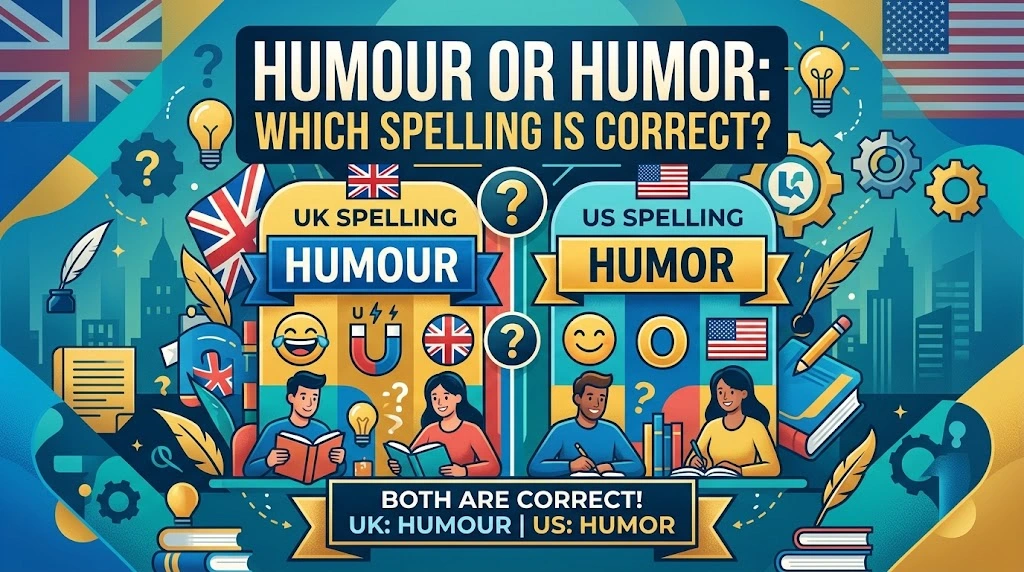
Humour or humor? If you’ve ever switched between British and American English, you’ve probably noticed this small spelling difference.
Both words mean the same thing. Both describe amusement, wit, comedy, or the quality of being funny. The only real difference is the spelling convention used by different varieties of English.
Humor is the standard spelling in American English.
Humour is the standard spelling in British English and is also used in several other English varieties that generally follow British spelling conventions.
So, neither spelling is simply “wrong.” The right choice depends on which variety of English you’re writing and who will read your work.
This distinction matters more than it might seem. If you’re writing for an American audience, humor will look natural. If you’re writing for a British audience, humour is expected. Mixing the two can make your writing look inconsistent.
Let’s take a closer look at the difference, including pronunciation, history, related words, examples, and practical usage.
Humor vs. Humour at a Glance
The quickest way to understand the difference is to put the two spellings side by side.
| Feature | Humor | Humour |
| Primary variety | American English | British English |
| Meaning | Amusement, comedy, wit, or a funny quality | Amusement, comedy, wit, or a funny quality |
| Pronunciation | Generally the same | Generally the same |
| American usage | Standard | Usually not used |
| British usage | Usually not preferred | Standard |
| Canadian usage | Both can appear depending on style | Both can appear depending on style |
| Australian English | Less common | Standard |
| Adjective | Humorous | Humorous |
| Person who writes or performs humor | Humorist | Humourist |
| Opposite-style adjective | Humorless | Humourless |
The important point is simple:
American English generally uses “humor,” while British English generally uses “humour.”
The meaning doesn’t change.
Is Humor or Humour Correct?
Both humor and humour are correct spellings.
However, they’re not normally interchangeable within a particular style of English.
American English uses humor:
She has a great sense of humor.
British English uses humour:
She has a great sense of humour.
The meaning remains identical.
This works much like other spelling differences between American and British English:
- color vs. colour
- favor vs. favour
- labor vs. labour
- honor vs. honour
- neighbor vs. neighbour
- behavior vs. behaviour
The difference isn’t about intelligence, correctness, or pronunciation. It’s a matter of regional spelling convention.
If you’re writing in American English, choose humor. If you’re following British English conventions, choose humour.
What Does Humor Mean?
Before examining the spelling, it’s useful to understand the word itself.
Humor or humour can refer to the quality of something that makes people laugh or feel amused.
For example:
His dry humor made everyone laugh.
The word can also describe someone’s ability to recognize or create something funny:
She has an excellent sense of humor.
It can describe a particular style of comedy:
His humor is sarcastic and understated.
The word also appears in phrases involving mood or temperament:
He was in a good humor.
Historically, however, humor had meanings that went far beyond comedy.
The older medical sense referred to bodily fluids believed to influence health and temperament. That historical meaning helped shape the development of the modern word.
Today, everyday English overwhelmingly associates the word with comedy, amusement, wit, and temperament.
Why Does American English Spell It “Humor”?
The missing u isn’t a random American invention.
American spelling developed its own conventions over time. Several American writers and dictionary makers helped establish spelling practices that differed from traditional British forms.
One particularly influential figure was Noah Webster, whose dictionaries promoted spelling patterns that became strongly associated with American English.
Webster favored forms such as:
- color instead of colour
- favor instead of favour
- honor instead of honour
- labor instead of labour
The same general pattern applies to humor.
The American spelling removes the u that appears in the British form.
That doesn’t mean Americans invented a completely new word. The two spellings developed from the same linguistic history.
In other words, humor and humour are regional spellings of the same word.
Why Does British English Spell It “Humour”?
British English traditionally retains the u in words ending with this spelling pattern.
Thus, British writers use:
- humour
- colour
- favour
- honour
- labour
- neighbour
These spellings reflect historical French influence on English vocabulary and long-established British spelling conventions.
The spelling humour has remained standard in British English.
You’ll see it in British newspapers, books, government publications, academic writing, websites, and everyday communication.
For example:
The comedian’s sense of humour appealed to the audience.
A British reader wouldn’t normally consider humour unusual. It’s the expected spelling.
Humor or Humour in American English
If you’re writing specifically for an American audience, humor is the natural choice.
This applies across almost every type of writing.
Everyday writing
He has a strange sense of humor.
Business writing
The campaign uses humor to connect with younger customers.
Academic writing
Humor can influence how audiences respond to advertising.
Journalism
The actor is known for his sharp sense of humor.
Fiction
She used humor to lighten the tense conversation.
American dictionaries such as Merriam-Webster list humor as the standard American spelling.
If the target audience lives primarily in the United States, there’s little reason to switch to humour.
Humour or Humor in British English
British English generally uses humour.
You’ll encounter it in formal and informal writing alike.
For example:
The novel combines dark humour with social commentary.
Another example:
His sense of humour helped him handle the awkward situation.
British publications also use the spelling in compounds and related expressions:
- sense of humour
- British humour
- dry humour
- dark humour
- black humour
- toilet humour
- self-deprecating humour
If you’re writing for readers in the United Kingdom, humour is normally the appropriate form.
Does Humor or Humour Change the Pronunciation?
Generally, no.
The u changes the spelling but doesn’t normally create a different pronunciation.
In both American and British English, the word is commonly pronounced approximately like:
HYOO-mər
There can be small pronunciation differences depending on the speaker’s accent. Those differences aren’t caused by the spelling distinction itself.
For example, a British speaker and an American speaker may pronounce the word somewhat differently because of their accents. However, the distinction isn’t equivalent to having two separate words.
Think of it like color and colour. The extra letter doesn’t create a different spoken word.
A simple pronunciation guide
| Spelling | Approximate pronunciation |
| humor | HYOO-mər |
| humour | HYOO-mə |
The final sound may vary according to accent, especially in non-rhotic British varieties.
The key takeaway remains straightforward:
The spelling changes. The basic word and meaning don’t.
The History of Humor and Humour
The story gets more interesting when you look beyond modern spelling.
The English word ultimately traces back through French and Latin.
The Latin word humor meant moisture or fluid. In medieval and early modern medicine, humors referred to bodily fluids that were believed to influence health and temperament.
The traditional four humors were:
- blood
- phlegm
- yellow bile
- black bile
Ancient and medieval medical theories associated different balances of these fluids with different physical and emotional characteristics.
That older meaning eventually connected the word with mood and temperament.
Over centuries, the meaning developed further. The word became associated with someone’s disposition, particularly a tendency toward amusement or a particular way of seeing things.
Eventually, the modern sense of humor/humour as something funny or amusing became dominant.
So the word’s journey is surprisingly long:
Latin → French → Middle English → Modern English
The spelling differences emerged as English spelling conventions developed on both sides of the Atlantic.
Humor vs. Humour and the American-British Spelling Divide
The difference makes more sense when you look at the larger pattern.
American and British English share the same language, but they don’t always share the same spelling conventions.
Consider these examples:
| American English | British English |
| humor | humour |
| color | colour |
| favor | favour |
| honor | honour |
| labor | labour |
| neighbor | neighbour |
| behavior | behaviour |
The pattern is especially noticeable with words containing -or/-our.
American English often uses the shorter -or ending.
British English generally keeps -our.
That pattern explains why humor looks perfectly normal to an American reader while humour looks perfectly normal to a British reader.
Neither spelling needs to be “fixed” when used in the appropriate variety.
What About Canadian English?
Canadian English deserves special attention because it sits between American and British spelling traditions in several areas.
Canadian English commonly uses British-style spellings such as:
- colour
- honour
- labour
However, Canadian usage isn’t simply identical to British English.
Different Canadian dictionaries, publications, institutions, and style guides can make different choices. As a result, humour is widely used in Canadian English, although Canadian English also has substantial American influence.
If you’re writing for Canadians, the safest approach is to follow the publication’s established style guide.
For example, don’t assume that every English-speaking country uses exactly the same spelling system.
English isn’t a single uniform block.
What About Australian and New Zealand English?
Australian and New Zealand English generally follow British spelling conventions for words in this group.
Therefore, humour is the standard form you’ll commonly encounter.
Examples include:
Australian audiences often appreciate dry humour.
and:
The show combines satire with gentle humour.
The same principle applies here: use the spelling expected by your intended audience.
Humor or Humour in Formal Writing
Formal writing doesn’t change the spelling rule.
In fact, consistency becomes even more important in formal documents.
Suppose an American company publishes a report containing:
The campaign uses humor to create an emotional connection.
That looks completely natural.
Now imagine the same report repeatedly using:
The campaign uses humour to create an emotional connection.
The spelling isn’t necessarily incomprehensible to Americans. However, it may suggest that the document follows British spelling conventions.
The reverse is true for British readers.
A British report would normally use:
The campaign uses humour to create an emotional connection.
When consistency matters most
Pay particular attention to spelling in:
- academic papers
- business reports
- books
- websites
- government documents
- marketing campaigns
- resumes
- professional correspondence
- newspapers
- magazines
- educational materials
If a style guide specifies American English, use humor.
If it specifies British English, use humour.
The worst approach is usually accidental inconsistency.
Common Related Words: Humor and Humour
One tricky part of this topic is that related words don’t always follow the spelling difference in exactly the way beginners expect.
Consider humorous.
The standard spelling is:
humorous
Not:
humourous
This catches many writers off guard.
The word humorous is used in both American and British English.
American English
The article has a humorous tone.
British English
The article has a humorous tone.
Notice that both varieties normally use humorous.
Here’s a useful comparison:
| Meaning | American English | British English |
| Comedy or amusement | humor | humour |
| Funny or amusing | humorous | humorous |
| Person associated with humor | humorist | humourist |
| Without a sense of humor | humorless | humourless |
| In a funny manner | humorously | humourously |
The exact spelling of related forms can depend on the word and the dictionary or style guide.
That’s why you shouldn’t automatically insert or remove u from every related word.
Is “Humourous” Correct?
This is one of the most common spelling traps.
The standard adjective is humorous.
She gave a humorous speech.
Not:
She gave a humourous speech.
The spelling humorous is standard in both American and British English.
That makes it different from the noun:
- American: humor
- British: humour
- Both: humorous
This is an important detail because writers sometimes assume that British English must use humourous.
It generally doesn’t.
Humorist vs. Humourist
The noun referring to a person who specializes in humor follows the regional spelling pattern more closely.
American English commonly uses:
humorist
British English commonly uses:
humourist
For example:
Mark Twain is often described as an American humorist.
A British publication might write:
The famous humourist became known for his sharp observations.
Again, the meaning stays the same.
Humorless vs. Humourless
The same distinction appears with -less.
American English:
humorless
British English:
humourless
Both mean lacking a sense of humor or amusement.
For example:
The review described the character as humorless.
British version:
The review described the character as humourless.
These differences are easy to understand once you recognize the underlying spelling system.
Common Phrases With Humor or Humour
Some expressions appear frequently in everyday English.
Sense of humor / sense of humour
American:
He has a great sense of humor.
British:
He has a great sense of humour.
Dark humor / dark humour
American:
The movie relies heavily on dark humor.
British:
The movie relies heavily on dark humour.
Dry humor / dry humour
American:
Her dry humor makes the interviews entertaining.
British:
Her dry humour makes the interviews entertaining.
Self-deprecating humor / self-deprecating humour
American:
His self-deprecating humor won over the audience.
British:
His self-deprecating humour won over the audience.
Humor in advertising
American:
Humor can make an advertisement more memorable.
British:
Humour can make an advertisement more memorable.
The spelling changes, but the sentence structure and meaning remain essentially the same.
Humor vs. Humour: Example Sentences
Seeing the words in real sentences makes the distinction easier to remember.
| American English | British English |
| She has a good sense of humor. | She has a good sense of humour. |
| His humor is very dry. | His humour is very dry. |
| The film uses dark humor. | The film uses dark humour. |
| Humor can make difficult subjects easier to discuss. | Humour can make difficult subjects easier to discuss. |
| Her humor made everyone comfortable. | Her humour made everyone comfortable. |
| The writer is known for his humor. | The writer is known for his humour. |
Notice something important: the grammar doesn’t change.
Only the spelling of the noun changes.
A Practical Case Study: One Article, Two Audiences
Imagine a company writes an article about comedy in advertising.
The company operates in New York and primarily targets American customers.
Its sentence reads:
Humor can help brands create memorable advertising campaigns.
That spelling fits the audience.
Now imagine the same company creates a UK version of the article.
The sentence becomes:
Humour can help brands create memorable advertising campaigns.
The underlying idea hasn’t changed.
Only the regional spelling has.
This is a useful lesson for websites with international audiences. You don’t necessarily need to rewrite the entire article. However, your spelling conventions should match the language style you’re targeting.
Should You Use Humor or Humour for SEO?
Search engines can understand that humor and humour refer to the same concept.
However, spelling still matters when you’re creating content for a specific audience.
If your website targets American readers, humor is the natural primary spelling.
If you’re targeting British readers, humour is more appropriate.
Don’t force both spellings into every paragraph simply because they are related keywords. That creates awkward writing.
Instead, write naturally for your audience.
For a US-focused website
Use:
- humor
- sense of humor
- American humor
- funny humor-related expressions where appropriate
For a UK-focused website
Use:
- humour
- sense of humour
- British humour
- related British spelling conventions
Search visibility comes from useful content, relevance, clarity, and satisfying the reader’s intent. Repeating regional variants unnaturally won’t improve the quality of an article.
How Style Guides Affect Humor vs. Humour
A style guide can settle the question immediately.
Different organizations may require different varieties of English.
For example, an American publication may follow a US-oriented style guide. A British publisher may follow British conventions.
When a style guide exists, follow it.
This matters particularly in organizations with multiple writers. Without a consistent style, one page might use color, while another uses colour. One writer might choose humor, while another chooses humour.
Neither writer necessarily made a spelling mistake.
The larger problem is inconsistency.
A professional publication should normally establish a clear language style and apply it throughout its content.
Common Mistakes With Humor and Humour
Several mistakes appear repeatedly.
Treating one spelling as universally correct
It’s incorrect to assume that only one form is valid everywhere.
Humor is standard American English.
Humour is standard British English.
Writing “humour” in American content accidentally
If you’re writing exclusively for Americans, switching between humor and humour can make the document look inconsistent.
Writing “humor” in British content without a reason
British readers understand humor, but humour is the conventional British spelling.
Spelling “humorous” as “humourous”
This is a separate spelling error.
The standard form is:
humorous
Mixing regional spellings
Consider this sentence:
The color of the neighbor’s car became the subject of much humour.
It combines American forms such as color and neighbor with the British humour.
There’s nothing inherently incomprehensible about it. However, it creates an inconsistent spelling system.
A consistent American version would be:
The color of the neighbor’s car became the subject of much humor.
A consistent British version would be:
The colour of the neighbour’s car became the subject of much humour.
A Quick Decision Guide for Humor or Humour
Not sure which one to choose?
Use this simple guide.
| Your situation | Recommended spelling |
| Writing for the United States | humor |
| Writing for the United Kingdom | humour |
| Writing for Australia | humour |
| Writing for New Zealand | humour |
| Writing for Canada | Usually humour, depending on style |
| Following an American style guide | humor |
| Following a British style guide | humour |
| Writing for an international audience | Choose one style and stay consistent |
| Quoting an original source | Preserve the source’s spelling when appropriate |
The final row matters especially in academic and journalistic writing.
If you’re reproducing a quotation exactly, don’t silently change the author’s spelling.
Humor or Humour in Quotations
Suppose an American author wrote:
“Humor is an important part of storytelling.”
If the quotation is reproduced exactly, humor should remain unchanged.
Likewise, if a British source uses:
“Humour can reveal character.”
The British spelling should normally remain in the quotation.
Direct quotations represent the original source. Changing spelling inside a quotation can alter the source’s wording.
When quoting someone, follow the relevant editorial rules for your publication.
Why Do English Spellings Differ by Country?
English spread across the world over many centuries.
As communities developed in different regions, spelling conventions evolved differently. Dictionaries, schools, publishers, newspapers, and governments reinforced those conventions.
American English developed a distinctive spelling tradition.
British English retained many older spellings.
Other varieties, including Canadian and Australian English, developed their own combinations of influences.
That’s why there isn’t one global spelling system that every English speaker follows.
The differences are usually small, but they’re highly visible.
Humor/humour is one of the clearest examples.
Is Humor More Correct Than Humour?
No.
Humor isn’t more correct than humour.
Likewise, humour isn’t more correct than humor.
Correctness depends on the variety of English you’re using.
An American dictionary will generally favor humor.
A British dictionary will generally favor humour.
For example, Cambridge Dictionary lists humour as the British spelling while identifying humor as the US spelling.
Merriam-Webster uses humor as the standard American headword.
These dictionary conventions reflect the regional forms rather than declaring one version universally superior.
Humor or Humour in Academic Writing
Academic writers should follow the conventions required by their institution, publisher, or style guide.
An American university assignment will generally use American spelling if the course requires US English.
A British university assignment will generally use British spelling.
The important thing is consistency.
For example, don’t write:
The study examines the relationship between colour preference and humor.
if the rest of the paper follows British English.
A British-style version would be:
The study examines the relationship between colour preference and humour.
An American-style version would be:
The study examines the relationship between color preference and humor.
This principle extends beyond one word.
Once you’ve chosen a spelling system, apply it throughout the document.
Humor or Humour in Business Writing
Businesses should consider their customers.
A US-based clothing company targeting American customers would normally write:
Our campaign uses humor to create a friendly brand personality.
A UK-based company might write:
Our campaign uses humour to create a friendly brand personality.
Neither sentence is more professional simply because of the spelling.
Audience determines convention.
That principle becomes especially important for multinational brands. A company may maintain separate regional versions of its website, each using the spelling conventions familiar to local readers.
A Simple Rule to Remember
There’s an easy way to remember the difference:
US English: humor
British English: humour
If you remember only one thing from this article, remember that.
You can then extend the same pattern to several related spellings:
color → colour
favor → favour
honor → honour
labor → labour
neighbor → neighbour
humor → humour
The American forms generally drop the u.
The British forms retain it.
Frequently Asked Questions About Humor or Humour
Is “humor” American English?
Yes. Humor is the standard spelling in American English.
For example:
He has a great sense of humor.
Is “humour” British English?
Yes. Humour is the standard spelling in British English.
For example:
He has a great sense of humour.
Are humor and humour pronounced differently?
Generally, no. The two spellings represent the same word and are normally pronounced similarly. Regional accents can produce differences in actual speech.
Is “humour” wrong in American English?
It’s understandable to American readers, but humor is the standard American spelling. Humour can look like a British spelling choice in US-focused writing.
Is “humor” wrong in British English?
British readers understand it, but humour is the conventional British spelling.
Is “humourous” correct?
No. The standard adjective is humorous.
For example:
She wrote a humorous article.
Should a US writer use “humour”?
Usually not when writing consistently in American English. Humor is the natural US spelling.
Should a British writer use “humor”?
Usually not when following standard British spelling conventions. Humour is the expected form.
Which spelling should international websites use?
Choose the variety that matches the website’s primary audience. If the site serves multiple regions, establish a clear editorial style and apply it consistently.
Does the meaning change between humor and humour?
No. The meaning is essentially the same. The difference is primarily regional spelling.
Is “sense of humor” American?
Yes. Sense of humor is the standard American spelling.
British English normally uses:
sense of humour
What is the adjective form?
The standard adjective is humorous in both American and British English.
What is the British word for a humorist?
Humourist is the British spelling.
American English generally uses humorist.
Humor vs. Humour: Final Comparison
Here’s the entire issue in one table.
| Question | Answer |
| Are both spellings valid? | Yes |
| American spelling | Humor |
| British spelling | Humour |
| Meaning | Essentially the same |
| Basic pronunciation | Essentially the same |
| Does the spelling change the meaning? | No |
| British adjective | Humorous |
| American adjective | Humorous |
| British noun for a humor specialist | Humourist |
| American noun for a humor specialist | Humorist |
| British negative adjective | Humourless |
| American negative adjective | Humorless |
Final Verdict: Humor or Humour?
So, humour or humor—which spelling is correct?
The answer depends on the English variety.
Humor is the standard spelling in American English.
Humour is the standard spelling in British English and is also common in other varieties that generally follow British spelling conventions.
Neither spelling is universally superior. The important thing is to match your spelling to your audience and remain consistent.
If you’re writing for readers in the United States, choose humor.
If you’re writing for readers in the United Kingdom, choose humour.
And remember one particularly useful exception: the adjective is normally humorous in both varieties, not humourous.
Once you understand that regional spelling pattern, the choice becomes easy. When in doubt, look at the spelling style used throughout the rest of your document. Consistency is what makes regional English feel natural.
