

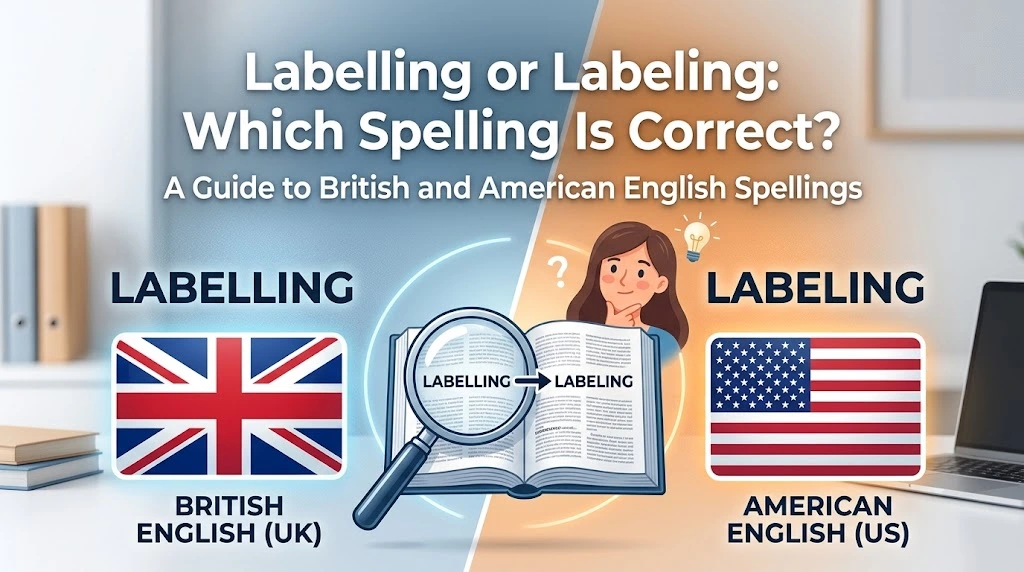
If you’ve ever stopped while writing and wondered whether labelling or labeling is correct, you’re not alone. The two spellings differ by only one letter, yet each follows a different English spelling convention.
The good news is simple: both labelling and labeling are correct.
The choice depends mainly on which variety of English you’re using. Labeling is the standard spelling in American English, while labelling is standard in British English and several other varieties that follow British spelling conventions.
Neither version has a different meaning. Both come from the verb label, and both describe the act of putting a label on something or identifying something with a particular name or category.
So, which one should you use? That depends on your audience, publication, school, employer, or preferred style guide.
Labelling or Labeling: The Quick Answer
Here’s the simplest way to remember the difference:
| Spelling | Main English variety | Example |
| Labeling | American English | The company is labeling the boxes. |
| Labelling | British English | The company is labelling the boxes. |
The meaning remains exactly the same.
For example:
American English: The manufacturer is labeling each package.
British English: The manufacturer is labelling each package.
The only meaningful difference is the spelling convention.
Labeling is the American spelling
In US English, labeling uses one l before the -ing ending.
You’ll see this form in American newspapers, websites, textbooks, business documents, government publications, and academic writing.
Examples include:
- product labeling
- food labeling
- chemical labeling
- data labeling
- package labeling
- warning-labeling requirements
- labeling a diagram
- labeling a chart
If your audience primarily uses American English, labeling is usually the form to choose.
Labelling is the British spelling
British English generally doubles the final l when forming this word:
label + ing → labelling
This spelling appears in British publications and in many varieties of English influenced by British spelling conventions.
Examples include:
- product labelling
- food labelling
- clothing labelling
- chemical labelling
- data labelling
- labelling a diagram
- labelling products correctly
The extra l doesn’t change the pronunciation or meaning.
What Does Labelling or Labeling Mean?
Before comparing the spellings, it helps to understand the word itself.
Label works as both a noun and a verb.
As a noun, a label is a piece of information attached to something. It might identify a product, explain its contents, provide instructions, or give other useful details.
For example:
- The shirt has a washing-instruction label.
- Check the food label for the ingredients.
- The box has a fragile label.
- Read the medicine label carefully.
As a verb, label means to attach or assign a label.
For example:
The worker is labeling the packages.
Or in British English:
The worker is labelling the packages.
The verb can also mean classifying or describing someone or something.
For instance:
Critics labeled the decision controversial.
In British spelling:
Critics labelled the decision controversial.
Again, the meaning doesn’t change.
Labeling can involve physical labels
The most literal use involves putting information directly onto an object.
A clothing company might label shirts with:
- size
- fabric composition
- washing instructions
- country of manufacture
- brand information
A warehouse might label boxes with:
- product codes
- shipping destinations
- handling instructions
- inventory numbers
- quantities
In these situations, labeling means marking something so people can identify or handle it correctly.
Labeling can also mean classification
The word has a broader meaning too.
People can label ideas, behaviors, groups, or situations.
For example:
The report labeled the method ineffective.
That doesn’t mean anyone attached a physical sticker to the method. Instead, the report classified or described it in a particular way.
Why Does Labelling Have Two Ls?
The difference comes from regional spelling conventions.
English spelling developed through several historical influences. British and American English eventually developed different preferences for certain words and word endings.
One of those differences concerns words ending in a single l.
British English commonly doubles the final l before certain suffixes, particularly when adding endings such as -ing.
That produces:
label + ing = labelling
American English generally keeps the single l in this situation:
label + ing = labeling
This pattern isn’t limited to labeling.
Consider these examples:
| Base word | American English | British English |
| label | labeling | labelling |
| travel | traveling | travelling |
| cancel | canceling | cancelling |
| model | modeling | modelling |
| dial | dialing | dialling |
| signal | signaling | signalling |
The pattern is useful because it shows that labelling vs. labeling isn’t an isolated spelling quirk.
It belongs to a larger difference between American and British spelling.
Labelling in British English
If you’re writing in British English, labelling is the standard form.
British spelling conventions commonly double the final l in words such as this when adding -ing.
You’ll therefore encounter:
- labelling
- travelling
- cancelling
- modelling
- signalling
- dialling
For example:
The store is labelling all its new products.
The researchers are labelling the samples.
The teacher is labelling the diagram.
The manufacturer changed its product labelling.
These sentences follow standard British spelling conventions.
Where else might you see labelling?
The spelling appears throughout British English materials, including:
- newspapers
- government documents
- university publications
- business websites
- product information
- educational materials
- technical documents
- professional reports
Other English varieties may also use labelling, depending on their local spelling conventions and institutional style.
Labeling in American English
American English normally uses labeling with one l.
For US readers, this is the spelling that will generally look natural in professional and everyday writing.
Examples include:
The company is labeling its new products.
The scientist is labeling the samples.
The teacher is labeling the parts of the diagram.
New regulations affect food labeling.
Notice that the meaning stays unchanged.
Only the spelling differs.
Why does American English use one L?
American spelling conventions often avoid doubling the final l in these forms.
That gives us:
- traveling
- canceled
- canceling
- modeling
- labeling
- signaling
This doesn’t mean American English has a universal rule of “never double the L.” English spelling contains plenty of exceptions and historical irregularities.
Instead, these words reflect an established American spelling pattern.
Labelling vs. Labeling: Side-by-Side Comparison
A direct comparison makes the distinction easy to remember.
| Feature | Labelling | Labeling |
| English variety | British English | American English |
| Meaning | Same | Same |
| Pronunciation | Essentially the same | Essentially the same |
| Number of Ls | Two | One |
| Verb form | Yes | Yes |
| Present participle | Yes | Yes |
| Gerund | Yes | Yes |
| Suitable for US English | Generally not preferred | Yes |
| Suitable for British English | Yes | Generally not preferred |
The key point is that neither spelling is inherently more correct.
The correct choice depends on the variety of English you’re using.
Why British English Uses Labelling
British English has a long-standing tendency to double a final consonant in certain words when adding suffixes.
This becomes easier to understand when you compare related words.
Consider:
travel → travelling
cancel → cancelling
model → modelling
label → labelling
The doubled consonant helps preserve the established spelling pattern within British English.
American English developed a different convention for many of these words:
travel → traveling
cancel → canceling
model → modeling
label → labeling
Neither system is a mistake. They’re simply different regional standards.
Labelling or Labeling in Different English-Speaking Countries
English spelling isn’t divided into only two neat boxes.
American and British English are the two most familiar standards, but other countries have their own preferences and style traditions.
Here’s a practical overview:
| Region | Common form |
| United States | labeling |
| United Kingdom | labelling |
| Australia | labelling |
| New Zealand | labelling |
| Canada | Often labelling, though usage can vary by style and context |
Canada deserves special attention because Canadian English often combines features associated with British and American English.
For professional writing, the safest approach is to follow the style guide used by your organization, school, publisher, or client.
That’s especially important when consistency matters across a large document.
Label, Labeled, Labelled, Labeling, and Labelling
Several forms of label can cause confusion.
The spelling difference doesn’t stop with labeling.
American and British English also differ in the past tense and past participle:
| Form | American English | British English |
| Base verb | label | label |
| Present participle | labeling | labelling |
| Past tense | labeled | labelled |
| Past participle | labeled | labelled |
| Noun | label | label |
For example:
American English
The company labeled the boxes yesterday.
British English
The company labelled the boxes yesterday.
Both sentences mean the same thing.
The same regional spelling distinction appears in the -ed form.
Is Labelled Also Correct?
Yes.
Labelled is the standard British spelling of the past tense and past participle.
American English generally uses labeled.
Compare:
The package was labeled correctly.
with:
The package was labelled correctly.
The difference is one letter.
The grammar and meaning remain unchanged.
This distinction becomes particularly useful when you’re proofreading a document. If you choose British English, don’t switch randomly between labelled and labeled.
Likewise, an American English document should generally use labeled consistently.
Common Examples of Labelling and Labeling
The word appears in many fields, so understanding its practical uses can help.
Product labeling or labelling
Companies use labels to identify products and communicate important information.
For example:
The manufacturer updated its product labeling.
British English would use:
The manufacturer updated its product labelling.
Product labels may include:
- product names
- quantities
- ingredients
- warnings
- instructions
- manufacturer details
- storage information
- dates
- identification codes
The exact requirements depend on the product and jurisdiction.
Food labeling or labelling
Food packaging provides another common example.
A food company might discuss:
- nutrition labeling
- ingredient labeling
- allergen labeling
- package labeling
- country-of-origin labeling
In British spelling, these become:
- nutrition labelling
- ingredient labelling
- allergen labelling
- package labelling
The terminology remains understandable in either spelling.
Data labeling or labelling
The word has also become common in technology and machine learning.
Data labeling refers to assigning meaningful categories or annotations to data.
For example, a dataset containing photographs might identify each image as:
- cat
- dog
- car
- bicycle
- person
A human annotator or specialized system can assign those labels.
In British English, you’d generally write data labelling.
In American English, data labeling is standard.
Labeling or Labelling in Diagrams
Teachers, scientists, engineers, and technical writers frequently use this word.
Suppose a biology diagram shows a cell.
The writer might say:
Label the nucleus, membrane, and cytoplasm.
When describing the activity itself, American English uses:
The exercise focuses on labeling the cell parts.
British English uses:
The exercise focuses on labelling the cell parts.
This distinction appears in textbooks, worksheets, laboratory manuals, and educational websites.
Labeling People, Ideas, and Behaviors
The word isn’t restricted to physical objects.
You can also label a person, idea, action, or situation.
For example:
The article labeled the claim misleading.
Or:
The article labelled the claim misleading.
Here, label means to describe or classify something in a particular way.
This use can sometimes carry an evaluative or social meaning.
For example, calling someone “lazy,” “difficult,” or “brilliant” doesn’t merely identify them. It assigns a description to them.
That’s why writers should consider context carefully when using the word.
A label can be useful for classification, yet it can also oversimplify a complicated situation.
Labelling or Labeling in Formal Writing
The best spelling for formal writing depends on your required English variety.
If you’re writing an American English research paper, use labeling.
If you’re writing according to British English conventions, use labelling.
The most important principle is consistency.
Imagine reading a report that says:
The researchers are labeling the samples.
A few paragraphs later, it says:
The samples were labelled according to size.
That combination may look careless if the document doesn’t have a specific reason for switching spelling systems.
A consistent style makes writing easier to read and edit.
Follow the required style guide
Some organizations specify a particular style.
For example, a university may require American English. A British publisher may require British English.
When a style guide exists, follow it rather than relying on personal preference.
This becomes especially important when several people contribute to the same document.
Labelling or Labeling in Academic Writing
Academic writing benefits from consistent spelling.
Before writing, determine which English variety your institution expects.
For an American academic audience:
- labeling
- labeled
- traveling
- modeling
- canceled
For a British academic audience:
- labelling
- labelled
- travelling
- modelling
- cancelled
A professor, journal, publisher, or university may have its own requirements.
What if your audience is international?
If no specific style is required, choose one standard variety and use it consistently.
Don’t alternate between British and American spellings simply because both are technically correct.
The goal isn’t to prove that you know both forms. The goal is to produce clean, coherent writing.
Labelling or Labeling in SEO and Online Content
Search-focused writing introduces another practical consideration: audience.
If your website primarily serves readers in the United States, labeling usually fits the expected American spelling.
If your website targets readers in the United Kingdom, labelling may be more appropriate.
For example, an American article could use:
Product Labeling Requirements for Small Businesses
A British publication might use:
Product Labelling Requirements for Small Businesses
The subject remains the same.
Should you use both spellings for SEO?
Usually, don’t force both spellings into the same article.
If your intended audience uses American English, use labeling naturally throughout the content.
If your audience uses British English, use labelling naturally.
Search engines understand language variations well enough that awkwardly repeating both versions isn’t a substitute for useful content.
Natural writing should come first.
Labelling vs. Labeling: A Practical Case Study
Imagine an American clothing company creates an online guide about garment labels.
Its target customers live mainly in the United States.
The company’s style guide uses American English.
In that situation, the natural choice is:
Clothing Labeling Requirements
The same company should generally write:
The manufacturer is labeling each garment with care instructions.
It should also use:
The garments were labeled before shipment.
Now imagine a British retailer publishing an equivalent guide for customers in the United Kingdom.
Its style guide uses British English.
The corresponding forms would be:
Clothing Labelling Requirements
and:
The manufacturer is labelling each garment with care instructions.
The garments were labelled before shipment.
What does this case show?
Neither company needs to change the underlying meaning.
They simply match their spelling to their intended English variety.
That’s the central rule behind labelling vs. labeling.
Common Mistakes to Avoid
Even simple spelling differences can cause unnecessary confusion.
Mistake: Calling labelling a misspelling
Seeing two Ls doesn’t make labelling wrong.
It’s the standard British form.
Mistake: Calling labeling a misspelling
Likewise, labeling isn’t an error simply because it has one L.
It’s the standard American form.
Mistake: Mixing regional spelling
Using labeling in one paragraph and labelling in another can make a document look inconsistent.
Pick the appropriate convention and stick with it.
Mistake: Assuming pronunciation changes
The additional l doesn’t create a major pronunciation difference.
Both forms refer to the same word.
Mistake: Assuming one version has a different meaning
There isn’t a semantic distinction between labelling and labeling.
The difference is primarily regional spelling.
Labelling or Labeling: How to Choose the Right One
When you’re unsure, ask three simple questions.
Who will read the content?
If your readers primarily use American English, choose labeling.
If they primarily use British English, choose labelling.
Does a style guide exist?
If a publisher, university, employer, or client provides a style guide, follow it.
A style guide takes priority over personal preference.
Which spelling are you already using?
Look at related words in your document.
If you’ve written:
- traveling
- modeling
- canceling
then labeling will probably keep your American English consistent.
If you’ve written:
- travelling
- modelling
- cancelling
then labelling will generally fit British English.
A Simple Memory Trick for Labelling vs. Labeling
Here’s an easy way to remember the distinction:
US English: one L — labeling.
British English: two Ls — labelling.
You can connect it with other examples:
American:
- traveling
- modeling
- canceling
- labeling
British:
- travelling
- modelling
- cancelling
- labelling
Once you recognize the pattern, the spelling becomes much easier.
Labelling or Labeling: Frequently Asked Questions
Is labelling or labeling correct?
Both are correct. Labeling is the standard American English spelling, while labelling is standard British English.
Is labeling American or British English?
Labeling is the standard form in American English.
Is labelling British English?
Yes. Labelling is the standard British English spelling.
Does labelling mean something different from labeling?
No. They have the same meaning and pronunciation. The difference comes from regional spelling conventions.
Is labeled or labelled correct?
Both are correct in their respective varieties.
Why does British English use two Ls?
British spelling conventions commonly double the final l in words such as labelling, travelling, and modelling when certain suffixes are added.
Why does American English use one L?
American spelling conventions generally retain one l in forms such as labeling, traveling, and modeling.
Should I write labeling or labelling in an article?
Use labeling for an American English audience and labelling for a British English audience. If a publication or organization has a style guide, follow that guide.
Is labeling wrong in British English?
It’s understandable and increasingly familiar to many readers, but labelling is the conventional British spelling.
Is labelling wrong in American English?
American readers will understand it, but labeling is the conventional US spelling.
Do labeling and labelling sound different?
Generally, no. The spelling difference doesn’t create a meaningful difference in pronunciation.
Labelling or Labeling: The Final Answer
So, labelling or labeling—which spelling is correct?
Both are correct.
The distinction is regional:
- Labeling = standard American English
- Labelling = standard British English
The same difference appears in related forms:
| American English | British English |
| labeling | labelling |
| labeled | labelled |
| traveling | travelling |
| traveled | travelled |
| modeling | modelling |
| modeled | modelled |
| canceling | cancelling |
| canceled | cancelled |
The important thing isn’t choosing one spelling as universally superior. It’s choosing the spelling that matches your audience and using it consistently.
If you’re writing for readers in the United States, labeling is the natural choice. If you’re following British English, use labelling.
When in doubt, check the style guide.
One L or two, the meaning stays the same.
