

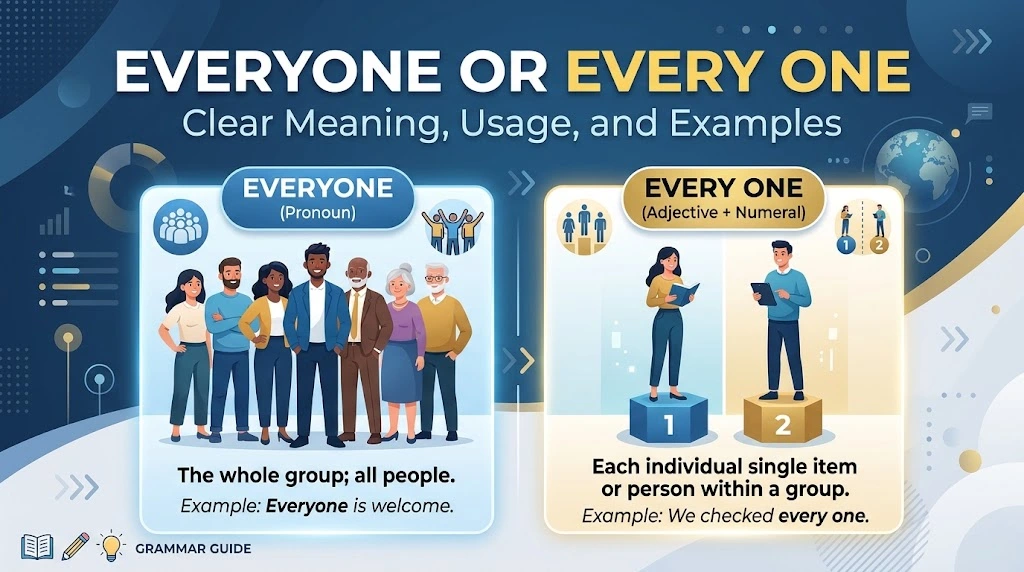
Everyone and every one sound almost identical when spoken aloud. That tiny space, however, changes the meaning and grammatical role of the phrase.
Use everyone when you mean all people in a group. Use every one when you mean each individual person or thing, especially in the common structure every one of.
For example:
- Everyone enjoyed the concert.
- Every one of the songs was memorable.
- Everyone in the room agreed.
- I checked every one of the documents.
The difference looks small on the page, but choosing the wrong form can change what your sentence means or make it grammatically incorrect.
This guide explains everyone vs. every one in detail. You’ll learn the meaning of each form, how they work grammatically, when to use them, common mistakes, verb agreement, pronouns, possessives, and plenty of real-world examples.
Everyone vs. Every One: The Quick Difference
The easiest way to remember the distinction is to focus on what one means.
Everyone is a single word. It means all people or each person in a group.
Every one consists of two words. It means each individual person or thing.
| Form | Meaning | Refers to | Common Pattern | Example |
| everyone | All people | People only | Everyone + verb | Everyone is ready. |
| every one | Each individual | People or things | Every one of + noun/pronoun | Every one of the books is new. |
Here’s another useful comparison:
Everyone = all the people
Every one = each individual one
That simple distinction solves most usage questions.
Consider these sentences:
Everyone passed the test.
This means all the people who took the test passed.
Every one of the answers was correct.
This focuses on each individual answer. The answers don’t have to be people.
You could say every one of the students because students are people. You can also say every one of the chairs because chairs are things.
You cannot normally replace that phrase with everyone of the chairs. The single-word everyone refers specifically to people.
What Does “Everyone” Mean?
Everyone is an indefinite pronoun that refers to all people in a particular group or situation.
It can mean:
- all people
- each person
- every person in a particular group
For example:
Everyone is invited to the wedding.
The sentence refers to all the relevant people. It doesn’t identify each person individually.
Likewise:
Everyone enjoyed the meal.
The sentence means all the people in the relevant group enjoyed it.
You don’t need to name the people individually. Everyone handles the entire group.
Examples of “Everyone”
- Everyone is waiting outside.
- Everyone knows the rules.
- Everyone received an invitation.
- Everyone wants a fair opportunity.
- Everyone has a different opinion.
- Everyone in the office attended the meeting.
- Everyone on the team worked hard.
- Everyone at the party seemed happy.
Notice an important pattern. Although everyone refers to multiple people, standard English normally treats it as grammatically singular.
That means you write:
Everyone is ready.
Not:
Everyone are ready.
You write:
Everyone has a ticket.
Not:
Everyone have a ticket.
This singular agreement becomes especially important in formal writing.
What Does “Every One” Mean?
Every one means each individual person or thing.
Unlike everyone, it can refer to objects and other nonhuman things.
For example:
Every one of the students passed.
Here, every one means each individual student.
But you can also write:
Every one of the paintings was sold.
Paintings aren’t people, so everyone would not work.
You can also use every one with documents, machines, houses, questions, answers, products, animals, photographs, and countless other nouns.
Examples of “Every One”
- Every one of the students submitted the assignment.
- Every one of the cookies was eaten.
- Every one of the machines passed inspection.
- Every one of the questions has an answer.
- Every one of the houses looks different.
- Every one of the photographs tells a story.
- Every one of the employees received a copy.
- Every one of the products was carefully tested.
The phrase often appears in the construction:
every one of + noun
For example:
Every one of the books was expensive.
Every one of them agreed.
Every one of us received a certificate.
That of phrase provides one of the strongest clues that you need every one rather than everyone.
Everyone vs. Every One: Why the Space Matters
The difference between these forms isn’t merely typographical.
Everyone functions as a single pronoun.
Every one combines every with one and emphasizes individual members or items.
Compare:
Everyone laughed.
This describes a group of people collectively.
Now compare:
Every one of the guests laughed.
This draws attention to each guest individually.
The practical difference can be subtle. In many sentences, both constructions can describe the same people.
For example:
Everyone passed the exam.
Every one of the students passed the exam.
Both sentences tell you that all the relevant students passed. The second version gives more emphasis to the individual members of the group.
That’s why writers sometimes choose every one when they want to stress completeness.
When to Use “Everyone”
Use everyone when you’re talking about all people in a group.
It works particularly well when the group is already obvious from context.
For example:
Everyone is ready to leave.
The reader understands that everyone refers to the people involved in the situation.
You could also say:
Everyone in the restaurant was surprised.
Here, everyone refers to all the people in the restaurant.
Use “Everyone” for People
Some examples include:
- Everyone deserves respect.
- Everyone needs a break sometimes.
- Everyone at work knows her.
- Everyone in the class finished early.
- Everyone at the meeting received a handout.
- Everyone on the bus was quiet.
The noun doesn’t have to appear immediately after everyone. You can add phrases such as in the room, at the event, on the team, or at school.
Everyone in the building heard the announcement.
The word everyone still means all the relevant people.
When to Use “Every One”
Use every one when you mean each individual person or thing.
It becomes especially useful when you have a phrase such as:
every one of the…
For example:
Every one of the players received a medal.
Or:
Every one of the boxes was labeled.
Or:
Every one of the files needs to be checked.
The phrase can also refer to people:
Every one of them agreed.
Every one of us knew the answer.
So don’t assume that every one means objects only. It can refer to people as well.
The important point is individual reference, not whether the noun is human.
The “Of” Test for Everyone vs. Every One
When you’re unsure, look at the words that follow the phrase.
If you want to say each individual member or item of a group, every one of is usually the correct construction.
Correct:
Every one of the students passed.
Incorrect:
Everyone of the students passed.
Correct:
Every one of the chairs was occupied.
Incorrect:
Everyone of the chairs was occupied.
Correct:
Every one of them received a prize.
Incorrect:
Everyone of them received a prize.
This makes the rule easy to remember:
“Every one of” is a standard construction. “Everyone of” is not.
However, don’t turn the rule into a mechanical trick. The presence of of isn’t the only reason to choose every one. The underlying meaning still matters.
Compare:
Everyone in the class passed.
Here, everyone is correct because it means all the people in the class.
You don’t need every one of simply because you’re describing a group.
Everyone Can Refer Only to People
This distinction causes many errors.
Everyone refers to people.
Every one can refer to people or things.
Consider these examples:
Everyone was excited. ✅
Every one of the guests was excited. ✅
Every one of the cars was inspected. ✅
Everyone of the cars was inspected. ❌
The final sentence fails because everyone doesn’t mean “each individual car.”
The correct version is:
Every one of the cars was inspected.
You can think of everyone as a human-only word.
Meanwhile, every one is much more flexible.
Subject-Verb Agreement With “Everyone”
One of the most important rules involving everyone concerns verb agreement.
Although everyone refers to many people, it takes a singular verb in standard English.
Correct Examples
- Everyone is welcome.
- Everyone has a seat.
- Everyone knows the answer.
- Everyone was prepared.
- Everyone wants to participate.
- Everyone needs a password.
Incorrect Examples
- Everyone are welcome.
- Everyone have a seat.
- Everyone know the answer.
- Everyone were prepared.
- Everyone want to participate.
Why does this happen?
The word everyone has a plural meaning but singular grammatical form. English contains several indefinite pronouns that work this way.
Think of everyone as meaning “every single person.” Each individual person is singular.
That’s why the verb remains singular.
Everyone is here.
The sentence describes many people, but everyone itself takes is.
Everyone and Singular “They”
Another common question concerns pronouns.
Consider:
Everyone should bring his or her identification.
That sentence is grammatically possible, but it can sound stiff or unnecessarily repetitive.
Modern standard English commonly uses singular they when the person’s gender isn’t specified:
Everyone should bring their identification.
This construction is widely used in contemporary English because their avoids unnecessary gender assumptions and keeps the sentence natural.
The same principle works in many situations:
- Everyone should bring their laptop.
- Everyone should check their email.
- Everyone needs to make their own decision.
- Everyone should take their seat.
The verb still agrees with everyone, not their.
So:
Everyone has their own opinion.
Not:
Everyone have their own opinion.
The pronoun doesn’t change the verb agreement.
Every One and Pronouns
Every one often appears with of + pronoun.
Common constructions include:
- every one of us
- every one of you
- every one of them
- every one of these
- every one of those
For example:
Every one of us received a certificate.
Every one of them agreed with the decision.
Every one of these needs to be replaced.
This structure emphasizes the individual members of a group.
Compare:
Everyone agreed.
with:
Every one of them agreed.
The first is broader and more natural in many contexts. The second puts greater focus on each member.
Everyone vs. “Every Person”
Everyone and every person can often express the same basic idea.
Compare:
Everyone deserves a chance.
Every person deserves a chance.
Both sentences refer to all people.
The difference usually comes down to style and emphasis.
Everyone sounds more natural and conversational.
Every person can sound more deliberate because it explicitly names the category being discussed.
For example:
Everyone in the neighborhood received a notice.
This feels natural.
You could write:
Every person in the neighborhood received a notice.
That version puts stronger emphasis on each individual person.
Neither construction is inherently more correct. Choose the one that best fits the sentence.
Every One vs. Each One
Every one and each one overlap significantly.
Compare:
Every one of the paintings was expensive.
Each one of the paintings was expensive.
Both sentences mean that all the paintings were expensive, with attention given to individual paintings.
There can be a slight difference in emphasis.
Each one often feels more explicitly individual.
Every one can emphasize the complete set.
For example:
Every one of the employees received the same notice.
This strongly emphasizes that nobody was left out.
Each one of the employees received a different assignment.
This focuses more naturally on individual assignments.
The difference isn’t always dramatic. Context determines which expression sounds better.
Common Mistakes With Everyone and Every One
“Everyone of the Students”
This is one of the most common mistakes.
Incorrect:
Everyone of the students passed.
Correct:
Every one of the students passed.
Why? The sentence means each individual student, so you need the two-word form.
“Everyone of the Books”
Incorrect:
Everyone of the books was damaged.
Correct:
Every one of the books was damaged.
Books aren’t people. Every one can refer to them.
“Everyone Are”
Incorrect:
Everyone are ready.
Correct:
Everyone is ready.
Remember that everyone takes a singular verb.
“Everyone Have”
Incorrect:
Everyone have a phone.
Correct:
Everyone has a phone.
Again, everyone requires a singular verb.
Using “Everyone” for Objects
Incorrect:
Everyone of these products is new.
Correct:
Every one of these products is new.
The meaning requires the two-word form.
Adding a Space to “Everyone” Without a Reason
Writers sometimes use every one simply because they want to emphasize a sentence.
That’s not enough.
The space should reflect the grammatical meaning.
Everyone was happy.
This means all people were happy.
Every one of the guests was happy.
This means each guest was happy.
Both can be correct. The sentence determines which form belongs there.
Everyone’s vs. Every One’s
The possessive form can create another layer of confusion.
Everyone’s is common and usually straightforward.
For example:
Everyone’s opinion matters.
Here, everyone’s means something belonging to everyone or associated with each person.
It can also represent the contraction:
Everyone’s coming.
This means:
Everyone is coming.
Context tells you which meaning applies.
What About “Every One’s”?
The construction every one’s is possible in highly specific contexts, but it’s much less common.
For example, a writer might theoretically refer to something belonging to each individual one:
Every one’s shape was different.
However, such wording often sounds awkward because every one is frequently clearer when followed by a noun or another construction.
Instead of forcing an unusual possessive, rewrite the sentence when possible:
Each person’s answer was different.
or:
The answers were all different.
Good writing isn’t just about following grammar rules. It also involves choosing the clearest natural construction.
Everyone in Questions and Negative Sentences
Everyone works normally in questions.
Examples:
- Is everyone ready?
- Did everyone arrive?
- Does everyone understand?
- Has everyone finished?
- Will everyone attend?
Notice the singular auxiliary verbs:
Is everyone ready?
Does everyone understand?
That’s consistent with the singular grammatical status of everyone.
“Not Everyone” Does Not Mean “No One”
This distinction matters.
Not everyone agreed.
means some people did not agree, but it doesn’t necessarily tell you how many agreed.
By contrast:
No one agreed.
means zero people agreed.
These expressions aren’t interchangeable.
| Expression | Meaning |
| Everyone agreed. | All relevant people agreed. |
| Not everyone agreed. | At least one person didn’t agree. |
| No one agreed. | Nobody agreed. |
That small difference can matter significantly in real communication.
Every One in Questions and Negative Sentences
Every one works naturally when you want to examine or identify individual members.
For example:
Did you check every one of the files?
This asks whether each individual file received attention.
Another example:
I didn’t read every one of the reports.
This means the speaker did not read all the reports.
Notice that this doesn’t necessarily mean the speaker read none of them.
That’s an important distinction.
I didn’t read every one of the reports.
usually means I read some, but not all, although context can affect interpretation.
Everyone vs. Every One in Everyday Situations
The difference becomes much easier when you see both forms in realistic situations.
At Work
Everyone joined the meeting.
Here, everyone means all the relevant employees or participants.
Every one of the reports was reviewed.
Here, every one refers to individual reports.
At School
Everyone completed the assignment.
This means all students completed it.
Every one of the answers was checked.
This means each answer received attention.
While Shopping
Everyone wanted a discount.
This refers to people.
Every one of the dresses was inspected.
This refers to dresses.
At a Restaurant
Everyone enjoyed the food.
This refers to diners or guests.
Every one of the tables was occupied.
This refers to tables.
In a Family
Everyone brought something to dinner.
This means all relevant family members brought something.
Every one of the dishes was homemade.
Here, every one refers to dishes.
A Practical Comparison Table
| Sentence | Correct? | Reason |
| Everyone is ready. | ✅ | Refers to all people. |
| Every one of the guests is ready. | ✅ | Refers to each guest. |
| Everyone of the guests is ready. | ❌ | Use “every one of.” |
| Everyone of the chairs is occupied. | ❌ | “Everyone” doesn’t refer to chairs. |
| Every one of the chairs is occupied. | ✅ | Refers to individual chairs. |
| Everyone has a ticket. | ✅ | “Everyone” takes singular “has.” |
| Everyone have a ticket. | ❌ | Singular agreement is required. |
| Every one of them agreed. | ✅ | Individual members are emphasized. |
| Everyone in the room agreed. | ✅ | Refers to all people in the room. |
| Every one is welcome. | ⚠️ | Usually unnatural when “everyone” is intended. |
The last example deserves attention. In ordinary writing, every one is welcome usually isn’t what you want. If you mean all people are welcome, write:
Everyone is welcome.
Use every one when the context clearly calls for the individual meaning.
Everyone or Every One: A Simple Decision Rule
When you’re stuck between the two forms, ask yourself a few quick questions.
Are You Talking About People as a Group?
Use everyone.
Everyone is invited.
Do You Mean Each Individual Person or Thing?
Use every one.
Every one of the guests is invited.
Does “Of” Follow the Expression?
Use every one.
Every one of the students passed.
Are You Talking About Objects?
Use every one.
Every one of the computers needs an update.
Does the Sentence Need a Singular Verb?
With everyone, yes.
Everyone is here.
Everyone has a copy.
This five-second check prevents most errors.
A Closer Look at “Everyone” and “Every One” in Formal Writing
Both forms are standard English. Neither is inherently informal.
Everyone appears frequently in everyday speech, professional emails, academic writing, journalism, instructions, and formal documents.
For example:
Everyone participating in the study received written instructions.
Likewise, every one is perfectly appropriate in formal writing:
Every one of the samples underwent laboratory analysis.
The important issue isn’t formality. It’s meaning and grammatical structure.
Choosing everyone because it sounds shorter doesn’t make sense when the sentence actually requires every one.
Likewise, inserting a space simply to make the sentence seem more formal won’t improve it.
Grammar should serve meaning.
Case Study: Editing a Short Paragraph
Consider this poorly written paragraph:
Everyone of the employees received a form. Everyone were asked to complete every one of the questions. Afterward, everyone of the forms was collected.
Several mistakes appear in just three sentences.
A corrected version reads:
Every one of the employees received a form. Everyone was asked to complete every one of the questions. Afterward, every one of the forms was collected.
Why?
- Every one of the employees refers to each individual employee.
- Everyone was asked refers to the employees collectively.
- Every one of the questions refers to individual questions.
- Every one of the forms refers to individual forms.
- Everyone was, not everyone were, because everyone takes singular agreement.
This example shows why context matters more than simply memorizing a spelling rule.
A Useful Mental Trick
Imagine replacing the phrase with all people.
If the replacement works naturally, everyone is probably correct.
Everyone was excited.
→ All people were excited.
The grammar changes slightly because all people is plural, but the meaning fits.
Now try:
Every one of the books was expensive.
Replace it with each individual book:
Each individual book was expensive.
That works perfectly.
So remember:
Everyone → all people
Every one → each individual one
It isn’t a perfect replacement test for every sentence, but it’s a useful shortcut.
Why “Everyone” and “Every One” Are Easy to Confuse
The confusion comes from pronunciation.
When spoken quickly, everyone and every one can sound almost identical. Listeners usually rely on context rather than hearing a clear difference.
Writing removes that ambiguity by adding or removing the space.
English has several other word pairs where spacing affects meaning. However, this particular distinction becomes especially noticeable because both forms contain the same words.
The difference is therefore grammatical rather than primarily phonetic.
That’s why reading the sentence aloud won’t always solve the problem. You need to understand what the sentence means.
Everyone or Every One: Quick Reference
| If you mean… | Use… | Example |
| All people | everyone | Everyone is invited. |
| All people in a group | everyone | Everyone in class passed. |
| Each individual person | every one | Every one of the students passed. |
| Each individual thing | every one | Every one of the books was sold. |
| Each member of a group | every one | Every one of them agreed. |
| A collective group of people | everyone | Everyone knows her. |
| Individual items from a set | every one | I checked every one. |
Frequently Asked Questions About Everyone and Every One
Is “everyone” one word?
Yes. Everyone is normally written as one word when it means all people or each person in a group.
Everyone is welcome.
Is “every one” two words?
Yes. Every one is written as two words when one functions separately and means each individual person or thing.
Every one of the boxes was opened.
Is “everyone of” correct?
Usually, no.
When you mean each individual member of a group, write:
Every one of the students passed.
Not:
Everyone of the students passed.
Can “everyone” refer to objects?
No. Everyone refers to people.
For objects, use every one:
Every one of the chairs was occupied.
Does everyone take a singular verb?
Yes. In standard English, everyone takes a singular verb.
Everyone is ready.
Everyone has a ticket.
Is “every one of them” correct?
Yes.
Every one of them received a certificate.
This means each individual person or thing in the group received one.
Is “everyone of them” correct?
No, not when you mean “each one of them.”
Use:
Every one of them.
Are “everyone” and “every one” interchangeable?
Not always.
They can sometimes express similar ideas when the subject consists of people, but their grammatical structures differ.
Everyone passed.
and
Every one of the students passed.
can communicate essentially the same overall fact.
However, every one can refer to things, while everyone cannot.
What is the difference between “everyone” and “each one”?
Both can emphasize individual members, but each one more directly highlights individual items or people.
Each one of the boxes was numbered.
Every one of the boxes was numbered.
Both are correct. The best choice depends on the surrounding sentence and the emphasis you want.
Is “everyone’s” correct?
Yes.
For example:
Everyone’s opinion matters.
It can also be a contraction:
Everyone’s coming.
Here, everyone’s means everyone is.
Final Takeaway: Everyone or Every One?
The difference between everyone and every one becomes simple once you focus on meaning.
Everyone is one word. It means all people or each person in a group.
Everyone is welcome.
Every one is two words. It means each individual person or thing.
Every one of the guests is welcome.
The most useful pattern to remember is every one of + noun or pronoun:
- every one of the students
- every one of the books
- every one of the answers
- every one of us
- every one of them
And remember the verb rule:
Everyone is, not everyone are.
When you aren’t sure which form belongs in your sentence, ask what you’re actually describing. If you mean all people, choose everyone. If you mean each individual person or thing, choose every one.
That tiny space carries a surprisingly useful grammatical distinction.
