

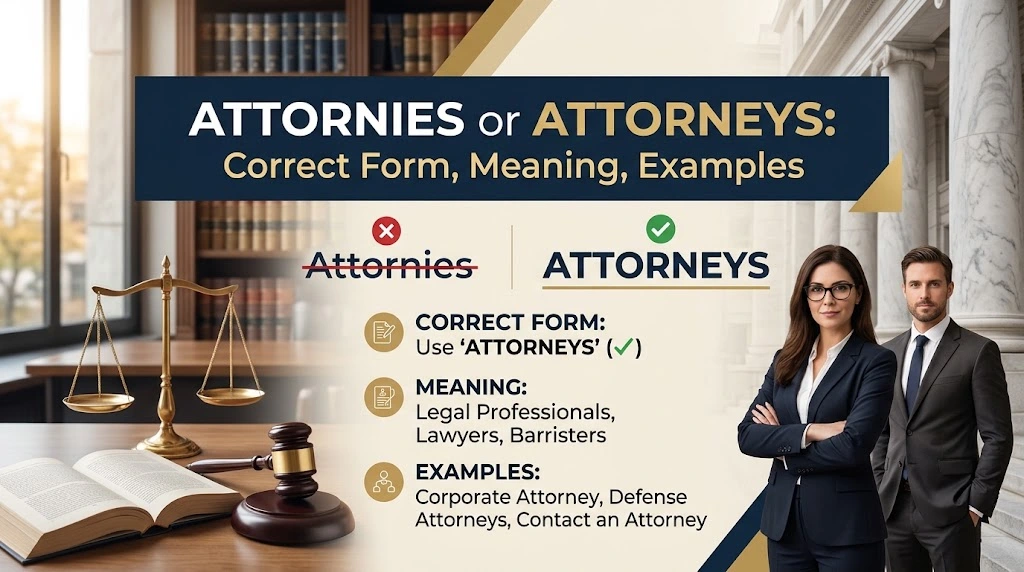
Attornies or attorneys? If you’ve ever hesitated over this spelling, you’re not alone. The word attorney looks like it should follow the same plural pattern as words such as city or party. Those words change -y to -ies, which makes attornies seem logical at first glance.
However, the correct plural spelling is attorneys.
You write attorney when you’re talking about one person. When you’re talking about two or more, you simply add -s to get attorneys. The final y stays exactly where it is.
Quick answer: Attorney is singular, attorneys is plural, and attornies is a misspelling in standard English.
That small spelling distinction matters in legal documents, business communication, websites, resumes, and everyday writing. A single misplaced letter can change a polished sentence into an obvious typo.
Let’s break down exactly why attorneys is correct and why attornies causes so much confusion.
Attornies or Attorneys: Which Spelling Is Correct?
The correct spelling is attorneys.
The spelling attornies is incorrect when you intend to write the plural of attorney. Standard English forms the plural by keeping the ending -ey and adding -s.
Here’s the basic pattern:
| Form | Correct? | Meaning |
| attorney | ✅ | One lawyer |
| attorneys | ✅ | Two or more lawyers |
| attornies | ❌ | Incorrect spelling |
| attorney’s | ✅ | Something belonging to one attorney |
| attorneys’ | ✅ | Something belonging to multiple attorneys |
For example:
The attorney reviewed the agreement.
That sentence refers to one person.
Now change the subject:
The attorneys reviewed the agreement.
The second sentence refers to two or more attorneys.
Notice what happened. The y didn’t change.
That’s the key point.
Why “Attornies” Looks Correct
The confusion comes from a common English spelling rule.
Many nouns ending in a consonant followed by y change the y to ies when pluralized.
For example:
- city → cities
- party → parties
- company → companies
- family → families
- country → countries
Because attorney ends in y, it’s easy to assume the same rule applies.
But attorney doesn’t end with a consonant directly before the y. It ends in ey.
That distinction matters.
Compare these forms:
- city → cities
- party → parties
- attorney → attorneys
- journey → journeys
- employee → employees
When a noun ends in a vowel + y, English generally keeps the y and adds s.
So:
attorney + s = attorneys
Not:
attorn + ies = attornies
What Does Attorney Mean?
An attorney is a person who is legally qualified to practice law. In US English, attorney commonly refers to a lawyer.
The word appears throughout legal, business, government, and everyday contexts.
For example:
Maria hired an attorney to handle her case.
Here, attorney refers to the legal professional Maria hired.
You might also see the word in official titles and legal expressions:
- Attorney General
- district attorney
- defense attorney
- prosecuting attorney
- United States attorney
- attorney at law
- power of attorney
The exact legal meaning can depend on the context and jurisdiction. In ordinary American usage, however, attorney and lawyer frequently refer to the same type of legal professional.
Attorney vs. Lawyer
The words aren’t always used in exactly the same way.
A lawyer is generally someone trained and qualified in law. An attorney is often used for a lawyer who is authorized to act for another person in legal matters.
In everyday US English, the distinction is often less strict.
For example, someone might say:
I need a lawyer.
They could also say:
I need an attorney.
Both statements normally communicate the same basic idea: the person wants legal assistance.
The word attorney tends to sound more formal and appears frequently in legal and government contexts.
Why Is “Attorneys” the Correct Plural?
The easiest way to understand attorneys is to look at the ending.
The singular form is:
attorney
The word ends with the letters e-y.
To make it plural, English adds s:
attorney + s = attorneys
The spelling doesn’t require removing the y.
This pattern appears in many other English nouns ending in vowel + y.
| Singular | Plural |
| attorney | attorneys |
| employee | employees |
| journey | journeys |
| boy | boys |
| toy | toys |
| day | days |
| key | keys |
| donkey | donkeys |
Now compare those with nouns ending in consonant + y:
| Singular | Plural |
| city | cities |
| party | parties |
| story | stories |
| country | countries |
| company | companies |
| family | families |
The difference is the letter immediately before y.
The Simple Rule
If a noun ends in consonant + y, the plural often changes y → ies.
If it ends in vowel + y, the plural generally adds s.
Because attorney ends in ey, the plural is:
attorneys
This isn’t merely a stylistic preference. It’s the standard spelling.
Attornies vs. Attorneys: Side-by-Side Comparison
Seeing the forms together makes the difference easier to remember.
| Word | Status | Explanation | Example |
| attorney | Correct | Singular | The attorney arrived. |
| attorneys | Correct | Plural | The attorneys arrived. |
| attornies | Incorrect | Misspelling | Don’t use this form for the plural. |
| attorney’s | Correct | Singular possessive | The attorney’s office is nearby. |
| attorneys’ | Correct | Plural possessive | The attorneys’ offices are nearby. |
The apostrophe creates another common source of confusion.
Consider these sentences:
The attorney’s car is outside.
One attorney owns or is associated with the car.
Now:
The attorneys’ cars are outside.
Multiple attorneys own or are associated with the cars.
Finally:
The attorneys are outside.
That’s simply the plural. No apostrophe is needed.
Attorney vs. Attorneys: Singular and Plural Examples
The distinction becomes straightforward when you see it in context.
Singular: Attorney
Use attorney when referring to one person.
The attorney called her client.
I spoke with an attorney yesterday.
That attorney specializes in employment law.
The attorney prepared the documents.
Plural: Attorneys
Use attorneys when referring to more than one person.
Several attorneys attended the meeting.
The attorneys reviewed the evidence.
Two attorneys represented the company.
The firm employs dozens of attorneys.
Singular Possessive: Attorney’s
Use attorney’s when something belongs to one attorney.
The attorney’s office opens at nine.
I read the attorney’s letter.
The attorney’s argument focused on the contract.
Plural Possessive: Attorneys’
Use attorneys’ when something belongs to multiple attorneys.
The attorneys’ arguments differed.
The attorneys’ offices are on the second floor.
The attorneys’ clients attended the hearing.
A quick test can help:
One attorney owns it → attorney’s
Multiple attorneys own it → attorneys’
Multiple attorneys are doing something → attorneys
Why Do People Spell It “Attornies”?
The spelling attornies usually comes from applying the wrong pluralization rule.
English contains many nouns ending in y, and some really do change to ies.
For example:
company → companies
policy → policies
agency → agencies
family → families
A writer who remembers only the broad rule might think:
attorney → attornies
That looks reasonable until you examine the preceding letter.
In attorney, the letter before y is e, which is a vowel.
Therefore, the normal plural pattern is:
attorney → attorneys
A Useful Comparison
Think about the words employee and attorney.
You wouldn’t normally write:
employeies
The correct plural is:
employees
The same basic idea applies to attorney.
Attorney ends with -ey, so its plural keeps that ending.
Attorneys or Attornies in American English
In standard American English, attorneys is the correct plural form.
You’ll find the word in many professional settings, including:
- Law firm websites
- Court documents
- Government publications
- Legal correspondence
- Contracts
- News articles
- Academic writing
- Business documents
- Professional biographies
The incorrect spelling attornies can still appear online because people make spelling mistakes. Search engines and user-generated content can preserve those errors.
That doesn’t make attornies a standard plural.
When writing professionally, use attorneys.
Example From Professional Writing
Correct:
The attorneys representing the parties submitted their arguments.
Incorrect:
The attornies representing the parties submitted their arguments.
The first sentence follows standard English spelling.
Attorneys vs. Lawyers: Are They the Same?
In American English, attorney and lawyer overlap heavily in everyday use.
A person might say:
She is a lawyer.
Another person might say:
She is an attorney.
Neither statement sounds unusual in ordinary US conversation.
The terms can carry different technical meanings in particular legal systems. However, general American usage often treats them as near-synonyms.
The word attorney is especially common in professional titles.
For example:
- personal injury attorney
- criminal defense attorney
- family law attorney
- tax attorney
- immigration attorney
- corporate attorney
Meanwhile, lawyer often sounds more conversational:
We should talk to a lawyer before signing this.
Both words can work naturally depending on the context.
Attorney in Common Legal Terms
The word attorney appears in several established legal expressions.
Understanding these phrases also helps you recognize the correct spelling.
Attorney at Law
Attorney at law is a formal term for a lawyer licensed to practice law.
Example:
The attorney at law represented the defendant.
Its plural is:
attorneys at law
Notice that attorneys remains the standard plural spelling.
Attorney General
An attorney general is a government official who serves as a chief legal officer at the federal or state level in the United States.
The plural form can be confusing because the phrase doesn’t behave like an ordinary noun phrase.
The plural is generally:
attorneys general
Not:
attorney generals
That’s an example of why legal terminology sometimes requires more than simply adding s to the last word.
District Attorney
A district attorney is a public prosecutor in certain US jurisdictions.
The plural is:
district attorneys
For example:
Several district attorneys issued a joint statement.
Power of Attorney
A power of attorney is a legal authorization that allows one person to act on behalf of another within the authority granted by the document.
Its plural is:
powers of attorney
Here, power changes to its plural form while attorney remains part of the fixed phrase.
Defense Attorney
A defense attorney represents a person accused of a crime in a criminal case.
Plural:
defense attorneys
Example:
Defense attorneys challenged the evidence presented in court.
Examples of “Attorney” in a Sentence
Context makes spelling easier to remember.
Here are several examples using the singular, plural, and possessive forms.
Singular Examples
The attorney reviewed the contract carefully.
She hired an attorney after receiving the legal notice.
The attorney explained the options to his client.
An experienced attorney handled the negotiation.
Plural Examples
The attorneys met before the hearing.
Several attorneys worked on the case.
The company consulted its attorneys before making the announcement.
The attorneys prepared separate briefs.
Possessive Examples
The attorney’s office is downtown.
The attorney’s client requested more time.
The attorneys’ offices are located in the same building.
The attorneys’ recommendations differed significantly.
Everyday Examples
Do you know a good attorney?
We need to speak with two attorneys.
Her attorney called this morning.
Their attorneys are reviewing the agreement.
Each sentence uses the spelling according to its grammatical function.
Common Mistakes With Attorney
The most obvious mistake is attornies, but it’s not the only one.
Mistake: Using “Attornies”
Incorrect:
The attornies met with their clients.
Correct:
The attorneys met with their clients.
The plural requires -s, not -ies.
Mistake: Using “Attorney’s” for a Simple Plural
Incorrect:
Three attorney’s attended the meeting.
Correct:
Three attorneys attended the meeting.
The apostrophe isn’t needed because the word is simply plural.
Mistake: Using “Attorneys” for Possession
Incorrect:
The attorneys office is closed.
Correct:
The attorney’s office is closed.
If one attorney has the office, use attorney’s.
For multiple attorneys:
The attorneys’ offices are closed.
Mistake: Adding an Apostrophe to a Regular Plural
Incorrect:
The attorneys’s filed documents.
Correct:
The attorneys filed documents.
Or, if possession is intended:
The attorneys’ documents were filed.
These small punctuation differences can completely change the grammatical function.
Attorney, Attorneys, Attorney’s, and Attorneys’: Quick Grammar Guide
Keep this table handy if these forms regularly trip you up.
| Form | What it means | Example |
| attorney | One person | The attorney called. |
| attorneys | More than one | The attorneys called. |
| attorney’s | Belonging to one | The attorney’s desk is clean. |
| attorneys’ | Belonging to several | The attorneys’ desks are clean. |
Here’s an easy way to remember them:
No apostrophe + singular: one attorney
No apostrophe + s: multiple attorneys
Apostrophe + s: one attorney owns something
Apostrophe after s: multiple attorneys own something
This distinction applies to many regular nouns.
Is “Attornies” Ever Correct?
For the ordinary plural of attorney, attornies is not the standard spelling.
If you mean more than one attorney, write:
attorneys
You might encounter attornies on websites, social media, scanned documents, or informal writing. Such appearances generally reflect a spelling mistake rather than an accepted plural form.
It’s important to separate something people write from something standard English accepts.
English contains countless misspellings that appear frequently online. Frequency alone doesn’t turn a typo into the standard form.
For professional writing, there is little reason to use attornies.
How to Remember the Correct Spelling
A simple memory trick can save you from making the same mistake again.
Think:
Attorney + s = Attorneys
Don’t change the final y.
Another useful comparison is:
- attorney → attorneys
- employee → employees
- journey → journeys
- boy → boys
- toy → toys
All of these words keep the y when they become plural.
Now compare:
- city → cities
- party → parties
- company → companies
- story → stories
Those words have a consonant immediately before the y, so the spelling changes.
The One-Letter Test
When you’re unsure about a plural ending in y, look at the letter immediately before the y.
If it’s a vowel, adding s is generally the pattern:
attorney → attorneys
If it’s a consonant, the word often changes y to ies:
city → cities
English has exceptions and additional spelling patterns, but this test works well for attorney.
Attorneys in Formal and Professional Writing
Legal writing leaves little room for casual spelling errors.
A typo in an email might seem minor. A typo in a legal document, firm website, professional biography, or court filing can make the writing look rushed.
That doesn’t mean every spelling error changes the legal meaning. It does mean accuracy matters in professional communication.
Consider a law firm’s website.
Compare:
Our attorneys have extensive experience in commercial litigation.
with:
Our attornies have extensive experience in commercial litigation.
The second sentence immediately contains a visible spelling error.
The information may still be understandable. However, professional readers expect careful proofreading.
Where Correct Spelling Matters Most
Pay particular attention when writing:
- Legal briefs
- Court filings
- Client letters
- Law firm websites
- Contracts
- Legal advertisements
- Resumes
- Cover letters
- Professional biographies
- Academic papers
- Business emails
A final spell-check helps. A human proofreading pass helps even more.
A Practical Proofreading Checklist
Before publishing a document containing the word attorney, check these points:
- Is attorney singular?
- Is attorneys plural?
- Did you accidentally write attornies?
- Does the sentence require a possessive?
- If so, is it attorney’s or attorneys’?
- Does the phrase contain a legal term with an irregular plural?
- Is capitalization appropriate?
- Does the surrounding sentence clearly indicate one person or multiple people?
This takes only a few seconds.
Those seconds can prevent an embarrassing typo from reaching a client or reader.
A Quick Case Study: One Letter, Three Different Meanings
Imagine a law firm’s internal memo.
The writer wants to say that three lawyers reviewed a contract.
The first draft says:
Three attorney’s reviewed the contract.
That sentence has two problems. Attorney’s is singular possessive, while the sentence needs a regular plural.
The corrected sentence is:
Three attorneys reviewed the contract.
Now suppose the writer wants to discuss something belonging to one lawyer:
The attorney’s review identified several problems.
Here, the apostrophe makes sense because the review belongs to one attorney.
Finally, suppose several lawyers contributed to the review:
The attorneys’ review identified several problems.
Now the apostrophe follows the plural s because multiple attorneys are involved.
What This Shows
The difference isn’t cosmetic.
| Intended meaning | Correct form |
| One lawyer | attorney |
| Multiple lawyers | attorneys |
| Something belonging to one lawyer | attorney’s |
| Something belonging to multiple lawyers | attorneys’ |
A single apostrophe can change the grammatical meaning.
A Closer Look at “Attorneys General”
One interesting phrase deserves special attention because it can confuse even careful writers.
The plural of attorney general is generally attorneys general.
Why?
The word attorney is the noun being pluralized. General functions as a modifier.
So:
one attorney general
becomes:
two attorneys general
The same structure appears in certain other titles where the main noun comes before the modifier.
This example also reinforces an important lesson: pluralization depends on the grammatical structure of a phrase, not simply on adding an ending to the final word.
Is “Attorney” Always the Same as “Lawyer”?
In everyday US English, the terms overlap substantially. Still, legal terminology can become more precise depending on the jurisdiction and context.
The word lawyer is broad and commonly understood.
The word attorney is also common in the United States and frequently appears in formal legal titles.
For ordinary writing, either may sound natural:
She spoke with a lawyer.
She spoke with an attorney.
However, specific legal roles can carry particular requirements. For example, a district attorney has a specific public prosecutorial role that the generic term lawyer doesn’t communicate.
Likewise, attorney general is an official government title rather than simply another way of saying “lawyer.”
So the safest approach is to consider the context rather than assuming every legal term is interchangeable.
Why Correct Spelling Matters for SEO and Online Content
Spelling also matters when publishing legal or educational content online.
Search engines can often understand misspellings and related queries. That doesn’t mean writers should intentionally use incorrect forms throughout an article.
A useful page can naturally address both forms:
Attornies or attorneys? The correct spelling is attorneys.
That approach answers the user’s actual search question while maintaining accurate language.
The same principle works for other spelling questions.
Readers often search for the incorrect form because they’re unsure. A strong article should acknowledge that confusion, explain the reason behind it, and provide the correct form clearly.
The goal isn’t to repeat a misspelling endlessly. The goal is to resolve the problem.
Attornies or Attorneys: Common Search Questions
Is “attornies” a word?
Attornies is not the standard plural spelling of attorney. The correct plural is attorneys.
What is the plural of attorney?
The plural of attorney is attorneys.
Example:
One attorney joined the case.
Three attorneys joined the case.
Is “attorneys” singular or plural?
Attorneys is plural.
The singular form is attorney.
Do you change the “y” to “ies” in attorney?
No.
The correct plural keeps the y:
attorney → attorneys
Is “attorneys” correct in American English?
Yes. Attorneys is the standard plural form in American English.
What is the possessive form of attorneys?
For multiple attorneys, the possessive form is attorneys’.
Example:
The attorneys’ offices are nearby.
What is the singular possessive of attorney?
The singular possessive is attorney’s.
Example:
The attorney’s office is nearby.
Are attorney and lawyer the same thing?
In everyday American English, they often refer to the same type of legal professional. Specific legal contexts can distinguish particular roles or qualifications.
Attornies or Attorneys: Final Answer
When choosing between attornies or attorneys, use attorneys.
That’s the standard plural form of attorney.
The spelling stays simple:
attorney → attorneys
The final y remains in place because attorney ends in -ey.
For possessives, remember the difference:
attorney’s = belonging to one attorney
attorneys’ = belonging to multiple attorneys
attorneys = simply more than one attorney
The easiest rule to remember is this:
Don’t change the “y” in attorney when making it plural. Just add “s.”
So if you’re writing about a legal team, a law firm, or several lawyers, write attorneys, not attornies.
If you’d like, the same article can also be expanded with etymology, dictionary references, authoritative grammar sources, and additional real-world usage examples while keeping the same conversational SEO style.
