

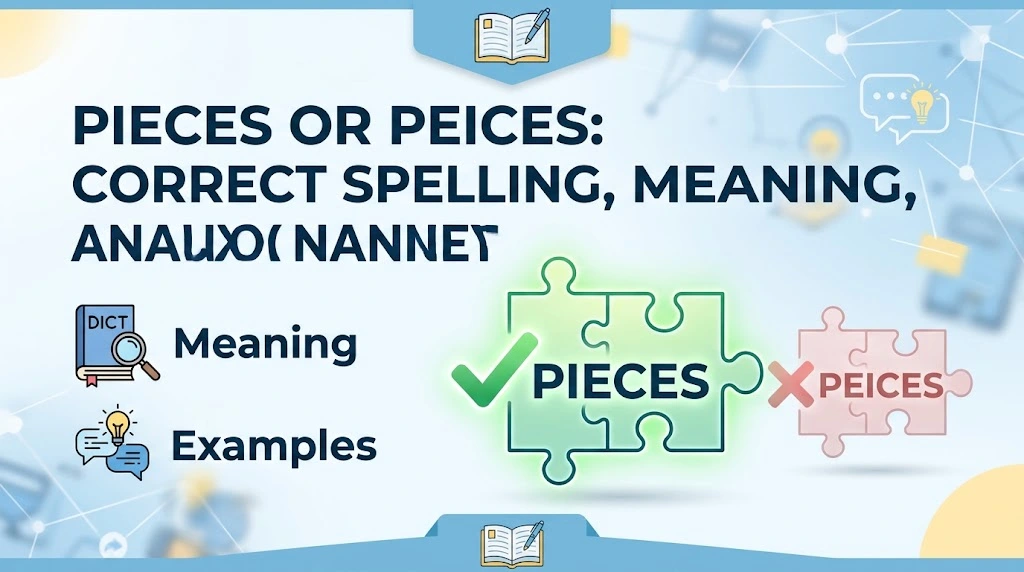
If you’ve ever hesitated between pieces and peices, you’re not alone. These two spellings look almost identical, yet only one belongs in standard English.
The correct spelling is pieces.
Peices is a misspelling. The confusion usually happens because English has several words with the ie and ei letter patterns. When you write quickly, it’s easy to put the letters in the wrong order.
The good news? There’s a simple way to remember it.
Think of PIE when you spell pieces:
PIE + CES = PIECES
This article explains the meaning of pieces, how to spell it, how to use it naturally, and why peices is incorrect. You’ll also see plenty of examples and comparisons so the difference sticks.
Pieces or Peices: Which Spelling Is Correct?
Pieces is the correct spelling.
Peices is incorrect in standard English.
| Spelling | Correct? | Meaning |
| pieces | ✅ Yes | Plural of piece |
| peices | ❌ No | Common misspelling of pieces |
For example:
She bought three pieces of fabric.
Not:
She bought three peices of fabric.
The mistake doesn’t change how most people pronounce the word. That makes it especially easy to miss when you’re proofreading.
If you’re writing an email, article, school assignment, product description, or business document, use pieces.
What Does “Pieces” Mean?
Pieces is the plural form of piece.
A piece generally refers to one individual part, portion, item, or unit of something. When there is more than one, you use pieces.
For example:
- one piece of cake
- two pieces of cake
- one piece of paper
- several pieces of paper
- one piece of furniture
- several pieces of furniture
The exact meaning depends on context.
A piece can be something physically separate from a larger object. It can also refer to an individual portion of food, artwork, writing, information, equipment, or evidence.
Examples of “pieces”
I need two pieces of paper.
The glass broke into several pieces.
We ordered four pieces of chicken.
She displayed her latest pieces at the gallery.
The detective gathered several pieces of evidence.
Notice how the same word works across very different situations.
Pieces Is the Plural of Piece
The basic relationship is straightforward:
Piece → Pieces
The singular form refers to one.
The plural form refers to more than one.
| Singular | Plural |
| one piece | two pieces |
| a piece | several pieces |
| this piece | these pieces |
| that piece | those pieces |
Singular examples
I found a piece of paper.
He ate one piece of cake.
She bought a piece of furniture.
Plural examples
I found several pieces of paper.
He ate three pieces of cake.
She bought several pieces of furniture.
This distinction matters because pieces is grammatically plural.
You wouldn’t normally write:
I need one pieces of paper.
Instead, write:
I need one piece of paper.
How Do You Spell Pieces Correctly?
The correct spelling is:
P-I-E-C-E-S
The most useful part to remember is PIE at the beginning.
The spelling breakdown
PIE + CES = PIECES
That gives you:
- PIE
- C
- E
- S
Put them together and you get:
PIECES
The incorrect spelling reverses the first two vowel letters:
PEI…
That’s why peices looks wrong once you become familiar with the correct pattern.
Why Is “Peices” a Common Misspelling?
The word peices appears because English spelling doesn’t always follow the patterns people expect.
Many English words contain ie or ei, so writers sometimes remember the sequence incorrectly.
For example:
- piece
- field
- believe
- receive
- ceiling
- their
- foreign
These words don’t all follow one simple spelling rule.
That’s important because the popular “i before e except after c” rhyme has many exceptions and limitations. You shouldn’t rely on it as a universal rule.
For piece, the easiest strategy is more practical:
Remember PIE inside PIECES.
That visual connection is often more useful than trying to apply a broad spelling rule every time.
A Simple Trick to Remember “Pieces”
Here’s an easy memory trick:
PIE + CES = PIECES
Imagine a delicious pie.
Then remember that pieces starts with the exact letters in pie.
PIE → PIECES
For example:
Cut the cake into six pieces.
You can mentally picture six pieces of pie or cake. That small association can make the spelling easier to recall.
Another quick reminder
When you see peices, ask yourself:
“Does this start with PIE?”
If the answer is no, fix it.
PIECES starts with PIE.
Pieces in a Sentence
The word pieces appears in many ordinary sentences.
Here are examples across different contexts.
Physical objects
The toy broke into several pieces.
Please put the pieces back in the box.
The puzzle has 1,000 pieces.
Food
She ordered two pieces of pizza.
Cut the watermelon into small pieces.
I saved a few pieces of cake for later.
Clothing and fabric
The tailor cut the fabric into several pieces.
These pieces need to be sewn together.
Art
The museum displayed several new pieces.
Her collection includes several impressive art pieces.
Writing
He published several short pieces in the magazine.
The newspaper ran three opinion pieces this week.
Information
We received several pieces of useful information.
Evidence
Investigators found several pieces of evidence.
The context changes, but the spelling stays the same.
Pieces as a Noun
Pieces is most commonly used as the plural noun form of piece.
A noun names a person, place, thing, or idea. In this case, pieces identifies multiple individual portions, objects, parts, or works.
Consider:
The vase shattered into pieces.
Here, pieces refers to the separate fragments of the broken vase.
Now consider:
She wrote several pieces for the magazine.
Here, pieces refers to individual written works.
The word therefore has a broad range of meanings.
Common Expressions With “Pieces”
Some expressions use pieces in ways that aren’t limited to physical objects.
Understanding these phrases helps you use the word naturally.
Pieces of information
The report contained several pieces of information.
Here, pieces provides a way to count individual bits of information.
Information is generally treated as an uncountable noun in standard English. That’s why you normally don’t write informations when referring to information generally.
Instead, you can say:
- a piece of information
- two pieces of information
- several pieces of information
Pieces of advice
The same pattern applies to advice.
She gave me several pieces of advice.
Standard English generally treats advice as uncountable.
So this is natural:
He gave me two pieces of advice.
Not:
He gave me two advices.
Pieces of evidence
Evidence also commonly takes the phrase pieces of evidence when individual items are being discussed.
The investigators found several pieces of evidence.
Again, the plural is expressed through pieces rather than by adding an s directly to evidence.
Pieces of equipment
You can also say:
The company purchased five pieces of equipment.
The noun equipment is generally uncountable in standard English.
This construction lets you refer to individual units without writing equipments.
Pieces of a puzzle
This is one of the most familiar uses.
We found all the pieces of the puzzle.
Here, the pieces are physical components that form a larger whole.
Pieces vs. Parts
Pieces and parts sometimes overlap, but they aren’t always interchangeable.
A part often refers to a component that has a specific role within a larger system.
A piece can be a separate portion or individual item without emphasizing its function.
Compare these sentences:
The engine has several important parts.
The broken chair was scattered into several pieces.
The first sentence focuses on components that perform specific functions.
The second focuses on separate fragments.
Comparison
| Word | Typical meaning | Example |
| Piece | An individual portion or item | I ate a piece of cake. |
| Part | A component of a larger whole | The engine has many parts. |
| Fragment | A small broken or detached portion | A fragment of glass was found. |
| Portion | A measured or allocated amount | She served a large portion. |
| Section | A distinct division | Read the final section. |
These words can overlap, but context determines which sounds most natural.
Pieces vs. Peaces
Don’t confuse pieces with peaces.
The words come from completely different vocabulary families.
Piece
Piece means an individual part, portion, item, or unit.
I need another piece of paper.
Peace
Peace generally refers to a state without war, conflict, or disturbance.
The two countries signed an agreement for peace.
The spelling changes only slightly, but the meanings are completely different.
What about “peaces”?
Peaces isn’t normally used as the plural of peace in ordinary modern English.
When talking about peace as a general concept, use:
We all want peace.
Not:
We all want peaces.
So if you mean separate portions or items, the correct word is:
pieces
Pieces vs. Pices
You may occasionally see pices when someone has typed pieces incorrectly.
For ordinary English writing, pices isn’t the standard spelling for the plural of piece.
The correct form remains:
pieces
Don’t remove the e from the middle.
The complete spelling is:
P-I-E-C-E-S
Common Mistakes With Pieces
Spelling errors often become habits because they look familiar.
Here are some common mistakes worth watching.
| Incorrect | Correct |
| peices | pieces |
| peice | piece |
| peices of cake | pieces of cake |
| two peices | two pieces |
| three peices of advice | three pieces of advice |
Mistake: “peice”
❌ I found a peice of glass.
Correct it to:
✅ I found a piece of glass.
Mistake: “peices”
❌ The puzzle has many peices.
Correct it to:
✅ The puzzle has many pieces.
Mistake: using “pieces” with one
❌ I bought one pieces of bread.
Correct:
✅ I bought one piece of bread.
The number determines whether you need the singular or plural form.
Pieces in Formal and Informal Writing
You’ll find pieces in virtually every type of English writing.
In casual conversation, someone might say:
Can I have two pieces?
In business writing:
The shipment contained 250 pieces of merchandise.
In academic writing:
The researchers examined several pieces of evidence.
In journalism:
The publication featured several opinion pieces.
In creative writing:
Broken pieces of glass covered the floor.
The word itself isn’t especially formal or informal.
Its register depends mostly on the surrounding language and context.
Pieces in Different Contexts
One reason pieces appears so often is its flexibility.
Food
We ordered eight pieces of chicken.
Clothing
The collection includes several matching pieces.
Furniture
The store sells individual pieces of furniture.
Machinery
Several pieces of equipment require maintenance.
Art
The gallery displayed five new pieces.
Writing
She contributed two pieces to the publication.
Evidence
The lawyer presented several pieces of evidence.
Information
We collected several pieces of information.
Puzzles
Three pieces are still missing.
Broken objects
The plate fell into several pieces.
The word acts like a linguistic Swiss Army knife. It handles many contexts without changing its basic spelling.
Pieces: Synonyms and Related Words
Depending on the context, several words can replace pieces.
However, they’re not always exact substitutes.
| Word | Best used when referring to | Example |
| Parts | Components of something | Machine parts |
| Portions | Amounts of food or material | Large portions |
| Sections | Divisions of something | Book sections |
| Fragments | Broken or incomplete parts | Glass fragments |
| Items | Individual objects | Ten items |
| Units | Individual measurable objects | Five units |
| Components | Functional elements | Computer components |
| Bits | Small portions, often informal | Bits of information |
For instance, components sounds natural when discussing technology.
The computer has several important components.
But pieces can sound more natural when discussing a puzzle.
The puzzle has 500 pieces.
Choosing the right synonym depends on what you mean.
Pieces vs. Parts vs. Portions
These three words deserve a closer look because writers often substitute one for another.
Pieces
Use pieces when you mean separate individual items or portions.
She cut the apple into four pieces.
Parts
Use parts when you mean components that belong to a larger structure.
The machine has several moving parts.
Portions
Use portions when the focus is on an amount allocated or served.
The restaurant serves generous portions.
A useful way to think about the difference is this:
Piece = separate item
Part = component
Portion = amount
That isn’t an absolute rule. English has plenty of overlap. Still, it provides a helpful starting point.
How to Pronounce “Pieces”
Pieces is pronounced approximately:
PEE-siz
The first syllable sounds like pee, while the final syllable has a sound similar to the ending in roses.
The spelling can therefore feel less obvious than the pronunciation.
That’s another reason people sometimes write peices. When you hear the word, you can’t see the letter order.
For spelling, pronunciation isn’t enough.
Remember the visual pattern:
PIE → PIECES
Why “Pieces” Has an Unusual Spelling Pattern
English spelling contains many historical patterns that aren’t perfectly predictable from pronunciation.
The spelling of piece comes through French and ultimately traces back to Latin. English adopted many French words after the Norman Conquest, and their spellings became part of English vocabulary over time.
The modern word piece is related to Old French piece, meaning a part or portion.
That history helps explain why spelling isn’t always something you can reconstruct from pronunciation alone.
Languages evolve like roads built over centuries. Some turns make perfect sense today. Others reflect where the road originally came from.
The “IE” Pattern in Pieces
The most important visual feature is the sequence:
IE
In pieces, that sequence appears immediately after the first letter:
P-I-E-C-E-S
The temptation to write PEI-CES comes from reversing those vowels.
However, there’s no need to memorize a complicated collection of spelling rules just for this word.
Instead, learn the word as a complete pattern:
PIECES
Then connect it with:
PIE
That approach is fast and practical.
A Quick Case Study: Why the Error Survives Spell-Checking
Consider someone writing:
The box contains twenty peices.
A modern word processor will often flag peices because it doesn’t recognize it as the standard spelling.
However, spell-checking isn’t a replacement for knowing the correct form.
Imagine a situation where an incorrect word happens to resemble another legitimate word. Automated tools can miss some contextual errors.
That’s why visual familiarity still matters.
After repeatedly seeing:
pieces
the incorrect form:
peices
starts to look noticeably strange.
Reading helps spelling stick.
Pieces in Everyday Writing
Here are more natural examples you can adapt to your own writing.
Everyday conversation
Can you cut the sandwich into smaller pieces?
I dropped the puzzle and lost several pieces.
Shopping
The package contains six pieces.
We ordered 20 pieces for the store.
Business
The shipment includes 500 pieces of clothing.
Education
Students received several pieces of reading material.
Food
Please cut the fruit into bite-sized pieces.
Home improvement
The kit includes all the necessary pieces.
These examples show why the word appears so frequently in ordinary English.
Pieces in Business and Retail
In commerce, pieces can describe individual units of merchandise.
For example:
The store received 300 pieces of clothing.
Or:
The supplier shipped 50 pieces of each design.
In inventory systems, piece can function as a unit of count.
You might see:
| Quantity | Description |
| 1 | piece |
| 2 | pieces |
| 10 | pieces |
| 100 | pieces |
| 500 | pieces |
In these situations, pieces essentially means individual units.
The exact inventory terminology can vary by industry. Still, the spelling remains pieces.
Pieces in Clothing and Fashion
The word also appears frequently in fashion writing.
For example:
The collection contains several statement pieces.
These two pieces work well together.
The store received new clothing pieces this week.
Here, pieces can refer to individual garments or fashion items.
Depending on the context, garments, items, or clothing might sound more precise.
Still, pieces is common in retail and fashion language.
Pieces of Information: Why This Phrase Matters
One of the most useful expressions to understand is pieces of information.
Because information is normally uncountable, you don’t generally pluralize it as informations.
Instead:
one piece of information
two pieces of information
several pieces of information
For example:
The witness provided three useful pieces of information.
This structure lets you count individual facts or details without changing information into an incorrect plural form.
Pieces of Advice: Another Common Example
The same principle applies to advice.
You can say:
She gave me one piece of advice.
Or:
She gave me three pieces of advice.
Avoid:
❌ three advices
Instead, use:
✅ three pieces of advice
This distinction is especially useful for English learners because many countable nouns behave differently from advice and information.
Pieces of Evidence
Evidence works similarly.
For example:
The prosecution presented several pieces of evidence.
This wording emphasizes individual items or forms of evidence.
Depending on the context, you could also simply say:
The prosecution presented substantial evidence.
The choice depends on whether you’re emphasizing separate items or evidence as a whole.
Pieces of Equipment
Another common construction is:
The factory purchased ten pieces of equipment.
Here, equipment remains uncountable.
The phrase pieces of equipment identifies separate machines, tools, or devices.
For example:
The laboratory received three new pieces of equipment.
This is perfectly natural standard English.
Pieces of a Puzzle
The phrase pieces of a puzzle works both literally and figuratively.
Literally:
We found all the pieces of the puzzle.
Figuratively:
These facts are important pieces of the puzzle.
The second example uses a metaphor. It suggests that individual facts help create a complete understanding of a complicated situation.
This kind of figurative use is common in everyday English.
Is “Peices” Ever Correct?
For the ordinary plural of piece, no.
If you mean multiple pieces, write:
pieces
Not:
peices
The incorrect spelling may appear in user-generated content, informal posts, or unedited text. Its appearance doesn’t make it a standard English spelling.
When you’re writing something important, use pieces.
Pieces or Peices: Quick Reference
| Question | Answer |
| Correct spelling? | Pieces |
| Incorrect spelling? | Peices |
| Singular form? | Piece |
| Plural form? | Pieces |
| Starts with? | Pie |
| Meaning? | Multiple pieces, portions, parts, or individual items |
| Pronunciation? | Approximately “PEE-siz” |
| Example? | She bought three pieces of fabric. |
| Common error? | Reversing ie to ei |
If you remember only one thing, remember this:
PIE + CES = PIECES
Frequently Asked Questions About Pieces
Is “peices” correct?
No. Peices is a misspelling of pieces.
The correct spelling is:
pieces
Is “pieces” plural?
Yes. Pieces is the plural form of piece.
One piece
Two pieces
What is the singular of pieces?
The singular form is piece.
one piece
The plural form is:
several pieces
How do you spell pieces?
Spell it:
P-I-E-C-E-S
The word starts with pie.
What does pieces mean?
Pieces can mean multiple parts, portions, items, units, fragments, or individual works. The exact meaning depends on context.
Is “peice” correct?
No. Peice is a common misspelling of piece.
Correct:
piece
Incorrect:
peice
Is “pieces of information” correct?
Yes.
The report contains several pieces of information.
This construction is especially useful because information is normally uncountable.
Is “pieces of advice” correct?
Yes.
She gave me two pieces of advice.
Avoid the nonstandard plural advices when referring to advice in ordinary English.
Can pieces refer to food?
Yes.
We ordered four pieces of chicken.
It can also describe portions of many other foods.
Can pieces refer to art?
Yes.
The gallery displayed several new pieces.
The surrounding context makes it clear that pieces means individual works of art.
Is “pieces” formal or informal?
Pieces works in both formal and informal writing.
Its appropriateness depends on the context rather than the word itself.
Final Takeaway: Pieces or Peices?
The answer is simple:
Pieces is correct. Peices is incorrect.
The word pieces is the plural of piece. It can describe separate objects, portions, fragments, units, works of art, written works, information, evidence, equipment, and much more.
The spelling becomes easier when you remember the first three letters:
PIE
Then add:
CES
Together:
PIECES
So the next time you wonder whether to write pieces or peices, don’t second-guess it.
Choose pieces.
PIE + CES = PIECES.
