

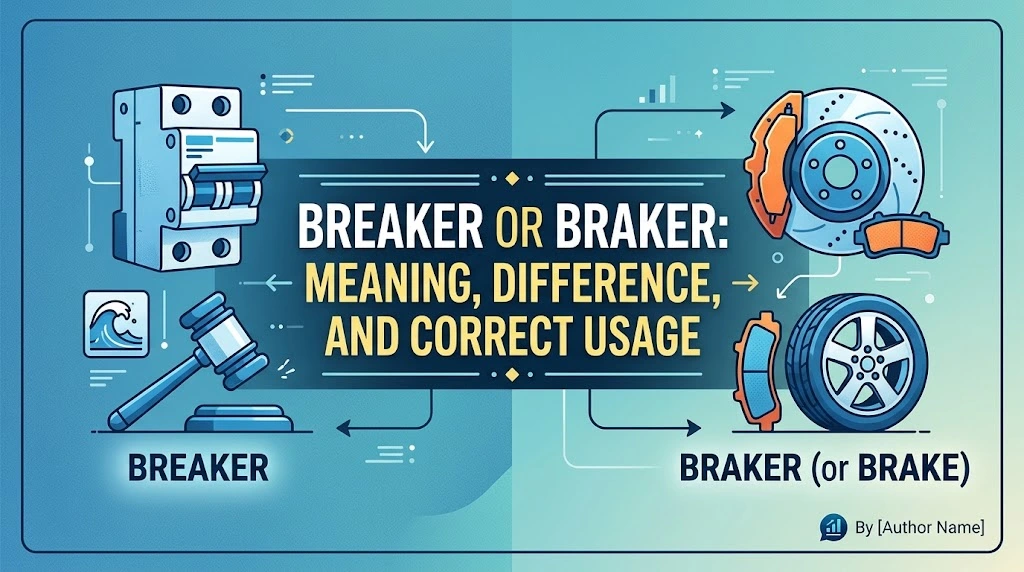
Breaker or braker? These two words look almost identical, and that small spelling difference can cause a surprisingly big change in meaning.
The confusion usually comes from two different verbs: break and brake. A breaker relates to break, while a braker relates to brake. However, English doesn’t use both forms equally. Breaker is a common, established word with many meanings and compounds. Braker exists too, but it’s much less common and usually appears in specialized contexts.
If you’re writing about electrical systems, ocean waves, records, rules, or machines, breaker is often the word you need. If you’re talking specifically about someone or something that applies a brake, braker can technically fit the meaning, although everyday English often uses a more natural alternative.
This guide explains breaker vs. braker, their meanings, pronunciation, grammar, common mistakes, and practical usage examples.
Breaker or Braker: The Quick Answer
The simplest way to remember the difference is this:
- Breaker comes from break.
- Braker comes from brake.
- Breaker is common in standard English.
- Braker is a real but uncommon word.
- Circuit breaker is correct.
- Circuit braker is incorrect.
- Record breaker is correct.
- Record braker is incorrect.
- For vehicles, brake, braking, or brake operator is usually more natural than braker.
Here’s the basic comparison:
| Word | Comes from | Basic meaning | Commonness |
| Breaker | Break | Someone or something that breaks | Very common |
| Braker | Brake | Someone or something that brakes | Uncommon |
| Break | — | To damage, separate, interrupt, or violate | Very common |
| Brake | — | To slow or stop a vehicle or machine | Very common |
So, if you’re unsure, don’t simply look at the spelling. Look at the meaning first.
What Does “Breaker” Mean?
Breaker is a noun formed from the verb break. It can describe a person, object, force, or device that breaks something.
The word has several established meanings. That’s one reason you’ll encounter breaker much more often than braker.
For example:
The breaker shut off the electricity.
Here, breaker refers to an electrical device designed to interrupt a circuit.
But consider this sentence:
The surfer waited for the next breaker.
Now breaker means a wave that breaks as it approaches shore.
The spelling stays the same. The meaning changes with context.
Breaker as Someone Who Breaks Something
A breaker can refer to a person who breaks something.
For example:
- a lawbreaker breaks the law
- a record breaker surpasses an existing record
- a rule breaker violates a rule
- a codebreaker solves or breaks a code
English frequently combines breaker with another word to create a compound noun.
Breaker as an Electrical Device
One of the most familiar uses is circuit breaker.
A circuit breaker protects an electrical circuit by interrupting current when the electrical conditions become unsafe, such as during an overload or short circuit.
For example:
The circuit breaker tripped when too many appliances were running.
A breaker can normally be reset after the fault has been addressed, depending on the type of system and the nature of the fault.
This is why circuit breaker is standard terminology.
You wouldn’t normally write:
The circuit braker tripped.
That spelling changes the word into something related to brake, which isn’t what an electrical circuit does.
Breaker as a Wave
A breaker can also mean a wave that breaks.
You might see sentences such as:
Several large breakers rolled toward the beach.
In this context, breaker has nothing to do with electricity, vehicles, or braking. It comes directly from the verb break because the wave breaks.
Breaker as a Tool or Machine
The word can also describe equipment designed to break, crush, split, or demolish something.
For example, construction and industrial settings use terms such as hydraulic breaker for equipment designed to break concrete, rock, or other hard materials.
Again, the connection is straightforward:
break → breaker
The device performs an action associated with breaking.
What Does “Braker” Mean?
Braker is formed from the verb brake.
In its most literal sense, a braker can mean someone or something that brakes.
The verb brake means to slow down or stop a moving vehicle, machine, or mechanism by using a braking system.
For example:
The operator acted as the braker during the test.
The word is understandable because English often creates nouns with the -er suffix.
Compare:
- drive → driver
- teach → teacher
- work → worker
- break → breaker
- brake → braker
However, there’s an important catch.
English doesn’t use every possible -er form equally often.
A word can be grammatically understandable without becoming common everyday vocabulary. Braker falls into that category.
In ordinary conversation, people generally say driver, brake operator, person applying the brakes, or simply describe the braking action instead.
For example:
The driver braked suddenly.
That sentence sounds natural.
The braker braked suddenly.
That sentence is grammatically understandable but much less natural.
Breaker vs. Braker: The Key Difference
The main difference is the verb behind each noun.
Breaker comes from break.
Braker comes from brake.
That distinction becomes easier when you examine what each root verb means.
| Root word | Meaning | Derived noun |
| break | Damage, split, interrupt, violate, or cause something to stop working | breaker |
| brake | Slow or stop a moving vehicle or machine | braker |
Consider these examples:
The child broke the window.
→ The person who breaks something could be described as a breaker.
Now:
The driver braked before the intersection.
→ Someone performing the braking action could theoretically be called a braker, although that noun isn’t normally needed.
The two words therefore have different semantic roots.
Why “Breaker” Is Usually the Correct Choice
The word breaker has become deeply established in English.
You’ll find it in everyday language, technical terminology, compound nouns, and specialized fields.
Some examples include:
- circuit breaker
- icebreaker
- lawbreaker
- record breaker
- codebreaker
- breaker point
- breaker panel
- hydraulic breaker
- wave breaker
These aren’t random combinations. They’re established terms with recognizable meanings.
By comparison, braker has a much narrower role.
That’s why someone writing about electrical equipment should use breaker, even though electrical equipment may stop a system in a way that feels vaguely similar to braking.
The correct choice comes from the word’s established meaning, not from what the action superficially resembles.
Breaker or Braker in Different Contexts
Context makes the distinction much easier.
Breaker in Electrical Systems
When discussing electrical circuits, breaker is the standard term.
Common expressions include:
- circuit breaker
- breaker panel
- breaker box
- main breaker
- branch breaker
- breaker switch
For example:
The electrician checked the breaker panel.
And:
The main breaker was turned off before the work began.
Calling it a braker panel would be a spelling error.
Breaker With Ocean Waves
In ocean and surfing terminology, breaker refers to a wave that breaks.
For example:
The boat moved beyond the breakers.
The word comes from break, because the wave breaks as it reaches shallow water or otherwise collapses.
Breaker With Rules and Laws
A person who violates a law can be called a lawbreaker.
Similarly, someone who violates rules can be called a rule breaker.
Examples:
The judge sentenced the convicted lawbreaker.
He’s known as a rule breaker at work.
The word braker wouldn’t work here because the person isn’t applying a brake.
Breaker With Records
A person who surpasses an existing record can be described as a record breaker.
For example:
The athlete became a record breaker after setting a new national mark.
You may also encounter the adjective record-breaking:
She delivered a record-breaking performance.
Notice the relationship:
break → breaker → breaking
The spelling remains connected to break, not brake.
Breaker With Machines and Tools
In mechanical and construction contexts, breaker can refer to equipment designed to break hard materials.
A hydraulic breaker, for example, uses mechanical force to fracture materials such as concrete and rock.
A sentence might read:
The crew used a hydraulic breaker to remove the concrete slab.
This has nothing to do with a vehicle’s braking system.
Breaker or Braker in Cars and Vehicles
Vehicle terminology creates much of the confusion.
Cars have brakes, not breaks.
You might say:
- brake pedal
- brake pads
- brake fluid
- brake rotor
- brake system
- braking distance
- emergency braking
- brake lights
For example:
Press the brake pedal gently.
And:
The car’s braking system needs inspection.
The verb is brake:
The driver braked before the corner.
It isn’t:
The driver breaked before the corner.
The past tense of brake is braked.
Is “Braker” Correct for a Person Driving a Car?
Technically, braker can be formed from brake, but it’s not the normal everyday word for someone who uses a vehicle’s brakes.
English speakers normally say:
The driver braked.
rather than:
The braker braked.
If you need a noun, alternatives such as driver or brake operator may communicate the role more naturally depending on the context.
That’s an important distinction between possible word formation and normal usage.
Break vs. Brake: The Root of the Confusion
The easiest way to understand breaker or braker is to understand break vs. brake.
What Does “Break” Mean?
Break has many meanings.
It can mean to:
- damage something
- separate something
- interrupt something
- violate a rule
- end a period of activity
- surpass a record
- cause something to stop functioning
Examples include:
Don’t break the glass.
Let’s take a break.
She broke the school record.
He broke the rules.
The machine broke down.
The noun breaker grows naturally from several of these meanings.
What Does “Brake” Mean?
Brake has a much narrower meaning.
It relates primarily to slowing or stopping motion.
Examples include:
Brake slowly on wet roads.
The driver pressed the brake.
The mechanic replaced the brake pads.
The car’s braking performance improved.
So remember:
Break = damage, separate, interrupt, violate, or surpass.
Brake = slow or stop movement.
Breaker, Braker, Brake, and Breaking Compared
These four forms can look confusing when placed together.
| Word | Part of speech | Main meaning | Example |
| Break | Verb/noun | Separate, damage, interrupt, etc. | Don’t break the glass. |
| Brake | Verb/noun | Slow or stop movement | Brake before the turn. |
| Breaker | Noun | Something or someone that breaks | The circuit breaker tripped. |
| Braker | Noun | Someone or something that brakes | The term appears mainly in specialized usage. |
| Breaking | Verb/adjective | The act of breaking | The breaking point was reached. |
| Braking | Verb/adjective | The act of slowing or stopping | The braking system needs service. |
One letter changes the root. The meaning follows that root.
Common Mistakes With Breaker and Braker
Some mistakes appear again and again because break and brake are homophones in standard American English.
That means they generally sound alike even though they have different spellings and meanings.
Mistake: “Circuit Braker”
Incorrect:
The circuit braker tripped.
Correct:
The circuit breaker tripped.
The electrical device is a breaker.
Mistake: “Record Braker”
Incorrect:
She became a record braker.
Correct:
She became a record breaker.
A record is broken, not braked.
Mistake: “Brake the Rules”
Incorrect:
He always brakes the rules.
Correct:
He always breaks the rules.
Rules are broken.
Mistake: “Break the Car”
If you mean slowing the vehicle, the correct word is:
Brake the car.
However, break the car means damage the car.
That tiny spelling difference creates two completely different statements.
Breaker or Braker: Example Sentences
Seeing the words in context makes the distinction stick.
Examples of “Breaker”
The electrician replaced the damaged breaker.
The main breaker controls power to the building.
The surfer watched the incoming breakers.
He’s a notorious rule breaker.
The runner became a national record breaker.
The construction crew rented a hydraulic breaker.
The ship moved carefully through the breakers.
Examples Related to “Brake”
The driver pressed the brake.
The mechanic inspected the brake pads.
She braked before reaching the intersection.
The vehicle needs better braking performance.
The driver applied the brakes suddenly.
Possible Specialized Uses of “Braker”
A specialized technical document may use braker to identify a person or mechanism involved in braking.
However, readers shouldn’t automatically assume that every person who uses a brake needs the noun braker.
In most everyday writing, a clearer alternative exists.
For example:
The driver applied the brakes.
This is usually clearer than:
The braker applied the brakes.
The first sentence tells readers exactly who acted.
Is “Braker” a Real Word?
Yes. Braker can function as a noun formed from brake.
But being a real word doesn’t make it equally common in every situation.
English contains thousands of words that are technically valid yet uncommon, specialized, regional, historical, or context-dependent.
That distinction matters.
Consider the difference between these statements:
“Braker is impossible English.”
and:
“Braker exists but is uncommon in ordinary English.”
The second statement is more precise.
A dictionary entry or specialized technical usage can establish that a word exists. Actual frequency and context determine whether it sounds natural to a particular audience.
That’s why braker shouldn’t automatically be labeled a spelling mistake. Instead, ask whether the writer actually means someone or something that brakes.
Is “Braker” the Person Who Brakes a Car?
This question deserves a careful answer.
Braker can logically describe someone who brakes. However, ordinary English usually doesn’t need that noun.
A person driving a car is a driver.
If the sentence focuses on the action, English naturally uses the verb:
The driver braked suddenly.
If it focuses on the equipment, use terms such as:
braking system
or:
brake operator
depending on the specific context.
The important lesson is simple: don’t force an uncommon noun when a familiar expression communicates the idea better.
Breaker or Braker in American English
In US English, breaker appears frequently in established everyday and technical expressions.
Think about common terms such as:
- circuit breaker
- breaker box
- breaker panel
- icebreaker
- lawbreaker
- record breaker
- codebreaker
By contrast, braker isn’t a common everyday label for drivers.
This doesn’t mean the word can never occur. Specialized terminology can behave differently from ordinary conversation.
When writing for a broad US audience, clarity should guide the choice.
Pronunciation of Breaker and Braker
There is another interesting part of this confusion: breaker and braker have essentially the same pronunciation in standard American English.
The difference appears in spelling and meaning rather than in ordinary pronunciation.
The same thing happens with:
- break / brake
- breaking / braking
That makes the words homophones.
You can hear the difference only when you see the spelling or understand the context.
For example:
The breaker tripped.
versus:
The braker applied the brake.
When spoken, the distinction between breaker and braker isn’t obvious. Writing has to carry the meaning.
A Simple Memory Trick for Breaker vs. Braker
Here’s an easy way to remember the difference:
Breaker → break → something gets broken.
Braker → brake → something slows or stops.
You can also connect common compounds to their roots.
Break Family
- break
- breaker
- breaking
- broken
- lawbreaker
- record breaker
- codebreaker
Brake Family
- brake
- brakes
- braked
- braking
- braker
When you see the word breaker, think break.
When you see braker, think brake.
That small mental shortcut prevents most spelling mistakes.
A Practical Decision Guide
When you’re unsure which spelling to use, ask one question:
What does the person or thing actually do?
If it breaks, use breaker.
If it brakes, braker may technically describe it, although another term may sound more natural.
Here’s a quick decision table:
| Intended meaning | Correct/common choice |
| Electrical device that interrupts current | Breaker |
| Person who violates a law | Lawbreaker |
| Person who violates rules | Rule breaker |
| Person who surpasses a record | Record breaker |
| Wave that breaks | Breaker |
| Construction tool that breaks material | Breaker |
| Vehicle stopping mechanism | Brake |
| Action of slowing a vehicle | Braking |
| Person driving and using brakes | Driver is usually more natural |
| Someone or something specifically described as braking | Braker may occur in specialized contexts |
Case Study: One Letter, Two Completely Different Meanings
Imagine a mechanic writes:
“The car needs a new breaker.”
That sentence immediately raises a question. What kind of breaker?
Now imagine the mechanic writes:
“The car needs new brake pads.”
The meaning is instantly clear.
Here’s another example:
“The breaker tripped during the storm.”
Most readers will understand this as an electrical breaker.
Now change one letter:
“The braker tripped during the storm.”
The sentence becomes strange because braker doesn’t naturally describe an electrical safety device.
The lesson isn’t simply “one spelling is right.”
The deeper lesson is that English words carry established meanings that readers recognize from context.
Breaker or Braker: What Should You Write?
For most everyday writing, use breaker when the intended meaning relates to break.
Use brake and braking when you’re discussing vehicles or mechanical slowing.
Use braker only when the context genuinely calls for a noun meaning someone or something that brakes, especially in specialized writing.
If you’re writing for a general audience, clarity usually improves when you choose a familiar phrase instead.
For example:
Less natural:
The braker reacted quickly.
More natural:
The driver braked quickly.
Or:
The driver applied the brakes quickly.
The second versions leave less room for confusion.
Frequently Asked Questions About Breaker or Braker
Is “braker” a correct English word?
Yes. Braker can be used as a noun related to the verb brake, meaning someone or something that brakes. However, it’s uncommon compared with breaker and often unnecessary in everyday English.
Is “breaker” or “braker” correct?
Both words can exist, but they don’t have the same meaning. Breaker relates to break, while braker relates to brake. The correct choice depends on the intended meaning.
Is “circuit braker” correct?
No. The standard term is circuit breaker.
A circuit breaker is an electrical protection device. The word comes from break, because it interrupts the electrical circuit.
Is “record braker” correct?
No. The standard expression is record breaker.
Someone who surpasses a record breaks it. They don’t brake it.
Is “braker” the normal word for someone who brakes a car?
No. Although braker can theoretically describe someone who brakes, everyday English normally uses driver or simply describes the action with braked.
Are “breaker” and “braker” pronounced the same?
In standard American English, they are generally pronounced alike. Their distinction comes from spelling and meaning.
What is the difference between “break” and “brake”?
Break can mean damage, separate, interrupt, violate, or surpass. Brake means to slow or stop a moving vehicle or machine.
Is “breaker” always related to something being broken?
Not in exactly the same way in every context. The word has several established meanings, but its vocabulary history connects it to break. For example, a wave is called a breaker because it breaks.
Should you use “braker” in ordinary writing?
Usually, no. If you’re discussing vehicles, driver, brake, braking, or another specific term will usually sound more natural.
Breaker or Braker: Final Takeaway
The difference between breaker and braker starts with two verbs that sound alike but mean different things.
Break and brake share a pronunciation in standard American English. Their meanings, however, are distinct.
From break, English gets breaker, a common word used in expressions such as circuit breaker, lawbreaker, record breaker, and wave breaker.
From brake, English can form braker, meaning someone or something that brakes. Yet this word is relatively uncommon, and everyday English usually chooses a clearer alternative.
Keep this simple rule handy:
If it breaks, think “breaker.” If it brakes, think “brake.”
When you’re writing about vehicles, use brake and braking for the system and action. When you’re writing about electrical circuits, records, rules, waves, or breaking tools, breaker is generally the established choice.
The spelling may differ by one letter. The meaning doesn’t.
Quick Reference
| If you mean… | Use… |
| Electrical safety device | Breaker |
| Circuit protection | Circuit breaker |
| Person who breaks a law | Lawbreaker |
| Person who violates a rule | Rule breaker |
| Person who surpasses a record | Record breaker |
| Wave that breaks | Breaker |
| Tool that breaks hard material | Breaker |
| Vehicle stopping mechanism | Brake |
| Action of slowing a vehicle | Braking |
| Past-tense action | Braked |
| Rare noun for someone or something that brakes | Braker |
Once you connect each word to its root, breaker vs. braker becomes much easier to remember. Break gives you breaker. Brake gives you braker. The context tells you which family you need.
