

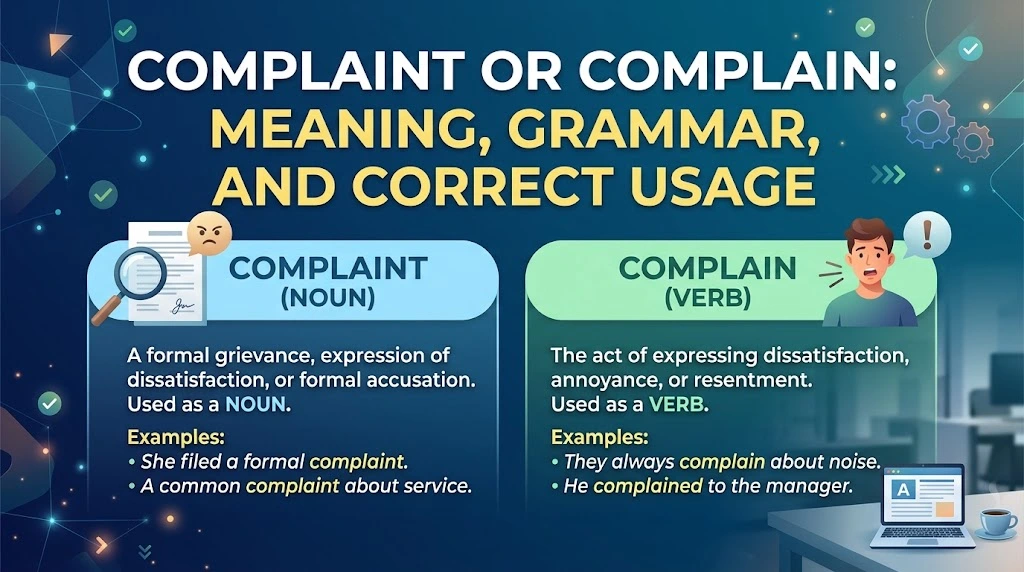
Complaint or complain can look like a tiny vocabulary question, but the difference matters whenever you write or speak English. The two words share the same basic idea, yet they perform completely different grammatical jobs.
Complain is a verb. It describes the action of expressing dissatisfaction, annoyance, pain, or a problem.
Complaint is a noun. It refers to the dissatisfaction, grievance, or expression itself.
Compare these two sentences:
- I complained about the poor service.
- I made a complaint about the poor service.
Both sentences communicate a similar idea. However, the grammar changes because complained is a verb while complaint is a noun.
Once you understand that basic distinction, the rest becomes much easier. You can then choose the right word in emails, workplace messages, customer-service requests, academic writing, and everyday conversations.
Complaint or Complain at a Glance
The fastest way to remember the difference is to identify each word’s grammatical role.
| Word | Part of speech | Basic meaning | Example |
| Complain | Verb | To express dissatisfaction or a problem | I complained about the delay. |
| Complaint | Noun | An expression of dissatisfaction or a grievance | I made a complaint about the delay. |
| Complained | Past-tense verb | Expressed dissatisfaction | She complained to the manager. |
| Complaining | Present participle/gerund | Expressing dissatisfaction | He keeps complaining about the noise. |
| Complaints | Plural noun | More than one complaint | The company received several complaints. |
| Complainer | Noun | A person who complains frequently | Nobody wants to be known as a constant complainer. |
A useful rule is simple:
Complain is an action. Complaint is a thing, statement, or grievance.
Think of it this way. If someone does the complaining, use complain. If you are talking about the complaint itself, use complaint.
What Does “Complain” Mean?
Complain means to express dissatisfaction, annoyance, pain, or concern.
It is a verb, so it normally tells you what someone does.
For example:
- I complain when a service doesn’t match what I paid for.
- She complained about the loud music.
- The customers complained to the manager.
- He often complains about his workload.
- Several passengers complained that the flight was delayed.
The word doesn’t always describe unreasonable behavior. Someone can complain about a legitimate problem.
For instance, if a customer receives the wrong order, saying, “The customer complained about the order” simply reports what happened. It doesn’t automatically mean the customer behaved badly.
Complain as a Verb
Because complain is a verb, it changes according to tense and subject.
| Tense or form | Example |
| Present | I complain about poor service. |
| Third-person singular | She complains about the temperature. |
| Past | They complained about the delay. |
| Present participle | He is complaining about the noise. |
| Perfect | We have complained several times. |
| Infinitive | I don’t want to complain. |
Notice the spelling in complained and complaining.
The basic verb remains complain, but its form changes depending on the grammatical context.
How to Use “Complain” in a Sentence
Several sentence patterns commonly follow complain. Learning these patterns helps you avoid awkward constructions.
Complain About Something
Use complain about when you identify the thing causing dissatisfaction.
Examples:
- She complained about the service.
- They complained about the noise.
- He complained about the price.
- Customers complained about the long wait.
- We complained about the damaged package.
This is probably the most common structure in everyday English.
Complain That Something Happened
You can also follow complain with a clause introduced by that.
Examples:
- She complained that the room was too cold.
- The customer complained that the order arrived late.
- Employees complained that the new schedule was inconvenient.
- He complained that nobody had explained the changes.
Here, the that-clause explains the problem or situation causing dissatisfaction.
Complain To Someone
Use complain to when you identify the person or organization receiving the complaint.
For example:
- I complained to the manager.
- She complained to customer service.
- They complained to the landlord.
- We complained to the airline.
You can combine to and about:
I complained to the manager about the service.
The distinction is useful:
- to the manager = who received the complaint
- about the service = what caused the complaint
Complain Of Something
Complain of has a somewhat different use.
It commonly appears when someone reports pain, illness, discomfort, or symptoms.
Examples:
- The patient complained of severe stomach pain.
- She complained of a headache.
- The child complained of feeling sick.
- The patient complained of chest discomfort.
In everyday speech, complain about may also appear in similar situations. However, complain of has a particularly established use in medical and formal contexts.
Examples of “Complain”
Context makes the meaning much clearer. Here are examples from common situations.
Customer Service
The customer complained about the damaged product.
Workplace
Several employees complained about the new schedule.
School
Students complained that the classroom was too hot.
Travel
Passengers complained to the airline about the canceled flight.
Home
My neighbor complained about the noise.
Health
The patient complained of persistent back pain.
Everyday Conversation
Stop complaining and help me carry these boxes.
That final example shows another common use. Complain can describe repeated expressions of dissatisfaction rather than a formal grievance.
What Does “Complaint” Mean?
Complaint is a noun.
It can refer to an expression of dissatisfaction, a specific grievance, or a formal statement about a problem.
For example:
- I made a complaint about the service.
- The company received several complaints.
- Your complaint has been forwarded to the relevant department.
- The manager reviewed the customer’s complaint.
Unlike complain, the word complaint names the thing being discussed.
Compare:
The customer complained about the delivery.
with:
The customer made a complaint about the delivery.
The meaning is closely related. The grammar is different.
How to Use “Complaint” in a Sentence
Because complaint is a noun, it often appears with determiners such as a, the, my, your, or several.
For example:
- a complaint
- the complaint
- my complaint
- your complaint
- several complaints
- customer complaints
You can also use common noun phrases such as make a complaint, file a complaint, and lodge a complaint.
Make a Complaint
Make a complaint means to formally or informally express dissatisfaction.
Examples:
I want to make a complaint about the service.
She made a complaint to the manager.
This construction is grammatically correct. However, in casual conversation, people often simply use the verb:
I want to complain about the service.
Both are natural. The second version is generally more direct.
File a Complaint
File a complaint usually sounds more formal.
It often appears in customer-service, workplace, government, regulatory, or legal contexts.
Examples:
The customer filed a complaint with the company.
Employees can file a complaint through the internal reporting system.
The phrase suggests that the complaint has been formally submitted or recorded.
Lodge a Complaint
Lodge a complaint also means to make a formal complaint.
It is common in formal English and is particularly familiar in British and international English.
For example:
The passenger lodged a complaint with the airline.
In everyday American English, file a complaint or simply make a complaint may sound more familiar depending on the context.
Examples of “Complaint”
Here are examples showing how the noun works in different settings.
| Context | Example |
| Customer service | The company received a complaint about the product. |
| Workplace | She submitted a complaint to HR. |
| Restaurant | The manager handled the customer’s complaint. |
| Housing | The landlord received a complaint about the plumbing. |
| Travel | The airline investigated the passenger’s complaint. |
| School | The principal reviewed the parent’s complaint. |
| Formal process | The agency accepted the complaint for review. |
The common thread is grammatical. Complaint functions as a noun in every example.
Complaint vs. Complain: The Grammar Difference
The clearest distinction appears when you place the words into parallel sentences.
| Verb: Complain | Noun: Complaint |
| I complained about the food. | I made a complaint about the food. |
| She complained to the manager. | She made a complaint to the manager. |
| They complained about the delay. | They submitted a complaint about the delay. |
| He complains about the noise. | His complaint concerns the noise. |
A common mistake is treating complaint as though it were a verb.
Incorrect:
I complaint about the service.
Correct:
I complain about the service.
Another common mistake goes the other direction.
Incorrect:
I made a complain about the service.
Correct:
I made a complaint about the service.
The ending -t in complaint is an easy visual clue that you’re dealing with the noun.
Complaint as a Countable Noun
In its ordinary meaning, complaint is a countable noun.
That means you can talk about:
- a complaint
- two complaints
- several complaints
- many complaints
- the complaint
- customer complaints
Examples:
We received one complaint yesterday.
The company received twenty complaints during the month.
Several complaints concerned delivery times.
The plural form is complaints, not complaintes or another modified spelling.
Complain as a Verb: Forms and Tenses
Understanding the verb forms makes the difference even easier.
Present Tense
I complain when something goes wrong.
She complains about almost everything.
Remember the third-person singular -s:
- I complain
- you complain
- we complain
- they complain
- he complains
- she complains
- it complains
Past Tense
The past form is complained.
We complained about the delay yesterday.
Present Participle
The -ing form is complaining.
He is complaining about the weather again.
Perfect Forms
You can also use complain in perfect constructions:
They have complained several times.
She had complained before the manager arrived.
These forms still describe an action because the underlying word remains a verb.
“Complain About” vs. “Complain Of”
These expressions overlap in meaning, but they aren’t interchangeable in every context.
Complain About
Use complain about for something that causes dissatisfaction or annoyance.
She complained about the noise.
He complained about his workload.
The customer complained about the poor service.
Complain Of
Use complain of especially when reporting physical symptoms, pain, or discomfort.
The patient complained of severe pain.
He complained of dizziness.
She complained of stomach discomfort.
The phrase complain of can sound more formal than complain about. Medical writing frequently uses it when describing symptoms reported by a patient.
Quick Comparison
| Expression | Typical use | Example |
| Complain about | Dissatisfaction with something | She complained about the delay. |
| Complain of | Pain, illness, or symptoms | She complained of chest pain. |
Context still matters. English isn’t a collection of rigid boxes. Some situations allow more than one natural construction.
“Complain To” vs. “Complain About”
This distinction becomes easy once you ask one question:
Who received the complaint?
Use to for the recipient.
I complained to the manager.
Then ask:
What was the complaint about?
Use about for the subject.
I complained about the service.
Put both together:
I complained to the manager about the service.
This structure is extremely useful in workplace and customer-service writing.
More Examples
She complained to the landlord about the broken heater.
The passengers complained to the airline about the cancellation.
We complained to the restaurant manager about the incorrect order.
In each sentence, to identifies the recipient. About identifies the problem.
“Make a Complaint” vs. “Complain”
Both expressions are correct, but they use different grammatical structures.
Complain is a verb:
I want to complain about this charge.
Make a complaint uses the noun:
I want to make a complaint about this charge.
The first version is shorter and more direct. The second can sound more formal or deliberate.
For most everyday conversations, complain is perfectly natural.
For a formal customer-service process, make a complaint can fit well.
“File a Complaint” and “Lodge a Complaint”
Formal settings often use specific verbs with complaint.
File a Complaint
File a complaint suggests formally submitting a complaint for review or record.
Examples:
She filed a complaint with the company.
The employee filed a formal complaint.
Lodge a Complaint
Lodge a complaint has the same broad idea of formally submitting a complaint.
Examples:
The passenger lodged a complaint with the airline.
Residents lodged complaints about the construction work.
In US English, file a complaint is often the more familiar formal expression.
Common Mistakes With Complaint and Complain
The difference seems simple until these words appear in real sentences. Here are the mistakes that cause the most trouble.
Mistake: “I Complaint About It”
Incorrect:
I complaint about the problem.
Correct:
I complain about the problem.
Why? Because the sentence needs a verb after the subject I.
Mistake: “I Made a Complain”
Incorrect:
I made a complain.
Correct:
I made a complaint.
After made a, you need the noun.
Mistake: “She Complaint to the Manager”
Incorrect:
She complaint to the manager.
Correct:
She complained to the manager.
The past-tense verb is complained.
Mistake: Confusing the Recipient and Subject
Consider:
I complained to the manager about the price.
Here, the manager receives the complaint. The price causes the dissatisfaction.
Changing the prepositions can change the meaning or make the sentence awkward.
Complaint or Complain in Formal Writing
Formal writing often uses complaint when describing an official process.
For example:
The department received a formal complaint regarding the service.
The complaint was reviewed by the appropriate team.
Customers may file a complaint through the company’s online portal.
However, formal writing doesn’t require the noun every time.
This sentence is also professional:
The customer complained about the delay.
The best choice depends on what the sentence needs grammatically.
Don’t choose complaint simply because it sounds more formal. Choose it because the sentence requires a noun.
Complaint or Complain in Everyday Conversation
Everyday speech tends to favor the simpler verb.
Instead of:
I want to make a complaint about the weather.
A person might naturally say:
I want to complain about the weather.
Instead of:
He made a complaint about his workload.
You might hear:
He complained about his workload.
Neither construction is automatically better. They simply package the same general idea differently.
Complaint, Complain, Complainer, and Complaining
These related words can be confusing because they share the same root.
| Word | Function | Example |
| Complain | Verb | Don’t complain about every little thing. |
| Complaint | Noun | We received a complaint. |
| Complained | Past-tense verb | She complained yesterday. |
| Complaining | -ing verb form/gerund | He is complaining again. |
| Complainer | Noun for a person | He’s becoming a constant complainer. |
| Complaints | Plural noun | The office received several complaints. |
What Is a Complainer?
A complainer is someone who complains, particularly someone who does so frequently.
For example:
He’s known as a constant complainer.
The word can carry a negative tone. It may suggest that the person’s complaints are excessive or repetitive.
That’s different from simply saying:
He complained about the broken equipment.
The second sentence makes no judgment about whether the complaint was reasonable.
Complaint vs. Grievance
Complaint and grievance overlap, but they aren’t always interchangeable.
A complaint can describe almost any expression of dissatisfaction.
A grievance often refers to a specific concern about unfair treatment, working conditions, rights, or another perceived wrong. The word frequently appears in formal workplace or institutional settings.
Compare:
The customer made a complaint about the delayed delivery.
The employee filed a grievance over the disciplinary decision.
The second example suggests a more formal dispute involving a particular perceived wrong.
Complaint vs. Criticism
A complaint expresses dissatisfaction with something.
Criticism involves pointing out faults, weaknesses, or problems.
These ideas can overlap.
For example:
Her complaint was about the restaurant’s slow service.
His criticism focused on the restaurant’s menu.
A complaint often carries a practical desire for something to change. Criticism may simply evaluate or identify weaknesses.
The distinction depends heavily on context.
Complaint vs. Claim
Claim has several meanings, so context matters.
A complaint generally expresses dissatisfaction or raises a grievance.
A claim can be a statement that something is true. In other contexts, it can be a formal request for money, compensation, or another benefit.
For example:
The customer made a complaint about the damaged package.
The customer submitted an insurance claim for the damaged package.
The first concerns dissatisfaction. The second requests compensation under an insurance arrangement.
Pronunciation of Complaint and Complain
Pronunciation can help reinforce the difference.
Complain is commonly pronounced:
/kəmˈpleɪn/
The stress falls on the second syllable.
Complaint is commonly pronounced:
/kəmˈpleɪnt/
Again, the main stress falls on the second syllable.
The words sound very similar. The key difference is the final t sound in complaint.
That final sound also reflects the grammatical difference in writing.
A Simple Memory Trick for Complaint or Complain
Here’s an easy rule:
Complain = do. Complaint = thing.
If someone does something, you need the verb:
She complains about the service.
If you’re naming the issue or expression itself, use the noun:
She made a complaint about the service.
Another useful test is to look at the words around it.
Words That Often Follow “Complain”
- complain about
- complain to
- complain that
- complain of
- complain about the price
- complain to the manager
Words That Often Follow “Complaint”
- a complaint
- the complaint
- my complaint
- customer complaint
- formal complaint
- make a complaint
- file a complaint
- lodge a complaint
- complaint about something
- complaint against someone
These patterns make the distinction much easier to recognize.
Quick Comparison Examples
The following pairs show how the same idea can use either form.
| Verb construction | Noun construction |
| She complained about the food. | She made a complaint about the food. |
| He complained to the manager. | He made a complaint to the manager. |
| They complained about the noise. | They submitted a complaint about the noise. |
| I complained about the charge. | I filed a complaint about the charge. |
| Customers complained about delays. | Customers submitted complaints about delays. |
Notice something important: changing complain to complaint usually requires changing the surrounding grammar too.
You can’t simply swap the words and leave the sentence untouched.
Practical Case Study: A Customer Service Problem
Imagine that a customer orders a jacket online. The package arrives late and the item has the wrong size.
You could describe the situation several ways.
Informal
The customer complained about the wrong size.
More detailed
The customer complained to customer service about the incorrect size.
Formal
The customer filed a complaint regarding the incorrect item.
Reporting multiple customers
The company received several complaints about incorrect sizes.
Each sentence works because the writer understands the grammatical role of the word.
The meaning stays connected. The structure changes.
Practical Case Study: A Workplace Problem
Suppose employees dislike a new work schedule.
You could write:
Several employees complained about the new schedule.
If the organization formally records the issue:
Several employees submitted complaints about the new schedule.
If an employee formally initiates a process:
One employee filed a formal complaint with HR.
The choice between complain and complaint depends on whether you’re describing an action or naming the grievance.
Useful Facts About Complaint and Complain
A few grammatical facts are worth keeping in mind:
- Complain is a verb.
- Complaint is a noun.
- Complained is the simple past and past participle of complain.
- Complaining is the present participle and gerund form.
- Complaints is the plural of complaint.
- Complain about commonly introduces the subject of dissatisfaction.
- Complain to commonly identifies the person or organization receiving the complaint.
- Complain of commonly introduces pain, illness, or symptoms.
- Make a complaint is grammatically correct.
- File a complaint generally suggests a formal submission.
- Lodge a complaint also describes a formal complaint.
- Complaint is normally countable when referring to a specific grievance.
Frequently Asked Questions About Complaint or Complain
Is “complaint” a noun or a verb?
Complaint is a noun. It refers to an expression of dissatisfaction, grievance, or formal objection.
Correct:
I made a complaint.
Incorrect:
I complaint about the service.
Use complain when you need the verb.
Is “complain” a noun?
In standard modern English, complain functions primarily as a verb.
For the noun, use complaint.
She complained about the noise.
She made a complaint about the noise.
Is “make a complaint” correct?
Yes. Make a complaint is grammatically correct.
For example:
I would like to make a complaint about the service.
You can also say:
I would like to complain about the service.
Should you say “complain about” or “complain to”?
Both are correct, but they answer different questions.
Complain about identifies the subject of dissatisfaction.
She complained about the price.
Complain to identifies the person or organization receiving the complaint.
She complained to the manager.
You can use both:
She complained to the manager about the price.
Is “file a complaint” formal?
Yes. File a complaint generally sounds more formal than simply complain.
It commonly describes submitting a complaint through an official process.
What is the plural of “complaint”?
The plural is complaints.
Example:
The company received several complaints.
Is “complained” the past tense of “complain”?
Yes.
Present: They complain about the service.
Past: They complained about the service.
Can you say “complaint about”?
Yes.
For example:
We received a complaint about the delivery.
Here, complaint is a noun followed by the preposition about.
Can you say “complaint against”?
Yes. Complaint against is common when identifying the person or organization that a formal complaint concerns.
For example:
The agency received a complaint against the company.
The exact meaning depends on the context and the type of formal process involved.
Complaint or Complain: The Fastest Way to Choose
When you’re unsure, stop and identify the job the word needs to perform.
Ask:
Am I describing an action?
Use complain.
They complained about the service.
Am I naming the grievance or expression of dissatisfaction?
Use complaint.
They submitted a complaint about the service.
Then check the sentence structure.
Use “Complain” When:
- A subject performs the action.
- You need a verb.
- You’re describing someone expressing dissatisfaction.
- You want to say someone complained about something.
- You want to say someone complained to someone.
Use “Complaint” When:
- You need a noun.
- You’re naming a grievance.
- You’re talking about an official submission.
- You need phrases such as a complaint, complaints, or the complaint.
- You’re using expressions such as make a complaint or file a complaint.
Final Takeaway: Complaint or Complain?
The difference between complaint and complain comes down to one basic grammatical distinction.
Complain is a verb. Complaint is a noun.
Use complain when you describe the action:
I complained about the delay.
Use complaint when you name the grievance:
I made a complaint about the delay.
From there, several useful patterns fall into place:
- complain about something
- complain to someone
- complain of pain or symptoms
- make a complaint
- file a complaint
- lodge a complaint
- receive a complaint
- submit a complaint
The easiest memory trick remains:
Complain = action. Complaint = thing.
Once that distinction becomes automatic, choosing between the two words gets much easier. Whether you’re writing a customer-service email, describing a workplace issue, or having an everyday conversation, the correct form will usually reveal itself from the sentence structure.
If needed, this article can also be expanded with a source-backed etymology section, more real-world examples, and a concise SEO FAQ section while keeping the same writing style.
