

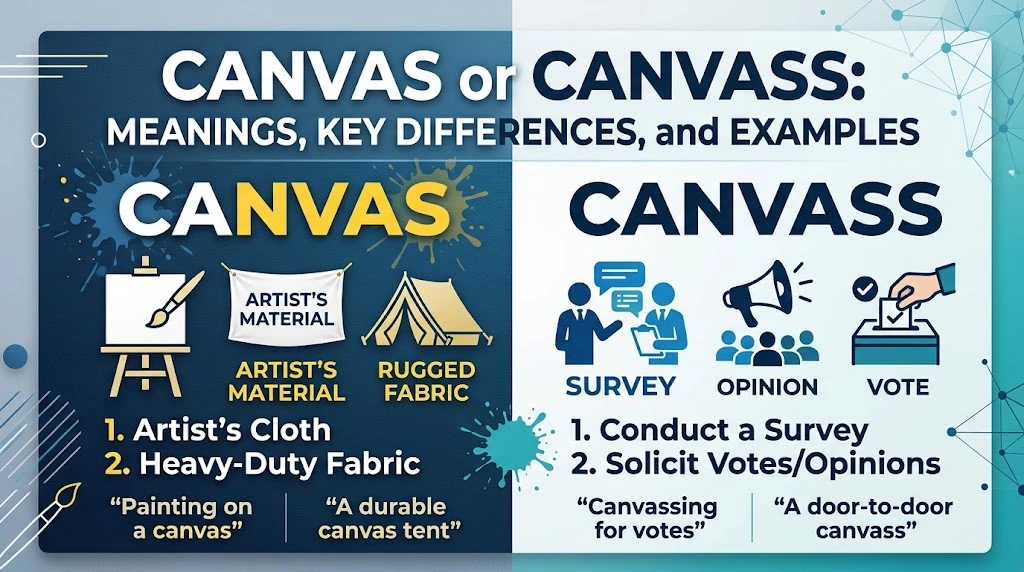
Canvas or canvass? These two words look almost identical, but they don’t mean the same thing.
The difference comes down to one extra letter and a completely different idea. Canvas usually refers to a strong fabric, an artist’s painting surface, or a digital working area. Canvass, on the other hand, usually means to ask people for opinions, votes, support, information, or responses.
That small spelling difference matters. Writing canvas voters when you mean canvass voters changes the word and can make the sentence confusing.
Fortunately, the distinction becomes easy once you connect each spelling with its main meaning.
Quick rule: Think canvas = surface and canvass = ask.
This guide explains canvas vs. canvass in detail, including definitions, pronunciation, grammar, examples, common mistakes, related forms, and practical memory tricks.
Canvas vs. Canvass: Quick Answer
The simplest distinction is this:
| Word | Main meaning | Common use | Example |
| Canvas | A strong fabric or surface | Art, bags, tents, shoes, digital design | She painted the landscape on canvas. |
| Canvass | To ask people for opinions, votes, support, or information | Elections, surveys, business, investigations | Volunteers canvassed the neighborhood. |
Canvas has several established meanings, but most involve some kind of material or surface.
Canvass usually involves talking to or contacting people to gather something, such as opinions or support.
Consider these two sentences:
- The artist stretched the canvas over a wooden frame.
- The volunteers canvassed the neighborhood.
The first sentence involves a physical material. The second involves people being contacted.
Canvas or Canvass at a Glance
| Feature | Canvas | Canvass |
| Spelling | One s at the end | Two s letters at the end |
| Typical role | Noun | Usually a verb |
| Main idea | Material, surface, or workspace | Asking or contacting people |
| Art-related | Yes | No |
| Fabric-related | Yes | No |
| Election-related | Usually no | Yes |
| Survey-related | Sometimes indirectly | Yes |
| Digital design-related | Yes | No |
| Person who canvasses | — | Canvasser |
So, if you can replace the word with “ask” or “contact people,” canvass is probably the word you need.
If you’re talking about fabric, painting, or a surface, choose canvas.
What Does Canvas Mean?
Canvas is primarily a noun. It refers to a durable woven fabric that people use for many practical and artistic purposes.
The word also describes a surface used for painting. In modern technology, canvas can describe a digital area where graphics or other visual content appear.
The exact meaning depends on context.
For example:
- The tent is made from heavy canvas.
- The painter covered the canvas with bright colors.
- The designer created the illustration on a digital canvas.
All three sentences use canvas correctly.
Canvas as a Fabric
Canvas is a sturdy woven textile traditionally associated with materials such as cotton or linen.
Manufacturers can produce canvas in different weights and finishes. Heavy canvas can withstand considerable wear, which explains its long history in outdoor equipment, bags, workwear, and other products.
You may encounter canvas in:
- Tents
- Backpacks
- Tote bags
- Shoes
- Work aprons
- Outdoor covers
- Sails
- Upholstery
- Tool bags
- Artist materials
The word doesn’t describe one single weight or construction. Canvas products vary depending on their intended use.
A lightweight canvas tote bag, for example, feels very different from the heavy canvas used for industrial equipment.
Canvas as an Art Surface
Artists commonly use canvas as a surface for painting.
A traditional artist’s canvas usually consists of fabric stretched across a frame. The fabric may receive a prepared coating before the artist applies paint.
Canvas works particularly well for painting because it provides a stable surface while remaining relatively lightweight compared with some rigid alternatives.
Oil and acrylic painters frequently use canvas. Artists can also work on other surfaces, including wood panels and paper.
Common canvas formats include:
- Stretched canvas
- Canvas panels
- Canvas boards
- Canvas rolls
- Pre-primed canvas
- Unprimed canvas
The phrase “on canvas” therefore refers to the surface rather than the act of painting itself.
For example:
The museum displayed several paintings on canvas.
Here, canvas means the material supporting the artwork.
Canvas in Figurative Language
The word canvas also appears in figurative expressions.
The best-known example is “a blank canvas.”
A blank canvas literally describes an unused surface ready for artwork. Figuratively, it describes something with room for development, creativity, or transformation.
For example:
The empty room became a blank canvas for the designer.
The room isn’t literally made of painting fabric. Instead, the writer compares the room to an unused artistic surface.
You might also hear:
- A blank canvas
- A fresh canvas
- Painted across the canvas
- A canvas for creativity
These expressions preserve the central idea of a surface that can receive something new.
Canvas as a Digital or Design Term
Canvas has also become common in technology.
A digital canvas is an area where users can draw, design, arrange objects, or display visual content.
For example, graphic design software may provide a canvas where you place text, images, shapes, and illustrations.
Web development uses the term in a more technical way too. The HTML <canvas> element provides a drawing surface that scripts can use to render graphics.
That gives canvas another modern meaning without changing its basic concept.
The underlying idea remains a surface or workspace.
For example:
Drag the image onto the canvas and resize it.
Here, canvas doesn’t mean fabric. It means the digital area where the design appears.
What Does Canvass Mean?
Canvass has a completely different meaning.
As a verb, canvass means to ask people for information, opinions, votes, support, or responses.
It often involves contacting people individually or systematically.
For example:
The volunteers canvassed residents about the proposed project.
The volunteers aren’t painting anything. They’re speaking with residents to gather information or support.
Other examples include:
- The organization canvassed customers about service quality.
- Volunteers canvassed voters before the election.
- Investigators canvassed the neighborhood for witnesses.
- The company canvassed employees for suggestions.
In each example, people are being contacted.
Canvass as a Verb
The verb canvass can take different objects depending on the situation.
You can:
- Canvass voters
- Canvass residents
- Canvass customers
- Canvass employees
- Canvass a neighborhood
- Canvass opinions
- Canvass support
- Canvass for information
The meaning changes slightly with context, but the central idea remains the same: systematically seeking information, opinions, support, or responses.
For example:
The researchers canvassed residents about traffic problems.
This means the researchers contacted residents to learn what they thought or experienced.
Canvass as a Noun
Canvass can also function as a noun, although this use is less common in everyday conversation.
A canvass can refer to the act or process of gathering opinions, votes, information, or responses.
For example:
The organization conducted a canvass of local residents.
Here, canvass refers to the organized effort to gather responses.
The noun appears more often in formal, political, journalistic, or organizational writing.
Canvass in Elections and Politics
Election-related writing provides one of the clearest examples of canvass.
Campaign volunteers may canvass voters by visiting homes, making calls, sending messages, or otherwise contacting people to discuss the campaign and gather information or support.
For example:
Volunteers spent Saturday canvassing voters in the district.
The spelling canvass is correct because the volunteers are contacting people.
However, election terminology has another important use that readers sometimes confuse with campaign canvassing.
An official canvass of election results can refer to the formal process of compiling, checking, certifying, or finalizing election results under applicable election rules.
That is different from campaign volunteers going door to door.
The surrounding context tells you which meaning applies.
Campaign Canvassing vs. Election Canvass
| Phrase | Meaning |
| Canvass voters | Contact voters to gather opinions, information, or support |
| Canvass a neighborhood | Contact people throughout an area |
| Canvass public opinion | Seek people’s views |
| Election canvass | Formal process associated with compiling or finalizing election results |
These uses share the same spelling but describe different activities.
Canvass for Information or Opinions
Canvassing isn’t limited to elections.
Businesses, researchers, community organizations, journalists, and investigators can all canvass people.
Imagine a restaurant wants to understand why customers aren’t returning. Staff might canvass customers for feedback.
A community organization could canvass residents about a proposed development.
Researchers might canvass households to collect responses.
An investigator might canvass a neighborhood looking for witnesses.
The common thread is systematic inquiry.
For example:
The manager canvassed employees for ideas before changing the schedule.
The manager asked employees for suggestions.
Another example:
Reporters canvassed the area for witnesses after the incident.
The reporters contacted people in the area to see whether anyone had useful information.
Canvas vs. Canvass: Key Differences
The easiest way to understand canvas vs. canvass is to focus on the core concept behind each word.
Canvas is a thing or surface.
Canvass is an action involving people or information.
That distinction covers most everyday situations.
| If you’re talking about… | Use |
| Painting material | Canvas |
| A sturdy textile | Canvas |
| A tote bag material | Canvas |
| A tent material | Canvas |
| A digital drawing area | Canvas |
| Asking voters for support | Canvass |
| Asking residents for opinions | Canvass |
| Seeking customer feedback | Canvass |
| Gathering information from witnesses | Canvass |
| Systematically asking people questions | Canvass |
A Simple Context Test
When you’re unsure, ask yourself:
Am I talking about a surface or about asking people?
If it’s a surface, use canvas.
If it’s about asking people, use canvass.
Compare:
He bought a canvas for the painting.
You can imagine the physical material.
Now compare:
He canvassed the neighborhood.
You can imagine him contacting people.
The two words may look like siblings, but they do different jobs.
Canvas vs. Canvass Pronunciation
In standard US English, canvas and canvass are pronounced essentially the same way.
Both are commonly pronounced approximately like:
KAN-vəs
The final syllable sounds like the unstressed “vuhs” in both words.
That creates an important spelling problem: you usually can’t hear the extra s.
When someone says:
We need to canvass the neighborhood.
You can’t rely on pronunciation to tell whether they mean canvas or canvass.
You have to use the context.
This is why the distinction often causes problems in writing rather than conversation.
Why Pronunciation Doesn’t Solve the Problem
Many word pairs become easier when their sounds differ.
That’s not the case here.
Canvas → /ˈkæn.vəs/
Canvass → /ˈkæn.vəs/
The pronunciations are essentially identical in standard American English.
So don’t try to solve the spelling question by sounding the word out.
Instead, identify the meaning first.
Canvas vs. Canvass Examples
Examples make the difference much easier to remember.
Examples With Canvas
- The artist painted the portrait on canvas.
- She bought a heavy canvas backpack.
- The tent uses waterproof canvas.
- The designer opened a new digital canvas.
- The empty room felt like a blank canvas.
- He stretched the canvas over the wooden frame.
Every example involves a material, surface, workspace, or figurative version of a surface.
Examples With Canvass
- Volunteers canvassed the neighborhood.
- The researchers canvassed residents for their opinions.
- The company canvassed customers for feedback.
- The campaign organized volunteers to canvass voters.
- Investigators canvassed the area for witnesses.
- The organization canvassed members about the proposed changes.
Every example involves seeking information, opinions, support, or responses.
Side-by-Side Examples
| Canvas | Canvass |
| She painted on canvas. | She canvassed the neighborhood. |
| The bag is made from canvas. | The team canvassed customers. |
| He prepared a new canvas. | They canvassed voters. |
| The artist stretched the canvas. | Researchers canvassed residents. |
| The designer created a digital canvas. | Investigators canvassed the area. |
The contrast becomes obvious when the words appear side by side.
Common Mistakes With Canvas and Canvass
The most common mistake involves using canvas as the verb when the writer means ask or contact people.
For example:
Incorrect:
The volunteers canvased the neighborhood.
Correct:
The volunteers canvassed the neighborhood.
The correct spelling contains two s letters at the end: canvass.
Another common error goes in the opposite direction.
Incorrect:
The painter worked on canvass.
Correct:
The painter worked on canvas.
Here, the writer has added an unnecessary second s.
Common Error Patterns
| Incorrect | Correct | Why |
| canvas voters | canvass voters | Contacting voters |
| paint on canvass | paint on canvas | Painting surface |
| a canvass bag | a canvas bag | Fabric |
| canvasing residents | canvassing residents | Asking residents |
| canvased the area | canvassed the area | Past tense of canvass |
Spelling becomes especially important in formal writing, journalism, academic work, and business communication.
Canvas vs. Canvass in Different Contexts
Context provides a useful shortcut.
Art
Use canvas.
The artist prepared a large canvas.
Fashion and Products
Use canvas when describing the fabric.
The company makes durable canvas shoes.
Construction and Outdoor Equipment
Use canvas when referring to the material.
The workers covered the equipment with canvas.
Technology
Use canvas for a digital drawing or visual workspace.
Place the objects on the canvas.
Elections
Use canvass when describing efforts to contact voters.
Volunteers canvassed voters throughout the district.
Use canvass or canvass of results when referring to the formal election process, depending on the jurisdiction and context.
Surveys and Research
Use canvass when people are being contacted to gather responses.
Researchers canvassed households for information.
Business
Use canvass when an organization actively seeks opinions or information.
The company canvassed customers before launching the new service.
Related Words and Forms
Understanding related forms can prevent spelling mistakes.
Canvas
Common forms include:
- canvas
- canvases
The plural of canvas is canvases.
For example:
The gallery displayed several large canvases.
Don’t confuse canvases with canvasses. They come from different words.
Canvass
Common forms include:
- canvass
- canvasses
- canvassed
- canvassing
- canvasser
For example:
She canvasses the neighborhood every weekend.
They canvassed several communities.
The volunteers are canvassing voters.
Each canvasser received training.
The spelling changes slightly when adding endings.
Canvasser
A canvasser is a person who canvasses.
For example:
The canvasser asked residents about their concerns.
The double s remains part of the word family.
Canvas or Canvass: A Useful Memory Trick
Here’s an easy way to keep the words straight:
Canvas = Create
Think:
Canvas → creativity → painting
If you’re creating something on a surface, think canvas.
Canvass = Contact
Think:
Canvass → contact people
If you’re asking people for opinions, information, votes, or support, think canvass.
You can also remember the extra s as representing seeking.
Canvass = seek information or support.
It’s not a formal spelling rule. It’s simply a memory aid.
Canvas vs. Canvass: A Mini Decision Guide
When you’re writing and hesitate between the two, run through these questions:
Is it a painting surface?
→ Canvas
Is it a type of fabric?
→ Canvas
Is it a digital drawing area?
→ Canvas
Are people being asked for opinions?
→ Canvass
Are voters being contacted?
→ Canvass
Are customers being asked for feedback?
→ Canvass
Are investigators seeking information from people?
→ Canvass
This quick test handles most real-world examples.
A Closer Look at the Grammar
The grammatical behavior of these words also helps distinguish them.
Canvas most commonly functions as a noun.
Examples:
- The canvas is stretched tightly.
- She bought three canvases.
- The digital canvas is empty.
It can appear in compound terms too:
- Canvas shoes
- Canvas bag
- Canvas tent
- Canvas board
Canvass commonly functions as a verb.
Examples:
- They canvass voters.
- She canvassed residents.
- The organization is canvassing customers.
It can also appear as a noun:
- The canvass revealed several concerns.
- The election canvass continued after voting ended.
Grammar doesn’t provide an absolute rule because canvas can have specialized uses as a verb and canvass can function as a noun. Still, these patterns cover most everyday writing.
Case Study: How One Letter Changes the Meaning
Consider this sentence:
The volunteers canvas the neighborhood.
At first glance, the sentence looks plausible.
However, the intended meaning probably involves volunteers visiting or contacting residents. In that context, the correct sentence is:
The volunteers canvass the neighborhood.
Now change the subject:
The artist canvasses the neighborhood.
That could technically suggest the artist is contacting people, but it doesn’t mean the artist is painting.
If the intended meaning is that the artist paints on a surface, the sentence needs canvas as a noun:
The artist paints on canvas.
The lesson is simple: don’t choose the spelling based on how similar the words look. Choose it based on meaning.
Frequently Asked Questions About Canvas or Canvass
Is it canvas or canvass for voters?
Use canvass.
Volunteers canvassed voters before the election.
The verb means they contacted voters to seek information, opinions, or support.
Is canvas a verb?
Yes, canvas can function as a verb in some specialized contexts, although its noun use is much more common.
For most everyday writing, you’ll encounter canvas as a material, painting surface, or digital workspace.
What does canvassing mean?
Canvassing means systematically contacting or asking people for information, opinions, votes, support, or responses.
The exact purpose depends on context.
Is canvassing always political?
No.
Political campaigns commonly canvass voters, but businesses, researchers, organizations, investigators, and community groups can also canvass people.
For example:
The company canvassed customers for feedback.
That’s not a political activity.
What is the plural of canvas?
The standard plural is canvases.
The gallery displayed five canvases.
What is the plural of canvass?
When used as a noun, the plural is canvasses.
The two forms differ:
- canvases = plural of canvas
- canvasses = plural of canvass
Do canvas and canvass sound the same?
Yes. In standard US English, they are generally pronounced the same way.
That means context and spelling do the work that pronunciation can’t.
Is it canvas bag or canvass bag?
It’s canvas bag.
A canvas bag is made from canvas fabric.
Is it canvass opinions or canvas opinions?
It’s canvass opinions.
The verb canvass means to seek people’s opinions or responses.
Is it a blank canvas or blank canvass?
It’s blank canvas.
The phrase refers to an unused surface that can receive artwork. Figuratively, it describes something open to development or change.
Canvas vs. Canvass: The Difference in One Sentence
If you’re talking about fabric, painting, a surface, or a digital workspace, use canvas.
If you’re talking about asking or contacting people for information, opinions, votes, or support, use canvass.
That single distinction resolves most spelling questions.
Final Takeaway: Canvas or Canvass?
Canvas and canvass differ by only one letter, but their meanings are far apart.
Canvas refers primarily to a strong fabric or a surface used for painting. The word also appears in digital design and figurative expressions such as “blank canvas.”
Canvass refers primarily to the act of asking or contacting people. You might canvass voters, residents, customers, employees, or witnesses.
Keep this shortcut in mind:
Canvas = surface.
Canvass = ask.
Once you connect the spelling to the meaning, canvas vs. canvass becomes much easier to handle. Whether you’re writing about art, fabric, technology, business, research, or elections, the context usually tells you which word belongs on the page.
