

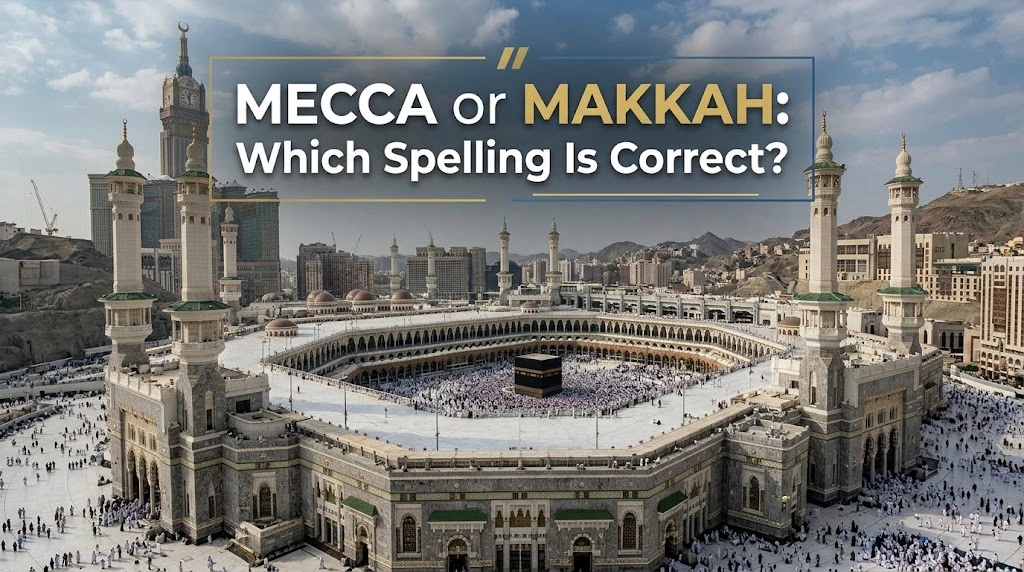
If you’ve seen Mecca and Makkah used for the same city, you’re not imagining things. Both spellings appear across English-language books, maps, news reports, travel websites, and religious writing.
So which one is correct?
The answer depends on what you mean by “correct.” Makkah is the modern standardized romanized form used in official Saudi and United Nations geographic contexts. Mecca is a long-established English conventional name for the same city.
In other words, Mecca and Makkah are not two different places. They represent the Arabic name مكة in different English naming traditions.
For formal geographic writing, Makkah is generally the better choice when you want to follow modern official romanization. However, Mecca remains a legitimate and widely recognized English place name.
This distinction becomes much clearer once you understand how Arabic names enter English.
Mecca or Makkah: The Quick Answer
Makkah is the standardized romanized form of the Arabic name مكة used in modern Saudi geographic naming and listed by the United Nations Group of Experts on Geographical Names (UNGEGN).
Mecca, meanwhile, is the traditional English form. It has appeared in English for centuries and remains widely understood.
Here’s the basic difference:
| Feature | Makkah | Mecca |
| Arabic name | مكة | مكة |
| Refers to the same city | Yes | Yes |
| Modern Saudi official usage | Common | Less preferred |
| UN romanized geographic form | Makkah | No |
| Traditional English usage | Less traditional | Very established |
| Directly reflects Arabic romanization | Yes | No |
| Appropriate in English | Yes | Yes |
| Common in older English sources | Less common | Very common |
So, if you’re writing a formal article about Saudi Arabia, geography, Islamic history, or pilgrimage, Makkah is a strong choice.
If you’re discussing an older English source or using established English terminology, Mecca may appear naturally.
The important point is consistency. Pick the form that fits your audience and style guide, then use it consistently.
What Is the Difference Between Mecca and Makkah?
The difference isn’t geographical. It’s linguistic.
The Arabic name is:
مكة
When Arabic names are written using the Latin alphabet, writers must choose a romanization system. That process can produce different spellings.
Makkah attempts to represent the Arabic name more directly. Mecca developed as a conventional English name through centuries of English-language usage.
Think of it like a name traveling between languages. The original name stays connected to the same place, but its spelling can change as it moves into another writing system.
This happens with many geographical names.
For example, Arabic names can have several English spellings because different systems represent Arabic sounds differently. Historical spellings may also become deeply established before modern standardization takes place.
That’s essentially what happened with Mecca.
Makkah represents modern romanization
The spelling Makkah is much closer to the Arabic form Makkah/Makka when represented in Latin letters.
The doubled k reflects the Arabic letter ك in the relevant romanization convention, while the final h helps represent the Arabic ending.
It isn’t an English translation of the city’s name.
It’s a romanized form.
Mecca represents an established English name
Mecca developed differently.
English speakers encountered the city’s name through historical religious, geographical, and literary sources. Over time, “Mecca” became the conventional English name.
That means you shouldn’t automatically treat every appearance of “Mecca” as a spelling mistake.
It has a substantial history in English.
Is Makkah the Correct Spelling?
If “correct” means the modern standardized romanized geographic name, then Makkah is the stronger answer.
The United Nations Group of Experts on Geographical Names lists Makkah as the romanized form of the city’s Arabic name.
The UNGEGN geographic database identifies the city as Makkah and associates it with Saudi Arabia.
You can check the relevant UN geographic-name record through the UNGEGN geographical names database.
Saudi Arabia also uses Makkah extensively in contemporary official English-language material.
That usage matters because geographical names aren’t simply spelling preferences. Governments, mapping agencies, international organizations, and other institutions need consistent names for databases and communication.
Why official standardization matters
Imagine an international geographic database containing several unrelated spellings for every city.
Search systems could become harder to maintain. Maps could become inconsistent. Government records could use different forms. Travelers might encounter unnecessary confusion.
Standardization helps reduce those problems.
For that reason, modern official usage often favors Makkah.
Is Mecca an Incorrect Spelling?
No. Calling Mecca simply “wrong” misses an important distinction.
Mecca is an established English conventional name for the city.
It has a long history in English and remains widely recognized by English speakers.
The key distinction is between a standardized romanization and a conventional English name.
These aren’t always identical.
A conventional name can survive for centuries even when an authority later promotes a different standardized form.
That doesn’t automatically erase the older name from the English language.
Conventional names are common worldwide
English doesn’t always use direct romanizations of foreign geographical names.
Consider familiar places such as:
- Munich rather than München
- Cologne rather than Köln
- Florence rather than Firenze
- Rome rather than Roma
- Vienna rather than Wien
Different languages develop their own conventional forms.
The same basic phenomenon applies to Mecca.
The important difference is that Makkah has become increasingly prominent in modern official and international usage.
Makkah in Arabic: مكة
The Arabic name of the city is written:
مكة
Arabic uses a completely different writing system from English.
When you write an Arabic geographical name in English, you need to represent Arabic letters with Latin characters.
That process is called romanization.
Romanization doesn’t mean translating the meaning of a name. Instead, it represents the original name using another alphabet.
Transliteration vs. romanization
These terms sometimes get used interchangeably, but there can be subtle differences.
Transliteration usually means representing characters from one writing system using characters from another according to a defined correspondence.
Romanization specifically means representing a language using the Roman or Latin alphabet.
So when مكة becomes Makkah, you’re dealing with romanization.
You’re not translating the city’s name into a completely different English word.
This distinction explains why Makkah looks much closer to the Arabic form than Mecca does.
How Do You Pronounce Makkah?
English speakers commonly pronounce Makkah approximately like:
MAK-kuh
The exact Arabic pronunciation involves sounds and distinctions that English doesn’t reproduce perfectly.
That’s an important point with romanized words. A Latin spelling can guide pronunciation, but it can’t always capture every feature of the original language.
The same issue occurs when English speakers pronounce names from Arabic, Chinese, Japanese, Russian, or other languages.
Why Makkah has two k’s
The double k isn’t decorative.
It reflects the Arabic consonant structure represented by كّ in fully marked Arabic writing, where the shadda indicates consonant doubling.
Arabic spelling normally appears without many vowel marks in ordinary writing, but pronunciation and grammatical context can provide information that isn’t obvious from the bare letters.
The spelling Makkah therefore gives English readers a closer indication of the original consonant structure than Mecca does.
Why Does Mecca Appear So Often in English?
There’s a simple reason: Mecca has been used in English for a very long time.
Before modern international geographic standardization became widespread, English writers developed conventional forms for many foreign places.
Once a spelling becomes established, it can persist through books, newspapers, dictionaries, maps, educational materials, and everyday speech.
That creates linguistic momentum.
Even after another spelling becomes preferable in official contexts, the older form doesn’t disappear overnight.
Historical English usage matters
For generations, English-language readers encountered terms such as:
- Mecca
- Meccan
- Mecca pilgrimage
- Mecca mosque
- Mecca in Arabia
Those forms became familiar.
As a result, Mecca remains deeply embedded in English vocabulary.
This is one reason a search for the “correct” spelling can produce confusing results. You’re looking at two naming traditions rather than a simple right-versus-wrong spelling dispute.
When Did Makkah Become the Preferred Official Form?
Modern Saudi official usage increasingly favors Makkah.
Saudi geographical-name standardization has played an important role in promoting Arabic-derived forms in English.
The Saudi Press Agency has reported on the use of Makkah rather than the older English form Mecca in official contexts.
For contemporary Saudi institutions, this distinction can be significant.
A government website isn’t necessarily trying to preserve historical English conventions. It may instead follow the country’s preferred English romanization.
That’s why official Saudi material frequently uses forms such as:
- Makkah
- Madinah
- Al-Madinah Al-Munawwarah
- Jeddah
- Riyadh
The spelling Makkah fits this broader approach to representing Arabic geographical names.
Mecca vs. Makkah in Official and Geographic Sources
Different sources can use different naming conventions.
That doesn’t necessarily mean one source made a mistake.
| Context | Common form |
| Arabic | مكة |
| UN geographic romanization | Makkah |
| Saudi official English usage | Makkah |
| Traditional English references | Mecca |
| Older English books | Mecca |
| Modern Islamic writing | Makkah or Mecca |
| Academic writing | Depends on style guide |
| General English writing | Mecca or Makkah |
The most important question is what naming standard the source follows.
A publication following modern geographic romanization may choose Makkah.
A historical English text may retain Mecca.
Neither choice changes the city’s identity.
Makkah in Modern Saudi Arabia
Walk through modern Saudi government communication and you’ll frequently encounter Makkah.
For example, Saudi government and ministry websites use Makkah in English-language materials.
The Saudi Ministry of Hajj and Umrah uses Makkah-related terminology in its English and Arabic communications.
This is especially relevant because Makkah isn’t merely a geographic location. It’s the destination of the annual Hajj pilgrimage and the location of Masjid al-Haram, Islam’s most sacred mosque.
Millions of pilgrims visit the city each year.
Because international visitors come from many countries, consistent English terminology has practical value.
Why Makkah Is Important for Geographic Naming
Geographic names serve more purposes than simply identifying places.
They appear in:
- Maps
- Passports and travel documents
- Government databases
- Airport information
- Navigation systems
- Academic publications
- Tourism websites
- Emergency services
- International news
- Digital search systems
When a city has multiple English spellings, people can still understand them. However, databases work better when authorities establish preferred forms.
That’s one reason organizations such as UNGEGN work on geographical-name standardization.
A standardized name doesn’t erase historical usage
This distinction is worth remembering.
Standardization is about consistency.
It isn’t necessarily an attempt to declare every older spelling linguistically invalid.
You can think of it like a road sign.
A government may decide that one spelling should appear on official signs. That doesn’t instantly rewrite every book ever printed with another spelling.
When Should You Use Makkah?
Makkah works especially well when you’re writing in a formal or contemporary context.
Consider using it for:
- Geographic articles
- Academic writing
- Modern Saudi affairs
- Government-related content
- Islamic studies
- Travel guides focused on Saudi Arabia
- Pilgrimage information
- International geographic references
- Articles following Saudi terminology
If your publication has a style guide, follow that guide first.
For example, a publisher might instruct writers to use Makkah throughout.
In that situation, consistency matters more than switching between forms.
Example
Instead of alternating between spellings:
Mecca is located in Saudi Arabia. Many pilgrims travel to Makkah during Hajj. Mecca’s historic sites attract visitors.
A consistent approach is clearer:
Makkah is located in western Saudi Arabia. Millions of Muslims travel to Makkah for Hajj and Umrah.
If the audience may recognize only the traditional English spelling, you can introduce both:
Makkah (Mecca) is the holiest city in Islam.
After that, use the preferred form consistently.
When Is Mecca Appropriate?
Mecca remains appropriate in many English-language contexts.
You may encounter or use it when:
- Discussing historical English sources
- Quoting an older publication
- Writing for a general English-speaking audience
- Referring to established English terminology
- Preserving the wording of a historical source
- Discussing how English place names developed
There’s also a well-known figurative English use of mecca.
In lowercase, mecca can mean a place that attracts many people who share a particular interest.
For example:
Nashville is a mecca for country music fans.
That figurative use comes from the city’s name.
It has become a regular English vocabulary item even though its origin is a proper geographical name.
Mecca or Makkah for SEO?
If you’re creating online content, both terms deserve attention.
People search using the spelling they’re familiar with.
Some readers type:
- Mecca
- Makkah
- Mecca Saudi Arabia
- Makkah Saudi Arabia
- Mecca city
- Makkah city
- Mecca pilgrimage
- Makkah pilgrimage
- Mecca Hajj
- Makkah Hajj
A useful SEO strategy doesn’t require awkwardly repeating both words.
Instead, establish the relationship naturally.
For example:
Makkah, also widely known in English as Mecca, is a city in western Saudi Arabia and the destination of the annual Hajj pilgrimage.
That single sentence helps readers understand the terminology.
It also lets the article naturally address both search variants.
Don’t force keyword repetition
Search engines don’t need an article that says “Mecca or Makkah” every other sentence.
That makes the writing uncomfortable.
Instead, use related terminology where it genuinely fits:
- Makkah
- Mecca
- مكة
- Makkah, Saudi Arabia
- Mecca, Saudi Arabia
- Makkah city
- Masjid al-Haram
- Hajj
- Umrah
- pilgrimage
- Islamic holy city
The goal should be clarity and topical completeness, not keyword stuffing.
Mecca or Makkah in Travel Writing?
Travel writers face a slightly different challenge.
A reader may search Google for Mecca, while an official Saudi source may use Makkah.
Using both terms at the beginning can prevent confusion.
For example:
Makkah (Mecca), Saudi Arabia, is one of the world’s most significant religious destinations.
After that, choose one form and stick with it.
For a Saudi-focused travel guide, Makkah may align better with contemporary official terminology.
For a historical travel article written around older English sources, Mecca may fit the source material better.
The audience matters.
Makkah, Mecca, and Other Variants
You may also encounter spellings such as:
- Makkah
- Makka
- Mecca
- Mekka
These variations don’t necessarily indicate different places.
They reflect different transliteration systems, languages, historical conventions, or editorial choices.
Makkah
Makkah is the modern standardized form commonly used in Saudi and international geographic contexts.
Makka
Makka is another romanization that more directly reflects the Arabic consonants without adding the final h.
You may encounter it in scholarly or linguistic contexts.
Mekka
Mekka appears in some European languages and historical sources.
It’s particularly associated with languages whose spelling conventions differ from English.
Mecca
Mecca is the established English conventional form.
It remains familiar to a huge English-speaking audience.
The spelling therefore has historical and linguistic significance even when official geographic naming favors Makkah.
Is Makkah a Translation?
No.
Makkah isn’t an English translation of مكة.
It’s a romanized representation of the Arabic name.
That’s an important distinction.
A translation changes the meaning of a word into another language. A romanization changes its writing system.
For example, when Arabic text is converted into Latin letters, the goal is generally to make the original name readable using the Latin alphabet.
The city doesn’t receive a new geographical identity.
Only the written representation changes.
Why Place-Name Standardization Matters
At first glance, spelling a city’s name may seem like a minor issue.
For large international systems, it isn’t.
Consider how many databases might contain a city’s name:
- National mapping databases
- International maps
- Airline systems
- Hotel platforms
- Government records
- Postal databases
- Geographic information systems
- Search engines
- Academic datasets
- Navigation applications
A consistent standardized name makes these systems easier to connect.
Standardization also respects local naming
Modern geographic naming increasingly considers the names used by the countries and communities where places are located.
That matters particularly for cities with major international importance.
Makkah is a Saudi Arabian city with an Arabic name. Using Makkah in official English geographic contexts therefore provides a closer connection to contemporary local naming conventions.
A Practical Case Study: Writing a Hajj Guide
Imagine you’re writing a guide for first-time pilgrims.
Your first sentence says:
Mecca is the destination of Hajj.
Later, you write:
Makkah has many important pilgrimage locations.
The reader can understand both sentences, but the switching feels inconsistent.
A better approach would be:
Makkah (Mecca) is the destination of Hajj and home to Masjid al-Haram.
Then continue with Makkah throughout the guide.
This approach solves two problems.
First, readers who know the traditional English name immediately recognize the city.
Second, the article establishes the modern spelling you’ll use afterward.
That’s a small editorial decision, but it makes the whole article feel more polished.
Another Case Study: Historical Research
Now imagine you’re quoting an English book published decades ago.
The book repeatedly uses Mecca.
Changing every occurrence to Makkah could distort the historical wording.
If the passage is a direct quotation, preserve the source’s original spelling.
For example:
The historian referred to the city as “Mecca” throughout the original publication.
That’s different from writing a modern geographic article.
The context determines the appropriate editorial choice.
Common Mistakes With Mecca and Makkah
Several mistakes appear repeatedly in discussions about these spellings.
Mistake: Saying they are two different cities
They’re not.
Mecca and Makkah refer to the same city in Saudi Arabia.
Mistake: Calling Mecca a simple typo
Mecca isn’t a random misspelling.
It’s a well-established English conventional name.
Mistake: Assuming Makkah is an English translation
It isn’t.
It’s a romanized form of the Arabic name.
Mistake: Mixing spellings without reason
Switching between Mecca and Makkah every few sentences can make an article look poorly edited.
Choose a preferred form and stay consistent.
Mistake: Ignoring the source’s style guide
Academic publishers, governments, newspapers, and organizations may have their own naming conventions.
Their rules should take priority in that publication.
Mistake: Treating historical usage as modern official usage
Older books may strongly favor Mecca.
That doesn’t mean modern Saudi authorities use the same preferred form today.
Historical usage and current official usage are separate questions.
Mecca or Makkah: Which One Should You Use?
The answer becomes straightforward when context is considered.
| If you’re writing… | Practical choice |
| Modern Saudi geographic information | Makkah |
| UN-style geographic information | Makkah |
| Saudi government-related content | Makkah |
| Academic Islamic studies | Follow the publication’s style guide |
| General English content | Mecca or Makkah |
| Historical discussion | Preserve the source’s terminology |
| Direct quotation | Keep the original spelling |
| Travel content | Makkah, with Mecca introduced if useful |
| SEO content | Use Makkah naturally and acknowledge Mecca |
| A linguistic discussion | Explain both forms |
This isn’t about declaring one spelling acceptable and the other forbidden.
It’s about choosing the form that fits the purpose.
How to Write Mecca and Makkah Correctly
For most modern articles, one simple pattern works well:
Makkah (Mecca)
Introduce both forms once.
Then use Makkah consistently.
For example:
Makkah (Mecca) is located in western Saudi Arabia. The city is home to Masjid al-Haram and the Kaaba. Muslims around the world face the Kaaba during daily prayer.
This approach is especially useful when your readers come from different backgrounds.
Someone familiar with Mecca immediately understands the reference.
Someone accustomed to Makkah sees the preferred modern form.
No confusion. No unnecessary repetition.
Mecca or Makkah: A Quick Comparison
Here’s the entire issue in one table:
| Question | Answer |
| Are Mecca and Makkah the same place? | Yes |
| What is the Arabic name? | مكة |
| Is Makkah a romanization? | Yes |
| Is Mecca an established English name? | Yes |
| Does UNGEGN use Makkah? | Yes |
| Does modern Saudi official usage favor Makkah? | Yes |
| Is Mecca historically common in English? | Yes |
| Is Mecca simply a typo? | No |
| Should writers use both randomly? | No |
| Should the spelling match the publication’s style? | Yes |
Frequently Asked Questions About Mecca and Makkah
Is Makkah or Mecca correct?
Both forms refer to the same city, but they serve different naming traditions.
Makkah is the modern standardized romanized geographic form used by UN geographic-name resources and widely used in Saudi official English.
Mecca is a long-established conventional English name.
Is Makkah the same as Mecca?
Yes.
Makkah and Mecca are two English representations of the same Saudi Arabian city.
The Arabic name is مكة.
Why do Muslims often write Makkah?
Many Muslims and modern Islamic publications use Makkah because it stays closer to the Arabic name and contemporary Arabic-to-Latin transliteration.
The preference can also reflect a desire to use terminology closer to the original Arabic.
Why do English sources say Mecca?
English has used Mecca as a conventional name for centuries.
That historical usage became firmly established in English-language literature, maps, journalism, and education.
Should I write Mecca or Makkah?
Use the form that fits your audience, source, and style guide.
For contemporary Saudi geographic writing, Makkah is generally the more appropriate choice.
For historical English sources, Mecca may be the correct form to preserve.
What is Makkah called in Arabic?
The city’s Arabic name is:
مكة
The name can be romanized in different ways, including Makkah and Makka.
Is Makka correct?
Makka is a valid romanization that you may encounter in linguistic, academic, or other contexts.
However, Makkah is the standardized form commonly used in modern Saudi and international geographic contexts.
Is Mecca an English word?
Yes.
Mecca functions as an established English proper noun for the Saudi city.
The lowercase noun mecca has also developed a figurative English meaning: a place that attracts large numbers of people because of a particular interest.
For example:
The city became a mecca for jazz musicians.
That figurative usage comes from the city’s name.
What Major Sources Say
For readers who want to verify the terminology directly, several authoritative sources are useful.
The United Nations Group of Experts on Geographical Names provides geographic-name information and lists Makkah as the romanized form.
The Saudi Press Agency provides official Saudi reporting and uses contemporary Saudi geographical terminology.
The Saudi Ministry of Hajj and Umrah provides current information relating to Hajj, Umrah, and Makkah.
These sources are more useful for modern official terminology than simply counting how many times each spelling appears on the internet.
Search frequency and official naming aren’t the same thing.
The Bottom Line: Mecca or Makkah?
Makkah and Mecca are both established names for the same city.
The difference comes from language history and naming conventions rather than geography.
Makkah is the modern standardized romanized form used in contemporary Saudi official contexts and listed by UN geographic-name resources.
Mecca is the traditional English conventional form with a long and well-established history.
So, if you’re writing a modern geographic, Saudi, pilgrimage, or formal informational article, Makkah is usually the clearest choice.
If you’re discussing historical English writing or quoting an older source, Mecca may be exactly what the context requires.
The smartest approach isn’t to pretend one spelling erased the other. Instead, understand what each form represents.
Makkah is the modern standardized romanization. Mecca is the established conventional English name. Both refer to the same city.
For most modern articles, a simple first reference works beautifully:
Makkah (Mecca), Saudi Arabia
Then choose one spelling and use it consistently.
That small editorial decision keeps the writing accurate, reader-friendly, and aligned with modern geographic naming.
