

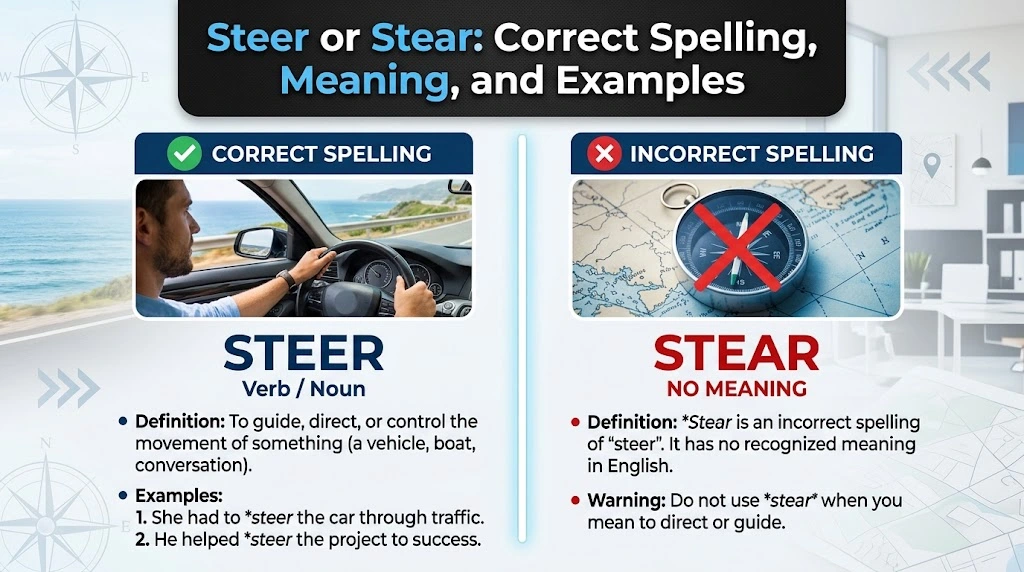
Steer or stear? If you’ve ever hesitated over these two spellings, you’re not alone. They look and sound similar enough to cause confusion, especially when you’re writing quickly.
The correct spelling for the common English word is steer. Depending on context, steer can mean to guide or control the direction of something, or it can refer to a male bovine, especially one raised for beef.
Stear isn’t the standard spelling when you mean steer in these everyday uses.
That small difference matters. A single letter can turn a correct sentence into a spelling error.
This guide explains the difference between steer and stear, including their meanings, grammatical forms, common expressions, sentence examples, and related words. By the end, you’ll know exactly when to use steer and why stear usually isn’t the word you’re looking for.
Steer or Stear: Which Spelling Is Correct?
When you’re choosing between steer or stear, use steer for the standard English word.
| Word | Standard English spelling? | Common meaning |
| Steer | Yes | To guide or control direction |
| Stear | Generally no for these meanings | Usually a misspelling of steer |
For example:
Correct: She learned how to steer the boat.
Incorrect: She learned how to stear the boat.
The same rule applies when you’re talking about guiding a person, conversation, or situation:
He tried to steer the conversation toward the main issue.
Not:
He tried to stear the conversation toward the main issue.
The confusion mostly comes from pronunciation. The vowel sound in steer doesn’t make the spelling immediately obvious. If you’ve mostly heard the word spoken rather than seen it written, stear can seem plausible.
Still, standard written English uses steer.
What Does “Steer” Mean?
The word steer has several meanings, but they all connect to direction or cattle.
As a verb, steer means to guide something in a particular direction. You can steer a car, boat, bicycle, or even an animal.
For example:
- She steered the car around the pothole.
- The captain steered the boat toward the harbor.
- He steered the horse toward the gate.
- She tried to steer the discussion back to the original topic.
The word also works figuratively. You can steer a person toward a decision or steer a situation in a particular direction.
For example:
Her mentor steered her toward a career in engineering.
Nobody is physically moving the person in this sentence. Instead, the mentor is influencing the person’s direction or choices.
Steer as a Noun
Steer also works as a noun.
In cattle terminology, a steer is generally a male bovine that has been castrated, especially one raised for beef.
For example:
The rancher raised several steers for the beef market.
This meaning is completely different from the verb steer, but the spelling is identical.
Context tells you which meaning applies.
Consider these two sentences:
He learned to steer the truck.
Here, steer is a verb.
The farmer bought three steers.
Here, steers is a plural noun referring to cattle.
Steer as a Verb: Main Meanings
The verb steer has a useful range of meanings. Its basic idea remains the same: directing something toward a particular path or outcome.
Guiding a Vehicle
The most familiar meaning involves controlling the direction of a vehicle.
She steered the car into the parking space.
Keep both hands on the wheel while you steer.
You can steer cars, trucks, buses, boats, bicycles, motorcycles, and other vehicles that require directional control.
Guiding an Animal
You can also steer an animal by directing where it moves.
The rider steered the horse toward the trail.
The animal doesn’t have to be mechanically controlled. The important idea is directing its movement.
Directing a Person
In figurative usage, steer can mean guiding someone’s choices or actions.
His teacher steered him toward a useful career path.
This meaning is common in conversations about education, careers, business, and personal decisions.
Directing a Conversation
A speaker can also steer a conversation.
Maria steered the conversation away from politics.
Here, steer means influence the subject or direction of the discussion.
Influencing an Outcome
You can steer a project, organization, or situation toward a particular result.
The manager steered the company toward a more sustainable business model.
Again, no literal steering wheel exists. The word creates a useful metaphor based on controlling direction.
What Does “Stear” Mean?
For ordinary modern English usage, stear isn’t the standard spelling of steer.
If you want to say that someone guides a vehicle, directs a conversation, or influences a situation, use steer.
For example:
Correct:
The driver knows how to steer through narrow streets.
Incorrect:
The driver knows how to stear through narrow streets.
That said, seeing stear doesn’t necessarily mean every appearance is meaningless. Words can occur as surnames, names, specialized terms, or historical forms. However, those specialized uses don’t make stear an interchangeable spelling of the ordinary English verb steer.
For everyday writing, the choice is simple:
Use steer.
Steer vs. Stear: Side-by-Side Comparison
A quick comparison makes the difference easier to remember.
| Feature | Steer | Stear |
| Standard spelling for “guide” | Yes | No |
| Used as a verb | Yes | Not as the standard form |
| Used as a cattle noun | Yes | No |
| Common in everyday English | Yes | No |
| Example | Steer the car carefully. | Usually incorrect in this context |
| Meaning “guide or direct” | Yes | No |
If you’re proofreading an article, email, school assignment, or business document, replace stear with steer whenever you intended the standard English word.
Examples of “Steer” in Sentences
Seeing the word in different contexts helps lock in the spelling.
Driving and Transportation
- Please steer the car slowly around the corner.
- He struggled to steer the truck through the narrow road.
- The driver steered around the fallen branch.
- She is learning how to steer a boat.
- The cyclist steered toward the open lane.
Conversations
- He tried to steer the conversation toward business.
- She steered the discussion away from personal matters.
- The moderator steered the meeting back to the agenda.
Advice and Decisions
- Her parents steered her toward a practical career.
- The counselor helped steer him toward better financial decisions.
- Good planning can steer a project toward success.
Avoidance
- We decided to steer clear of the crowded area.
- The driver steered away from the obstacle.
- She told her friend to steer clear of unnecessary arguments.
Cattle
- The rancher purchased several steers.
- The cattle buyer inspected the steer carefully.
- The farm raises steers for beef production.
Steer in Driving and Transportation
Few uses of steer are more familiar than driving.
When you drive a vehicle, you control its direction through the steering system. That’s why the verb steer naturally describes the action.
You might:
- steer left
- steer right
- steer around an obstacle
- steer toward a destination
- steer away from danger
- steer into a parking space
For example:
The driver saw the obstacle and quickly steered around it.
Notice how steer focuses on direction, not simply movement.
You can drive forward without changing direction much. However, when you steer, you’re deciding where the vehicle goes.
Steer vs. Drive
These words overlap, but they aren’t identical.
Drive usually describes operating a vehicle.
Steer specifically focuses on controlling its direction.
I drove to the store.
I steered around the construction zone.
The first sentence describes the overall act of operating the vehicle. The second highlights directional control.
Steer in Figurative English
Here’s where steer becomes especially useful.
English often uses physical movement as a metaphor for decisions and ideas. Think about phrases such as move forward, take a different path, or change direction. Steer fits naturally into the same pattern.
You can steer:
- A conversation
- A discussion
- A project
- A business
- A career
- A decision
- A relationship
- A situation
- Someone’s attention
For example:
The manager steered the team toward a practical solution.
Nobody is physically turning a steering wheel. The manager is influencing the team’s direction.
Likewise:
She steered the conversation away from the controversial topic.
The speaker changed the discussion’s direction.
This figurative use is extremely common in professional and everyday English.
Common Phrases With “Steer”
Several expressions containing steer appear frequently in modern English.
Steer Clear Of
Steer clear of means to avoid someone or something.
Steer clear of that road during the storm.
You should steer clear of unnecessary arguments.
The expression uses the idea of directing yourself away from something.
Steer Someone Toward Something
This phrase means to guide or influence someone toward a particular choice or direction.
Her advisor steered her toward a more affordable program.
Steer Away From
Steer away from means to direct someone or something away from a subject, place, action, or outcome.
The coach tried to steer the players away from distractions.
Steer the Conversation
This means to influence the topic or direction of a discussion.
He steered the conversation toward the upcoming project.
This expression works especially well in workplace and social contexts.
Steer Clear Of: Meaning and Usage
Among all the common expressions containing steer, steer clear of deserves special attention.
The phrase means to deliberately avoid something or someone.
It doesn’t necessarily involve physical movement.
Literal example
The captain steered clear of the rocky shoreline.
The boat physically moved away from the rocks.
Figurative example
She decided to steer clear of office gossip.
Here, the person isn’t steering anything physically. She simply avoids getting involved.
More examples
- Steer clear of that unreliable website.
- He tries to steer clear of unnecessary conflict.
- The hikers steered clear of the unstable slope.
- We should steer clear of unnecessary expenses.
This idiom is useful because it works in both literal and figurative situations.
Steer vs. Guide, Direct, and Drive
Although steer, guide, direct, and drive can overlap, they don’t always carry exactly the same meaning.
| Word | Core idea | Example |
| Steer | Control direction or influence a course | She steered the boat toward shore. |
| Guide | Help someone or something follow a path | He guided the visitors through the museum. |
| Direct | Give instructions or control where something goes | The officer directed traffic. |
| Drive | Operate a vehicle or push something toward an outcome | She drove to work. |
The distinction becomes clearer with vehicles.
You drive a car.
You steer a car.
You can also guide someone through a difficult process.
Meanwhile, you might direct traffic at an intersection.
Choosing the right word depends on what you’re emphasizing.
Steer, Steered, Steering, and Steers
The word changes form depending on grammar.
| Form | Function | Example |
| steer | Base form | I can steer the boat. |
| steers | Present tense, third person singular | She steers carefully. |
| steered | Past tense | He steered around the obstacle. |
| steering | Present participle/gerund | She is steering the boat. |
| steer | Singular cattle noun | The rancher sold a steer. |
| steers | Plural cattle noun | The rancher owns several steers. |
The past tense is steered, not steard or stearred.
Likewise, the present participle is steering.
She steered the car into the driveway.
He is steering the boat toward the dock.
Understanding these forms makes the spelling easier to recognize.
Common Spelling Mistakes With “Steer”
The biggest mistake is simply replacing ee with ea.
Incorrect
He knows how to stear the car.
Correct
He knows how to steer the car.
Another mistake appears when people write the past tense incorrectly.
Incorrect
She stearred the boat toward shore.
Correct
She steered the boat toward shore.
The correct pattern is:
steer → steered → steering
Once you remember that sequence, several spelling questions disappear.
How to Remember the Spelling of Steer
A simple memory trick can help.
Think:
Steer = See the direction and steer.
The word steer contains ee, just like see.
You can connect the two ideas mentally:
See → Steer
You see where you’re going, then you steer toward it.
Another useful sentence is:
I see the road, so I steer the car.
That sentence reinforces the ee spelling.
It isn’t a formal spelling rule. It’s simply a practical memory hook.
Steer vs. Stare vs. Stair
Sometimes the confusion around steer extends beyond stear. English contains several words with similar-looking or similar-sounding letter combinations.
| Word | Meaning | Example |
| Steer | Guide or direct | Steer the car carefully. |
| Stare | Look at something for a long time | Don’t stare at strangers. |
| Stair | A step in a staircase | She walked up the stair. |
These words have completely different meanings.
Steer relates to direction.
Stare relates to looking.
Stair relates to steps.
Context usually makes the intended word obvious. Spelling still matters, especially in formal writing.
Quick Grammar Guide to “Steer”
Here are some common sentence patterns you can use.
Steer + object
She steered the boat.
The object is the thing being directed.
Steer toward + destination or outcome
He steered the discussion toward a solution.
This structure works for both literal and figurative direction.
Steer away from + something
They steered away from the busy highway.
It can also describe avoiding an idea or behavior:
The teacher steered students away from unreliable sources.
Steer someone toward + something
Her mentor steered her toward a promising career.
This construction often describes advice or influence.
Steer clear of + noun
We decided to steer clear of the area.
This is an established idiomatic expression meaning to avoid.
Real-World Examples of “Steer”
The word appears across many areas of everyday English.
In driving
Slow down and steer carefully through the curve.
In boating
The captain steered the vessel toward the harbor.
In animal handling
The farmer steered the horse into the stable.
In business
The new strategy helped steer the company toward growth.
In meetings
The chairperson steered the discussion back to the budget.
In education
The teacher steered the student toward useful resources.
In personal decisions
Her experience steered her away from making the same mistake twice.
These examples show why steer is more versatile than it might initially seem.
A Practical Case Study: Choosing “Steer” in Context
Consider a workplace meeting.
A manager wants the team to stop discussing an unrelated problem and focus on the current project.
Someone might write:
The manager tried to stear the conversation toward the project deadline.
The meaning is understandable. However, the spelling is incorrect.
The corrected sentence is:
The manager tried to steer the conversation toward the project deadline.
Nothing about the meaning changed. Only the spelling needed correction.
Now consider a second example:
The driver steared around the pothole.
This also needs correction.
The correct past-tense form is:
The driver steered around the pothole.
These examples show why learning the base form alone isn’t enough. You also need to recognize its grammatical forms.
Is “Stear” Ever Correct?
In ordinary writing, stear should not replace steer.
However, English contains proper names, surnames, historical spellings, and specialized terms that may look unusual. A particular occurrence of Stear can therefore have a context-specific explanation.
That doesn’t change the everyday spelling rule.
If the intended meaning is:
- guide a car,
- direct a boat,
- influence a conversation,
- guide someone’s choices,
- avoid something through the phrase steer clear of, or
- refer to cattle,
the standard spelling is steer.
Steer or Stear: Which One Should You Use?
The answer is straightforward: use steer when you’re writing the standard English word meaning to guide, direct, or control direction.
Use steer in sentences such as:
Please steer the vehicle carefully.
She steered the conversation toward the main issue.
He is steering the boat toward shore.
You should steer clear of unnecessary trouble.
And use steer when referring to the cattle noun:
The rancher sold a steer.
By contrast, stear generally isn’t the standard spelling for these meanings.
Frequently Asked Questions About Steer or Stear
Is “stear” the correct spelling?
No, not when you mean the common English word steer. The standard spelling is steer.
Is “steer” a verb?
Yes. Steer is commonly used as a verb meaning to guide or control direction.
She steered the car around the obstacle.
Is “steer” also a noun?
Yes. A steer is generally a castrated male bovine, especially one raised for beef.
What is the past tense of steer?
The past tense is steered.
He steered the boat toward the dock.
What is the -ing form of steer?
The -ing form is steering.
She is steering the vehicle carefully.
What does “steer clear of” mean?
Steer clear of means to avoid someone or something.
We decided to steer clear of the crowded road.
Can you say “steer the conversation”?
Yes. Steer the conversation means to influence or change the direction of a discussion.
She steered the conversation toward the upcoming event.
Is “steer” the same as “drive”?
Not exactly. Drive generally refers to operating a vehicle, while steer specifically focuses on controlling its direction.
How can you remember “steer” instead of “stear”?
A useful memory trick is “See, then steer.” Both see and steer contain ee.
Why do people spell steer as “stear”?
The spelling can be confusing because pronunciation doesn’t always make the vowel letters obvious. People may write stear based on how they think the word sounds. Standard English spelling uses steer.
Final Takeaway: Steer or Stear
When you’re deciding between steer or stear, choose steer for standard English usage.
The word has two major everyday roles. As a verb, it means to guide, direct, or control a course. As a noun, it refers to a male bovine, particularly one raised for beef.
Its common forms are:
- Steer
- Steers
- Steered
- Steering
You can steer a car, steer a boat, steer a conversation, or steer someone toward a particular choice. You can also steer clear of something when you want to avoid it.
The easiest spelling reminder is simple:
See the direction, then steer.
So when stear and steer compete for attention on the page, remember the standard spelling: steer.
This can also be adapted into a more SEO-focused version with a meta title, meta description, FAQ schema questions, internal-link suggestions, and a featured-snippet section.
