

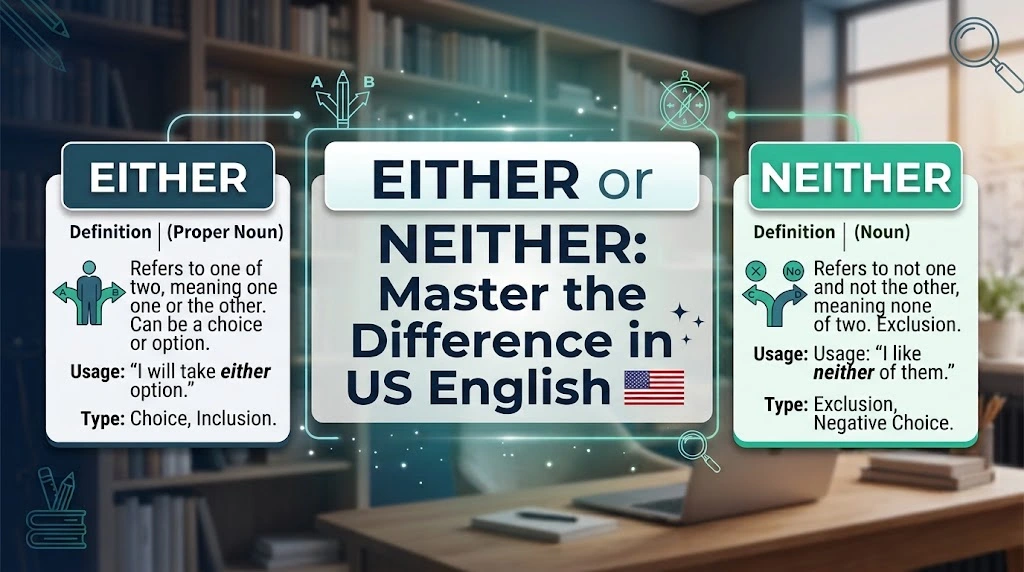
Either or neither can look like a tiny grammar problem. In practice, these two words cause plenty of confusion.
They both deal with two people, things, choices, or possibilities. The trouble starts when you need to decide whether you’re selecting one option or rejecting both.
Consider these sentences:
- Either answer could be correct.
- Neither answer is correct.
The difference is only one word, but the meaning changes completely.
Either generally points to one of two possibilities. Neither means not one and not the other. Once that basic contrast becomes clear, related structures such as either…or, neither…nor, either of, and neither of become much easier to handle.
This guide explains either or neither in US English, including their meanings, sentence patterns, subject-verb agreement, pronunciation, punctuation, negative constructions, and the mistakes writers make most often.
Either or Neither: The Basic Difference
The fastest way to understand either vs. neither is to imagine two doors.
If either door can lead you where you want to go, you have a choice.
If neither door leads anywhere useful, both choices are rejected.
| Word | Basic meaning | Simple example |
| Either | One of two | Either option will work. |
| Neither | Not one and not the other | Neither option will work. |
| Both | The two together | Both options will work. |
So the basic relationship looks like this:
Either = one of two
Neither = zero of two
Both = two of two
Cambridge defines either as referring to one or the other of two choices. It also notes that neither means “not either” when referring to two people or things. (Cambridge Dictionary)
A Simple Example
Suppose a restaurant offers two desserts: cheesecake and pie.
You can say:
Either dessert is fine with me.
That means you don’t care which one you get.
If you dislike both choices, you say:
Neither dessert appeals to me.
If you want both, you say:
Both desserts look delicious.
That’s the heart of the either or neither distinction.
What Does “Either” Mean?
Either usually identifies one of two alternatives.
It can function as a determiner, pronoun, adverb, or conjunction depending on the sentence. Cambridge’s US English dictionary lists these different grammatical roles. (Cambridge Dictionary)
Either as a Determiner
When either comes directly before a singular countable noun, it refers to one of two possibilities.
Examples:
- Either answer is acceptable.
- Either candidate could win.
- Either route will get you there.
- You can choose either shirt.
- Either restaurant would be fine.
Notice something important: the noun after either is normally singular.
Either option is available.
Not:
Either options is available.
When you mean two specific options identified by a plural noun phrase, use either of:
Either of the options is available.
That distinction becomes especially useful in formal writing.
Either as a Pronoun
Either can stand alone when the two choices are already understood.
For example:
“Which chair should I take?”
“Either is fine.”
The word either replaces the noun because the listener already knows which two chairs you’re discussing.
You can also use it in negative sentences:
I don’t like either.
Here, either means that you don’t like the first choice and you don’t like the second choice.
Either as an Adverb
In negative sentences, either can mean something similar to also or too.
For example:
I don’t like coffee either.
She didn’t call me either.
He isn’t coming either.
This use is especially common in everyday American English.
Compare:
I like coffee too.
with:
I don’t like coffee either.
The negative verb creates the environment in which either works as an adverb.
What Does “Neither” Mean?
Neither means not one and not the other of two.
It already carries a negative meaning.
For example:
Neither answer is correct.
This means:
- Answer A isn’t correct.
- Answer B isn’t correct.
You don’t need another negative word to express that idea.
Neither as a Determiner
Use neither before a singular countable noun.
Examples:
- Neither answer is correct.
- Neither candidate received enough votes.
- Neither car is available.
- Neither restaurant serves breakfast.
- Neither plan makes sense.
The noun remains singular:
Neither choice is suitable.
Not:
Neither choices are suitable.
Neither as a Pronoun
Like either, neither can stand alone.
For example:
“Which movie do you want to watch?”
“Neither. They’re both boring.”
The noun doesn’t need to be repeated because the two choices have already been identified.
You can also say:
Neither is available.
That means both options are unavailable.
Either or Neither: A Quick Comparison
The easiest way to see the difference is through parallel sentences.
| Either | Neither |
| Either answer is acceptable. | Neither answer is acceptable. |
| Either candidate can win. | Neither candidate can win. |
| Either restaurant is open. | Neither restaurant is open. |
| Either route will work. | Neither route will work. |
| Either student may participate. | Neither student may participate. |
The meaning flips from allowing either choice to rejecting both choices.
Think of either as opening two doors and saying, “Pick one.”
Think of neither as looking at the same doors and saying, “No thanks.”
How to Use “Either or”
The construction either…or presents two alternatives.
It tells the reader that one possibility or the other applies.
Examples:
- You can either call or email me.
- Either John or Maria will attend.
- We can either leave now or wait.
- The package will arrive either Monday or Tuesday.
- Either the manager or the assistant will contact you.
The two sides of either…or should generally have parallel grammatical structures.
Keep the Structure Parallel
Compare these examples:
She will either drive home or take a taxi.
Both alternatives are verb phrases.
A less balanced sentence would be:
She will either drive home or a taxi.
The second half doesn’t match the first.
Parallel structure makes the relationship obvious:
He will either study tonight or study tomorrow.
You can remove repeated wording when the meaning remains clear:
He will either study tonight or tomorrow.
However, when a sentence becomes ambiguous, repeating the verb can improve clarity.
How to Use “Neither nor”
The negative counterpart of either…or is neither…nor.
Use neither…nor when both alternatives are negative.
Examples:
- Neither John nor Maria attended.
- Neither the manager nor the assistant responded.
- She speaks neither French nor German.
- The product is neither cheap nor durable.
- Neither option is practical.
The relationship is straightforward:
Either A or B = one alternative is possible.
Neither A nor B = neither alternative is true or acceptable.
Cambridge describes neither…nor as a construction used to connect negative alternatives. (Cambridge Dictionary)
Either of vs. Neither of
This is one of the most useful distinctions to learn.
Use either of and neither of before certain plural noun phrases and pronouns.
Either of
Examples:
- Either of the answers is acceptable.
- Either of the cars will work.
- Either of them can help.
- Either of my brothers can drive.
The noun after of is plural:
either of the options
But the concept represented by either is singular: one of the two.
Neither of
Examples:
- Neither of the answers is correct.
- Neither of the cars works.
- Neither of them is available.
- Neither of my brothers lives nearby.
The same structural principle applies.
neither of the options
The noun after of is plural, while neither refers to the two choices individually.
Either or Neither and Subject-Verb Agreement
Subject-verb agreement becomes tricky when either or neither appears with of.
In formal US English, either and neither are normally treated as singular when they serve as the subject.
So these are standard formal constructions:
Either of the answers is correct.
Neither of the answers is correct.
Either of them is acceptable.
Neither of them is available.
Cambridge notes that formal styles commonly use a singular verb after neither of, although plural verbs occur frequently in informal speech. (Cambridge Dictionary)
Why This Seems Strange
At first glance, this can look inconsistent:
Neither of the students is ready.
There are multiple students. Why isn’t the verb plural?
Because the grammatical subject is neither, which means not one of the two.
For formal writing, neither is remains the safest choice.
What About Everyday Speech?
In conversation, you may hear:
Neither of them are coming.
This construction is common in informal speech. However, if you’re writing an academic paper, professional document, or polished article, neither of them is coming is the safer standard choice.
The distinction isn’t about whether people understand the sentence. It’s about choosing the form expected in formal edited English.
Either…or Subject-Verb Agreement
Things become more complicated when either…or connects two subjects.
Consider:
Either John or Maria is responsible.
Both subjects are singular, so the singular verb is straightforward.
Now consider:
Either the manager or the assistant is responsible.
Again, both are singular.
But what happens here?
Either the manager or the employees are responsible.
The second subject is plural.
Traditional grammar discussions often describe agreement in these constructions as following the subject closest to the verb. This is sometimes called proximity agreement.
That gives us:
Either the manager or the employees are responsible.
But a sentence can become awkward when the two alternatives have different numbers:
Either the employees or the manager is responsible.
Grammatically, this can work, but the reader may have to pause.
A Better Solution
When agreement becomes distracting, rewrite the sentence.
Instead of:
Either the manager or the employees are responsible for the error.
You might write:
The manager or the employees are responsible for the error.
Or, depending on the intended meaning:
Responsibility lies with either the manager or the employees.
Clear writing doesn’t need to wrestle with grammar when a simple rewrite solves the problem.
Neither…nor Subject-Verb Agreement
The same issue appears with neither…nor.
For example:
Neither John nor Maria is available.
Both subjects are singular.
With mixed numbers:
Neither the manager nor the employees are available.
The verb commonly agrees with the nearer subject in this construction.
However, awkward agreement is often a sign that the sentence could benefit from restructuring.
For professional writing, clarity should win whenever possible.
Either vs. Neither in Negative Sentences
One of the most common mistakes involves combining neither with another negative.
For example:
I don’t want neither option.
This creates a double negative in standard US English.
The intended meaning is probably that the speaker wants neither option.
Write:
I want neither option.
Or:
I don’t want either option.
Both communicate the intended negative meaning without stacking negatives.
Cambridge specifically recommends not…either rather than not…neither in standard usage. (Cambridge Dictionary)
Compare These Sentences
| Sentence | Meaning |
| I want either option. | One of the two is acceptable. |
| I want neither option. | Both are unacceptable. |
| I don’t want either option. | Both are unacceptable. |
| I don’t want neither option. | Nonstandard double-negative construction in formal US English. |
The third sentence is especially useful in everyday American English.
“I Don’t Like Either” vs. “I Like Neither”
These sentences can express essentially the same idea:
I don’t like either.
I like neither.
The first sounds more natural in many casual conversations.
The second is grammatically correct but can sound more formal or deliberate.
For example:
“Do you want the blue one or the red one?”
“I don’t like either.”
That’s perfectly natural.
You could also say:
“Neither.”
The best choice depends on the surrounding sentence and tone.
Either and Neither in Questions
Both words can appear naturally in questions.
Questions With Either
Use either when asking whether one of two possibilities applies.
Examples:
Did either candidate respond?
Can either of you help me?
Is either restaurant open?
Would either date work for you?
The question leaves both possibilities open.
Questions With Neither
Neither can also appear in questions, usually when the speaker expects or considers the possibility that both choices are negative.
For example:
Did neither candidate respond?
This isn’t equivalent in tone to:
Did either candidate respond?
The first question specifically asks whether both failed to respond.
The second simply asks whether at least one responded.
That subtle difference matters.
Either, Neither, and Both
These three words form a useful logical set.
Either
Either focuses on one of two possibilities.
Either player can win.
This means one player or the other can win.
Neither
Neither rejects both possibilities.
Neither player can win.
This means player A can’t win and player B can’t win.
Both
Both includes the two together.
Both players can win.
This means the two players are capable of winning.
Cambridge defines both as referring to two people or things together. (Cambridge Dictionary)
The Three-Way Comparison
| Word | Logical meaning | Example |
| Either | One of two | Either player can win. |
| Neither | Zero of two | Neither player can win. |
| Both | Two of two | Both players can win. |
This table is worth remembering because it solves many either or neither questions instantly.
Either vs. Neither vs. Any vs. None
Another common source of confusion is the difference between either/neither and any/none.
The traditional distinction is simple:
- Either → one of two
- Neither → zero of two
- Any → one or more possibilities from a broader group, depending on context
- None → zero from a group
Suppose you’re discussing two laptops:
Either laptop will work.
Neither laptop will work.
Now imagine you’re discussing ten laptops:
Any laptop from this group will work.
None of these laptops will work.
Cambridge notes that none can mean “not one” or “not any” and can refer to groups beyond two. (Cambridge Dictionary)
Why the Number Matters
If you’re talking specifically about two people:
Neither of them called.
If you’re talking about a larger group:
None of them called.
Both sentences are grammatical. The number of people changes the appropriate word.
Can Either Refer to More Than Two?
In its standard choice-related use, either refers to two alternatives.
For example:
You can take either road.
That sentence presents two roads.
However, English has another use of either that doesn’t simply mean “one of exactly two.” Cambridge notes that either can also appear in expressions such as either side, where it can refer to both sides. (Cambridge Dictionary)
For ordinary writing, the safest rule is:
Use either when presenting a choice between two alternatives.
If three or more distinct choices are involved, any may be more appropriate.
Can Neither Refer to More Than Two?
In standard usage, neither is associated with two alternatives.
For example:
Neither candidate won.
There are two candidates under discussion.
If you’re discussing five candidates, use none:
None of the candidates won.
This distinction keeps the number of alternatives clear.
Two vs. More Than Two
| Number of choices | Positive choice | Negative choice |
| Two | Either | Neither |
| Three or more | Any | None |
Context can create exceptions, but this is a reliable rule for everyday writing.
Common Either or Neither Mistakes
Small errors involving these words can change the meaning or make a sentence sound awkward.
Mistake: “Neither…or”
Incorrect:
Neither John or Sarah attended.
Correct:
Neither John nor Sarah attended.
The standard pair is:
neither…nor
Not:
neither…or
Mistake: “Either…nor”
Incorrect:
Either John nor Sarah will attend.
Correct:
Either John or Sarah will attend.
The standard pair is:
either…or
Mistake: “I Don’t Want Neither”
Incorrect in formal standard US English:
I don’t want neither.
Better:
I don’t want either.
Or:
I want neither.
Because neither already expresses a negative meaning, adding don’t creates an unnecessary double negative.
Mistake: “Either Options”
Incorrect:
Either options are acceptable.
Correct:
Either option is acceptable.
Or:
Either of the options is acceptable.
The first construction uses either + singular noun. The second uses either of + plural noun phrase.
Mistake: “Neither Options”
Incorrect:
Neither options are available.
Correct:
Neither option is available.
Or:
Neither of the options is available.
Either of and Neither of: The Most Useful Patterns
Here are the patterns worth memorizing.
Either + Singular Noun
Either option is fine.
Neither + Singular Noun
Neither option is fine.
Either of + Plural Noun Phrase
Either of the options is fine.
Neither of + Plural Noun Phrase
Neither of the options is fine.
Either of + Pronoun
Either of them can help.
Neither of + Pronoun
Neither of them can help.
Once these six patterns become familiar, many grammar questions become almost automatic.
“Neither Do I” and “Either”
There’s another important use of neither that appears frequently in conversation.
Suppose someone says:
I don’t like spicy food.
You can respond:
Neither do I.
That means:
I don’t like spicy food either.
The structure is different from ordinary not…either.
With neither, the auxiliary verb comes before the subject:
Neither do I.
Neither can she.
Neither will they.
Cambridge describes this pattern as neither/nor + auxiliary or modal + subject when agreeing with a negative statement. (Cambridge Dictionary)
Compare the Two Structures
I don’t like it either.
Neither do I.
Both mean that the second speaker also doesn’t like it.
The difference is grammatical structure rather than basic meaning.
“Nor Do I” vs. “Neither Do I”
You may also hear:
Nor do I.
This works similarly to:
Neither do I.
For example:
“I can’t swim.”
“Neither can I.”
Or:
“I can’t swim.”
“Nor can I.”
Both are grammatical.
In everyday American conversation, neither can I may sound more immediately natural to many speakers.
Pronunciation of Either and Neither
Pronunciation can create another point of confusion.
Either has two widely recognized pronunciations in US English:
- EE-ther
- EYE-ther
Likewise, neither can be pronounced:
- NEE-ther
- NYE-ther
Cambridge lists both pronunciation patterns for either and neither. (Cambridge Dictionary)
Neither pronunciation changes the meaning.
So there’s no need to worry that one pronunciation is automatically incorrect. Regional preference and personal speech habits influence which form a speaker uses.
Punctuation With Either…or and Neither…nor
Short either…or and neither…nor constructions usually don’t require a comma simply because these words appear.
For example:
You can either stay or leave.
Neither John nor Maria called.
No comma is needed.
Longer constructions can require punctuation for other grammatical reasons. The key isn’t to insert a comma automatically before or or nor.
Instead, look at the sentence’s actual structure.
Parallel Structure Matters More
Consider:
The company will either expand into Canada or open a new office in Texas.
The two alternatives are clearly balanced.
Now consider a sentence where one side contains a long phrase and the other contains a completely different structure. Even when the punctuation is technically manageable, the reader may struggle to understand the comparison.
Good punctuation can’t rescue poor parallel structure.
Either or Neither in Formal Writing
In business, academic, and professional writing, precision matters.
Choose the construction that expresses the intended relationship without forcing readers to interpret your meaning.
For Business Writing
Prefer:
Neither proposal meets the company’s requirements.
Instead of:
Both proposals don’t meet the company’s requirements.
The first sentence makes the negative meaning direct.
For Academic Writing
Prefer:
Neither study provides sufficient evidence.
Instead of:
Both studies don’t provide sufficient evidence.
The first version removes ambiguity.
For Everyday Conversation
You can use natural conversational forms:
I don’t like either.
Me neither.
Either one is fine.
Neither one works.
These aren’t mistakes. They’re normal English constructions.
A Practical Case Study: Choosing Between Two Options
Imagine a manager must choose between two software platforms.
Platform A costs $500 per month.
Platform B costs $650 per month.
The manager could say:
Either platform could meet our basic needs.
This means both are viable alternatives, and one could be selected.
After testing both platforms, suppose neither meets the company’s security requirements.
The manager can say:
Neither platform meets our security requirements.
Now the meaning is completely different.
The manager isn’t choosing between two acceptable options. Both have failed the requirement.
If the manager later finds that both platforms meet the requirements, the sentence changes again:
Both platforms meet our security requirements.
The three words create three distinct outcomes:
- Either → one can be selected.
- Neither → zero can be selected.
- Both → both qualify.
That’s why choosing the right word isn’t merely a grammar exercise. It affects the information a sentence communicates.
Either or Neither in Everyday Conversation
These words appear constantly in ordinary speech.
Choosing Food
Either pizza or pasta sounds good.
Rejecting Two Choices
Neither pizza nor pasta sounds good tonight.
Agreeing With a Negative Statement
“I don’t want dessert.”
“Neither do I.”
Discussing Two People
Either Sam or Alex can pick us up.
Discussing Two Items
Neither shirt fits me.
The structures are simple once the central meaning becomes automatic.
Quick Decision Guide for Either or Neither
When you’re unsure, ask one question:
Are you accepting one of two possibilities or rejecting both?
If you’re accepting one:
Either
If you’re rejecting both:
Neither
Here’s a quick visual guide:
TWO OPTIONS
|
——————-
| |
One works? Neither works?
| |
EITHER NEITHER
| |
either A or B neither A nor B
For larger groups, consider any and none instead.
Two choices:
Either / Neither
Three or more:
Any / None
This isn’t a universal rule for every idiomatic construction, but it’s an excellent working rule for standard usage.
Either or Neither: Side-by-Side Examples
| Situation | Correct sentence |
| One of two choices works | Either choice works. |
| Both choices fail | Neither choice works. |
| One person can help | Either person can help. |
| Both people can’t help | Neither person can help. |
| Choosing between two actions | You can either call or email. |
| Rejecting two actions | You can do neither. |
| Two people both fail to attend | Neither person attended. |
| Negative agreement | Neither do I. |
| Negative sentence | I don’t like either. |
| Two options identified by “the” | Either of the options is fine. |
| Both options rejected | Neither of the options is suitable. |
| Three or more choices | Any option will work. |
| Three or more rejected choices | None of the options will work. |
Frequently Asked Questions About Either or Neither
Is either positive or negative?
Either is not inherently negative.
It commonly introduces a choice between two possibilities:
Either answer could be correct.
However, either also appears in negative sentences:
I don’t like either answer.
Its meaning depends on the grammatical context.
Is neither always negative?
Neither expresses a negative meaning by itself.
Neither answer is correct.
You don’t need to add another negative word.
Is “either or” correct?
Yes, when used as the paired construction either…or.
Either John or Maria will attend.
The two words work together to introduce alternatives.
Is “neither or” correct?
No, not as the standard paired construction.
Use:
Neither John nor Maria attended.
The standard pair is neither…nor.
Should I say “neither is” or “neither are”?
When neither is the subject, formal standard usage generally takes a singular verb:
Neither is available.
Neither of them is available.
Plural agreement appears in informal speech, especially with neither of, but singular agreement is the safer choice for formal writing. (Cambridge Dictionary)
Is “either of them are” correct?
You may hear it in everyday speech:
Either of them are welcome.
However, for formal writing, use:
Either of them is welcome.
The same principle applies to neither of:
Neither of them is available.
What’s the difference between “not either” and “neither”?
They can express the same basic negative idea.
I don’t like either.
I like neither.
The first uses ordinary negation plus either. The second uses neither, which already contains the negative meaning.
Do either and neither take singular nouns?
Yes, when they directly modify a noun:
Either option is acceptable.
Neither option is acceptable.
With of, use a plural noun phrase:
Either of the options is acceptable.
Neither of the options is acceptable.
Can “neither” be used by itself?
Yes.
“Which one do you want?”
“Neither.”
The word works as a pronoun because the two choices are already understood.
Is “neither of them were” wrong?
It’s common in informal speech, but neither of them was is the safer form for formal US English.
Is “I don’t like neither” correct?
Avoid it in standard formal US English.
Use:
I don’t like either.
Or:
I like neither.
The first option will often sound more natural in everyday conversation.
A Simple Memory Trick for Either vs. Neither
If grammar rules start feeling like a maze, reduce the distinction to three numbers:
Either = 1 of 2
Neither = 0 of 2
Both = 2 of 2
For example:
Either candidate can win.
One candidate or the other can win.
Neither candidate can win.
Zero candidates can win.
Both candidates can win.
Two candidates can win.
That small numerical framework makes the difference surprisingly easy to remember.
Final Takeaway: Either or Neither?
The difference between either and neither becomes much easier once you focus on what happens to the two choices.
Either presents or allows a choice between two alternatives.
Either option is acceptable.
Neither rejects both alternatives.
Neither option is acceptable.
When you connect alternatives, remember the standard pairs:
- either…or
- neither…nor
When using of, remember:
- either of + plural noun/pronoun
- neither of + plural noun/pronoun
For formal writing, singular agreement is generally the safest choice:
Either of the options is acceptable.
Neither of the options is acceptable.
Avoid unnecessary double negatives such as:
I don’t want neither.
Choose:
I don’t want either.
or:
I want neither.
Finally, remember the simplest formula:
| Word | Meaning |
| Either | One of two |
| Neither | Not one or the other |
| Both | The two together |
| Any | One or more from a broader group |
| None | Zero from a broader group |
Once you understand that basic logic, either or neither stops being a guessing game. The right word usually becomes obvious because the meaning tells you which one belongs in the sentence.
The article follows standard US English usage while recognizing that some plural agreement forms occur in informal speech. Cambridge’s current grammar guidance supports the distinctions between either, neither, not…either, either…or, and neither…nor used above. (Cambridge Dictionary)
If desired, the article can also be adapted into a more SEO-aggressive version with a stronger keyword structure, featured-snippet answers, FAQ schema-style questions, and additional comparison examples.
