

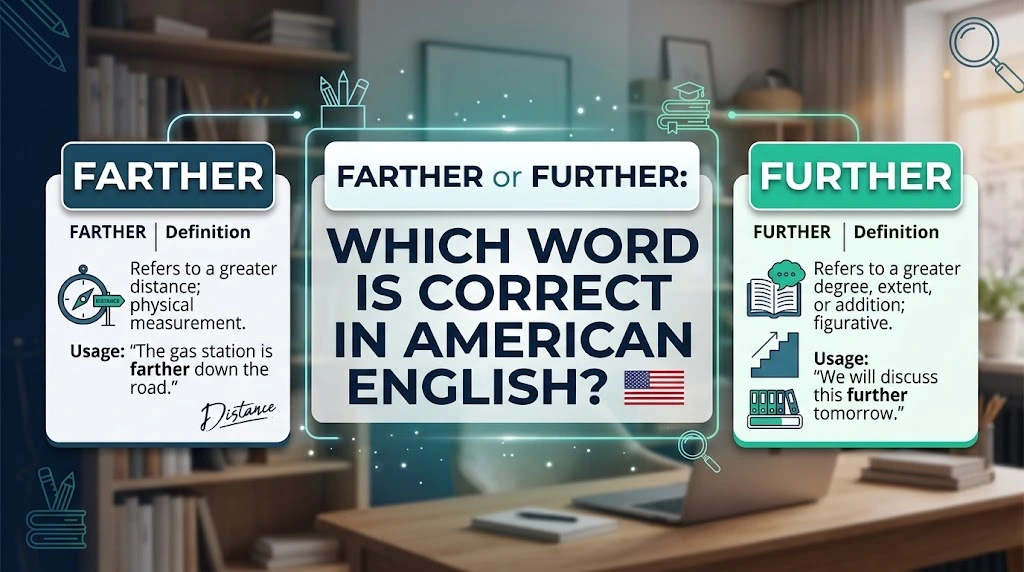
Farther or further? The two words look almost identical, sound similar, and often appear in the same kinds of sentences. That makes them easy to mix up, even for experienced writers.
The traditional rule is fairly simple: use farther for physical distance and further for figurative distance, degree, progress, or something additional.
For example:
- “The gas station is farther down the highway.”
- “We need to discuss the issue further.”
- “Please send further information.”
- “The second store is farther from my house.”
That rule gives you a reliable starting point. However, American English has a wrinkle worth knowing. Further can also describe physical distance, especially in everyday speech and modern writing. Because of that overlap, treating the distinction as an unbreakable grammatical law can create more confusion than clarity.
The better approach is to understand the traditional distinction, recognize modern usage, and then choose the word that best fits your meaning.
This guide explains farther vs. further in detail, including their definitions, grammar, common phrases, special cases, examples, and practical rules for American English.
Farther or Further: The Quick Answer
If you need an answer right now, use this basic rule:
Use farther for physical distance and further for figurative distance, degree, progress, or additional information.
Here are the most useful examples:
| Meaning | Preferred word | Example |
| Physical distance | Farther | We drove farther than expected. |
| Figurative distance | Further | Nothing could be further from the truth. |
| Additional information | Further | Please provide further details. |
| Additional discussion | Further | We can discuss the matter further. |
| Progress or advancement | Further | The discovery furthered scientific research. |
| Physical distance in modern usage | Farther/Further | We walked farther/further down the trail. |
The distinction becomes especially useful when a sentence could technically accept either word.
Consider these two sentences:
“How much farther do we have to walk?”
The speaker clearly means physical distance.
Now compare:
“How much further should we investigate this issue?”
Here, the distance is conceptual. The investigation needs to go beyond its current point.
The words overlap in some contexts, but they aren’t interchangeable everywhere.
What Does “Farther” Mean?
Farther traditionally describes a greater physical distance.
It works especially well when you can imagine measuring the distance with a ruler, map, odometer, measuring tape, or another physical reference.
For example:
- The library is farther from here than the bank.
- We walked farther than we planned.
- The restaurant is farther down the street.
- How much farther is the airport?
- She moved farther away from the edge.
- The hikers traveled farther into the mountains.
In each case, the word describes movement or separation through physical space.
Farther for Physical Distance
The clearest use of farther involves literal distance.
Imagine you’re driving along a highway and someone asks, “Is the next exit close?”
You might answer:
“No. It’s farther down the road.”
The road gives you a physical path. You could measure the distance in miles or kilometers.
The same principle works for walking:
“We need to walk farther before we reach the campsite.”
You can physically travel another mile. That’s a straightforward use of farther.
Farther as a Comparative
Farther functions as a comparative form of far.
The basic progression is:
- far — describes distance
- farther — describes greater distance
- farthest — describes the greatest distance
For example:
“The park is far from here.”
Then:
“The museum is farther away.”
And:
“The airport is the farthest of the three.”
This comparative relationship explains why farther feels especially natural when talking about physical space.
What Does “Further” Mean?
Further has several meanings, but most involve going beyond a current point.
It can describe additional information, greater degree, continued progress, or figurative distance.
For example:
- We need further evidence.
- Let’s investigate the matter further.
- She wants to pursue further education.
- The company took further action.
- Nothing could be further from the truth.
- The discussion requires further consideration.
Notice something important: none of these examples requires physical distance.
Instead, further moves an idea, process, discussion, or situation beyond its current position.
Further for Figurative Distance
Think of further as describing an invisible road.
You can’t necessarily measure that road in miles. Instead, you’re moving deeper into an idea, argument, process, or degree.
For example:
“Let’s examine this issue further.”
Nobody is walking anywhere. The sentence means, “Let’s examine it in greater depth.”
Similarly:
“The evidence takes us further toward an answer.”
The movement is intellectual rather than physical.
Further Meaning “Additional”
One of the most important uses of further is its meaning of additional or more.
This is why phrases such as these are standard:
- further information
- further details
- further questions
- further research
- further investigation
- further discussion
- further instructions
- further consideration
- further action
- further explanation
For example:
“For further information, contact the customer service department.”
You could replace further with “additional” without changing the basic meaning:
“For additional information, contact the customer service department.”
You can’t normally do the same with farther.
“Farther information” doesn’t convey the intended meaning.
Further as a Verb
There’s another important difference between the two words.
Further can function as a verb. Farther generally does not.
As a verb, further means to advance, promote, develop, or help something progress.
For example:
“The grant will further medical research.”
Here, further means the grant will help advance medical research.
Another example:
“The program furthered her professional development.”
The program helped her progress.
You might see the verb further in contexts involving:
- careers
- education
- research
- goals
- causes
- development
- knowledge
- understanding
- progress
For instance:
“The study could further our understanding of climate patterns.”
The study doesn’t physically move understanding. Instead, it advances knowledge.
That’s a distinctly figurative use.
Farther or Further: The Main Difference
The traditional distinction becomes easier when you think about what kind of distance you’re describing.
Use Farther for Literal Distance
If the distance exists in physical space, farther is traditionally preferred.
Ask yourself:
Could I measure the distance physically?
If the answer is yes, farther is usually the safest choice.
Examples:
- We drove farther than expected.
- The store is farther away.
- Walk farther down the path.
- The moon is farther from Earth than the International Space Station.
- Their new house is farther from downtown.
Use Further for Abstract Distance
If you’re talking about an idea, degree, process, discussion, or development, further usually fits.
Examples:
- Let’s discuss this further.
- The issue needs further review.
- The evidence requires further analysis.
- We need further clarification.
- She wants to take the project further.
The underlying idea is still “going beyond,” but the distance isn’t physical.
Use Further for Additional
When you mean additional, choose further.
For example:
“Do you have any further questions?”
This means:
“Do you have any additional questions?”
Similarly:
“No further action is required.”
That means:
“No additional action is required.”
This is one of the easiest rules to apply because farther doesn’t have this meaning.
When Can “Further” Refer to Physical Distance?
Here’s where the neat grammar rule gets messy.
Modern American English frequently uses further for physical distance.
For example:
“We walked further down the beach.”
Many American speakers find this completely natural.
Traditional usage guidance may prefer:
“We walked farther down the beach.”
Both versions appear in real-world English. The second makes the physical-distance distinction clearer, while the first is widely accepted in ordinary usage.
Major dictionaries document this overlap rather than pretending the boundary is perfectly rigid.
That matters because language doesn’t stand still. English speakers have used farther and further with overlapping meanings for centuries.
Farther vs. Further in Modern American English
The distinction is best understood as a preference, not an absolute prohibition.
If you’re writing carefully and want to make physical distance unmistakable, farther remains an excellent choice.
For example:
“The trail continues farther into the forest.”
That sentence leaves little ambiguity.
However, further can work naturally too:
“The trail continues further into the forest.”
In casual conversation, the difference may barely register.
The key is not to invent a mistake where standard contemporary usage allows variation.
Farther vs. Further in American English
American English generally follows the traditional distinction often taught in grammar guides:
Farther tends to refer to measurable physical distance.
Further tends to refer to abstract distance, degree, progress, or additional information.
Yet actual usage shows considerable overlap.
This creates an important distinction between traditional guidance and real-world usage.
Traditional guidance helps you make precise choices. Actual usage tells you what American speakers and writers genuinely use.
Both matter.
For formal writing, a simple strategy works well:
Use farther when physical distance is clearly intended. Use further for everything involving additional amounts, abstract progress, or figurative distance.
That rule avoids most problems.
Common Phrases With “Farther”
Several expressions strongly favor farther when they describe literal distance.
Farther Away
“The second hotel is farther away.”
The phrase describes physical separation.
Farther Down the Road
“The gas station is farther down the road.”
The road provides a literal spatial reference.
Farther North
“The town lies farther north.”
Here, farther describes geographic position.
Farther South
“The storm moved farther south.”
Again, the movement occurs across physical geography.
Farther Along
This phrase can describe physical or figurative movement.
For example:
“The hikers were farther along the trail.”
That’s physical.
But:
“We’re farther along in the project than expected.”
That’s figurative progress.
This is one reason context matters so much.
Farther From
“The new office is farther from downtown.”
The physical relationship makes farther a natural choice.
How Much Farther?
This is one of the clearest physical-distance patterns:
“How much farther is the station?”
You’re asking for a measurable remaining distance.
Common Phrases With “Further”
Further appears in many established expressions.
Further Information
“Visit the website for further information.”
Here, further means additional.
Further Details
“The report contains further details about the proposal.”
Again, it means additional details.
Further Discussion
“The matter requires further discussion.”
The discussion needs to continue.
Further Research
“Further research is needed.”
This means additional research.
Further Consideration
“The proposal requires further consideration.”
The decision-making process needs to continue.
Further Notice
“The office will remain closed until further notice.”
This means until another or additional notice is issued.
Further Action
“No further action is necessary.”
That means no additional action is necessary.
Further Questions
“Please contact us if you have further questions.”
The meaning is simply “additional questions.”
These combinations are so established that replacing further with farther would sound clearly wrong.
Farther or Further in Common Sentences
The easiest way to master the distinction is to see the words side by side.
| Sentence | Best choice | Reason |
| How much ___ is the airport? | farther | Physical distance |
| Please provide ___ information. | further | Additional information |
| We need to walk ___ down the trail. | farther | Physical distance |
| Let’s discuss the matter ___. | further | Deeper discussion |
| The company needs ___ research. | further | Additional research |
| Nothing could be ___ from the truth. | further | Figurative distance |
| The second house is ___ away. | farther | Physical distance |
| Do you have any ___ questions? | further | Additional questions |
| The discovery furthered scientific knowledge. | further | Advance or promote |
| We drove ___ than planned. | farther | Physical distance |
The pattern becomes obvious once you stop focusing on spelling and focus on meaning.
Farther or Further: Special Cases
Some expressions deserve special attention because they don’t fit neatly into a one-line rule.
“Further Away” vs. “Farther Away”
Both expressions occur in American English.
“The school is farther away than I expected.”
This follows the traditional physical-distance distinction.
You may also encounter:
“The school is further away than I expected.”
That’s common modern usage.
When you’re choosing between them yourself, farther away is a safe option when literal distance is the focus.
“Further Along”
The phrase further along can refer to either physical location or progress.
Physical:
“The picnic area is further along the trail.”
Figurative:
“We’re further along in the negotiations.”
Because the phrase can describe either type of movement, context determines the meaning.
“Nothing Could Be Farther From the Truth”
This expression is traditionally associated with farther:
“Nothing could be farther from the truth.”
The “distance” from truth is metaphorical, which makes the traditional distinction especially interesting.
Modern English also commonly uses:
“Nothing could be further from the truth.”
Both forms are established.
In contemporary American writing, further from the truth is extremely familiar. Therefore, neither version should be treated as an obvious grammatical blunder.
“Go Further” vs. “Go Farther”
These phrases can express different ideas.
“We need to go farther.”
This naturally suggests additional physical distance.
“We need to take the project further.”
This means the project needs additional development.
The verb itself doesn’t determine the answer. The intended meaning does.
Farther or Further in Formal Writing
Formal writing rewards precision, but precision doesn’t mean forcing every sentence into an artificial rule.
When discussing physical distance, farther is usually the clearest choice:
“The facility is located farther from the city center.”
When discussing additional material, use further:
“Further analysis is necessary.”
When discussing an abstract process, use further:
“The evidence further supports the hypothesis.”
This approach works especially well in:
- academic writing
- business reports
- professional emails
- technical documentation
- journalism
- educational materials
The goal isn’t to make the language sound formal for its own sake. The goal is to remove ambiguity.
Common Mistakes With Farther and Further
Mistake: Using Farther for “Additional”
Incorrect:
“Please send farther details.”
Better:
“Please send further details.”
Why? Further means additional here.
Mistake: Assuming Further Can Never Describe Distance
This rule is too strict.
You may encounter:
“We walked further down the road.”
Modern American usage allows this construction.
If you want the traditional distinction to be especially clear, use:
“We walked farther down the road.”
Mistake: Treating the Words as Completely Interchangeable
The opposite extreme causes problems too.
You wouldn’t normally write:
“Further information is attached.”
That sentence is correct.
But:
“Farther information is attached.”
doesn’t convey the intended meaning.
The words overlap in some situations, but they don’t share every definition.
Mistake: Confusing Farther and Farthest
Farther is comparative.
Farthest is superlative.
Compare:
“The red house is farther away.”
with:
“The blue house is the farthest away.”
You compare two things with farther. You identify the greatest distance with farthest.
Mistake: Choosing Based Only on Sound
The words sound similar enough that pronunciation won’t reliably tell you which one to use.
Instead, identify the meaning first.
Ask:
Am I describing space?
If yes, farther is usually the best traditional choice.
Am I describing something additional, abstract, or figurative?
If yes, further is usually the better choice.
A Simple Trick to Remember Farther vs. Further
Here’s a practical memory trick:
Farther has “far” inside it. Think physical distance.
You can imagine a road stretching farther ahead.
For further, think:
Further = additional or beyond.
So:
- farther down the road → physical distance
- further discussion → additional discussion
- farther from home → physical distance
- further research → additional research
- farther across the field → physical distance
- further explanation → additional explanation
It’s not a perfect rule for every sentence. It is, however, an excellent working rule.
Farther vs. Further: Side-by-Side Comparison
| Feature | Farther | Further |
| Physical distance | Traditional preference | Common in modern usage |
| Figurative distance | Sometimes used | Traditional preference |
| Additional meaning | No | Yes |
| Degree or extent | Limited | Common |
| Progress | Less common | Common |
| Verb meaning “advance” | No | Yes |
| Comparative relationship to “far” | Yes | Historically related |
| Formal writing | Appropriate | Appropriate |
The most important row is the one involving additional meaning.
If you can replace the word with additional, choose further.
For example:
“We need further evidence.”
Becomes:
“We need additional evidence.”
The substitution works perfectly.
Try the same trick with:
“We drove farther.”
“Additional” doesn’t work. That’s a strong sign that farther is the right choice.
Farther or Further in Different Contexts
Travel
Travel provides the clearest examples of farther.
“We drove farther than expected.”
The car physically traveled a greater distance.
“How much farther is the next exit?”
The question asks for measurable space.
However:
“Let’s travel further into the subject.”
Now the travel is metaphorical. The subject is being explored more deeply.
Work and Business
Business writing heavily favors further when discussing additional work.
Examples include:
- further action
- further review
- further discussion
- further approval
- further information
- further instructions
For example:
“The proposal requires further review before approval.”
The review isn’t moving through physical space. It is continuing to another stage.
Education
Education provides another clear figurative use.
“She pursued further education after completing her degree.”
Here, further means additional education.
You might also write:
“Further study could clarify the issue.”
Again, the meaning is additional study.
Everyday Conversation
Spoken American English often shows more flexibility.
Someone might say:
“We walked further than we expected.”
Another speaker might say:
“We walked farther than we expected.”
Neither version is likely to cause confusion.
The traditional distinction still helps writers make deliberate choices, especially when precision matters.
Academic Writing
Academic prose frequently uses further because research often deals with abstract development.
Examples:
“Further research is necessary.”
“The findings require further analysis.”
“The study provides further evidence.”
By contrast:
“The sampling site was located farther from the laboratory.”
Here, the distance is physical.
A Practical Case Study: One Word Changes With Context
Consider a project manager speaking to a research team.
First, she says:
“We need to go farther down the road to collect samples.”
The team needs to travel to a more distant physical location.
Later, she says:
“We need to take this research further.”
Now she wants the researchers to develop the project beyond its current stage.
Finally, she says:
“Please provide further details in the report.”
This time, further means additional.
The same speaker uses both words correctly because each sentence expresses a different kind of “distance.”
That’s the real secret behind farther vs. further: don’t memorize the words in isolation. Read the meaning of the entire sentence.
How Dictionaries Treat Farther and Further
Modern dictionaries generally recognize that farther and further have overlapping uses.
For current definitions and usage notes, useful references include:
- Merriam-Webster: Farther
- Merriam-Webster: Further
- American Heritage Dictionary: Farther
- American Heritage Dictionary: Further
- Cambridge Dictionary: Farther
- Cambridge Dictionary: Further
These references are useful because dictionary entries capture actual language usage rather than relying solely on simplified classroom rules.
That distinction matters. A grammar shortcut can be helpful without describing every situation English speakers encounter.
Which Word Should You Use?
When you’re stuck, use this decision process.
Choose Farther When:
- You’re talking about physical distance.
- You can measure the distance in space.
- You’re comparing how far two physical locations are.
- You’re describing travel or movement across a physical area.
Examples:
“The station is farther away.”
“We walked farther.”
“The second store is farther down the street.”
Choose Further When:
- You mean additional.
- You’re discussing abstract progress.
- You’re describing greater degree or extent.
- You’re continuing a discussion.
- You’re referring to additional research or analysis.
- You’re using further as a verb meaning advance or promote.
Examples:
“We need further information.”
“Let’s investigate further.”
“The discovery furthered our understanding.”
“Further analysis revealed a pattern.”
When Either May Work
Physical-distance contexts can allow further in contemporary American English.
For example:
“We walked farther down the trail.”
and:
“We walked further down the trail.”
If you want the most traditional and precise distinction, choose farther for literal distance.
If you’re describing ordinary modern usage, recognize that further is also common.
Farther or Further: A Quick Decision Chart
FARTHER OR FURTHER?
|
What does the word mean?
|
+———–+———–+
| |
Physical distance? Additional/abstract?
| |
Yes Yes
| |
FARTHER FURTHER
| |
Example: “We drove Example: “We need
farther.” further details.”
There’s one caveat:
Physical distance + modern usage
|
FURTHER may also work
|
FARTHER remains the clearer
traditional choice
This is why context beats rigid formulas.
Frequently Asked Questions About Farther or Further
Is “farther” or “further” correct in American English?
Both are correct words. The traditional distinction is that farther refers to physical distance while further refers to figurative distance, degree, progress, or additional information.
Modern American English also uses further for physical distance.
Is farther only used for physical distance?
Traditionally, physical distance is its main use.
However, English usage isn’t perfectly divided. Farther can appear in figurative expressions, particularly established phrases such as “nothing could be farther from the truth.”
Can further describe physical distance?
Yes. Modern American English commonly uses further for physical distance.
For example:
“We walked further down the trail.”
That construction is widely understood and used.
Still, farther is the traditional choice when you want to emphasize literal measurable distance.
Is “further information” or “farther information” correct?
Further information is correct.
Here, further means additional.
“Please contact the office for further information.”
“Farther information” doesn’t have the intended meaning.
Is it “farther away” or “further away”?
Both occur in contemporary American English.
Farther away follows the traditional physical-distance distinction.
Further away is also common and accepted in modern usage.
If you’re aiming for a clear traditional distinction, farther away is the safest choice for literal distance.
Is “further from the truth” correct?
Yes.
“Further from the truth” is a well-established modern expression.
You may also see:
“Nothing could be farther from the truth.”
Both forms are familiar in American English.
Is further a verb?
Yes.
As a verb, further means to advance, promote, or develop something.
For example:
“The scholarship furthered her education.”
“The research furthered our understanding of the disease.”
Which is more common in American English?
The answer depends on context.
Further appears extremely often because it has several meanings, including “additional.” Farther remains common when writers describe physical distance.
Because the two words overlap, frequency alone doesn’t provide a useful rule for choosing between them.
Is “go farther” or “go further” correct?
Both can be correct.
“We need to go farther.”
usually suggests physical travel.
“We need to go further.”
can describe either physical movement or figurative progress, depending on context.
For a physical-distance meaning, go farther provides the clearer traditional distinction.
Is “further along” correct?
Yes.
Further along can describe physical position or progress.
Physical:
“The cabin is further along the trail.”
Figurative:
“The project is further along than expected.”
The surrounding context tells you which meaning applies.
Final Verdict: Farther or Further?
The simplest reliable rule is this:
Farther traditionally refers to physical distance. Further usually refers to additional amounts, abstract distance, degree, progress, or continuation.
Use farther when you’re talking about something that can be measured in physical space:
“We drove farther than expected.”
Use further when you mean additional:
“We need further information.”
Use further for figurative progress:
“Let’s take the discussion further.”
And remember that modern American English often uses further for physical distance too:
“We walked further down the road.”
So the old rule is useful, but it isn’t a brick wall.
When you need a quick choice, remember:
Farther = physical distance.
Further = additional, abstract, or extended meaning.
That distinction will handle the vast majority of farther or further questions you encounter in American English.
This version can also be adapted into a more SEO-focused article with a stronger featured-snippet section, keyword variations, and a tighter search-intent structure.
