

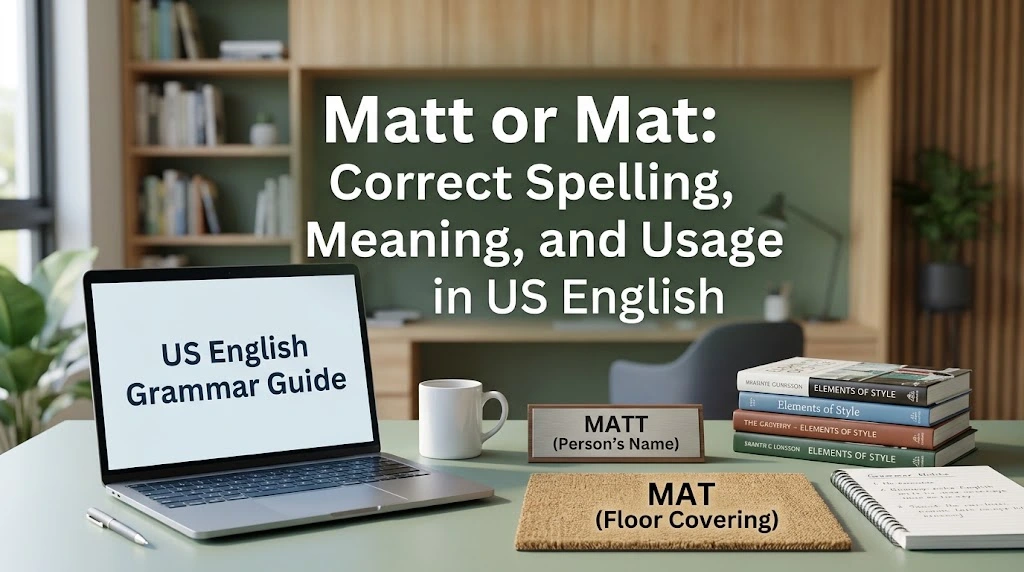
Matt or mat? The answer depends entirely on what you mean.
If you’re talking about a person named Matthew, Matt is usually the spelling you’re looking for. If you’re talking about something placed on a floor, used for exercise, or designed to protect a surface, the correct word is mat.
There’s another word that often joins the confusion: matte. It describes a surface that isn’t shiny or glossy.
These three words can sound similar in everyday speech, but their meanings are quite different. One refers primarily to a person’s name, another refers to a physical object, and the third describes a type of finish.
Understanding the difference takes only a minute. Once you see the patterns, you’ll rarely mix them up again.
Matt or Mat: The Quick Answer
Here’s the simplest way to remember the difference:
| Word | Main meaning | Example |
| Matt | A common short form of Matthew | “Matt called me this morning.” |
| Mat | A flat piece of material used for a particular purpose | “Leave your shoes on the mat.” |
| Mat | A person’s chosen name or nickname spelling | “Mat joined the meeting.” |
| Matte | A non-glossy or dull finish | “The photo has a matte finish.” |
So, if you’re writing about a person named Matthew, Matt is generally the conventional shortened form in US English.
If you’re writing about something you stand on, wipe your feet on, exercise on, or use to protect a surface, use mat.
If you’re describing something without a glossy surface, use matte.
The easiest rule
Matt is usually a name. Mat is usually an object. Matte usually describes a finish.
That one distinction handles most everyday situations.
However, names can follow personal preferences. Someone named Matthew may spell their nickname Matt, Mat, or even use their full name. When you’re referring to a specific person, their preferred spelling always takes priority.
What Does “Matt” Mean?
Matt as a Male Name
Matt is commonly used as a shortened form of the masculine given name Matthew.
Matthew comes from a Hebrew name traditionally understood to mean “gift of Yahweh” or “gift of God.” The name has a long history through biblical and Christian naming traditions.
In modern American English, Matt works as both a nickname and an established everyday given name.
For example:
- “Matt is waiting outside.”
- “I spoke with Matt yesterday.”
- “Matt sent the report this morning.”
- “Have you met Matt from accounting?”
Notice something important in every example: Matt begins with a capital letter because it’s a person’s name.
Is Matt Short for Matthew?
Yes. Matt is one of the most common shortened forms of Matthew.
That doesn’t mean every person named Matthew uses Matt. Some people prefer Matthew, while others might use Mat, Mattie, or another personal form.
Names don’t always follow a rigid spelling rule. A person gets to decide how their own name appears.
For example, if someone introduces themselves as Mat, writing “Matt” because it’s more common would still be incorrect when referring to that individual.
The practical rule is simple:
Follow the person’s preferred spelling.
Matt in Everyday Writing
You’ll commonly see Matt in casual and professional communication:
- Text messages
- Emails
- Workplace conversations
- School records
- Social media
- News articles
- Sports coverage
- Business correspondence
For instance:
“Matt will send the revised contract by Friday.”
There’s nothing informal or grammatically incorrect about using Matt in that sentence. It’s simply a person’s name.
What Does “Mat” Mean?
Unlike Matt, the lowercase noun mat usually refers to a physical object.
A mat is generally a relatively flat piece of material designed to serve a particular purpose. Its function can range from cleaning shoes to cushioning the body during exercise.
Mat as a Floor Covering
One of the most familiar meanings of mat involves floors.
A mat can protect flooring, collect dirt, provide traction, or make a surface more comfortable.
Common examples include:
- Doormat
- Welcome mat
- Bath mat
- Kitchen mat
- Entryway mat
- Door mat
- Anti-slip mat
For example:
“Please wipe your feet on the mat.”
Here, mat clearly refers to an object rather than a person.
Mat as Exercise Equipment
A mat can also provide cushioning during physical activity.
You might use a yoga mat for stretching, balance, meditation, or yoga. A gym mat can provide a softer surface for exercises such as floor work, tumbling, or stretching.
Examples include:
- Yoga mats
- Exercise mats
- Wrestling mats
- Martial arts mats
- Gymnastics mats
- Pilates mats
- Camping mats
Consider this sentence:
“She put her mat on the floor before starting yoga.”
The word has nothing to do with the name Matt.
Mat as Protective Equipment
Mats also protect people, equipment, and surfaces.
A workshop might use rubber mats to provide cushioning beneath machinery. A commercial kitchen may use anti-fatigue mats where employees stand for long periods. A vehicle owner might use floor mats to protect a car’s carpeting.
The word stays the same even though the purpose changes.
For example:
“The rubber mat protects the garage floor from oil and dirt.”
Mat in Sports
Sports provide another common use.
In wrestling, martial arts, gymnastics, and other activities, a mat creates a designated surface for practice or competition.
A wrestling mat, for example, isn’t simply a decorative floor covering. It provides a specialized surface designed for the activity.
You might write:
“The wrestlers stepped onto the mat.”
Again, context makes the meaning obvious.
Matt vs. Mat: Side-by-Side Comparison
The difference becomes clearer when you put the words next to each other.
| Feature | Matt | Mat |
| Typical role | Proper noun | Common noun |
| Main meaning | Short form of Matthew | Flat piece of material |
| Capitalization | Usually capitalized | Usually lowercase |
| Refers to a person? | Yes | Sometimes, if it’s someone’s chosen name |
| Refers to an object? | No | Yes |
| Example | “Matt is here.” | “The mat is dirty.” |
| Common plural | Matt’s / Matts depending on context | Mats |
The biggest clue is capitalization.
Compare these two sentences:
Matt is standing by the door.
The mat is by the door.
The words sound alike in many varieties of English, but their meanings are completely different.
Matt or Mat as a Personal Name
Here’s where the issue becomes slightly more interesting.
Mat can also be a personal name.
Some people use Mat as a short form of Matthew or as their preferred given name. In that case, Mat is perfectly valid for that person.
There’s an important distinction, though.
If you’re asking which spelling is more commonly expected in American English as a short form of Matthew, Matt is the familiar conventional choice.
But if a particular person spells their name Mat, you should use Mat.
A Name Doesn’t Have to Follow the Most Common Pattern
Imagine meeting two people named Matthew.
One introduces himself as:
“I’m Matt.”
The other says:
“I’m Mat.”
Both spellings are correct for the people who use them.
You wouldn’t correct someone’s name simply because another spelling is more common.
That principle applies to many names. Personal names can have traditional spellings, alternative spellings, family-specific spellings, or completely individual choices.
Matt vs. Mat vs. Matte
Many spelling questions involving Matt or mat actually come from a third word: matte.
These words deserve separate treatment.
| Word | Meaning | Example |
| Matt | Usually a person’s name | “Matt works here.” |
| mat | A flat object used for a particular purpose | “Put the bag on the mat.” |
| matte | A non-shiny surface or finish | “The paint has a matte finish.” |
What Does Matte Mean?
Matte describes a surface that lacks a strong shine or glossy appearance.
You’ll commonly encounter the word in:
- Photography
- Printing
- Paint
- Cosmetics
- Packaging
- Furniture
- Automotive finishes
- Graphic design
For example:
“She chose a matte black finish for the cabinet.”
Or:
“The photographer printed the portrait on matte paper.”
In these examples, mat would be incorrect.
Is “Matt” the Same as “Matte”?
No.
Although the pronunciation can create confusion, Matt and matte have different meanings and grammatical functions.
Matt is normally a person’s name.
Matte is an adjective or noun associated with a non-glossy finish.
So these sentences mean different things:
“Matt bought a new camera.”
“The camera has a matte finish.”
The first sentence identifies a person. The second describes an object’s surface.
Matt or Mat: Which Spelling Should You Use?
Choosing between Matt and mat becomes easy when you identify the meaning first.
Use “Matt” when:
- You’re referring to someone named Matt.
- You’re referring to Matthew by his preferred nickname.
- You’re writing someone’s name in a sentence.
- You’re discussing a person whose name is spelled Matt.
Example:
“Matt will meet us at six.”
Use “mat” when:
- You’re talking about a floor mat.
- You’re describing a yoga mat.
- You’re referring to a bath mat.
- You’re discussing a wrestling mat.
- You’re talking about a protective or industrial mat.
Example:
“The dog is sleeping on the mat.”
Use “matte” when:
- You’re describing a non-glossy finish.
- You’re talking about matte paint.
- You’re discussing matte photographic paper.
- You’re describing matte cosmetics.
- You’re talking about a matte surface.
Example:
“The designer selected matte black hardware.”
Use “Mat” when:
- You’re referring to a specific person who spells their name that way.
Example:
“Mat introduced himself after the meeting.”
That’s not a spelling error. It’s the person’s chosen name.
Common Mistakes With Matt and Mat
These words create a handful of predictable mistakes.
Mistake: Writing “Matt” for a Floor Mat
This is one of the easiest errors to spot.
Incorrect:
“Please wipe your shoes on the Matt.”
Correct:
“Please wipe your shoes on the mat.”
The capitalized version looks like someone’s name.
Mistake: Writing “mat” for Someone Named Matt
If you’re referring to a person named Matt, capitalize the name.
Incorrect:
“I talked to mat yesterday.”
Correct:
“I talked to Matt yesterday.”
However, if that person’s name is officially spelled Mat, use Mat instead.
Mistake: Using “matt” for a Non-Shiny Finish
In standard US English, matte is the usual spelling for this meaning.
Incorrect:
“I prefer a matt finish.”
Standard form:
“I prefer a matte finish.”
You’ll sometimes encounter matt as an alternative spelling in other varieties or contexts, but matte is the standard form American readers generally expect.
Mistake: Assuming Every Matthew Is Matt
This mistake isn’t about grammar. It’s about personal preference.
A person named Matthew might prefer:
- Matthew
- Matt
- Mat
- Mattie
- Another nickname
- No nickname at all
The safest approach is to use the person’s preferred form.
Examples of Matt in Sentences
Here are several natural examples:
- Matt is waiting in the lobby.
- I sent Matt the documents yesterday.
- Matt and Sarah went to lunch.
- Have you heard from Matt?
- Matt will lead the presentation.
- The manager asked Matt to call the client.
- I met Matt at the conference.
- Matt lives near the university.
In each example, the word functions as a proper name.
Matt in Professional Writing
Using Matt isn’t automatically too casual for professional writing.
For example:
“Matt Johnson will contact you tomorrow.”
That’s perfectly normal in many workplace settings.
However, formal documents may use a person’s full legal or professional name when appropriate.
The choice depends on the context and the person’s own preference.
Examples of Mat in Sentences
Now compare those examples with mat:
- The shoes are beside the mat.
- She bought a new yoga mat.
- The bath mat needs washing.
- Put the tools on the rubber mat.
- The wrestler stepped onto the mat.
- The dog slept on the mat.
- The entrance mat collected most of the dirt.
- We need a larger mat for the exercise room.
Here, mat functions as a common noun.
Matt or Mat in Common Phrases
The word mat appears in many familiar expressions.
Doormat
A doormat is a mat placed near an entrance. People commonly use it to wipe dirt and moisture from their shoes.
“The new doormat is beside the front door.”
Welcome Mat
A welcome mat is traditionally placed at an entrance and may display a welcoming message.
The expression also has a figurative meaning.
Someone might say:
“They rolled out the welcome mat.”
This means they gave someone a warm or enthusiastic reception.
Yoga Mat
A yoga mat provides a defined surface for yoga and related exercises.
“Bring your yoga mat to class.”
Bath Mat
A bath mat is designed for use near a bathtub or shower.
“The bath mat is still wet.”
Wrestling Mat
A wrestling mat provides a specialized surface for wrestling practice or competition.
“The referee called the wrestlers back to the mat.”
None of these expressions uses Matt.
Pronunciation: Do Matt and Mat Sound the Same?
In standard American English, Matt and mat are generally pronounced the same way.
They use the same basic short a vowel sound followed by the t sound.
A simplified pronunciation guide is:
- Matt: /mæt/
- mat: /mæt/
That creates a classic case of words that sound alike but have different meanings and spellings.
Context does most of the work.
Consider:
“Matt is on the floor.”
You’d normally understand Matt as a person’s name.
Now consider:
“The mat is on the floor.”
The second sentence clearly refers to an object.
The surrounding words make the intended meaning obvious.
Why Context Matters With Matt and Mat
English contains many words that sound alike but differ in spelling and meaning. Matt and mat fit this pattern when Matt functions as a person’s name.
This is why listening alone isn’t always enough.
Imagine someone says:
“I left it by the mat.”
You can’t see the spelling, but the context tells you they’re talking about an object.
Now imagine someone says:
“I left it with Matt.”
The preposition and context strongly suggest that Matt is a person.
Writing removes much of that ambiguity because capitalization and spelling provide visual clues.
A Simple Context Test
When you’re unsure, ask yourself:
Am I talking about a person?
If yes, Matt may be correct.
Am I talking about an object?
If yes, mat is probably correct.
Am I describing a surface without shine?
Then matte is probably the word you need.
This three-question test solves most problems immediately.
A Practical Matt or Mat Decision Guide
Use this quick decision tree:
What do you mean?
|
+————–+————–+
| | |
Person? Object? Surface finish?
| | |
Yes Yes Yes
| | |
Matt* mat matte
|
*Unless the person
prefers another spelling.
This isn’t a grammar trick. It’s simply a way to connect meaning with spelling.
Matt or Mat: Quick Grammar Guide
| Situation | Correct Form | Example |
| Short form of Matthew | Matt | “Matt called earlier.” |
| Person who spells their name Mat | Mat | “Mat is joining us.” |
| Floor covering | mat | “The mat is dirty.” |
| Yoga equipment | mat | “Grab your yoga mat.” |
| Bathroom floor covering | mat | “The bath mat is wet.” |
| Wrestling surface | mat | “He stepped onto the mat.” |
| Non-glossy finish | matte | “Choose a matte finish.” |
| Non-shiny photographic paper | matte | “The photo uses matte paper.” |
Case Study: How One Letter Changes the Meaning
Consider a simple sentence:
“I spoke to Matt near the mat.”
There are two similar-looking words in the same sentence, yet their roles are unmistakable.
Matt is the person.
mat is the object.
Now change the sentence:
“I spoke to Mat near the mat.”
This sentence could still be perfectly correct if the person spells their name Mat.
That’s why spelling can’t be separated completely from personal names.
A dictionary can tell you the standard word. It can’t decide how an individual chooses to spell their own name.
Matt or Mat in Digital Communication
Texting and online communication make this distinction even more useful.
Suppose someone writes:
“Tell Matt I’m outside.”
The capital letter signals that Matt is probably a person’s name.
Now compare:
“The package is outside the mat.”
That sentence may sound unusual depending on the context, but mat still represents the physical object.
Autocorrect can complicate things further. Phones may automatically capitalize Matt because they recognize it as a name. They may also leave mat lowercase because it functions as a common noun.
Still, you shouldn’t rely entirely on autocorrect. Meaning and context should guide the spelling.
Is “Mat” a Correct Spelling of Matthew?
Yes, Mat can be a person’s name.
But there’s an important distinction between “Is Mat a valid name?” and “Is Mat the most common short form of Matthew in US English?”
Those aren’t the same question.
Matt is the familiar conventional spelling in American English. Mat is also used by some people.
If you’re writing about a specific individual, check how that person spells their name.
For example:
“Mat Smith joined the company in 2024.”
If Mat Smith spells his name that way, changing it to Matt Smith would introduce an error.
Personal names don’t need to conform to the most common dictionary spelling.
Is “Matt” Always Short for Matthew?
No.
Matt is commonly short for Matthew, but names can develop independently through personal, family, or cultural usage.
In everyday American English, though, the connection between Matt and Matthew is very strong.
When someone says:
“My name is Matt.”
Most readers will understand that Matthew is a likely full form, even though the person’s official name may simply be Matt.
Again, the person’s own preference matters more than assumptions.
What Is the Plural of Mat?
The standard plural of mat is mats.
Examples:
- one mat
- two mats
- several mats
- exercise mats
- bath mats
- floor mats
For example:
“The gym ordered twenty new exercise mats.”
The plural simply adds -s.
When Matt refers to a person’s name, pluralization works differently and usually depends on the intended meaning.
For example, a sentence such as:
“The company has three Matts.”
means that three people named Matt work there.
In formal writing, however, it’s often clearer to identify people by their full names or surnames.
What Is the Difference Between Mat and Matte?
This distinction deserves one final look because it’s a frequent source of confusion.
Mat
A mat is generally a physical object.
“The cat is sleeping on the mat.”
Matte
Matte describes a surface or finish that isn’t shiny.
“The photographer chose matte paper.”
Matt
Matt is generally a person’s name.
“Matt chose the paper.”
Put all three together:
Matt placed the matte photograph on the mat.
The sentence may sound slightly playful, but it shows the distinction perfectly.
Frequently Asked Questions About Matt or Mat
Is Matt or Mat the correct spelling?
Both can be correct, but they usually mean different things. Matt commonly refers to a person, especially as a short form of Matthew. Mat normally refers to a physical object. Mat can also be a person’s chosen name spelling.
Is “Matt” short for Matthew?
Yes. Matt is one of the most common shortened forms of Matthew in American English.
Is “Mat” a name?
Yes. Some people use Mat as their given name or nickname. When referring to a specific person, always use their preferred spelling.
Is it mat or matt for a floor mat?
The correct spelling is mat.
For example:
“Please put the shoes on the mat.”
Is it mat or matte for a non-shiny surface?
The standard US English spelling is matte.
For example:
“The wall has a matte finish.”
Are Matt and mat pronounced the same?
In standard American English, they are generally pronounced the same: /mæt/.
Their spelling and meaning distinguish them in writing.
Should Matt always be capitalized?
When Matt is someone’s name, yes. Proper names receive capital letters.
When mat refers to the physical object, it normally remains lowercase.
What is the plural of mat?
The standard plural is mats.
For example:
“The store sells yoga mats.”
Can Mat be short for Matthew?
Yes. Some people use Mat as a short form or preferred spelling of Matthew. However, Matt is the more familiar conventional spelling in US English.
Is “matt” a correct spelling for a dull finish?
In standard US English, matte is the usual spelling for a dull or non-glossy finish.
Final Verdict: Matt or Mat?
The difference between Matt and mat is simple once you focus on meaning.
Matt usually refers to a person. It’s commonly used as a short form of Matthew, and it normally begins with a capital letter.
Mat usually refers to a flat piece of material used for a particular purpose. You can wipe your feet on one, exercise on one, or use one to protect a surface.
Mat can also be a person’s name when that individual uses that spelling.
Then there’s matte, which describes a finish that lacks a glossy appearance.
The easiest rule to remember is:
Matt = usually a person’s name.
Mat = usually a physical object.
Matte = a non-shiny finish.
When in doubt, don’t just look at the letters. Look at the meaning and context. That’s the real key to choosing the correct spelling.
Quick Reference
| If you mean… | Use… |
| A person named Matthew who uses the common nickname | Matt |
| A person who specifically spells their name Mat | Mat |
| Something you stand on | mat |
| Something used for yoga or exercise | mat |
| A bathroom floor covering | mat |
| A wrestling or gymnastics surface | mat |
| A non-glossy finish | matte |
Once you connect each spelling to its meaning, Matt or mat stops being a confusing choice. The context does most of the heavy lifting.
Useful references: Merriam-Webster — mat · Merriam-Webster — matte · Merriam-Webster — Matthew · Cambridge Dictionary — mat · Cambridge Dictionary — matte
