

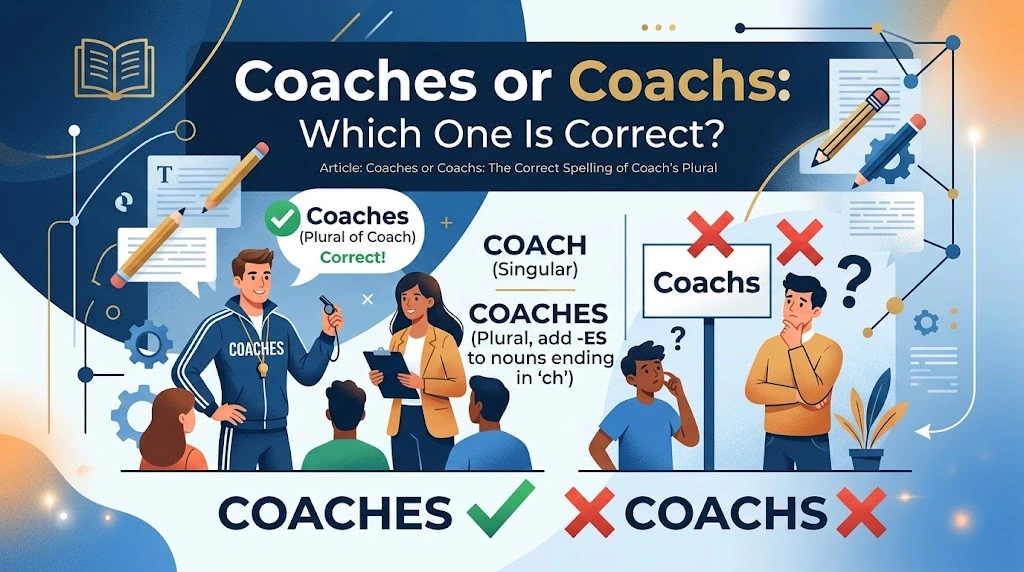
Coaches or coachs? If you’ve ever hesitated over this spelling, you’re not alone. The two forms look almost identical, but only one is correct in standard English.
The correct spelling is coaches.
Coachs is not the standard plural form of coach. When you want to talk about more than one coach, use coaches. The same spelling also appears as a verb when coach describes what one person does, such as “She coaches the team.”
So why does coach become coaches instead of coachs? The answer comes down to a common English pluralization pattern involving words that end in -ch.
This guide explains the difference between coaches and coachs, why the spelling works this way, how to pronounce coaches, and how to distinguish it from forms such as coach’s and coaches’.
Coaches or Coachs: Which Spelling Is Correct?
The correct spelling is coaches.
When coach functions as a noun and refers to more than one person, the plural is coaches.
| Form | Correct? | Meaning |
| coach | Yes | One coach |
| coaches | Yes | Two or more coaches |
| coachs | No | Incorrect standard spelling |
| coach’s | Yes | Possessive form of one coach |
| coaches’ | Yes | Possessive form of multiple coaches |
For example:
- The coach arrived before practice.
- The coaches arrived before practice.
- The coach’s office is upstairs.
- The coaches’ offices are upstairs.
The important point is simple: coachs is not the correct plural of coach.
English doesn’t always form plurals by adding just -s. Several spelling patterns determine whether a noun takes -s, -es, or another ending.
In this case, coach follows the -es pattern.
Why Is It Coaches Instead of Coachs?
The spelling coaches follows a standard English pluralization rule.
Words ending in certain consonant sounds commonly form their plurals by adding -es. The ending -ch is one of the important patterns to recognize.
The process looks like this:
coach + es = coaches
The final -es isn’t just decorative. It also helps produce a natural pronunciation.
Compare these examples:
- church → churches
- bench → benches
- match → matches
- branch → branches
- peach → peaches
- coach → coaches
Writing coachs would ignore the established spelling pattern used by these words.
Think of the plural ending as a small bridge between the original word and its plural pronunciation. English spelling can be quirky, but this particular pattern is highly regular.
Coaches vs. Coachs: The Basic Rule
If you need to remember only one thing, remember this:
When the plural of coach means more than one coach, spell it coaches.
The pattern is:
coach → coaches
Not:
coach → coachs
Here are a few quick examples:
- one coach → two coaches
- one head coach → several head coaches
- one life coach → several life coaches
- one assistant coach → several assistant coaches
- one basketball coach → several basketball coaches
This rule applies whether you’re writing about sports, education, business, fitness, or personal development.
What Does Coach Mean?
Before looking more closely at the plural, it helps to understand the word coach itself.
As a noun, coach commonly means a person who trains, teaches, or guides someone toward better performance.
In sports, a coach may plan practices, teach techniques, develop strategies, and help athletes improve.
For example:
The basketball coach designed a new practice routine.
The word also appears outside traditional sports.
A life coach may help clients work toward personal goals. A career coach may help people navigate professional decisions. An executive coach may work with business leaders on communication, leadership, or workplace goals.
The word coach can also function as a verb.
For example:
She coaches the high school volleyball team.
Here, coaches doesn’t mean multiple people. It means one person performs the action of coaching.
That distinction becomes important later.
Coach vs. Coaches: Singular and Plural
The difference between coach and coaches is primarily about number when you’re using them as nouns.
Use coach for one.
The coach spoke to the players.
Use coaches for two or more.
The coaches spoke to the players.
The change looks small, but it carries important grammatical information.
| Number | Form | Example |
| Singular | coach | The coach called a meeting. |
| Plural | coaches | The coaches called a meeting. |
Notice that the verb can change too.
The coach is ready.
The coaches are ready.
The noun tells you how many people you’re discussing. The verb then agrees with that number.
Examples of Coach and Coaches
Here are several examples:
Singular:
- The coach arrived at 6 a.m.
- Our coach changed the training schedule.
- The coach watched the entire game.
- A new coach joined the school.
Plural:
- The coaches arrived at 6 a.m.
- Our coaches changed the training schedule.
- The coaches watched the entire game.
- Several new coaches joined the school.
The difference is straightforward once you focus on the number.
Why “Coachs” Is Incorrect
The form coachs looks tempting because many English plurals simply add -s.
For example:
- player → players
- teacher → teachers
- runner → runners
- student → students
That pattern can lead writers to assume:
coach + s = coachs
But English has many spelling rules that override the basic add -s pattern.
Words ending in -ch commonly take -es.
So:
coach + es = coaches
The same pattern appears in:
- church → churches
- lunch → lunches
- branch → branches
- match → matches
- sandwich → sandwiches
Therefore:
❌ The school hired three coachs.
✅ The school hired three coaches.
The incorrect version isn’t a different regional spelling. It is simply not the standard plural spelling of coach.
The Pluralization Rule for Words Ending in -Ch
The -ch + -es pattern helps explain why coaches looks different from many ordinary plurals.
Consider these words:
| Singular | Plural |
| coach | coaches |
| church | churches |
| bench | benches |
| branch | branches |
| match | matches |
| peach | peaches |
| lunch | lunches |
| sandwich | sandwiches |
| torch | torches |
The pattern becomes easier to recognize when you see several examples together.
Why Does English Add -Es?
English spelling needs to represent pronunciation as well as grammatical number.
If you simply wrote coachs, the spelling wouldn’t represent the conventional pronunciation of the plural.
The standard form coaches is pronounced with an additional syllable:
coach → coaches
The plural ending sounds roughly like /ɪz/.
That pronunciation is one reason the spelling pattern feels natural when spoken aloud.
Are All Words Ending in “Ch” the Same?
Not necessarily.
English spelling rules depend partly on pronunciation and historical spelling patterns. You shouldn’t assume that every word containing the letters ch behaves identically.
For ordinary words ending in the ch sound, however, adding -es is a common and useful pattern.
For example:
- watch → watches
- catch → catches
- teach → teaches
- reach → reaches
- search → searches
Notice that these examples include verbs as well as nouns.
The same spelling principle can therefore appear in different grammatical situations.
How Do You Pronounce Coaches?
The word coach is generally pronounced with one syllable:
coach — /koʊtʃ/
The plural coaches is pronounced approximately:
coaches — /ˈkoʊtʃɪz/
The plural has an additional syllable.
You can think of the difference like this:
- coach → one syllable
- coaches → two syllables
The added syllable helps explain why coaches doesn’t simply behave like a word whose plural ends in a single /s/ sound.
Compare:
- coach → coaches
- cat → cats
- book → books
In cats and books, the plural ending doesn’t create a new syllable. In coaches, the ending does.
Coaches as a Noun
As a noun, coaches usually means two or more people who train, teach, or guide others.
For example:
The coaches met before the tournament.
Here, coaches is plural because more than one person attended the meeting.
Another example:
Several coaches attended the training conference.
Again, coaches refers to multiple people.
The word can describe professionals in many settings.
Sports Coaches
Sports are probably the most familiar context.
- soccer coaches
- basketball coaches
- football coaches
- tennis coaches
- swimming coaches
- baseball coaches
For example:
The soccer coaches reviewed the team’s defensive strategy.
Professional Coaches
The word also appears in business and personal development.
Common examples include:
- career coaches
- executive coaches
- leadership coaches
- life coaches
- business coaches
- performance coaches
For example:
Several career coaches spoke at the professional development event.
In every case, the plural spelling remains coaches.
Coaches as a Verb
Here’s where things get interesting.
Coaches isn’t always a plural noun.
It can also be the third-person singular present-tense form of the verb coach.
Consider this pattern:
| Subject | Verb |
| I | coach |
| You | coach |
| He | coaches |
| She | coaches |
| It | coaches |
| We | coach |
| They | coach |
Examples:
I coach the junior team.
She coaches the junior team.
They coach the junior team.
Notice something important.
The form coaches appears with he, she, and it in the present tense.
So you can’t determine the meaning of coaches from spelling alone. You need to examine the sentence.
Compare:
The coaches arrived early.
Here, coaches is a plural noun.
Now compare:
She coaches the team.
Here, coaches is a verb.
Same spelling. Different grammatical role.
Coaches as a Noun vs. Coaches as a Verb
This distinction becomes easier when you look at the surrounding words.
“Coaches” as a noun
The coaches discussed the schedule.
The word refers to multiple people.
“Coaches” as a verb
Maria coaches the school team.
The word describes an action performed by Maria.
A useful test is to ask:
Who or what is “coaches” referring to?
If it identifies multiple people, it’s a noun.
If it describes what one person or thing does, it’s a verb.
Coach’s, Coaches’, and Coaches: Don’t Mix Them Up
One of the biggest sources of confusion isn’t actually coaches vs. coachs. It’s the difference between coaches, coach’s, and coaches’.
These forms look similar, but they perform different jobs.
| Form | Function | Example |
| coach | Singular noun | The coach arrived. |
| coaches | Plural noun | The coaches arrived. |
| coach’s | Singular possessive | The coach’s office is open. |
| coaches’ | Plural possessive | The coaches’ offices are open. |
| coaches | Verb | She coaches the team. |
Coach’s
Coach’s shows possession by one coach.
The coach’s whistle was on the bench.
The whistle belongs to one coach.
Coaches’
Coaches’ shows possession by multiple coaches.
The coaches’ meeting lasted an hour.
The meeting involved multiple coaches.
Coaches
Coaches without an apostrophe usually functions as a plural noun or verb.
The coaches arrived.
Or:
She coaches the team.
Apostrophes matter here. They aren’t optional decoration.
Coaches or Coachs in Compound Terms
Compound terms follow the same plural principle.
If you’re talking about more than one head coach, write:
head coaches
Not:
head coachs
Similarly:
- life coach → life coaches
- career coach → career coaches
- assistant coach → assistant coaches
- football coach → football coaches
- strength coach → strength coaches
- pitching coach → pitching coaches
The noun coach still becomes coaches.
Example
The organization hired three new assistant coaches.
Not:
The organization hired three new assistant coachs.
The second version applies the wrong plural rule.
What Is the Plural of Life Coach?
The standard plural is life coaches.
The plural marker belongs to the noun coach:
life coach → life coaches
For example:
The conference brought together dozens of life coaches.
The same principle applies to other compound expressions.
| Singular | Plural |
| life coach | life coaches |
| career coach | career coaches |
| executive coach | executive coaches |
| head coach | head coaches |
| assistant coach | assistant coaches |
| fitness coach | fitness coaches |
This is a useful pattern because compound nouns can sometimes make pluralization confusing.
What Is the Plural of Head Coach?
The correct plural is head coaches.
For example:
Several head coaches attended the meeting.
You don’t pluralize head because it modifies the noun coach. The plural ending goes on the main noun.
The same principle applies to:
This structure appears frequently in sports writing.
Common Mistakes With Coach
Even though coaches is straightforward, several related errors appear often.
Writing “coachs”
❌ The coaches met with the players.
Wait—that sentence is correct. The mistake would be:
❌ The coachs met with the players.
Correct:
✅ The coaches met with the players.
Using “coach’s” as a plural
❌ The coach’s met after practice.
If you’re talking about multiple coaches, use:
✅ The coaches met after practice.
The apostrophe doesn’t make an ordinary noun plural.
Using “coaches’” without possession
❌ Three coaches’ attended the event.
Correct:
✅ Three coaches attended the event.
The apostrophe in coaches’ signals plural possession.
Confusing the noun and verb
Consider:
The coaches train every morning.
Here, coaches is a noun.
Now:
She coaches every morning.
Here, coaches is a verb.
The context determines the grammatical function.
Coaches in Different Types of Writing
The word coaches appears across many forms of English writing.
Sports Writing
Sports articles regularly use coaches when discussing multiple team leaders.
The coaches met before the championship game.
Education
Schools often have multiple coaches across different teams.
The school appointed new coaches for its athletic programs.
Business Writing
Business and executive coaching have their own professional vocabulary.
Executive coaches often work with leaders on communication and management goals.
Fitness
Fitness facilities may employ several specialized coaches.
The gym’s coaches created individual training plans.
News Writing
News reports may refer to coaches when covering teams, competitions, appointments, or organizational changes.
The coaches spoke with reporters after the match.
Regardless of the subject, the spelling remains coaches.
Coaches vs. Other Similar Plurals
Learning a few related examples makes the rule easier to remember.
| Singular | Correct plural |
| coach | coaches |
| box | boxes |
| class | classes |
| dish | dishes |
| church | churches |
| match | matches |
| branch | branches |
| peach | peaches |
| bus | buses |
These words use -es because their endings create particular pronunciation and spelling patterns.
The important lesson isn’t that every English plural follows one universal formula. English has many irregular plurals and exceptions.
Instead, recognize common patterns.
When you see coach, remember:
coach → coaches
A Simple Memory Trick for Coaches or Coachs
Here’s an easy way to remember the correct spelling.
Think: “Coach needs ES.”
Take:
COACH
Then add:
ES
You get:
COACHES
You can also remember the rhyme:
One coach, two coaches.
Not:
One coach, two coachs.
That tiny -es ending makes all the difference.
Quick Comparison: Coaches or Coachs
If you’re editing an article, email, school assignment, or social media post, this table gives you the quick answer.
| Word | Correct? | Use |
| coach | ✅ | Singular noun or base verb |
| coaches | ✅ | Plural noun or third-person singular verb |
| coachs | ❌ | Incorrect standard spelling |
| coach’s | ✅ | Singular possessive |
| coaches’ | ✅ | Plural possessive |
When in doubt, identify what you’re trying to say first.
Are you talking about one person?
Use coach.
Are you talking about multiple people?
Use coaches.
Are you showing ownership by one coach?
Use coach’s.
Are you showing ownership by several coaches?
Use coaches’.
A Practical Editing Example
Imagine you’re proofreading this paragraph:
The school hired three new coachs. The coach’s met with the athletic director before practice. Each coaches has a different training style.
Several errors appear here.
A corrected version would read:
The school hired three new coaches. The coaches met with the athletic director before practice. Each coach has a different training style.
Notice how the corrections aren’t based on appearance alone.
The final sentence uses coach because each refers to members individually. Even though the group contains multiple people, the noun following each is singular.
That’s a useful grammar detail that often gets overlooked.
A Mini Case Study: Why Context Matters
Consider these three sentences:
The coaches arrived early.
She coaches the team.
The coach’s office is nearby.
All three sentences contain closely related forms.
Yet each one performs a different job.
Coaches in the first sentence is a plural noun.
Coaches in the second sentence is a verb.
Coach’s in the third sentence is a singular possessive.
This is why proofreading isn’t simply about memorizing spelling. Grammar and context work together.
Coaches or Coachs in Professional Communication
Correct spelling becomes especially important in professional writing.
Imagine a school website saying:
Meet Our Coachs
That small spelling error can make the page look rushed or poorly edited.
The professional version is:
Meet Our Coaches
The same applies to:
- resumes
- newsletters
- business websites
- sports programs
- brochures
- event announcements
- school communications
- training materials
- marketing copy
A single missing letter may seem harmless. However, polished writing depends on hundreds of these small details.
Facts to Remember About Coaches
Here are the key facts in one place:
- Coaches is the correct plural of coach.
- Coachs is not the standard plural spelling.
- Coach normally takes -es when pluralized.
- Coaches can also function as a verb.
- Coach’s is the singular possessive form.
- Coaches’ is the plural possessive form.
- Life coaches, head coaches, and career coaches are correctly pluralized compound terms.
- The plural coaches is pronounced with two syllables.
Frequently Asked Questions About Coaches or Coachs
Is “coachs” a word?
Coachs is not the standard plural spelling of coach. The correct plural is coaches.
What is the plural of coach?
The plural of coach is coaches.
One coach, two coaches.
Why is it coaches instead of coachs?
English commonly uses -es to form plurals of words ending in the ch sound. Therefore:
coach → coaches
Is coaches singular or plural?
As a noun, coaches is plural.
The coaches arrived.
However, coaches can also be a singular verb.
She coaches the team.
The sentence context determines which function it has.
Is “coach’s” the plural of coach?
No. Coach’s is the singular possessive form.
The coach’s office.
For a normal plural, use coaches.
Is “coaches’” correct?
Yes. Coaches’ is the plural possessive form.
The coaches’ meeting began at noon.
The apostrophe shows that something belongs to multiple coaches.
What is the plural of life coach?
The standard plural is life coaches.
Several life coaches attended the conference.
What is the plural of head coach?
The standard plural is head coaches.
The head coaches met before the tournament.
What is the plural of assistant coach?
The correct plural is assistant coaches.
The assistant coaches helped organize practice.
How many syllables are in coaches?
Coaches normally has two syllables: coach-es.
The singular coach has one syllable.
Is “coaches” only used for sports?
No. Coaches can work in sports, business, careers, fitness, personal development, education, and other fields.
Can coaches be a verb?
Yes.
She coaches the varsity team.
In that sentence, coaches is the third-person singular present form of coach.
Coaches or Coachs: Final Answer
When choosing between coaches or coachs, the correct form is clear:
Coaches is correct. Coachs is incorrect.
The plural of coach is formed by adding -es:
coach → coaches
Use coaches when referring to more than one coach:
The coaches met after practice.
Use coaches as a verb when one person performs the action:
She coaches the team.
Use coach’s when something belongs to one coach:
The coach’s office is locked.
Use coaches’ when something belongs to multiple coaches:
The coaches’ meeting starts at noon.
The easiest rule to remember is simple: coach takes -es in the plural.
So whenever you find yourself wondering whether to write coaches or coachs, choose coaches.
