

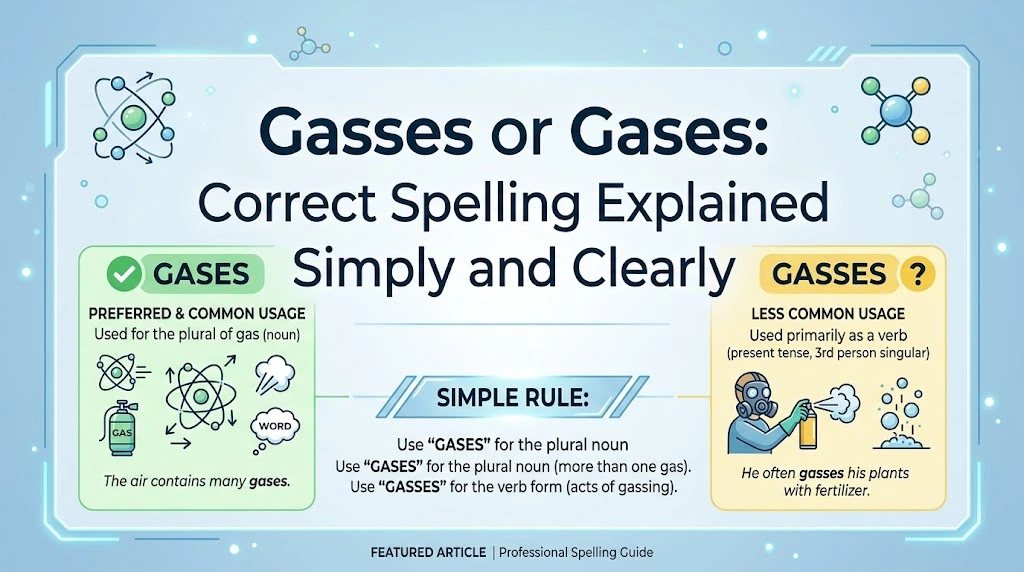
Gasses or gases can look like two versions of the same word. In most cases, though, they aren’t interchangeable. The spelling you need depends on what the word means and how it functions in the sentence.
If you’re talking about oxygen, nitrogen, carbon dioxide, hydrogen, or several other substances in a gaseous state, the correct plural is gases.
Gasses has a much narrower use. It can be a verb form of the uncommon verb gass, which has a different meaning. That’s why seeing two s’s doesn’t automatically make gasses a plural form of gas.
The easiest rule is simple:
Gas → gases when you mean more than one gas.
This guide explains the difference between gasses vs. gases, how each word works, how they’re pronounced, and which spelling you should use in scientific, academic, professional, and everyday writing.
Gases vs. Gasses: The Quick Answer
When gas means a substance or material in a gaseous state, its standard plural is gases.
For example:
- Oxygen and nitrogen are gases.
- Several gases were detected in the laboratory.
- Greenhouse gases include carbon dioxide and methane.
- Some industrial gases require special storage.
So why does gasses exist?
Because gasses can represent a verb form associated with the uncommon verb gass. It isn’t the ordinary plural of gas.
| Word | Typical function | Meaning | Example |
| gas | Noun | A substance in a gaseous state | Oxygen is a gas. |
| gases | Plural noun | More than one gas | Oxygen and hydrogen are gases. |
| gass | Verb | An uncommon verb with its own meaning | The verb appears in specialized or informal usage. |
| gasses | Verb | Third-person singular form of gass | The engine gasses up. |
For normal writing, the distinction is straightforward. Use “gases” when you mean multiple gases.
What Does “Gases” Mean?
Gases is the plural form of the noun gas.
A gas is one of the basic states of matter. Unlike a solid, it doesn’t retain a fixed shape or volume under ordinary conditions. Gas particles generally move freely and spread throughout the space available to them.
When you refer to more than one type or instance of gas, you use gases.
For example:
Oxygen and carbon dioxide are different gases.
Here, gases refers to two different substances.
The same pattern appears in technical writing:
Scientists measured several gases released during the experiment.
The word doesn’t describe one particular substance. Instead, it refers to multiple gases.
Examples of “Gases”
You might encounter gases in many fields:
- Oxygen and nitrogen in atmospheric science
- Carbon dioxide and methane in climate discussions
- Hydrogen and helium in chemistry
- Anesthetic gases in medicine
- Industrial gases in manufacturing
- Exhaust gases in automotive engineering
- Noble gases in chemistry
- Toxic gases in workplace safety
Each example uses gases because the writer is referring to more than one gas.
Why Is the Plural of “Gas” “Gases”?
The spelling can seem slightly odd because gas already ends in s.
English commonly adds -es to nouns ending in certain consonant sounds or spellings. This helps create a pronounceable plural form.
Consider these examples:
- gas → gases
- class → classes
- glass → glasses
- bus → buses
- pass → passes
- box → boxes
The pattern isn’t identical for every English noun, but words ending in s frequently take -es in the plural.
That gives us:
gas + es = gases
The spelling contains only one s before the plural ending appears visually as -es.
This is why gases is the standard plural noun.
What Does “Gasses” Mean?
Gasses is not normally the plural of gas.
Instead, it can be the third-person singular present-tense form of the uncommon verb gass.
That distinction matters because English sometimes contains words that look closely related while performing completely different grammatical jobs.
For example:
The machine gasses up before the next stage.
Here, gasses functions as a verb. It doesn’t mean “multiple gases.”
However, this verb is relatively uncommon compared with ordinary uses of gas. Depending on the intended meaning, writers may encounter other verb forms such as gases or gasses in different dictionaries and style contexts.
That makes context especially important.
If your sentence says:
Several gasses were present in the container.
and you mean several chemical substances, gases is the standard spelling:
Several gases were present in the container.
The extra s changes the grammatical interpretation.
Is “Gasses” Ever Correct?
Yes, but it isn’t the spelling you should automatically choose for the plural of gas.
The important point is that gasses can have a legitimate grammatical role when it comes from the verb gass.
That use is much less common than gases as the plural noun.
This creates an important distinction:
If you mean multiple gases, write “gases.”
If “gasses” is being used as a verb, its meaning comes from the verb “gass,” not from the plural noun “gas.”
This difference resembles other English words where a small spelling change signals a different grammatical function.
Why “Gasses” Looks Like a Plural
The confusion is understandable.
A reader sees:
gas → gasses
and may assume that doubling the final consonant creates the plural.
English doesn’t work that way here.
The standard plural is:
gas → gases
The spelling gasses contains an additional s, which makes it look like a conventional plural. Grammatically, however, that isn’t how the common noun works.
Gases or Gasses in Science
Scientific writing overwhelmingly favors gases when discussing multiple gases.
That’s because scientific terminology routinely describes different substances that exist in gaseous form.
You’ll see phrases such as:
- greenhouse gases
- noble gases
- reactive gases
- combustible gases
- toxic gases
- trace gases
- industrial gases
- exhaust gases
- anesthetic gases
- atmospheric gases
For example:
The atmosphere contains several different gases, including nitrogen, oxygen, argon, and carbon dioxide.
Using gasses in this sentence would normally be a spelling error because the writer is using the plural noun.
Why Precision Matters in Scientific Writing
Scientific writing depends heavily on precise terminology.
A single letter can sometimes distinguish two different words, concepts, or grammatical functions. That doesn’t mean every spelling difference changes scientific meaning, but careful spelling helps readers understand exactly what a sentence is doing.
Consider:
Researchers analyzed the gases released by the reaction.
The meaning is immediately clear.
Now compare:
Researchers analyzed the gasses released by the reaction.
Most readers will interpret this as an incorrect spelling of gases because gasses doesn’t fit the intended noun usage.
The first version communicates the scientific idea cleanly.
Gases or Gasses in Everyday English
The same rule applies outside science.
Suppose you’re writing about vehicle emissions:
Modern engines produce several types of exhaust gases.
Or perhaps you’re discussing cooking:
Some cooking processes release gases and vapors.
Environmental writing uses the same spelling:
Certain gases contribute to air pollution.
Medical writing does too:
The patient received a mixture of medical gases.
In every case, gases is correct because the writer means multiple gases.
Common Everyday Phrases With “Gases”
Here are some natural expressions you’ll encounter:
| Phrase | Example |
| greenhouse gases | Greenhouse gases can affect Earth’s climate system. |
| toxic gases | Workers must avoid exposure to toxic gases. |
| exhaust gases | The system reduces harmful exhaust gases. |
| natural gases | Different natural gases have different properties. |
| industrial gases | Industrial gases support many manufacturing processes. |
| noble gases | Helium and neon are noble gases. |
| combustible gases | Combustible gases require careful handling. |
The plural remains gases in all of these expressions.
Gases vs. Gasses: What’s the Grammatical Difference?
The clearest way to understand the difference is to look at the part of speech.
Gases is commonly a plural noun.
Gasses can function as a verb associated with gass.
That means you shouldn’t decide between the two spellings simply by counting letters. Ask what role the word plays.
When “Gases” Is a Noun
Three gases were identified.
Here, gases names multiple substances.
You can usually replace it with:
three different gases
The word answers the question “What things?”
When “Gasses” Is a Verb
The equipment gasses up before operation.
Here, gasses describes an action.
It isn’t naming several substances.
The word answers the question “What does it do?”
That simple grammatical test can eliminate much of the confusion.
Gases vs. Gasses: Pronunciation
Pronunciation adds another layer to the confusion.
The plural gases is commonly pronounced with a long a sound and a z sound at the end:
Gases → roughly “GAY-ziz”
The verb form gasses, when used with the verb gass, is generally pronounced differently:
Gasses → roughly “GAS-iz”
The exact pronunciation can vary according to the word’s context and the speaker’s dialect. However, the difference is useful because it shows that these aren’t simply two interchangeable spellings.
When you hear the words aloud, the intended meaning can sometimes become clearer.
How to Remember “Gases” vs. “Gasses”
A simple memory trick works for most situations:
More than one gas = gases.
That’s the rule worth remembering.
If you’re writing about:
- oxygen,
- nitrogen,
- carbon dioxide,
- methane,
- hydrogen,
- helium,
- pollutants,
- exhaust,
- industrial substances,
you’ll almost certainly need gases when referring to more than one.
The Substitution Test
When you’re unsure, replace the word with:
more than one gas
If that replacement makes sense, use gases.
For example:
Several ___ were detected.
Try the substitution:
Several more than one gas were detected.
The grammar sounds awkward because of the phrase itself, but the intended noun meaning is obvious. You’re talking about multiple gas substances, so the correct word is:
Several gases were detected.
The test isn’t a formal grammar rule. It’s simply a quick way to identify the intended meaning.
Common Mistakes With Gases and Gasses
The biggest mistake is treating gasses as the ordinary plural of gas.
Here are some frequent examples.
Mistake: “Greenhouse Gasses”
Incorrect in standard noun usage:
Greenhouse gasses contribute to climate change.
Correct:
Greenhouse gases contribute to climate change.
The sentence refers to multiple gases. Therefore, gases is the appropriate plural noun.
Mistake: “Several Gasses Were Detected”
Incorrect when gasses means multiple substances:
Several gasses were detected.
Correct:
Several gases were detected.
The second version clearly uses the standard plural of gas.
Mistake: Assuming “Gasses” Is More Formal
Some writers assume that doubling the s makes the word look more technical or formal.
It doesn’t.
Gasses isn’t a more sophisticated spelling of gases.
In fact, using gasses where gases is required can make otherwise polished writing look careless.
Mistake: Applying One Plural Rule Everywhere
English spelling contains many patterns, but no single rule explains every plural.
For example:
- gas → gases
- dog → dogs
- box → boxes
- city → cities
- child → children
Learning common patterns works better than trying to force every noun into one formula.
Gases or Gasses: Examples in Sentences
Seeing the words in context makes the distinction easier.
Correct Uses of “Gases”
Oxygen and nitrogen are the two most abundant gases in Earth’s dry atmosphere.
Scientists measured several gases during the experiment.
Some gases expand when heated.
Industrial gases require appropriate storage and handling.
Certain gases can be detected using specialized instruments.
Exhaust gases may contain several different chemical compounds.
Noble gases have distinctive chemical properties.
Greenhouse gases include carbon dioxide, methane, nitrous oxide, and other substances.
In each example, gases is a plural noun.
Uses of “Gasses”
The word gasses can appear when it functions as a verb form associated with gass.
For example:
The vehicle gasses up before the long trip.
This usage is uncommon enough that many readers won’t encounter it often.
That’s why context matters more than appearance.
Gases or Gasses in Academic Writing
Academic writing generally rewards clarity and conventional terminology.
If you’re writing a research paper, essay, laboratory report, textbook, or technical explanation, use gases when referring to multiple gases.
For example:
The experiment examined how different gases reacted under controlled conditions.
That’s clear and conventional.
Using gasses in the same sentence could distract readers because they may interpret it as a spelling mistake.
Academic writing doesn’t benefit from unusual wording simply for the sake of sounding sophisticated. The goal is accuracy.
Standard terminology usually wins.
Gases or Gasses in Technical Writing
Technical documents often contain phrases such as:
- compressed gases
- hazardous gases
- fuel gases
- process gases
- calibration gases
- medical gases
- inert gases
- corrosive gases
For example:
Store compressed gases according to the manufacturer’s safety requirements.
Here, gases is clearly the plural noun.
Technical writers should pay particular attention to terminology because instructions need to be unambiguous. A spelling choice that looks minor can create unnecessary confusion.
A Closer Look at the Word “Gas”
The noun gas has several meanings in English.
In chemistry and physics, a gas is a state of matter characterized by particles that move freely and occupy available space.
In everyday American English, gas can also mean gasoline.
For example:
The car needs more gas.
That meaning is different from the scientific meaning, but its plural can still become gases when the noun itself is being pluralized in an appropriate context.
The word also appears in expressions such as:
- gas station
- gas tank
- gas pedal
- gas stove
- gas leak
- gas line
The meaning depends heavily on context.
Gas Doesn’t Always Mean a Chemical Gas
This is worth remembering.
In American English, gas commonly means gasoline.
So a sentence such as:
We stopped at three gas stations.
doesn’t mean three gaseous substances. Here, gas appears as part of the compound noun gas station.
That distinction illustrates an important point about English: a word’s meaning comes from its context.
Gases, Gas, and Gasoline
American English creates another possible source of confusion because gas has both scientific and everyday meanings.
Consider:
The laboratory contains several gases.
Here, gases means multiple gaseous substances.
Now consider:
The car needs gas.
Here, gas means gasoline.
The plural spelling question usually arises when the writer is referring to multiple gaseous substances.
That gives you a practical rule:
If you’re talking about several gaseous substances, use “gases.”
Gases vs. Gasses: A Practical Comparison
| Question | Gases | Gasses |
| Is it the standard plural of gas? | Yes | No |
| Can it be a plural noun? | Yes | Generally not in this meaning |
| Can it be a verb? | In some contexts, depending on the verb | Yes, from “gass” |
| Common in science? | Yes | Rare |
| Common in academic writing? | Yes | Rare |
| Common in everyday writing? | Yes | Uncommon |
| Refers to multiple gaseous substances? | Yes | No |
| Safe choice for “more than one gas”? | Yes | No |
The table reveals the key point: gases is the normal choice whenever the intended meaning is the plural noun.
Why “Gases” Appears So Often in Scientific Terminology
Science frequently deals with mixtures and multiple substances.
Earth’s atmosphere, for example, contains several gases. Air isn’t one pure chemical substance. It’s a mixture dominated by nitrogen and oxygen along with smaller amounts of other gases.
That naturally produces phrases such as:
Atmospheric gases interact with solar radiation.
Similarly, chemistry discusses:
reactive gases
inert gases
noble gases
combustible gases
toxic gases
The plural form is necessary because these phrases describe categories containing multiple substances.
That’s why gases is deeply established in scientific vocabulary.
Case Study: Fixing a Common Science Sentence
Consider this sentence:
The researchers identified five different gasses in the sample.
At first glance, it may look perfectly reasonable. The writer clearly means five different gaseous substances.
However, gasses isn’t the standard plural noun form of gas.
The corrected version is:
The researchers identified five different gases in the sample.
Nothing else needs changing.
The sentence remains clear and natural. Only the spelling needs correction.
This small example demonstrates why proofreading matters. A single extra letter can make technically accurate content appear less polished.
Case Study: Environmental Writing
Environmental articles frequently discuss atmospheric substances.
Suppose a draft says:
Several greenhouse gasses occur naturally in Earth’s atmosphere.
The intended meaning is clear. The writer refers to multiple gases.
The standard correction is:
Several greenhouse gases occur naturally in Earth’s atmosphere.
The correction doesn’t change the scientific idea. It simply uses the standard plural spelling.
Common environmental phrases include:
- greenhouse gases
- atmospheric gases
- air pollutants and gases
- trace gases
- exhaust gases
Again, gases is the normal plural.
Case Study: Workplace Safety
Imagine a workplace safety instruction:
Workers must wear appropriate equipment when handling hazardous gasses.
If the document means several hazardous gaseous substances, the spelling should be:
Workers must wear appropriate equipment when handling hazardous gases.
Safety documentation benefits from familiar terminology. Readers shouldn’t have to pause and wonder whether an unusual spelling represents a specialized term.
Clarity is the name of the game.
Related Words: Gas, Glass, Class, and Pass
Comparing gas with similar words can make the spelling pattern easier to remember.
| Singular | Plural |
| gas | gases |
| glass | glasses |
| class | classes |
| pass | passes |
| bus | buses |
| box | boxes |
These examples show why gases isn’t unusual.
The plural ending -es appears naturally after many words that end in certain sounds or spellings.
So instead of thinking:
gas + another s = gasses
think:
gas + plural ending = gases
That mental shift makes the spelling much easier to remember.
Is “Gasses” a Misspelling of “Gases”?
Not necessarily.
The answer depends on the intended word.
If someone writes:
Three gasses were found in the tank.
and means three gaseous substances, gasses is an incorrect spelling for that intended noun.
But if gasses is being used as a legitimate verb form of gass, then it isn’t simply a typo.
This is an important distinction because spelling errors aren’t always about the letters alone.
Meaning determines correctness.
The same sequence of letters can be valid in one grammatical context and wrong in another.
Which Spelling Should You Use?
For almost every situation involving multiple gases, choose:
Gases
Use gases when you’re talking about:
- multiple chemical gases
- different gases
- atmospheric gases
- greenhouse gases
- exhaust gases
- industrial gases
- toxic gases
- noble gases
- medical gases
- fuel gases
Use gasses only when the sentence genuinely calls for the uncommon verb gass.
If you’re writing an article, essay, report, school assignment, product description, scientific document, or general website content, gases will usually be the correct choice when you mean more than one gas.
Frequently Asked Questions About Gasses or Gases
Is “gases” the plural of “gas”?
Yes. The standard plural noun form of gas is gases.
For example:
Oxygen and hydrogen are gases.
Is “gasses” grammatically correct?
It can be, but it has a different grammatical use. It can function as a verb form of the uncommon verb gass.
It isn’t the standard plural of the noun gas.
Should I write “greenhouse gases” or “greenhouse gasses”?
Use greenhouse gases when referring to multiple gases.
Greenhouse gases affect Earth’s climate system.
Is “gasses” the plural of gas in American English?
No. The standard plural is gases.
American English also commonly uses gas to mean gasoline, but that doesn’t change the standard plural spelling of the noun referring to gaseous substances.
How do you spell the plural of gas?
The standard spelling is:
gases
Not:
gasses
when you mean multiple gaseous substances.
Are “gases” and “gasses” pronounced differently?
They can be.
Gases is commonly pronounced approximately like “GAY-ziz.”
The verb gasses is commonly pronounced approximately like “GAS-iz.”
Pronunciation can vary by dialect and context.
Why does “gas” become “gases”?
English commonly forms the plural of gas with -es, producing gases.
The same general pattern appears in words such as:
- glass → glasses
- class → classes
- bus → buses
Should I use “gases” in scientific writing?
Yes. When referring to multiple gases, gases is the standard and expected spelling in scientific writing.
Is “gasses” always wrong?
No. It can have a legitimate verb use related to gass. However, it isn’t the standard plural noun form of gas.
Which is correct: “different gases” or “different gasses”?
Different gases is correct when you mean different gaseous substances.
Scientists studied three different gases.
A Quick Editing Checklist
Before publishing your sentence, ask these questions:
- Am I referring to more than one gas?
- Is the word functioning as a noun?
- Am I discussing oxygen, nitrogen, carbon dioxide, methane, or another gaseous substance?
- Does the sentence describe multiple gaseous substances?
If the answer is yes, use:
gases
If the word is functioning as a verb and comes from gass, examine the context carefully before choosing gasses.
This quick check can prevent one of the most common spelling mistakes involving the word gas.
Final Takeaway: Gasses or Gases?
The difference between gasses and gases becomes simple once you focus on meaning.
Gases is the standard plural of gas. Use it when you mean two or more gaseous substances. It’s the form you’ll normally see in science, medicine, environmental writing, engineering, education, and everyday descriptions of multiple gases.
Gasses has a much narrower role. It can function as a verb form associated with the uncommon verb gass. It isn’t simply a double-s version of the plural noun.
The easiest rule to keep in your back pocket is this:
If you mean more than one gas, write “gases.”
So when you’re writing about oxygen and nitrogen, describing greenhouse gases, discussing exhaust gases, or explaining a chemistry experiment, gases is the spelling you want.
When in doubt, don’t let the extra s fool you. Gas becomes gases in the plural.
