

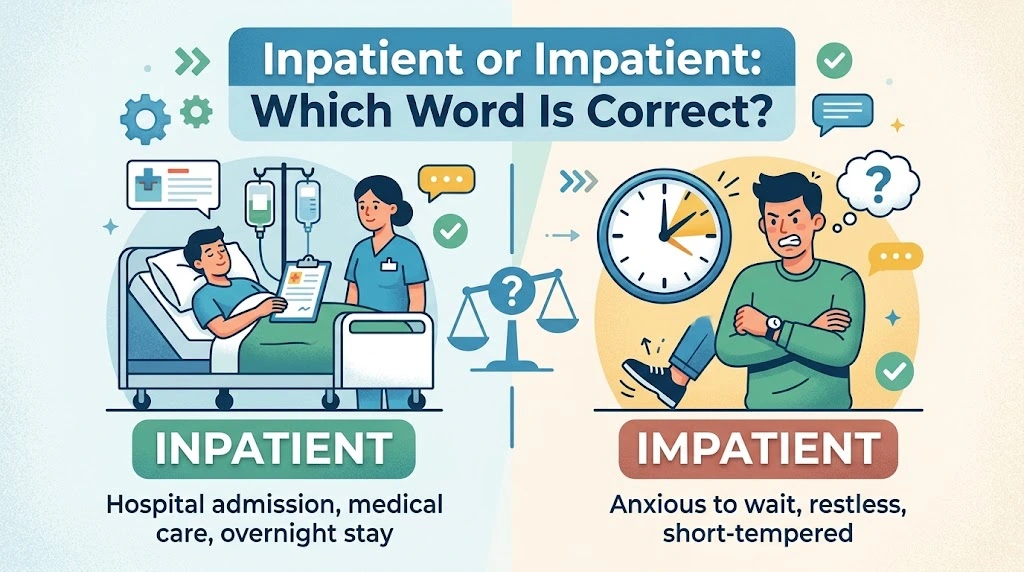
Inpatient or impatient? These two words look almost identical, but they describe completely different ideas. One belongs mainly to healthcare and hospital admission. The other describes someone who doesn’t want to wait or becomes frustrated by delay.
That single letter “n” changes the meaning entirely.
For example, a hospital might admit an inpatient for overnight treatment. Meanwhile, the patient’s family member could become impatient while waiting for an update.
The distinction becomes much easier once you connect each spelling with its meaning:
- Inpatient = someone receiving medical care while admitted to a healthcare facility.
- Impatient = someone who struggles to wait calmly or becomes frustrated by delays.
- Patient = a person receiving medical care, or someone who can wait calmly.
This guide explains the difference between inpatient and impatient, how to pronounce and spell them, when to use each one, and how to avoid common mistakes.
Inpatient vs. Impatient: Quick Difference
The fastest way to understand inpatient or impatient is to look at what each word describes.
| Word | Meaning | Part of Speech | Example |
| Inpatient | A person admitted to a hospital or healthcare facility for treatment | Noun / adjective | The inpatient remained in the hospital overnight. |
| Impatient | Someone who isn’t willing to wait calmly | Adjective | She became impatient after waiting for an hour. |
| Patient | A person receiving medical care; also someone able to wait calmly | Noun / adjective | The patient spoke with the doctor. |
Consider these two sentences:
The inpatient received treatment overnight.
The inpatient’s family became impatient while waiting for news.
Both words can appear in the same situation. However, they perform completely different jobs.
Inpatient identifies someone’s medical-care status. Impatient describes someone’s attitude toward waiting.
That’s the central distinction.
What Does “Inpatient” Mean?
Inpatient refers to a person who receives medical treatment after being formally admitted to a hospital or another healthcare facility.
As a noun, inpatient identifies the person.
For example:
The hospital admitted three inpatients for overnight observation.
As an adjective, inpatient describes care, services, facilities, units, treatment, or other healthcare matters associated with admitted patients.
For example:
The hospital expanded its inpatient services.
The important idea is admission.
An inpatient generally needs care that requires them to remain in the facility rather than simply visiting for an appointment or treatment session.
Inpatient as a Noun
When you use inpatient as a noun, you’re talking about the person receiving admitted care.
Examples include:
- The inpatient was moved to another room.
- Nurses monitored the inpatient throughout the night.
- The doctor examined each inpatient during morning rounds.
- The facility has space for 120 inpatients.
- The inpatient received additional treatment after surgery.
In ordinary conversation, however, healthcare professionals often simply use patient when the admission status isn’t important.
For example:
The nurse checked on the patient.
You don’t necessarily need to say inpatient unless the distinction matters.
Inpatient as an Adjective
Inpatient can also describe something related to hospital-based care for admitted patients.
Common examples include:
- inpatient care
- inpatient treatment
- inpatient services
- inpatient unit
- inpatient facility
- inpatient rehabilitation
- inpatient admission
- inpatient program
For example:
The doctor recommended inpatient treatment.
Here, inpatient doesn’t identify a person. It describes the type of treatment.
What Does “Impatient” Mean?
Impatient is an adjective that describes someone who doesn’t want to wait or who becomes annoyed by delay.
It has nothing specifically to do with hospitals.
You might become impatient when:
- traffic barely moves
- a website takes too long to load
- someone arrives late
- a meeting runs overtime
- you’re waiting for an important response
- a line at a store moves slowly
For example:
I became impatient after waiting for nearly an hour.
Here, the person isn’t being described as a hospital patient. The sentence describes a reaction to waiting.
Common Uses of Impatient
The adjective impatient commonly appears with several patterns.
Impatient with usually identifies the person or situation causing frustration:
She was impatient with the slow service.
Impatient for often introduces something someone eagerly wants:
He was impatient for the results.
Impatient to can introduce an action:
They were impatient to get started.
The word can describe a temporary mood or a recurring tendency.
Mark became impatient during the delay.
This describes a particular reaction.
Mark is often impatient with slow processes.
This suggests a more regular behavior.
Inpatient or Impatient: Meaning Compared Side by Side
The difference becomes obvious when you place the words next to each other.
| Situation | Correct Word | Example |
| Someone stays in a hospital after admission | Inpatient | The inpatient received overnight care. |
| Someone becomes frustrated while waiting | Impatient | The customer became impatient. |
| Hospital treatment requiring admission | Inpatient | The doctor recommended inpatient treatment. |
| Someone dislikes delays | Impatient | She gets impatient in long lines. |
| A hospital department for admitted patients | Inpatient | The inpatient unit was renovated. |
| Someone wants something to happen immediately | Impatient | He was impatient to begin. |
A useful shortcut is simple:
Think “in” when you see inpatient.
An inpatient is associated with being in a healthcare facility for admitted care.
Think patience when you see impatient.
Someone who is impatient doesn’t have much patience for waiting.
Why Are Inpatient and Impatient Confused?
The confusion isn’t surprising.
Both words contain patient, and their beginnings look similar. When people speak quickly, the difference may also become less obvious.
There’s another reason these words cause trouble: patient itself has two major meanings.
As a noun:
The patient waited for the doctor.
Here, patient means someone receiving healthcare.
As an adjective:
The patient teacher explained the concept again.
Here, patient means someone who can tolerate delay or difficulty calmly.
Adding different prefixes creates different meanings.
The Word Family
| Word | Core Meaning |
| Patient | A person receiving medical care |
| Patient | Able to wait calmly |
| Inpatient | A patient admitted for healthcare |
| Impatient | Not willing to wait calmly |
| Outpatient | A patient receiving care without hospital admission |
This word family explains why inpatient or impatient can feel confusing at first glance.
The shared element doesn’t mean the words share the same meaning.
Inpatient vs. Outpatient
One of the most important distinctions in medical vocabulary is inpatient vs. outpatient.
An inpatient receives care after being admitted to a healthcare facility.
An outpatient receives care without being admitted as an inpatient.
For example, suppose someone visits a hospital for a scheduled procedure and returns home afterward. That person may receive outpatient care.
Another person might require monitoring and treatment in the hospital for several days. That person receives inpatient care.
The exact rules for admission can vary by healthcare system and clinical circumstances. Still, the basic distinction is consistent: inpatient care involves admission, while outpatient care does not.
Examples of Inpatient Care
Depending on the situation, inpatient care may involve:
- hospitalization after serious illness
- postoperative monitoring
- certain types of rehabilitation
- intensive medical treatment
- psychiatric hospitalization
- extended observation or nursing care
The term doesn’t simply mean “someone who is sick.”
A person can be seriously ill and still receive outpatient treatment.
The key issue is the care setting and admission status.
Patient, Inpatient, and Impatient: The Full Picture
These three words deserve special attention because they share the same base word.
| Word | Meaning | Example |
| Patient | A person receiving medical care | The patient spoke with the surgeon. |
| Patient | Calm when waiting | She remained patient during the delay. |
| Inpatient | A patient admitted for healthcare | The inpatient stayed overnight. |
| Impatient | Frustrated by waiting or delay | He became impatient in traffic. |
Now compare these sentences:
The patient waited for the doctor.
The patient waited patiently for the doctor.
The inpatient stayed at the hospital overnight.
The impatient visitor repeatedly asked when the doctor would arrive.
The context does most of the work.
Inpatient Pronunciation vs. Impatient Pronunciation
Pronunciation can add another layer of confusion.
Inpatient contains the sound associated with the prefix in- before patient. In standard American English, it is commonly pronounced roughly like in-PAY-shunt.
Impatient is commonly pronounced roughly like im-PAY-shunt.
The difference is subtle enough that fast speech can make the words sound remarkably similar.
The spelling therefore becomes important in writing.
If you’re writing about hospital admission, check for the n:
inpatient
If you’re writing about frustration with waiting, use:
impatient
A Simple Pronunciation Reminder
Break the words into two parts:
in + patient → inpatient
im + patient → impatient
The spelling follows the prefix.
That small visual distinction can prevent a surprisingly awkward mistake.
How to Remember the Difference Between Inpatient and Impatient
A good memory trick should connect spelling with meaning.
Remember “Inpatient” With “In”
Think:
Inpatient = in the hospital.
This isn’t a complete definition because inpatient care can occur in different healthcare facilities. Still, the association makes the spelling easier to remember.
If the sentence involves admission, hospitalization, or admitted medical care, inpatient is likely the word you need.
Remember “Impatient” With “Patience”
Think:
Impatient = lacking patience.
If someone can’t wait calmly, they’re impatient.
For example:
The children became impatient while waiting for dinner.
There’s no medical meaning here.
The sentence concerns waiting. Therefore, impatient fits.
Common Phrases With “Inpatient”
You’ll often encounter inpatient in healthcare writing.
Inpatient Care
Inpatient care refers to medical care provided to someone who has been admitted to a healthcare facility.
The hospital provides inpatient care for patients requiring continuous monitoring.
Inpatient Treatment
Inpatient treatment describes treatment delivered in an admitted-care setting.
The physician recommended inpatient treatment after evaluating the patient.
Inpatient Unit
An inpatient unit is a hospital or healthcare area where admitted patients receive care.
The patient was transferred to an inpatient unit.
Inpatient Rehabilitation
Inpatient rehabilitation generally refers to rehabilitation provided in a residential or hospital-based setting where the patient remains at the facility during treatment.
She entered an inpatient rehabilitation program after surgery.
Inpatient Services
Inpatient services covers healthcare services provided to admitted patients.
The hospital recently expanded its inpatient services.
These phrases are common in hospital websites, medical documents, insurance materials, and healthcare reports.
Common Phrases With “Impatient”
Impatient appears much more broadly in everyday English.
Common combinations include:
- become impatient
- grow impatient
- feel impatient
- impatient with someone
- impatient with delays
- impatient for results
- impatient to leave
- impatient to begin
- impatiently wait
Consider the difference between these structures:
She became impatient with the delay.
He was impatient for the results.
They were impatient to start.
Each construction expresses the same basic idea: a lack of patience or tolerance for waiting.
Inpatient or Impatient in Sentences
Context makes the distinction especially clear.
Example: Hospital Admission
The inpatient received medication throughout the night.
The word inpatient works because the sentence concerns someone receiving admitted medical care.
Example: Waiting
The patient became impatient while waiting for test results.
Here, impatient describes the person’s reaction to waiting.
Example: Hospital Services
The hospital offers inpatient rehabilitation.
The word describes the type of rehabilitation service.
Example: Frustration
The customer grew impatient after the delivery was delayed.
The customer isn’t receiving medical care. The issue involves frustration with a delay.
Example: Both Words Together
The inpatient became impatient while waiting for the specialist.
This sentence contains both words correctly.
The person is an inpatient because they’re admitted for healthcare.
The person is impatient because they’re frustrated by waiting.
That’s perhaps the clearest demonstration of the difference.
Common Mistakes With Inpatient and Impatient
Small spelling mistakes can completely change the meaning of a sentence.
Mistake: Using “Impatient” for Hospital Care
Incorrect:
The hospital admitted several impatient patients.
This sentence isn’t grammatically impossible. In fact, it means the hospital admitted several patients who weren’t patient.
If the intended meaning is that the people were admitted for medical care, the word inpatient may be needed instead.
For example:
The hospital treated several inpatients overnight.
The difference isn’t cosmetic. The meaning changes.
Mistake: Using “Inpatient” for Someone Who Hates Waiting
Incorrect:
She became inpatient while waiting for the bus.
Correct:
She became impatient while waiting for the bus.
There’s no healthcare admission involved. The sentence describes frustration with waiting.
Mistake: Assuming “Inpatient” Means “Patient”
An inpatient is a type of patient, but the terms aren’t interchangeable in every context.
Every inpatient is a patient in the ordinary medical sense.
However, not every patient is an inpatient.
Someone could receive medical care as an outpatient.
That distinction matters in medical writing, healthcare administration, insurance documents, and hospital records.
Grammar: How to Use “Inpatient” Correctly
Inpatient can function as both a noun and an adjective.
Inpatient as a Noun
The inpatient was discharged this morning.
Here, inpatient refers directly to the person.
Plural:
The hospital treated 85 inpatients last month.
Inpatient as an Adjective
The hospital opened a new inpatient ward.
Here, inpatient modifies ward.
Other examples include:
- inpatient services
- inpatient treatment
- inpatient facility
- inpatient care
- inpatient rehabilitation
The word stays connected to the healthcare context.
Grammar: How to Use “Impatient” Correctly
Impatient functions as an adjective.
It describes a person or their behavior.
She is impatient.
He became impatient.
They seemed impatient.
You can also use it with common prepositions.
Impatient With
He was impatient with the slow response.
Impatient For
She was impatient for the results.
Impatient To
They were impatient to get started.
The choice depends on what follows the adjective.
A Practical Decision Test
When you’re unsure about inpatient or impatient, ask one question:
Is the sentence about healthcare admission or waiting?
If it’s about healthcare admission, choose:
inpatient
If it’s about frustration, delay, or waiting, choose:
impatient
For example:
The hospital needs more ___ beds.
The answer is inpatient.
Why? The beds are associated with admitted hospital care.
Now consider:
The customer became ___ after waiting 45 minutes.
The answer is impatient.
Why? The sentence describes frustration caused by waiting.
This quick test works in most everyday situations.
Inpatient or Impatient: A Mini Case Study
Imagine a patient named Daniel who visits a hospital for treatment.
After evaluation, doctors decide Daniel needs to remain at the hospital overnight.
At this point, Daniel is an inpatient.
Later, Daniel waits two hours for a specialist to arrive. He starts checking the clock and asking the nurse when the specialist will come.
Now Daniel is also impatient.
Nothing about the first word changed. Nothing about the second word changed.
The two words describe different aspects of the same person.
| Situation | Word | Why |
| Daniel is admitted to the hospital | Inpatient | It describes his healthcare status |
| Daniel becomes frustrated while waiting | Impatient | It describes his reaction to delay |
This example shows why context matters more than spelling alone.
Why the “N” Matters in Inpatient
The letter n isn’t decorative.
It helps distinguish inpatient from impatient.
Compare:
inpatient
impatient
That one letter changes the word’s meaning.
A useful visual trick is to isolate the beginning:
IN + patient → INPATIENT
IM + patient → IMPATIENT
Then connect each prefix with the concept:
- IN → admitted in a healthcare setting
- IM → lacking patience
The memory trick isn’t a formal linguistic definition. It’s simply an easy way to remember the spelling.
When “Patient” Means Something Completely Different
There’s another wrinkle worth understanding.
Patient doesn’t always refer to healthcare.
Consider:
Please be patient.
Here, patient means calm and willing to wait.
Now add the negative prefix:
Please don’t be impatient.
The meaning becomes almost the opposite.
The medical noun works differently:
The patient needs medication.
So English uses the same spelling, patient, for two related but distinct meanings.
The surrounding words tell you which meaning applies.
Inpatient or Impatient: Which Word Should You Use?
Choose inpatient when the sentence relates to someone who has been admitted for medical care or to healthcare services designed for admitted patients.
Choose impatient when the sentence describes someone who doesn’t want to wait, becomes frustrated by delay, or wants something to happen sooner.
Here’s the simplest comparison:
Inpatient = medical admission.
Impatient = lack of patience.
For example:
- Inpatient treatment requires the healthcare context.
- Impatient customer describes someone’s behavior.
- Inpatient unit refers to a medical setting.
- Impatient driver describes someone’s attitude.
- Inpatient rehabilitation refers to an admitted treatment setting.
- Impatient child describes someone who doesn’t want to wait.
Frequently Asked Questions About Inpatient or Impatient
Is “inpatient” one word or two?
Inpatient is normally written as one word when it refers to admitted medical care.
Examples include:
Is “impatient” related to “patient”?
Yes. Impatient contains patient and expresses the opposite of being patient in the sense of calmly tolerating delay.
patient → able to wait calmly
impatient → unable or unwilling to wait calmly
Does “inpatient” mean someone who is patient?
No.
Inpatient refers to a person admitted to a healthcare facility for treatment.
The word isn’t describing the person’s personality.
What is the opposite of inpatient?
In healthcare terminology, outpatient is the contrasting term.
An inpatient receives care after admission. An outpatient receives care without being admitted as an inpatient.
What is the difference between a patient and an inpatient?
A patient is a person receiving medical care.
An inpatient is a patient who has been admitted for care in a healthcare facility.
Therefore, inpatient is more specific.
Is “impatient” a noun?
In standard modern English, impatient is primarily an adjective.
You can say:
She is impatient.
You wouldn’t normally use impatient itself as the noun for a person. Instead, you might say:
She is an impatient person.
Can someone be both inpatient and impatient?
Absolutely.
A person can be an inpatient because they’ve been admitted to a hospital. That same person can become impatient while waiting for treatment or information.
For example:
The inpatient became impatient after waiting for the doctor.
Both words are correct because they describe different things.
How can I remember inpatient vs. impatient?
Use this quick association:
Inpatient → in healthcare
Impatient → impatience
If the sentence involves hospital admission, inpatient is likely correct.
If it involves waiting or frustration, impatient is likely correct.
Inpatient vs. Impatient: Final Comparison
| Feature | Inpatient | Impatient |
| Main meaning | Related to admitted medical care | Lacking patience |
| Common context | Hospitals and healthcare | Everyday life |
| Part of speech | Noun or adjective | Adjective |
| Related term | Outpatient | Patient |
| Refers to waiting? | No | Yes |
| Refers to medical admission? | Yes | No |
| Example | inpatient treatment | impatient customer |
Final Takeaway: Inpatient or Impatient?
The difference between inpatient and impatient comes down to context.
Inpatient belongs to the world of healthcare. It describes a person who has been admitted for medical care or something associated with that type of care.
Impatient belongs to the world of behavior and emotions. It describes someone who doesn’t want to wait calmly or who becomes frustrated by delay.
The easiest memory trick is this:
Inpatient = in for medical care.
Impatient = not patient enough to wait.
So if you’re writing about hospital admission, inpatient treatment, or inpatient services, use inpatient.
If you’re describing someone who is frustrated, hurried, or tired of waiting, use impatient.
One letter makes a big difference. Once you connect that letter to the meaning, inpatient or impatient becomes much easier to get right.
