

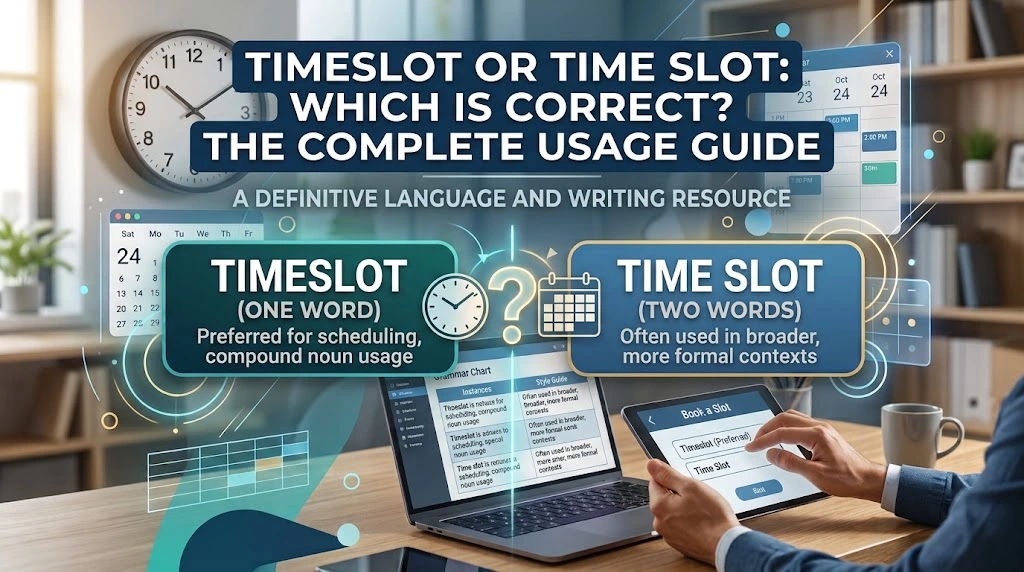
When you need to describe a specific period reserved for an appointment, program, meeting, class, or task, one small spelling choice can cause surprising confusion: timeslot or time slot?
Both forms appear in real-world English. That makes the question more complicated than simply declaring one spelling “right” and the other “wrong.” In general US English, however, time slot is the safer and more widely established choice for ordinary writing.
The closed form timeslot also appears in dictionaries, professional publications, broadcasting terminology, software interfaces, and other specialized contexts. Its existence isn’t a grammatical accident. English regularly turns frequently used word combinations into compounds over time.
So, which should you use?
Use “time slot” in general writing unless a trusted dictionary, industry convention, or house style specifically calls for “timeslot.”
This guide explains the difference, shows how each form works, covers common mistakes, and gives you a practical rule for choosing the right spelling every time.
Time Slot vs. Timeslot: The Quick Answer
If you need the answer right away, here’s the simplest rule:
“Time slot” is the best general-purpose spelling. “Timeslot” is an established closed variant that appears in some specialized contexts.
Consider these examples:
- Please select an available time slot.
- The appointment has a 30-minute time slot.
- The television program received a new time slot.
- Each speaker will have a 15-minute time slot.
All four examples use the standard two-word form naturally.
You may also encounter sentences such as:
- The network changed the show’s timeslot.
- The system automatically assigns a timeslot.
- The software reserves each timeslot independently.
That doesn’t mean the writer has necessarily made a spelling error. Timeslot is a recognized usage in some dictionaries and specialized fields.
The important distinction is this: dictionary recognition and preferred general style aren’t always identical.
What Does “Time Slot” Mean?
A time slot is a specific period set aside for something.
Think of a schedule as a row of empty boxes. Each box represents a particular period during which an activity can happen. That box is the time slot.
For example, a medical office might divide an afternoon into several appointments:
| Time | Activity |
| 1:00–1:30 p.m. | Patient appointment |
| 1:30–2:00 p.m. | Patient appointment |
| 2:00–2:30 p.m. | Patient appointment |
| 2:30–3:00 p.m. | Break |
Each 30-minute period can be called a time slot.
The expression works in many other settings, too:
- appointment time slot
- interview time slot
- class time slot
- meeting time slot
- broadcast time slot
- delivery time slot
- exam time slot
- presentation time slot
- booking time slot
The meaning stays essentially the same: a particular period allocated for a planned activity.
Why Is “Time Slot” Usually Written as Two Words?
The phrase time slot functions as a compound noun.
English contains thousands of compound nouns, but they don’t all follow one spelling pattern. Some remain open compounds, some become hyphenated, and others eventually become closed compounds.
Compare:
- ice cream
- high school
- coffee table
- toothbrush
- notebook
- mother-in-law
These combinations all contain multiple words or word elements, yet English treats them differently.
Time slot generally remains an open compound noun in standard general usage.
That’s why you normally write:
I booked a time slot for Tuesday.
rather than:
I booked a timeslot for Tuesday.
The open form is especially useful when writing for a broad audience because readers immediately recognize both components.
Is “Timeslot” a Real Word?
Yes. Timeslot is used as a closed compound in actual English.
This point matters because calling it simply “incorrect” oversimplifies the issue.
Major dictionaries and established publications can recognize closed compounds even when another form remains more common or preferred in general prose. Usage also varies by field and region.
For example, broadcasting has long used time slot as a technical scheduling term. Technology and software documentation may use timeslot because specialized terminology often favors compact compound forms.
The practical question isn’t whether people use timeslot. They clearly do.
The better question is:
Which form should you choose for your particular audience and context?
For most ordinary US English writing, time slot is the safest answer.
Timeslot or Time Slot: What’s the Actual Difference?
In most contexts, timeslot and time slot refer to the same basic concept.
The difference usually concerns orthography, meaning how the term is written, rather than its meaning.
| Form | Meaning | General recommendation |
| time slot | A designated period | Preferred for general writing |
| timeslot | A designated period | Used in some specialized contexts |
| time-slot | Same basic concept | Usually unnecessary |
You don’t normally need to change the meaning simply because you change the spelling.
For example:
Choose a time slot between 9 a.m. and noon.
and:
Choose a timeslot between 9 a.m. and noon.
communicate essentially the same idea.
The first version is generally the better choice for standard, broadly accessible writing.
Why “Time Slot” Is the Safer Choice
When two forms exist, writers often wonder which one will look most natural to readers.
For general US English, time slot wins on familiarity and editorial safety.
There are several reasons.
It follows established general usage
The two-word form appears naturally in everyday scheduling language.
People routinely say:
- “What time slot works for you?”
- “I’ll take the morning time slot.”
- “There’s an opening in the 3 p.m. time slot.”
The phrase doesn’t need any special explanation.
It works across industries
Whether you’re writing about healthcare, education, television, business, travel, or appointments, time slot fits comfortably.
That makes it a useful default.
It avoids unnecessary closed compounds
English already has enough spelling quirks without closing every familiar word combination.
Using time slot keeps the construction transparent. Readers can see immediately that you’re talking about a slot of time.
It works well in formal and informal writing
You can use time slot in an email, article, academic paper, website, scheduling application, business document, or casual conversation.
For example:
Please let us know which time slot you’d prefer.
Nothing about the phrase sounds overly formal or informal.
When Is “Timeslot” Acceptable?
Timeslot can make sense when you’re following an established terminology system.
Suppose a software company consistently calls its scheduling units “timeslots.” Changing every instance to “time slots” might actually create inconsistency within the product’s documentation.
The same principle applies to organizations with formal editorial standards.
If a company’s internal style guide says:
Use timeslot throughout scheduling documentation.
then writers should normally follow that convention.
Consistency matters.
However, don’t assume that a specialized environment automatically requires the closed spelling. Check the terminology used by that organization or industry first.
A practical decision rule
Use this hierarchy:
- Follow the required house style if one exists.
- Follow established terminology when writing technical or industry-specific material.
- For ordinary US English, choose “time slot.”
- Whatever form you choose, use it consistently within the same document.
That simple approach eliminates most problems.
Time Slot in Scheduling and Appointments
Scheduling is probably the most common everyday use of time slot.
A business might divide its working day into predefined periods:
- 9:00–9:30 a.m.
- 9:30–10:00 a.m.
- 10:00–10:30 a.m.
- 10:30–11:00 a.m.
Each period becomes an available time slot.
For example:
Customers can select a 30-minute time slot when booking online.
The phrase can describe both the period itself and the allocation of that period.
You might also see:
- available time slot
- preferred time slot
- open time slot
- reserved time slot
- morning time slot
- afternoon time slot
- evening time slot
“Time slot” does not always mean a fixed duration
A time slot might last 15 minutes, 30 minutes, two hours, or an entire afternoon.
Its duration depends on the scheduling system.
For instance:
The conference gives each speaker a 20-minute time slot.
But:
The delivery service offers a two-hour time slot.
The expression describes the allocated period, not a specific length.
Time Slot in Television and Radio
Broadcasting provides another important use.
A television or radio time slot is a particular period assigned to a program.
For example:
The network moved the series to a later time slot.
The phrase can refer to a recurring position in a programming schedule.
A show might air:
- Monday at 8 p.m.
- Tuesday at 8 p.m.
- Wednesday at 8 p.m.
That recurring position represents its programming time slot.
Broadcasting terminology sometimes favors compact industry-specific language. That’s one reason you may encounter timeslot in media-related material.
Still, time slot remains completely natural in general writing about television.
Time Slot in Education
Schools and universities also use time slot when organizing classes, examinations, laboratories, presentations, and office hours.
For example:
Students must select a time slot for their oral examination.
Or:
The laboratory uses a two-hour time slot for each group.
A course schedule might look like this:
| Course | Day | Time slot |
| Biology | Monday | 9:00–10:30 a.m. |
| Chemistry | Monday | 11:00 a.m.–12:30 p.m. |
| History | Tuesday | 10:00–11:00 a.m. |
Here, time slot clearly refers to the period assigned to each activity.
Time Slot in Business and Workplaces
Businesses use time slots to organize meetings, consultations, interviews, calls, deliveries, and services.
For example:
The hiring manager has three interview time slots available tomorrow.
Or:
Please reserve a time slot before visiting the office.
The phrase is particularly useful when several people compete for limited availability.
Imagine a consultant with only six appointment periods each day. Once all six slots fill up, the calendar is closed. Calling each period a time slot gives the schedule a simple and intuitive structure.
Time Slot in Events and Reservations
Events often divide a larger program into smaller periods.
A conference might offer:
- 9:00–10:00 a.m. keynote
- 10:15–11:00 a.m. workshop
- 11:15 a.m.–12:00 p.m. panel
- 1:00–2:00 p.m. networking session
Attendees may need to reserve a particular time slot.
The same idea appears in:
- museum visits
- guided tours
- theme parks
- photography sessions
- fitness classes
- restaurant reservations
- delivery services
- customer support appointments
Again, the central idea is allocation: a particular period is reserved for a particular purpose.
Time Slot vs. Time Frame
These expressions look similar, but they don’t mean exactly the same thing.
A time slot is usually a designated period within a schedule.
A time frame is a broader period during which something is expected to happen.
Consider this comparison:
| Expression | Meaning | Example |
| time slot | An assigned period | “Choose a 30-minute time slot.” |
| time frame | A period for completion or occurrence | “The project has a six-week time frame.” |
| time window | A limited period during which something is possible | “Delivery has a two-hour time window.” |
Here’s an easy way to remember the difference:
A time slot belongs on a schedule. A time frame describes a broader span.
For example:
The technician will arrive within a two-hour time frame.
But:
The technician has a 2:00–2:30 p.m. time slot.
The first describes an expected period. The second identifies an allocated appointment.
Time Slot vs. Time Window
Time slot and time window sometimes overlap, but they aren’t interchangeable in every situation.
A time slot usually represents an assigned position in a schedule.
A time window emphasizes the period during which something can happen.
Consider an online delivery service.
Select a time slot from the available options.
This suggests the customer chooses one predefined period.
Now consider:
Your package will arrive within a two-hour time window.
That wording emphasizes an interval rather than a specific appointment slot.
The distinction can be subtle, but it matters in precise writing.
Should “Time Slot” Be Hyphenated?
In ordinary usage, time slot is written as two separate words.
You generally don’t need:
time-slot
The hyphen can appear in unusual grammatical constructions or specialized editorial contexts, but writers shouldn’t add one simply because two words work together.
Compare:
Please choose a time slot.
with:
Please choose a time-slot.
The first is the normal choice.
What about “time-slot selection”?
This is where things can become more complicated.
When compound modifiers appear before nouns, writers sometimes use hyphens to make relationships clearer. However, not every multiword phrase automatically requires a hyphen.
For professional writing, the safest approach is to check the surrounding construction rather than mechanically hyphenating every compound.
Is “Timeslot” Grammatically Wrong?
No. The issue isn’t really grammar.
Timeslot and time slot differ primarily in spelling and usage convention.
Grammar determines how a term functions within a sentence. Spelling determines how the term is written.
That distinction prevents a common mistake: treating every variation in compound spelling as a grammatical error.
English has many competing compound forms.
For example:
- website / web site
- email / e-mail
- healthcare / health care
- online / on-line
Some forms gain wider acceptance over time. Others remain preferred in particular publications or fields.
Timeslot fits into that broader pattern of English compound-word development.
Why English Has Open, Hyphenated, and Closed Compounds
English compounds don’t always follow a neat mathematical formula.
A phrase can begin as two separate words. Over decades, frequent use can push those words closer together. Eventually, a closed compound may become standard.
The process isn’t perfectly predictable.
Consider:
| Open | Hyphenated | Closed |
| ice cream | well-being | notebook |
| high school | mother-in-law | toothbrush |
| time slot | decision-making | bedroom |
Not every compound moves through all three stages. Some remain open for centuries.
That means you shouldn’t decide that timeslot must be correct simply because English has many closed compounds.
Likewise, you shouldn’t assume it’s wrong simply because time slot remains common.
Actual usage and authoritative reference works matter.
Common Mistakes With “Time Slot” and “Timeslot”
A few recurring mistakes deserve attention.
Automatically writing “timeslot”
Some writers assume that frequently used compounds should always become one word.
That’s not how English spelling works.
The familiar and widely accepted general form remains time slot.
Switching between “time slot” and “timeslot”
Inconsistent spelling can distract readers.
Imagine a scheduling guide that says:
Select a time slot.
A few paragraphs later:
The system creates a new timeslot.
Then later:
Each time slot has a unique ID.
Unless the document follows a deliberate technical convention, that inconsistency looks accidental.
Choose one form and stick with it.
Adding an unnecessary hyphen
time-slot
is not normally needed when the phrase functions as an ordinary noun.
Use the standard open form unless your context calls for something different.
Confusing “time slot” with “time frame”
A time slot usually represents an allocated position in a schedule.
A time frame describes the broader period in which something occurs.
Those concepts overlap, but they aren’t identical.
“Time Slot” Plural: Time Slots or Timeslots?
If you use the standard open form, the plural is straightforward:
time slots
Examples:
- We offer four appointment time slots.
- All morning time slots are full.
- Additional time slots will open next week.
If your organization deliberately uses the closed form, its plural follows the same basic pattern:
timeslots
For general writing, however, time slots is the safer and more familiar choice.
“Time Slot” in Formal Writing
You can comfortably use time slot in formal writing.
There’s no need to replace it with an unnecessarily elaborate phrase such as:
designated temporal allocation period
That would make a simple idea sound like it needs a committee meeting.
Instead, write:
Please select an available time slot.
The sentence is precise, professional, and easy to understand.
Good writing doesn’t become more authoritative merely because its vocabulary becomes heavier. Often, clarity comes from choosing the ordinary word that says exactly what you mean.
A Practical Style Guide for Time Slot vs. Timeslot
If you’re writing website content, documentation, emails, reports, or marketing copy, use this quick guide.
| Situation | Recommended form |
| General US English | time slot |
| Appointment scheduling | time slot |
| Business email | time slot |
| Academic writing | time slot |
| General website content | time slot |
| Television discussion | time slot |
| Specialized technical documentation | Follow the relevant style guide |
| Company terminology explicitly uses “timeslot” | timeslot |
| Internal software field named timeslot | Preserve the established technical term |
This approach balances correctness with real-world usage.
A Closer Look at Industry-Specific Usage
Specialized industries often create their own terminology.
Software developers, broadcasters, telecommunications professionals, transportation companies, and scheduling platforms may use timeslot as a technical label.
That doesn’t necessarily mean the industry considers time slot incorrect.
Technical terminology often values compactness. A system may define a database object called Timeslot, for example. In that environment, changing the name to Time Slot could create confusion because the term has become a formal identifier.
The same principle applies to branded products and proprietary systems.
Example
Suppose a scheduling platform defines:
Timeslot ID: TS-1048
A documentation writer should generally preserve the platform’s official terminology.
But if an independent article explains the platform to ordinary readers, it might naturally say:
Each appointment has an assigned time slot.
The audience and purpose change the best wording.
A Mini Case Study: Choosing the Right Form
Imagine a healthcare website publishing appointment instructions.
The original draft says:
Select your preferred timeslot from the available options.
The editorial team wants simple, broadly recognized US English.
A cleaner version would be:
Select your preferred time slot from the available options.
Why?
The website isn’t defining a proprietary software object. It’s communicating with ordinary patients. Time slot is immediately familiar and requires no specialized terminology.
Now imagine a software manual for an internal scheduling engine where the product documentation consistently defines a data object called a Timeslot.
In that situation, changing every occurrence to time slot could actually weaken consistency.
The lesson is simple:
General audience? Use “time slot.” Established technical terminology? Follow the terminology.
How Dictionaries Help Settle “Timeslot or Time Slot”
Dictionaries are useful here because compound-word spelling can change over time.
However, don’t treat a single dictionary entry as the entire story. Different dictionaries can record usage differently, and dictionaries may document a word without prescribing that writers should always prefer it.
For reliable checking, consult established references such as:
When researching a disputed compound, check:
- Whether the closed form has an entry.
- Whether the open form has an entry.
- Whether one form is labeled as a variant.
- Whether the dictionary indicates regional or specialized usage.
- Whether your publication has a house style that overrides the general preference.
This is much more reliable than relying on a random “correct spelling” list.
Why Search Results Can Be Misleading
Search engines often show both time slot and timeslot because both forms occur online.
That doesn’t automatically establish that they’re equally preferred.
Search frequency can reflect:
- industry terminology
- regional variation
- old documents
- user-generated content
- technical databases
- inconsistent editorial practices
- search engine indexing
In other words, frequency isn’t the same thing as editorial recommendation.
If you want polished US English, use authoritative references and the conventions of your intended audience.
Examples: Time Slot Used Correctly
Here are practical examples across different contexts.
Appointments
Please select a time slot that works for you.
The 10:30 a.m. time slot is no longer available.
Interviews
Each candidate receives a 30-minute interview time slot.
Meetings
I’ll reserve a time slot on Thursday afternoon.
Education
Students must choose an examination time slot before Friday.
Television
The network moved the program to a later time slot.
Events
Guests can select a preferred entry time slot online.
Delivery
Customers can choose a two-hour delivery time slot.
Work scheduling
Employees can request an evening time slot through the scheduling system.
Notice how naturally the two-word form fits every example.
Examples of “Timeslot” in Specialized Contexts
The closed form can also appear naturally where a specific convention supports it.
For example:
The scheduling engine generates a unique timeslot for each booking.
Or:
The broadcast system assigns each program to a timeslot.
These sentences aren’t difficult to understand. The closed compound simply reflects a particular terminology choice.
Still, if you’re writing general-purpose content rather than specialized documentation, time slot remains the better default.
Is “Time Slot” One Word or Two?
Time slot is normally written as two words in general US English.
That’s the key fact to remember.
You don’t need to combine the words merely because they form a compound noun.
Write:
time slot
not:
timeslot
unless your context specifically favors the closed form.
Is “Timeslot” One Word?
Yes. Timeslot is written as one word when you use the closed-compound variant.
The fact that it is one word doesn’t make it automatically preferable.
English contains many legitimate spelling variants whose suitability depends on style, audience, and context.
Therefore:
- time slot = open compound
- timeslot = closed compound
- Both can occur in actual English usage.
- Time slot is the safer general-writing choice.
Can “Time Slot” Be Used as an Adjective?
Yes, but the surrounding construction matters.
For example:
The time slot availability changes daily.
Here, time slot functions as a noun phrase.
You might also encounter compounds such as:
time-slot availability
or:
time slot availability
The preferred treatment can depend on the sentence and the style guide.
Rather than adding hyphens automatically, first determine whether the compound could confuse the reader.
When clarity matters, rewriting is often cleaner:
Availability for each time slot changes daily.
That version avoids unnecessary punctuation and reads more naturally.
Time Slot or Appointment Slot?
Sometimes appointment slot is a more concise choice.
Compare:
Choose an available time slot for your appointment.
with:
Choose an available appointment slot.
Both can work, but they emphasize slightly different things.
Time slot focuses on the period.
Appointment slot focuses on the scheduled appointment itself.
Likewise:
- meeting slot
- interview slot
- booking slot
- delivery slot
can sometimes replace time slot when the context already makes the scheduling concept clear.
Don’t force the longer phrase when a shorter, precise term does the job.
The Best Way to Remember the Difference
Here’s an easy mental shortcut:
If you’re talking about a scheduled period, “time slot” is your default.
Imagine writing an appointment email:
What time slot works best for you?
That sentence sounds natural because it matches everyday English.
Now imagine a technical manual:
The Timeslot object stores the start and end timestamps.
The second sentence may require the closed form because Timeslot functions as a defined technical term.
Context decides the details.
Frequently Asked Questions About Timeslot or Time Slot
Is “time slot” or “timeslot” correct?
Time slot is the safest choice for general US English. Timeslot is also used as a closed variant, particularly in some specialized contexts.
Is “timeslot” grammatically wrong?
No. The issue concerns spelling and usage rather than basic grammar.
Is “time slot” two words?
Yes. The standard general form is time slot.
Is “timeslot” one word?
Yes. Timeslot is the closed-compound form.
Should I write “time-slot”?
Usually no. Time slot is normally written as two words.
What is the plural of “time slot”?
The standard plural is time slots.
Is “time slot” formal English?
Yes. It’s a neutral expression suitable for both professional and everyday writing.
Can “time slot” describe a television program?
Yes. A television program can occupy a particular time slot in a broadcast schedule.
Can I use “time slot” for appointments?
Absolutely. Appointment scheduling is one of the most common uses.
Is “timeslot” more professional?
Not necessarily. A closed compound isn’t automatically more formal or professional. Time slot is often clearer for a general audience.
Should a company use “timeslot” if its software calls it that?
If Timeslot is an established product or technical term, consistency with the product terminology is usually the better choice.
Which spelling should a website use?
For general US-English website content, time slot is the safest default.
Final Verdict: Timeslot or Time Slot?
The answer is straightforward once you separate general usage from specialized terminology.
Use time slot when:
- You’re writing general US English.
- You’re writing for a broad audience.
- You’re discussing appointments.
- You’re explaining schedules.
- You’re writing emails, articles, or business content.
- No house style requires another form.
Use timeslot when:
- An organization officially uses that spelling.
- A technical system defines it as a specific term.
- An established industry style requires it.
- You’re maintaining terminology within existing documentation.
The most useful rule is also the simplest:
When in doubt, write “time slot.”
It is clear, familiar, versatile, and appropriate across a wide range of contexts.
At the same time, don’t label timeslot as an outright error simply because you prefer the open form. English compounds evolve, and established usage can differ between general writing and specialized fields.
For polished content, the real goal isn’t to win a one-word spelling argument. It’s to choose the form that fits your audience, your context, and your style standard.
And when none of those factors point elsewhere, time slot is the solid choice.
