

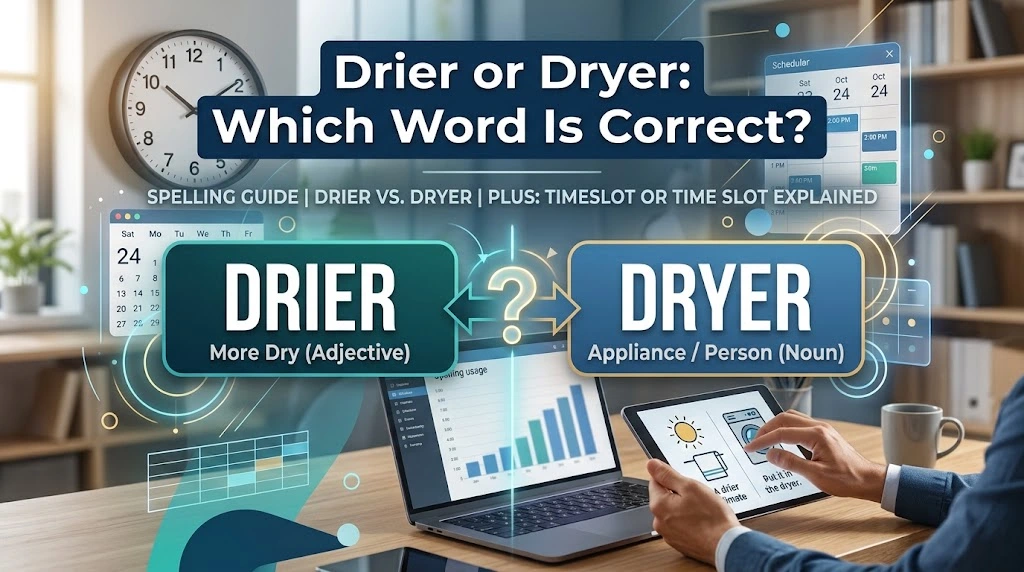
Drier or dryer? These two words look almost identical, but they don’t mean the same thing. One usually describes something that has more dryness, while the other usually names a machine or device that makes something dry.
Then there’s another spelling puzzle: timeslot or time slot. Although both forms appear in modern writing, time slot remains the standard choice in general American English.
A single letter can change the grammatical job of a word. That small distinction matters when you’re writing an email, article, school assignment, product description, schedule, or professional document.
The good news? You don’t need to memorize a mountain of grammar rules. Once you understand what each word means, the choice becomes remarkably simple.
Drier or Dryer: Which Word Is Correct?
Both drier and dryer are correct English words. The important point is that they perform different jobs.
Drier is normally the comparative form of the adjective dry. It means more dry than something else.
Dryer is usually a noun that refers to a machine or device designed to remove moisture.
Consider these two sentences:
- The desert is drier than the forest.
- The clothes are inside the dryer.
The first sentence compares two levels of dryness. The second identifies an appliance.
That’s the entire distinction in miniature.
| Word | Main meaning | Typical grammatical role | Example |
| Drier | More dry | Comparative adjective | “This winter is drier than last winter.” |
| Dryer | A device that dries | Noun | “The dryer finished the cycle.” |
A useful memory trick is simple:
Drier compares. Dryer dries.
Once that clicks, most cases become easy.
What Does Drier Mean?
Drier is the comparative form of dry.
The adjective dry describes something that contains little or no moisture. When you compare two things and say one contains less moisture than the other, you generally use drier.
For example:
- “Arizona is drier than Florida.”
- “My skin feels drier during the winter.”
- “This towel is drier than the one on the floor.”
- “The soil became drier after several weeks without rain.”
- “The second batch produced a drier cake.”
In every example, drier means roughly more dry.
Drier Is a Comparative Adjective
The word comparative matters here.
English commonly uses the ending -er to form comparative adjectives:
- tall → taller
- fast → faster
- cold → colder
- bright → brighter
- dry → drier
Because dry ends in a consonant followed by y, English spelling generally changes the y to i before adding -er.
That produces:
dry → drier
The same pattern appears in words such as:
- happy → happier
- easy → easier
- busy → busier
- noisy → noisier
- messy → messier
So if you’re describing something as more dry, the standard comparative spelling is drier.
Drier Can Describe Physical Dryness
The most obvious use involves moisture.
Imagine two towels hanging outside. One dried for ten minutes, while the other stayed in the sun for an hour.
You might say:
“The towel in the sun is drier.”
You’re comparing their condition.
The same principle applies to clothes, soil, food, wood, paper, paint, and many other materials.
For example:
- drier clothes
- drier soil
- drier wood
- drier air
- drier food
- drier paint
The word doesn’t require a literal measurement of moisture. Context tells the reader what you’re comparing.
Drier Can Describe Weather and Climate
Weather writing frequently uses drier because climate conditions naturally invite comparisons.
You could write:
“The western region tends to be drier than the eastern region.”
Or:
“September was drier than August.”
Here, drier doesn’t mean completely dry. It simply means that the compared period or location experienced less moisture.
That distinction is useful because people sometimes assume that something must be completely dry before they can use drier. That’s not true.
A wet towel can become drier without becoming dry.
What Does Dryer Mean?
Dryer usually refers to something that dries another object or substance.
In everyday American English, the most familiar example is a clothes dryer.
For example:
“Put the wet towels in the dryer.”
Here, dryer names the appliance.
Other common examples include:
- hair dryer
- hand dryer
- clothes dryer
- food dryer
- industrial dryer
- shoe dryer
- dish dryer
The basic idea stays the same: the device helps remove moisture.
Dryer Is Usually a Noun
Unlike drier, which commonly works as a comparative adjective, dryer is usually a noun.
Look at these examples:
- “The dryer is running.”
- “The dryer stopped halfway through the cycle.”
- “She bought a new hair dryer.”
- “The restaurant uses an industrial food dryer.”
- “The hand dryer wasn’t working.”
In each sentence, the word identifies a thing.
That’s the key grammatical difference.
Drier describes. Dryer names a device.
Drier vs. Dryer: The Fastest Way to Tell the Difference
When you’re stuck between drier and dryer, don’t stare at the spelling. Look at the meaning.
Ask yourself one question:
Am I comparing dryness, or am I naming a device?
If you’re comparing dryness, use drier.
If you’re naming a machine or device, use dryer.
Use Drier When You Mean “More Dry”
Examples:
- “The air is drier today.”
- “This towel is drier than that one.”
- “The climate here is drier.”
- “The paint looks drier now.”
- “The bread became drier overnight.”
Use Dryer When You Mean “A Device That Dries”
Examples:
- “The clothes are in the dryer.”
- “I need a new hair dryer.”
- “The hand dryer isn’t working.”
- “The industrial dryer processes the material.”
- “The dryer uses less energy than the older model.”
Here’s the distinction in one glance:
| If you mean… | Use… |
| More dry | drier |
| A machine that dries clothes | dryer |
| More dry air | drier |
| A machine that dries hair | dryer |
| More dry soil | drier |
| A device that removes moisture | dryer |
Why Is the Comparative Form “Drier” Instead of “Dryer”?
The spelling follows a familiar English pattern.
When an adjective ends in consonant + y, the y generally changes to i before the comparative suffix -er.
So:
dry + er → drier
The same spelling process appears here:
| Base adjective | Comparative |
| dry | drier |
| happy | happier |
| easy | easier |
| busy | busier |
| heavy | heavier |
| noisy | noisier |
This is why drier is the standard comparative form.
However, dryer isn’t simply a misspelling of drier. It has developed as a separate word because dryer functions as a noun for a drying device.
In other words, English has two words that happen to sit very close together alphabetically.
Drier or Dryer in Everyday Sentences
Context makes the difference especially clear when you put the words side by side.
Weather
Correct:
“The weather is drier this year.”
Why? You’re comparing the current weather with another period.
Incorrect for this meaning:
“The weather is dryer this year.”
If you mean more dry, drier is the standard choice.
Laundry
Correct:
“Put the clothes in the dryer.”
Why? You’re naming the appliance.
Using drier here changes the grammatical meaning.
Hair
Correct:
“She used a hair dryer.”
The device is a dryer.
But:
“Her hair is drier now.”
Now you’re comparing the condition of her hair.
Notice how both words can appear in the same situation:
“Her hair is drier because she used the hair dryer.”
That’s a perfect example of why context matters.
Soil
“The soil is drier than it was last week.”
You’re comparing moisture levels, so drier fits.
Machine
“The factory installed a larger dryer.”
You’re referring to equipment, so dryer fits.
Drier vs. Dryer: Common Mistakes
These errors usually happen because the two words sound similar.
Mistake: “The weather is dryer today.”
If the intended meaning is more dry, write:
“The weather is drier today.”
Mistake: “Put the clothes in the drier.”
If you’re referring to the appliance, write:
“Put the clothes in the dryer.”
Mistake: Treating the Words as Interchangeable
They aren’t interchangeable in standard usage.
Compare:
“The air is drier.”
This describes air.
Now compare:
“The air dryer is broken.”
This describes a device.
Changing the spelling changes the meaning.
Mistake: Choosing Based Only on Pronunciation
In many accents, drier and dryer sound extremely similar. That can make the spelling tricky.
Instead of relying on sound, identify the word’s role.
Is it describing more dryness?
Use drier.
Is it naming something that dries?
Use dryer.
Drier, Dryer, Dryest, Driest, and Drying
The word dry has several related forms, and understanding them helps prevent confusion.
| Form | Function | Example |
| dry | Base adjective/verb | “The towel is dry.” |
| drier | Comparative adjective | “This towel is drier.” |
| driest | Superlative adjective | “This is the driest towel.” |
| drying | Present participle/gerund | “The towel is drying.” |
| dryer | Usually a drying device | “The towel is in the dryer.” |
There is an important distinction between drier and driest.
Use drier when comparing two things:
“This room is drier than the other room.”
Use driest when identifying the extreme within a group:
“This is the driest room in the building.”
That pattern follows the broader English comparative system.
Is “Dryer” Ever Used as a Comparative Form?
In standard modern American English, drier is the normal comparative form of dry.
When you mean more dry, choose drier.
The spelling dryer is overwhelmingly associated with the noun meaning a device that dries something.
That distinction becomes especially important in polished writing. A reader may understand your meaning from context even if you choose the wrong spelling, but correct word choice removes that speed bump.
For professional, academic, commercial, or editorial writing, drier is the safe standard choice for the comparative adjective.
A Simple Case Study: One Conversation, Both Words
Imagine someone doing laundry on a humid afternoon.
They might say:
“The clothes are drier than they were an hour ago, but the dryer is still running.”
Both words are correct.
Drier compares the clothes’ current condition with their earlier condition.
Dryer identifies the machine.
Now imagine the same person talking about weather:
“Today is drier than yesterday.”
Again, drier describes a comparison.
This tiny example captures the entire rule. You don’t need to memorize dozens of exceptions when the meaning already tells you which spelling belongs.
Timeslot or Time Slot: Which Spelling Is Correct?
The second spelling question has a different answer.
In general American English, time slot is the standard form.
A time slot is a particular period assigned to an appointment, activity, broadcast, meeting, class, event, or other scheduled activity.
For example:
- “Choose a time slot for your appointment.”
- “The interview has a 30-minute time slot.”
- “The program received an evening time slot.”
- “Each speaker has a 15-minute time slot.”
- “The doctor has one available time slot tomorrow.”
The standard spelling is written as two words:
time slot
Why Is “Time Slot” Usually Two Words?
The phrase consists of the noun slot, modified by time.
A slot represents an opening, position, or designated place. When you specify that the slot relates to time, you create the phrase time slot.
The same structure appears in many familiar expressions:
- time period
- time limit
- time frame
- time zone
- time scale
- time management
- time estimate
Some combinations eventually become established as closed compounds. Others remain open phrases.
For general American English, time slot remains the conventional spelling.
What Does Time Slot Mean?
A time slot is an assigned or available period when something is scheduled to happen.
The length can vary dramatically.
A time slot might last:
- 10 minutes
- 15 minutes
- 30 minutes
- 45 minutes
- 1 hour
- several hours
The exact duration depends on the activity.
For example, a medical appointment system might offer 15-minute time slots. A conference could assign each speaker a 30-minute slot. A television network might allocate an hour-long programming slot.
The concept remains the same: a particular stretch of time reserved for something.
Time Slot in Appointments
Appointment scheduling is one of the most common contexts.
For example:
“Please select an available time slot.”
This tells the reader to choose a particular period from a schedule.
Other examples include:
- “The 9:30 a.m. time slot is available.”
- “Your appointment time slot begins at noon.”
- “All morning time slots are booked.”
- “The system displays available time slots.”
- “Please choose another time slot.”
Notice that time slot works naturally in both casual and professional writing.
Time Slot in Work and Scheduling
Businesses often divide working hours into designated periods.
For example:
“The manager assigned each employee a time slot.”
A schedule might look like this:
| Activity | Time slot |
| Team meeting | 9:00–9:30 a.m. |
| Client call | 10:00–10:30 a.m. |
| Training | 1:00–2:00 p.m. |
| Project review | 3:00–3:30 p.m. |
Here, time slot describes each reserved period.
The phrase also works for interviews, consultations, classes, deliveries, presentations, and customer service appointments.
Time Slot in Television and Broadcasting
The term has a long-standing use in broadcasting.
A television network may assign a program a particular time slot.
For example:
“The show moved to a later time slot.”
This means the program now airs during a different scheduled period.
Broadcasters may discuss:
- prime-time slots
- evening time slots
- morning time slots
- late-night time slots
- weekend time slots
The same phrase also appears in radio and other scheduled media.
Is “Timeslot” Wrong?
Timeslot does appear in English-language writing, including technical and industry-specific material.
However, if you’re writing general-purpose American English, time slot is the safer and more conventional form.
That doesn’t mean every appearance of timeslot represents a catastrophic grammatical error. English contains many compounds that vary between open, hyphenated, and closed forms depending on context, industry, and editorial convention.
Still, when you want the broadly accepted form for a general audience, choose:
time slot
This is especially sensible in articles, business communication, educational material, websites, and formal documents.
Timeslot vs. Time Slot: Quick Comparison
| Form | Status in general US English | Best use |
| time slot | Standard and widely preferred | General writing |
| timeslot | Variant found in some usage | Follow a specific house or industry style when required |
If you aren’t working under a specialized style guide, time slot is the straightforward choice.
Drier, Dryer, and Time Slot: Quick Reference
These three terms create different kinds of confusion, but they’re easy to separate once you focus on meaning.
| Word or phrase | Meaning | Example |
| dry | Having little moisture | “The towel is dry.” |
| drier | More dry | “The towel is drier now.” |
| driest | Most dry | “This is the driest towel.” |
| dryer | A device that dries | “The dryer is running.” |
| drying | Becoming or making dry | “The clothes are drying.” |
| time slot | An assigned period of time | “Choose a time slot.” |
| timeslot | Variant spelling of time slot | Use only when a style or context calls for it |
The pattern is much less mysterious when you stop treating these words as spelling puzzles.
They are meaning puzzles.
A Practical Decision Guide
When you’re writing and hesitate between drier and dryer, run through this quick test.
Are you comparing two levels of dryness?
Use drier.
“The air is drier today.”
Are you talking about an appliance or machine?
Use dryer.
“The dryer needs repair.”
Are you describing something that became more dry?
Use drier.
“The paint is drier than it was earlier.”
Are you referring to a device used for hair?
Use dryer.
“She bought a new hair dryer.”
Are you assigning a period on a schedule?
Use time slot.
“The next time slot starts at 2 p.m.”
Are you unsure whether to write “timeslot”?
In general American English, choose time slot.
A Few More Examples to Make the Difference Stick
Here are several examples where the correct spelling becomes obvious from context.
Example: Laundry
“The clothes are drier now because they spent twenty minutes in the dryer.”
The first word describes the clothes.
The second names the machine.
Example: Hair
“Her hair became drier after she used the hair dryer.”
Again, both words belong in the same sentence because they have different meanings.
Example: Climate
“The northern region is drier than the coastal region.”
This sentence compares two climates.
Example: Scheduling
“The afternoon time slot is available for your appointment.”
This sentence has nothing to do with drying. Time slot refers to a scheduled period.
Example: Broadcasting
“The network moved the program to a later time slot.”
The phrase describes the show’s scheduled position.
Why Context Matters More Than Pronunciation
Words that sound alike can cause spelling mistakes because your ears can’t always reveal the difference.
Drier and dryer are particularly troublesome because their pronunciation can be very similar.
Written English gives you another clue: meaning.
Think of spelling as a road sign. Pronunciation tells you roughly where you’re going, but context tells you which road to take.
If the sentence describes a comparison, drier makes sense.
If the sentence names equipment, dryer makes sense.
That approach works far better than trying to hear a tiny pronunciation difference that may not exist in your accent.
What Dictionaries Say About Drier and Dryer
Major English dictionaries distinguish these words according to meaning and grammatical function.
Useful references include:
- Merriam-Webster — dry
- Cambridge Dictionary — drier
- Cambridge Dictionary — dryer
- Oxford Learner’s Dictionaries — dry
- Merriam-Webster — dryer
These references are useful when a particular publication, classroom, workplace, or style guide requires a dictionary-based justification.
Frequently Asked Questions About Drier or Dryer
Is “drier” or “dryer” correct?
Both are correct, but they have different meanings.
Use drier when you mean more dry. Use dryer when you mean a machine or device that dries something.
Is it “drier weather” or “dryer weather”?
Use drier weather when you’re comparing weather conditions.
For example:
“This summer has been drier than last summer.”
Is a clothes drier or dryer?
The standard term for the appliance is clothes dryer.
For example:
“The clothes are in the dryer.”
Is “hair drier” correct?
Hair dryer is the standard modern term for the appliance.
However, you may occasionally encounter hair drier in older or variant usage. In contemporary general American English, hair dryer is the clear practical choice.
What is the comparative form of “dry”?
The comparative form is drier.
The pattern is:
dry → drier
What is the superlative form of “dry”?
The standard superlative form is driest.
For example:
“Death Valley is one of the driest places in North America.”
Is “timeslot” one word or two?
Time slot is the standard general form in American English.
Write it as two words unless a specific style guide or specialized context calls for timeslot.
Is “timeslot” grammatically wrong?
Not necessarily. Timeslot appears as a variant in some modern usage, particularly in certain technical or industry contexts.
However, time slot is the safer choice for general American English writing.
Should I write “time slot” in formal writing?
Yes. Time slot is clear, conventional, and widely understood.
For formal documents, business writing, educational material, and general web content, there’s little reason to complicate the choice.
Why are drier and dryer so easy to confuse?
They have similar spelling and pronunciation. Their meanings also relate to the same concept of dryness.
The grammatical difference solves the problem:
The Bottom Line: Drier Compares, Dryer Dries
The easiest way to remember the distinction is to focus on what the word does.
Drier is the comparative form of dry. It means more dry.
“The climate is drier this year.”
Dryer usually refers to a machine or device that removes moisture.
“The clothes are in the dryer.”
Then there’s time slot, which refers to a specific period assigned to an activity or appointment.
“Please select an available time slot.”
So the quick-reference rule is:
Drier = more dry.
Dryer = a device that dries.
Time slot = an assigned period of time.
When in doubt, don’t let the spelling trip you up. Ask what you actually mean. If you’re comparing dryness, choose drier. If you’re naming a drying machine, choose dryer. If you’re talking about a scheduled period, time slot is the standard choice.
Three terms. Three jobs. Once you see the difference, the confusion dries up pretty quickly.
