

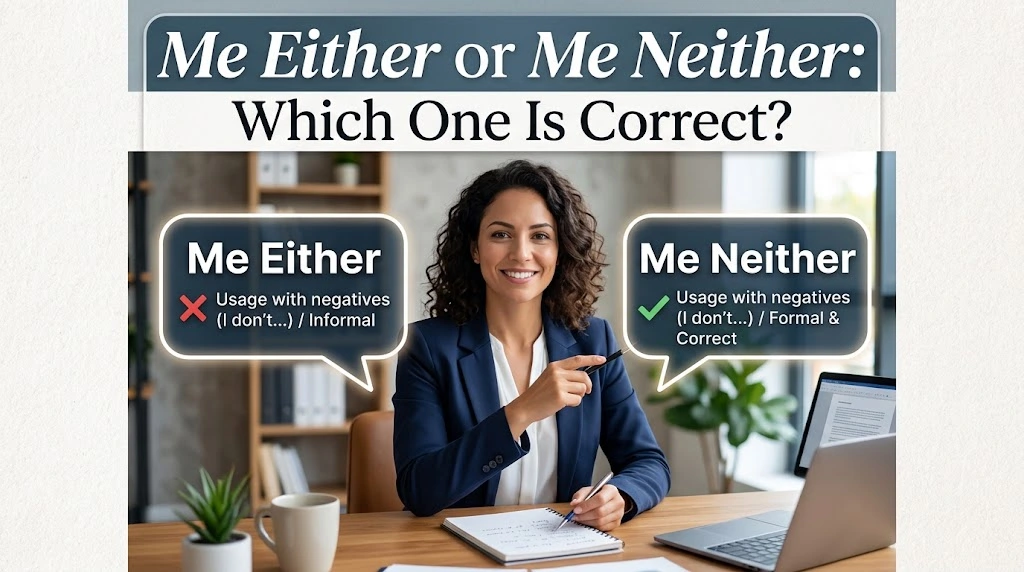
“Me either” or “me neither?” If you’ve ever paused before replying to a negative statement, you’re not alone. These two expressions sound remarkably similar, yet standard English treats them differently.
The short answer is simple: “me neither” is the standard expression for agreeing with a negative statement. For example:
“I don’t like spicy food.”
“Me neither.”
However, either is also correct in negative sentences. The usual structure is different:
“I don’t like spicy food either.”
That small difference causes a surprising amount of confusion. The problem becomes even trickier because “me either” does appear in casual speech, especially in some varieties of English. Hearing it regularly doesn’t necessarily make it the preferred form in standard edited English.
This guide breaks down me either vs. me neither, explains the grammar behind both words, and shows exactly when to use each expression.
Me Either vs. Me Neither: The Quick Answer
When you’re responding to someone’s negative statement and you want to say that the same thing applies to you, use “me neither.”
For example:
“I don’t watch horror movies.”
“Me neither.”
You can also express the same idea with “neither do I.”
“I don’t watch horror movies.”
“Neither do I.”
By contrast, either normally appears at the end of a negative sentence:
“I don’t watch horror movies either.”
Here’s the basic distinction:
| Expression | Standard use | Example |
| Me neither | Negative agreement | “I don’t drink coffee.” — “Me neither.” |
| Neither do I | Negative agreement | “I don’t drink coffee.” — “Neither do I.” |
| I don’t either | Negative agreement | “I don’t drink coffee either.” |
| Me either | Heard in informal speech but generally nonstandard for this construction | “I don’t drink coffee.” — “Me either.” |
A useful rule is:
Negative statement + agreement → “me neither.”
Negative sentence containing “either” → “I don’t either” or another appropriate negative construction.
What Does “Me Neither” Mean?
“Me neither” means “neither do I,” “neither am I,” or another equivalent negative-agreement construction.
It tells someone that you share the negative situation they just described.
Consider this conversation:
“I don’t like crowded restaurants.”
“Me neither.”
The second speaker isn’t simply saying “no.” They’re saying:
“I don’t like crowded restaurants either.”
The expression works as a compact conversational response.
That’s why “me neither” is so common in everyday dialogue. It saves you from repeating the entire sentence.
Examples of “Me Neither”
Here are several natural examples:
- “I don’t eat seafood.” — “Me neither.”
- “I haven’t watched that movie.” — “Me neither.”
- “I can’t swim.” — “Me neither.”
- “I’m not hungry.” — “Me neither.”
- “I don’t understand the instructions.” — “Me neither.”
- “I won’t be going tomorrow.” — “Me neither.”
- “I’ve never been to Canada.” — “Me neither.”
Notice something important: the original sentences don’t all use the same verb.
That’s where English grammar gets interesting.
Why Is “Me Neither” Correct?
The word neither has a negative meaning. In agreement structures, it allows you to respond to another person’s negative statement without repeating the negative clause.
The fuller grammatical pattern usually looks like this:
Neither + auxiliary verb + subject
For example:
“I don’t know.”
“Neither do I.”
Or:
“I’m not tired.”
“Neither am I.”
Or:
“I haven’t finished.”
“Neither have I.”
The exact auxiliary changes according to the original sentence.
“Me neither” is more conversational because it doesn’t explicitly repeat that auxiliary structure. Context supplies the missing information.
Think of it like a shortcut on a familiar road. The longer route is grammatically explicit. The shorter route works because everyone already knows where you’re going.
“Me Neither” and Different Verb Types
Compare these examples:
| Original statement | Full response | Conversational response |
| “I don’t know.” | “Neither do I.” | “Me neither.” |
| “I’m not ready.” | “Neither am I.” | “Me neither.” |
| “I haven’t eaten.” | “Neither have I.” | “Me neither.” |
| “I can’t drive.” | “Neither can I.” | “Me neither.” |
| “I won’t go.” | “Neither will I.” | “Me neither.” |
| “I wasn’t there.” | “Neither was I.” | “Me neither.” |
The conversational expression stays the same even though the full grammatical response changes.
Is “Me Either” Ever Correct?
This is where the answer needs a little nuance.
“Me either” is heard in informal English, but standard English generally prefers “me neither” when responding directly to a negative statement.
For example:
“I don’t like this movie.”
“Me neither.” ✅
The same response as:
“Me either.” ⚠️ Informal/nonstandard in this use
That doesn’t mean someone who says “me either” can’t be understood. In many conversations, the meaning is perfectly clear.
Language users don’t always speak according to formal grammar rules. Everyday speech contains regional expressions, shortcuts, and constructions that may differ from edited standard English.
However, if you’re writing for school, work, publication, or a formal audience, “me neither” is the safer standard choice.
Where “Either” Is Correct
The word either absolutely belongs in negative constructions.
For example:
“I don’t like this movie either.”
That’s standard English.
You can also say:
“I can’t swim either.”
Or:
“I haven’t seen that show either.”
So the issue isn’t that either is wrong with negative statements. The issue is the particular structure “me either.”
Me Either vs. Me Neither in Everyday Conversation
The easiest way to understand the difference is to put both expressions into complete conversations.
Example: Food
Alex: I don’t like olives.
Sam: Me neither.
Or:
Alex: I don’t like olives.
Sam: I don’t like them either.
Both standard responses communicate the same basic idea.
But this version is generally not preferred in standard English:
Alex: I don’t like olives.
Sam: Me either.
Example: Movies
Alex: I haven’t seen that movie.
Sam: Me neither.
Or:
Alex: I haven’t seen that movie.
Sam: I haven’t seen it either.
Again, both standard structures work.
The key difference is grammatical position.
Neither can introduce a short agreement response:
“Neither do I.”
Either usually appears inside the negative sentence:
“I haven’t seen it either.”
Neither vs. Either: The Grammar Behind the Confusion
The confusion disappears once you understand the basic jobs of either and neither.
How “Either” Works
Either can refer to one of two choices:
“You can take either road.”
It also appears in negative statements to mean something like “also” or “as well.”
For example:
“I don’t like it either.”
Here, either adds the second person’s negative agreement.
How “Neither” Works
Neither means not one and not the other.
For example:
“Neither answer is correct.”
It can also form a negative-agreement response:
“I don’t like it.”
“Neither do I.”
And it appears in the familiar paired construction:
neither…nor
For example:
“Neither John nor Maria attended the meeting.”
The two words are related, but they don’t simply swap places.
“Me Neither” vs. “Neither Do I”
These expressions usually communicate the same idea, but their tone differs slightly.
“Me neither” sounds casual and conversational.
“Neither do I” sounds more grammatically complete and can fit more formal contexts.
Compare:
“I don’t eat meat.”
“Me neither.”
with:
“I don’t eat meat.”
“Neither do I.”
Both responses are natural.
The second one explicitly follows the grammatical inversion pattern used after neither.
Why Does “Neither Do I” Use “Do”?
The auxiliary do comes from the original sentence:
“I don’t eat meat.”
The positive agreement structure would use:
“So do I.”
The negative counterpart uses:
“Neither do I.”
The same principle applies to other auxiliaries.
“I haven’t finished.” → “Neither have I.”
“I can’t dance.” → “Neither can I.”
“I’m not ready.” → “Neither am I.”
That’s why saying “Neither do I” after every negative sentence isn’t always correct.
For example:
“I’m not tired.”
“Neither do I.” ❌
The correct response is:
“Neither am I.” ✅
Or, in casual conversation:
“Me neither.” ✅
“Me Neither” vs. “I Don’t Either”
Another useful comparison is “me neither” and “I don’t either.”
Consider:
“I don’t like horror movies.”
“Me neither.”
You can also say:
“I don’t like horror movies either.”
Both communicate negative agreement.
The difference comes from sentence structure.
“Me Neither”
This works as a short standalone response.
“I don’t like coffee.”
“Me neither.”
“I Don’t Either”
This requires a complete negative clause.
“I don’t like coffee either.”
You wouldn’t normally say:
“I don’t either coffee.” ❌
The negative clause needs its proper verb and object.
This distinction becomes particularly useful when you’re writing rather than speaking. In writing, complete sentences often make the relationship between the ideas clearer.
Common Mistakes With Me Either and Me Neither
Several recurring mistakes cause confusion around these expressions.
Using “Me Either” for Negative Agreement
The most common issue is responding to a negative statement with:
“Me either.”
Although people use this form informally, “me neither” is the standard choice.
Use:
“I don’t like broccoli.”
“Me neither.”
Or:
“I don’t like broccoli either.”
Using “Neither” With Another Negative
Avoid creating an unnecessary double negative.
Incorrect:
“Neither don’t I.”
Correct:
“Neither do I.”
The negative meaning already comes from neither.
Using the Wrong Auxiliary Verb
The auxiliary must match the original sentence.
Incorrect:
“I haven’t finished.”
“Neither do I.”
Correct:
“Neither have I.”
Likewise:
“I can’t drive.”
“Neither can I.”
And:
“I’m not angry.”
“Neither am I.”
Treating “Either” and “Neither” as Exact Synonyms
They’re connected, but they don’t perform identical grammatical jobs.
Compare:
“I don’t want it either.”
with:
“Neither do I.”
The first sentence uses either inside a negative clause.
The second uses neither to create a negative-agreement response.
Me Neither in Different Situations
Once you know the pattern, you can use “me neither” in many everyday situations.
Agreeing With a Negative Opinion
“I don’t think this restaurant is very good.”
“Me neither.”
You’re agreeing with the negative opinion.
Sharing a Negative Experience
“I’ve never visited New York.”
“Me neither.”
The second speaker says they’ve also never visited.
Sharing an Inability
“I can’t play the guitar.”
“Me neither.”
Here, me neither means:
“I can’t play the guitar either.”
Sharing a Current Condition
“I’m not hungry.”
“Me neither.”
This is one of the most natural everyday uses.
Sharing a Future Decision
“I won’t be attending the party.”
“Me neither.”
The expression shows that both speakers have the same negative intention.
When to Use “Me Either”
For standard English, don’t make “me either” your default negative-agreement response.
Instead, choose one of these:
- Me neither.
- Neither do I.
- Neither am I.
- Neither have I.
- Neither can I.
- I don’t either.
- I haven’t either.
- I can’t either.
However, either itself remains perfectly correct in many negative sentences.
For example:
“I don’t want dessert either.”
“She doesn’t understand it either.”
“We haven’t decided either.”
“He can’t come either.”
The important point is that either doesn’t become wrong simply because the sentence is negative.
Formal Alternatives to “Me Neither”
If you’re writing something formal, you may prefer the complete grammatical construction.
Neither Do I
Use this after a statement with do/does/did or a corresponding simple present/past verb structure.
“I don’t like the proposal.”
“Neither do I.”
Neither Am I
Use this after a sentence built around be.
“I’m not worried.”
“Neither am I.”
Neither Have I
Use this with have/has/had constructions.
“I haven’t finished the report.”
“Neither have I.”
Neither Can I
Use this with can.
“I can’t attend the meeting.”
“Neither can I.”
Neither Will I
Use this with will.
“I won’t change my mind.”
“Neither will I.”
These responses are especially useful when you want your writing to sound polished without becoming stiff.
Positive Agreement: “Me Too” vs. “Me Neither”
Here’s another simple way to remember the rule.
“Me too” normally agrees with a positive statement.
“I love chocolate.”
“Me too.”
“Me neither” agrees with a negative statement.
“I don’t like chocolate.”
“Me neither.”
The contrast is straightforward:
| Statement | Natural agreement |
| “I like tea.” | “Me too.” |
| “I don’t like tea.” | “Me neither.” |
| “I’m tired.” | “Me too.” |
| “I’m not tired.” | “Me neither.” |
| “I can swim.” | “Me too.” |
| “I can’t swim.” | “Me neither.” |
| “I’ve been there.” | “Me too.” |
| “I haven’t been there.” | “Me neither.” |
This isn’t a complete grammar rule for every possible sentence, but it’s an excellent everyday shortcut.
Is “Me Neither” Formal or Informal?
“Me neither” is informal conversational English.
It’s completely natural in dialogue, casual emails, texts, messages, and everyday conversation.
For example:
“I don’t feel like going out tonight.”
“Me neither.”
Nobody needs a longer sentence in that context.
In formal writing, however, a complete structure may sound more appropriate:
“I don’t support the proposal either.”
Or:
“Neither do I.”
The choice depends on the setting.
Where “Me Neither” Works Well
- Casual conversations
- Text messages
- Social media comments
- Informal emails
- Dialogue in fiction
- Everyday speech
Where a Fuller Construction May Work Better
- Academic writing
- Formal reports
- Professional correspondence
- Legal or technical writing
- Formal presentations
The expression isn’t grammatically defective simply because it’s informal. Informal language has its own useful structures.
Me Neither in American English
In American English, “me neither” is a familiar conversational response to negative statements.
For example:
“I don’t watch much television.”
“Me neither.”
It sounds natural because the listener understands the omitted grammatical structure from context.
Formal grammar and everyday speech don’t always look identical. Spoken English frequently shortens information that both speakers already understand.
That’s why expressions such as “me too” and “me neither” work so efficiently in conversation.
They’re compact. They’re clear. And they avoid unnecessary repetition.
Regional and Informal Usage of “Me Either”
If you’ve heard native speakers say “me either,” you’re not imagining it.
The expression occurs in informal speech. Language varies by region, community, and conversational habit. Speakers may use forms that differ from the conventions expected in edited standard English.
That distinction matters.
A form can exist in real speech without being the preferred form for standard writing.
For example, someone might naturally say:
“Me either.”
Another speaker might say:
“Me neither.”
Both listeners can understand the intended meaning.
Still, if the goal is standard English, “me neither” remains the better choice for negative agreement.
This is especially important for learners who hear informal expressions and assume every commonly heard construction belongs equally in formal writing.
Me Either or Me Neither: Side-by-Side Comparison
The following table puts the major differences together:
| Feature | Me Either | Me Neither |
| Used for negative agreement | Informal/nonstandard in this construction | Standard |
| Common in casual speech | Yes | Yes |
| Works as a short response | Heard in informal usage | Yes |
| Preferred in standard writing | No | Yes, in conversational writing |
| Standard fuller alternative | “I don’t either” | “Neither do I” |
| Example | “I don’t like it.” — “Me either.” | “I don’t like it.” — “Me neither.” |
The distinction becomes even clearer when you compare complete sentences:
| Meaning | Standard construction |
| Negative agreement | Me neither. |
| Negative agreement with a full sentence | I don’t either. |
| Negative agreement with “do” | Neither do I. |
| Negative agreement with “be” | Neither am I. |
| Negative agreement with “have” | Neither have I. |
| Negative agreement with “can” | Neither can I. |
A Simple Diagram for Remembering the Rule
What did the first speaker say?
|
┌──────────┴──────────┐
| |
Positive Negative
| |
“Me too” “Me neither”
|
Or use a full sentence
|
“I don’t either.”
“Neither do I.”
“Neither am I.”
“Neither have I.”
This isn’t a complete map of every English agreement structure. It simply gives you the quickest route through the me either vs. me neither question.
Real-World Dialogue Examples
Seeing the expressions in context makes the difference easier to remember.
Example: Coffee
Mia: I don’t drink coffee.
Jack: Me neither.
Or:
Mia: I don’t drink coffee.
Jack: I don’t drink it either.
Both are standard.
Example: Travel
Mia: I’ve never been to Australia.
Jack: Me neither.
The fuller version is:
“Neither have I.”
Not:
“Neither do I.”
Why? Because the original sentence uses have:
“I’ve never been…”
Example: Ability
Mia: I can’t ski.
Jack: Me neither.
The formal/full version is:
“Neither can I.”
Example: Current State
Mia: I’m not tired.
Jack: Me neither.
The corresponding full structure is:
“Neither am I.”
These examples show why “me neither” can be so convenient. You don’t have to think about which auxiliary verb belongs in the response.
A Practical Case Study: Choosing the Right Response
Imagine you’re chatting with a coworker after lunch.
Coworker: “I don’t think I can finish this project today.”
You: “Me neither.”
That sounds natural in casual conversation.
Now imagine you’re writing a formal workplace message:
“I don’t think I can complete the project today either.”
That version provides a complete grammatical structure.
Or suppose you’re responding during a formal meeting:
“Neither do I.”
The meaning remains essentially the same. The context changes the most natural form.
This illustrates an important principle: grammar isn’t only about whether a sentence communicates an idea. Register matters too.
Easy Rules to Remember
If you regularly confuse me either or me neither, keep these rules nearby.
Rule: Negative Agreement Uses “Me Neither”
“I don’t like it.”
“Me neither.”
Rule: “Either” Usually Appears in the Negative Sentence
“I don’t like it either.”
Rule: Positive Agreement Uses “Me Too”
“I like it.”
“Me too.”
Rule: Match the Auxiliary With “Neither”
“I haven’t finished.” → “Neither have I.”
“I can’t go.” → “Neither can I.”
“I’m not ready.” → “Neither am I.”
Rule: Don’t Add an Extra Negative
“Neither do I.” ✅
“Neither don’t I.” ❌
Once you understand these patterns, the choice becomes much less mysterious.
Frequently Asked Questions About Me Either or Me Neither
Is “me either” grammatically correct?
“Me either” occurs in informal speech, but standard English generally uses “me neither” when agreeing with a negative statement.
For example:
“I don’t like fish.”
“Me neither.”
If you want to use either, say:
“I don’t like fish either.”
Is “me neither” correct?
Yes. “Me neither” is a standard informal expression for agreeing with a negative statement.
For example:
“I haven’t seen that movie.”
“Me neither.”
A fuller version is:
“Neither have I.”
Should you say “me either” or “me neither”?
For standard English, choose “me neither” when you’re responding directly to a negative statement.
“I don’t understand.”
“Me neither.”
If you want a complete sentence, use a construction with either:
“I don’t understand either.”
Can you say “I don’t either”?
Yes.
“I don’t either” is a standard negative-agreement construction when the omitted information is clear from context.
For example:
“I don’t want dessert.”
“I don’t either.”
You can also make the sentence explicit:
“I don’t want dessert either.”
What’s the difference between “me too” and “me neither”?
“Me too” generally agrees with a positive statement.
“I love this song.”
“Me too.”
“Me neither” agrees with a negative statement.
“I don’t like this song.”
“Me neither.”
Is “neither do I” more formal than “me neither”?
Generally, yes. “Neither do I” provides the full inverted grammatical structure, while “me neither” is a shorter conversational response.
Neither expression needs to sound stiff. Context determines the best fit.
Can “neither” be used without “nor”?
Yes.
The word neither doesn’t always need nor.
For example:
“Neither do I.”
That’s a complete negative-agreement construction.
However, neither…nor is another common structure:
“Neither Sarah nor David attended.”
These are different grammatical patterns.
Can “either” agree with a negative statement?
Yes. In fact, this is one of its common uses.
For example:
“I don’t like it either.”
The issue isn’t the combination of either + negative meaning. The issue is using “me either” as the standalone response when standard English normally uses “me neither.”
Me Either or Me Neither: Final Takeaway
The difference between “me either” and “me neither” becomes simple once you focus on sentence structure.
When someone makes a negative statement and you agree, the standard conversational response is:
“Me neither.”
You can also use a fuller construction:
“Neither do I.”
“Neither am I.”
“Neither have I.”
“Neither can I.”
If you want to use either, put it inside the negative sentence:
“I don’t either.”
“I haven’t either.”
“I can’t either.”
So remember this quick formula:
Positive statement → “Me too.”
Negative statement → “Me neither.”
Negative sentence with “either” → “I don’t … either.”
And what about “me either?” You may hear it in casual speech, but “me neither” is the standard choice when you want your English to follow conventional grammar.
Once that distinction clicks, this little grammar puzzle stops being a stumbling block and becomes an easy rule to apply.
