

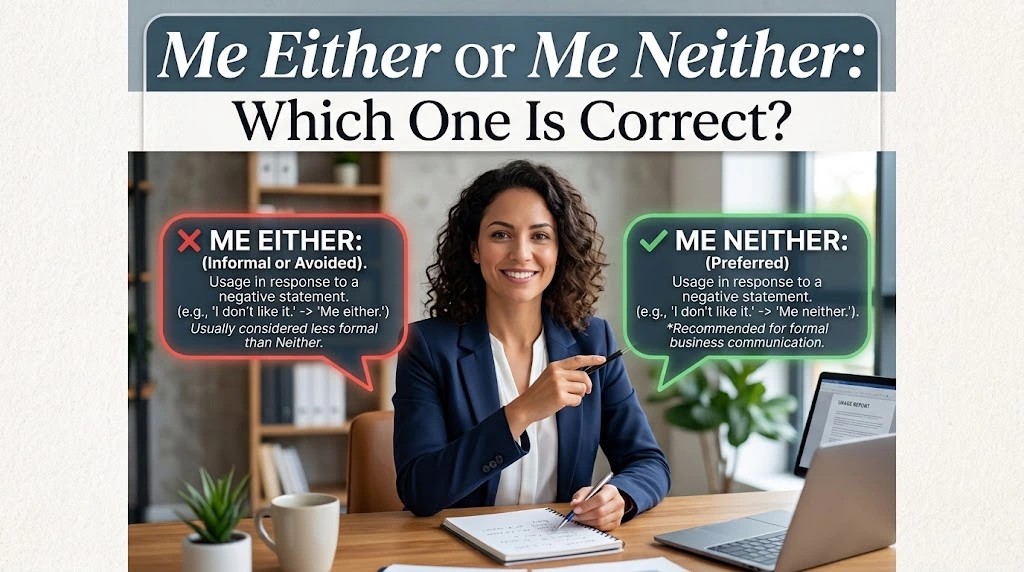
Me either or me neither? If you’ve ever paused during a conversation because you weren’t sure which response sounded right, you’re not alone.
Both expressions appear in everyday English. You may hear someone say, “I don’t like it either,” while another person responds, “Me neither.” In casual American conversation, you may also hear “me either.”
That creates an obvious question: Which one is correct?
The short answer is that “me neither” is the more established expression for agreeing with a negative statement. “Me either” also occurs in informal speech, particularly in American English, but many style guides and traditional grammar references prefer alternatives such as “me neither,” “neither do I,” or “I don’t either.”
The choice becomes much easier once you understand what either and neither actually do in English.
This guide breaks down the difference, explains the grammar behind both expressions, and shows you exactly what to say in everyday and formal situations.
Me Either or Me Neither: The Quick Answer
When someone makes a negative statement and you want to say that the same thing applies to you, “me neither” is the conventional conversational response.
For example:
“I don’t like horror movies.”
“Me neither.”
You can also say:
“I don’t like horror movies either.”
Or:
“Neither do I.”
In casual American speech, some people say:
“Me either.”
So, when comparing me either vs. me neither, the safest general rule is:
| Expression | Typical use | Example |
| Me neither | Informal agreement with a negative statement | “I don’t eat meat.” — “Me neither.” |
| Me either | Informal agreement with a negative statement | “I don’t watch football.” — “Me either.” |
| Neither do I | Negative agreement using a complete grammatical structure | “I don’t watch football.” — “Neither do I.” |
| I don’t either | Negative agreement using a complete sentence | “I don’t watch football.” — “I don’t either.” |
If you’re writing something formal, “neither do I” or the appropriate negative sentence with “either” is usually the safer choice.
For casual conversation, “me neither” is completely natural.
What Does “Me Neither” Mean?
“Me neither” means “I don’t either” or “neither do I.”
You use it when another person has made a negative statement and you want to say that the same negative situation applies to you.
Consider this conversation:
Alex: I don’t like mushrooms.
Sam: Me neither.
Sam isn’t simply saying “no.” Sam means:
“I don’t like mushrooms either.”
The word neither carries the negative sense.
Here are several more examples:
- “I don’t drink coffee.” — “Me neither.”
- “I haven’t seen that movie.” — “Me neither.”
- “I can’t swim.” — “Me neither.”
- “I didn’t enjoy the concert.” — “Me neither.”
- “I wasn’t invited.” — “Me neither.”
Notice something important. The original statement can use different negative constructions.
The first speaker might use don’t, haven’t, can’t, didn’t, or wasn’t. The response “me neither” remains unchanged.
That’s one reason the expression works so smoothly in conversation.
Why Does “Me Neither” Work Grammatically?
The structure “me neither” is an abbreviated conversational response.
It doesn’t look like a complete sentence in the traditional grammatical sense. There is no explicit verb or subject-verb structure such as “I don’t either.”
Yet conversational English regularly uses shortened constructions.
For example:
“Who wants another slice?”
“Me.”
Nobody normally objects that “Me” isn’t a complete sentence. The missing information is obvious from context.
The same principle applies to “me neither.”
The full meaning might be expressed as:
“Neither do I.”
Or:
“I don’t either.”
But conversation often compresses that information.
“Me neither” can respond to different negative structures
Compare these examples:
“I don’t eat seafood.”
“Me neither.”
“I haven’t visited Canada.”
“Me neither.”
“I can’t drive.”
“Me neither.”
“I wasn’t there.”
“Me neither.”
The response stays short because the listener already understands the grammatical relationship.
What Does “Me Either” Mean?
“Me either” is an informal expression used by some English speakers to agree with a negative statement.
For example:
“I don’t like spicy food.”
“Me either.”
The intended meaning is usually:
“I don’t like spicy food either.”
This construction appears in spoken English and informal communication. It’s especially noticeable in American English conversation.
However, there’s an important distinction between what people say and what traditional formal grammar recommends.
English isn’t only a collection of classroom rules. It’s also a living language. Speakers shorten phrases, develop regional habits, and create conversational patterns that don’t always match formal written structures.
That’s why you’ll encounter “me either” even though many grammar references recommend “me neither” or another construction instead.
Why Do People Say “Me Either”?
The answer becomes clearer when you look at the word either.
In negative sentences, either commonly appears at the end of a clause.
For example:
“I don’t like coffee either.”
Here, either means that the negative statement applies to another person as well.
The sentence can be understood as:
“I don’t like coffee, and I also don’t like it.”
In conversation, some speakers shorten that idea to:
“Me either.”
The expression therefore has a connection to the standard pattern:
I don’t either.
The difference is that “I don’t either” retains the subject and verb, while “me either” uses an object pronoun as a conversational fragment.
This distinction explains why “me either” can sound perfectly natural to some speakers while still being considered less conventional in formal English.
Me Either or Me Neither: What’s the Difference?
The biggest practical difference isn’t usually the meaning. Both expressions can communicate negative agreement.
The difference lies mainly in usage, convention, and register.
| Point | Me Neither | Me Either |
| Meaning | Negative agreement | Negative agreement |
| Common in conversation | Yes | Yes, among some speakers |
| Traditional grammar preference | Generally accepted | Often discouraged |
| Informal American speech | Common | Also occurs |
| Formal writing | Better replaced with a complete structure | Generally avoid |
| Clear alternative | “Neither do I” | “I don’t either” |
If you’re speaking with friends, “me neither” is an easy and widely understood choice.
If you’re writing a business email, academic paper, report, or formal document, don’t rely on either conversational fragment. Instead, use a complete construction.
For example:
“I don’t agree either.”
Or:
“Neither do I.”
“Me Neither” vs. “Neither Do I”
These expressions have almost the same basic meaning.
The difference is grammatical structure and tone.
Me neither is a short conversational response.
Neither do I is a more complete grammatical construction.
Compare:
“I don’t watch television much.”
“Me neither.”
Now compare:
“I don’t watch television much.”
“Neither do I.”
Both responses communicate negative agreement.
The second structure follows this pattern:
Neither + auxiliary verb + subject
The auxiliary verb changes according to the original sentence.
Present simple
“I don’t like onions.”
“Neither do I.”
Past simple
“I didn’t see the accident.”
“Neither did I.”
Present perfect
“I haven’t finished the report.”
“Neither have I.”
Modal verb
“I can’t stay tonight.”
“Neither can I.”
Verb “be”
“I wasn’t ready.”
“Neither was I.”
This flexibility is important. You can’t simply use “neither do I” after every negative sentence.
The auxiliary must match the grammar of the original statement.
“Me Either” vs. “I Don’t Either”
The alternative “I don’t either” follows a different pattern.
It retains the negative auxiliary from the original sentence.
For example:
“I don’t eat breakfast.”
“I don’t either.”
Or:
“I haven’t finished my homework.”
“I haven’t either.”
Or:
“I can’t stay late.”
“I can’t either.”
The structure is straightforward:
Subject + negative auxiliary + either
The word either comes at the end.
Compare the patterns
| Original statement | Neither response | Either response |
| “I don’t smoke.” | “Neither do I.” | “I don’t either.” |
| “I didn’t go.” | “Neither did I.” | “I didn’t either.” |
| “I haven’t eaten.” | “Neither have I.” | “I haven’t either.” |
| “I can’t swim.” | “Neither can I.” | “I can’t either.” |
| “I wasn’t invited.” | “Neither was I.” | “I wasn’t either.” |
This is one of the easiest ways to avoid confusion.
How to Agree With Negative Statements
When someone makes a negative statement, you have several options.
Use “Me neither”
This is short and conversational.
“I don’t like scary movies.”
“Me neither.”
Use “Neither do I”
This sounds more complete and works well in careful speech and writing.
“I don’t like scary movies.”
“Neither do I.”
Use a negative sentence with “either”
This is also completely natural.
“I don’t like scary movies.”
“I don’t either.”
The right choice depends on the setting.
Casual conversation gives you more freedom. Formal writing calls for clearer, more complete structures.
Present Simple Examples
Suppose someone says:
“I don’t eat breakfast.”
You could respond:
- “Me neither.”
- “Neither do I.”
- “I don’t either.”
All three communicate negative agreement, although they differ in style.
Another example:
“I don’t enjoy crowded restaurants.”
Possible responses include:
“Me neither.”
Or:
“Neither do I.”
Or:
“I don’t either.”
The key is that the first speaker uses do not/don’t.
Therefore, the formal neither construction uses do:
Neither do I.
Present Perfect Examples
Now consider a sentence using the present perfect:
“I haven’t visited New York.”
Natural responses include:
“Me neither.”
“Neither have I.”
“I haven’t either.”
Notice what happens with the neither construction.
You don’t say:
“Neither do I.”
You say:
“Neither have I.”
Why?
Because the original sentence uses have as its auxiliary:
I haven’t visited.
Therefore:
Neither have I.
This pattern makes the grammar much easier to understand.
Modal Verb Examples
Modal verbs create another common pattern.
Suppose someone says:
“I can’t drive.”
You can respond:
“Me neither.”
Or:
“Neither can I.”
Or:
“I can’t either.”
The same principle works with other modal verbs:
- “I won’t go.” → “Neither will I.”
- “I shouldn’t eat that.” → “Neither should I.”
- “I wouldn’t do that.” → “Neither would I.”
- “I couldn’t hear him.” → “Neither could I.”
The auxiliary or modal verb carries the grammatical information.
Past Simple Examples
Consider:
“I didn’t see Sarah yesterday.”
You can answer:
“Me neither.”
Or:
“Neither did I.”
Or:
“I didn’t either.”
The important point is that did appears in the inverted neither construction because the original statement uses didn’t.
So:
I didn’t go.
becomes:
Neither did I.
Not:
Neither do I.
That small difference matters.
“Me Too” vs. “Me Neither”
A very common mistake happens when people confuse me too and me neither.
The basic distinction is simple.
Use me too to agree with a positive statement.
Use me neither to agree with a negative statement.
Positive statement
“I love pizza.”
“Me too.”
Negative statement
“I don’t like mushrooms.”
“Me neither.”
Here’s another pair:
“I have seen that movie.”
“Me too.”
But:
“I haven’t seen that movie.”
“Me neither.”
Think of it like two doors:
Positive → me too
Negative → me neither
Once you spot whether the first statement is positive or negative, the choice becomes much easier.
Me Either or Me Neither in American English
American English contains many conversational expressions that differ from formal written conventions.
“Me either” is one example that appears in informal speech. Speakers may use it naturally after negative statements.
For example:
“I don’t want to go out tonight.”
“Me either.”
To that speaker, the expression may feel completely ordinary.
Another speaker might naturally say:
“Me neither.”
Neither listener is likely to misunderstand the intended meaning.
However, when precision and conventional grammar matter, alternatives are easier to defend:
“Neither do I.”
Or:
“I don’t either.”
This distinction is useful because language usage and formal grammar aren’t always identical.
A phrase can appear frequently in speech without becoming the preferred construction for formal writing.
Is “Me Either” Grammatically Wrong?
Calling “me either” simply “wrong” misses an important part of how English works.
The expression occurs in real-world informal speech. Its meaning is usually clear from context. However, traditional grammar guidance often favors “me neither” or complete alternatives such as “I don’t either” and “neither do I.”
That creates three practical categories:
Common and conventional
Me neither.
Informal and conversational
Me either.
Formal or careful
Neither do I.
Or:
I don’t either.
So, if the goal is to communicate clearly in a formal setting, choose a complete construction.
If you’re reproducing natural dialogue, “me either” may accurately reflect how some speakers talk.
Is “Me Neither” Always Correct?
Not quite.
The expression works when you respond to a negative statement.
It doesn’t normally replace me too after a positive statement.
For example:
“I love jazz.”
“Me neither.” ❌
The intended meaning is positive agreement. The natural response is:
“Me too.” ✅
Now change the first statement:
“I don’t like jazz.”
“Me neither.” ✅
The difference comes down to the polarity of the original statement.
Positive
“I like tea.” → “Me too.”
Negative
“I don’t like tea.” → “Me neither.”
Negative with either
“I don’t like tea.” → “I don’t either.”
That’s the core rule worth remembering.
Common Mistakes With Me Either and Me Neither
Using “me neither” after a positive statement
Incorrect:
“I love this song.”
“Me neither.”
Better:
“Me too.”
Using “neither do I” with the wrong auxiliary
Incorrect:
“I haven’t finished.”
“Neither do I.”
Better:
“Neither have I.”
The auxiliary needs to match.
Treating “either” and “neither” as interchangeable
They aren’t interchangeable in every construction.
For example:
“I don’t like it either.”
works naturally.
But:
“I don’t like it neither.”
is generally considered a nonstandard double-negative construction in standard English.
Using conversational fragments in formal writing
A sentence like:
“Me either.”
may sound perfectly normal among friends.
In a formal report, however, write:
“I don’t either.”
Or:
“Neither do I.”
Context matters.
Me Either or Me Neither in Formal Writing
Formal writing rewards clarity.
If you’re writing an essay, report, professional email, academic paper, or business document, avoid relying on conversational fragments when a complete sentence works just as well.
Instead of:
“Me neither.”
you could write:
“Neither do I.”
Or, depending on the sentence:
“I don’t either.”
For example:
Casual conversation:
“I don’t think the proposal will work.”
“Me neither.”
Formal discussion:
“I don’t think the proposal will work.”
“Neither do I.”
The second version fits a more polished register.
That doesn’t make the first expression useless. It simply means the audience and context influence your choice.
Formal vs. Informal Usage
Here’s a practical guide.
| Situation | Recommended expression |
| Chatting with friends | “Me neither.” |
| Casual conversation | “Me neither.” |
| Informal American speech | “Me neither” or “me either” |
| Text messages | “Me neither.” |
| Professional email | “I don’t either.” |
| Academic writing | “Neither do I” or a complete sentence |
| Formal report | Complete grammatical construction |
| Dialogue in fiction | Depends on the character’s natural speech |
The more formal the setting, the more useful complete sentence structures become.
Real-Life Conversation Examples
Talking about food
Mia: I don’t eat seafood.
James: Me neither.
Mia: I’ve never liked the smell.
James: Neither have I.
Here, the speakers use two different negative-agreement structures naturally.
Talking about movies
Chris: I haven’t seen that new movie.
Jordan: Me neither.
Chris: I don’t really watch superhero films.
Jordan: I don’t either.
Again, the grammar changes with the original sentence.
Talking about travel
Emma: I’ve never been to Japan.
Noah: Neither have I.
The present perfect requires have in the inverted construction.
Talking about abilities
Liam: I can’t play the guitar.
Olivia: Me neither.
Liam: I couldn’t even play one song.
Olivia: Neither could I.
These examples show why neither do I isn’t a universal response. The auxiliary changes with the original sentence.
A Simple Grammar Formula
You don’t need to memorize dozens of examples.
For negative agreement, remember these patterns.
Conversational “me” pattern
Me neither.
This stays the same regardless of the original negative verb.
“Neither” inversion pattern
Neither + auxiliary/modal + subject
Examples:
Neither do I.
Neither did I.
Neither have I.
Neither can I.
Neither will I.
Neither was I.
“Either” sentence pattern
Subject + negative auxiliary/modal + either
Examples:
I don’t either.
I didn’t either.
I haven’t either.
I can’t either.
I won’t either.
I wasn’t either.
This three-part framework covers most everyday situations.
Why “Neither” Has a Negative Meaning
The word neither means not one and not the other when discussing two possibilities or people.
For example:
“Neither answer is correct.”
That means both answers are incorrect.
In agreement, neither carries the idea that the negative situation applies to another person too.
So:
“I don’t like tea.”
“Neither do I.”
means:
“I don’t like tea, and you don’t like tea either.”
This is why neither fits negative agreement so naturally.
Why “Either” Appears in Negative Sentences
Either has several functions in English.
One familiar use appears in choices:
“You can choose either option.”
Another appears in negative clauses:
“I don’t want either option.”
It can also appear at the end of a negative sentence:
“I don’t want it either.”
In this construction, either means that the negative statement applies to another person or situation as well.
That’s why you can say:
“I don’t like it either.”
The conversational phrase “me either” appears to develop from this broader pattern, although it doesn’t follow the traditional subject-verb structure.
A Useful Comparison: Neither vs. Either
| Word | Common negative-agreement use | Example |
| Neither | Often starts the inverted response | “Neither do I.” |
| Either | Often ends a negative sentence | “I don’t either.” |
| Neither | Can form a conversational fragment | “Me neither.” |
| Either | Can occur in informal “me either” speech | “Me either.” |
The words overlap in meaning within certain contexts. Their grammatical behavior differs.
When Should You Say “Me Neither”?
Choose me neither when you’re having an ordinary conversation and someone makes a negative statement that also applies to you.
For example:
“I don’t like crowded places.”
“Me neither.”
It’s short, natural, and widely understood.
It’s especially useful when you don’t need to repeat the entire statement.
Instead of saying:
“I don’t like crowded places either.”
you can simply say:
“Me neither.”
That’s conversational efficiency at work.
When Should You Say “Me Either”?
“Me either” belongs primarily to informal conversational usage.
If you hear someone say it, the intended meaning will usually be obvious:
“I don’t want dessert.”
“Me either.”
In everyday speech, language doesn’t always behave like a grammar worksheet. People shorten phrases and develop local or social speech patterns.
Still, if you’re learning English and want a broadly accepted default, “me neither” is the safer conversational choice.
For formal contexts, choose a complete construction instead.
Which Is Better: “Me Either” or “Me Neither”?
The answer depends on what you mean by better.
If you mean more conventional for negative agreement, choose:
Me neither.
If you mean a complete formal grammatical structure, choose:
Neither do I.
Or use the appropriate auxiliary:
“Neither have I.”
“Neither can I.”
“Neither did I.”
If you want a negative sentence using either, say:
I don’t either.
So the most useful hierarchy is contextual rather than absolute.
Casual: “Me neither.”
Informal variant: “Me either.”
Careful/formal: “Neither do I” or the matching auxiliary construction.
Quick Decision Guide
When you’re stuck between me either or me neither, follow these steps.
First, check whether the original statement is negative.
“I don’t like it.”
It is negative.
Next, choose your response style.
Casual:
“Me neither.”
Complete negative:
“I don’t either.”
Inverted formal/careful structure:
“Neither do I.”
If you’re responding to a positive statement:
“I like it.”
Use:
“Me too.”
That’s the whole system in miniature.
Frequently Asked Questions About Me Either or Me Neither
Is “me either” correct English?
“Me either” occurs in informal English, particularly in conversational American English. However, traditional grammar guidance generally favors “me neither” or a complete construction such as “I don’t either” or “neither do I” for negative agreement.
Is “me neither” grammatically correct?
“Me neither” is a standard conversational expression for agreeing with a negative statement. It’s an abbreviated response equivalent in meaning to constructions such as “neither do I” or “I don’t either.”
Should I say “me either” or “me neither”?
For a general-purpose conversational choice, “me neither” is the safer option.
In formal writing, use “neither do I” or another complete structure that matches the original verb.
Is “neither do I” more formal than “me neither”?
Yes. “Neither do I” has a complete subject-auxiliary structure, while “me neither” functions as a conversational fragment.
Both are natural in the right context.
What is the positive version of “me neither”?
The usual positive counterpart is:
“Me too.”
For example:
“I love Italian food.”
“Me too.”
For a negative statement:
“I don’t like Italian food.”
“Me neither.”
Can “neither do I” follow every negative sentence?
No.
The auxiliary must match the original statement.
For example:
“I haven’t been there.”
“Neither have I.”
Not:
“Neither do I.”
Similarly:
“I can’t swim.”
“Neither can I.”
What is the difference between “neither do I” and “I don’t either”?
They usually communicate the same basic idea.
Compare:
“I don’t eat meat.”
“Neither do I.”
And:
“I don’t eat meat.”
“I don’t either.”
Both express negative agreement.
The difference is mainly in sentence structure and style.
Can “me neither” follow “I haven’t”?
Yes.
For example:
“I haven’t seen that show.”
“Me neither.”
You can also use the more explicit:
“Neither have I.”
Can “me either” be used after a positive sentence?
Generally, no. If someone says:
“I love this song.”
the natural agreement is:
“Me too.”
Not:
“Me either.”
Is “me either” an American expression?
The construction occurs in American conversational English, but it shouldn’t be treated as exclusively American. English varies across regions, communities, and speakers.
Its presence in informal speech doesn’t mean it’s the preferred construction in formal writing.
The Easiest Rule to Remember
If you remember only one thing from this article, remember this:
Positive statement → Me too.
Negative statement → Me neither.
Then remember the formal alternatives:
Neither + matching auxiliary + I
and:
I + matching negative auxiliary + either
For example:
“I don’t like tea.”
Me neither.
Neither do I.
I don’t either.
Once you understand this pattern, the me either or me neither question becomes much less confusing.
Final Takeaway
“Me neither” is the conventional conversational choice for agreeing with a negative statement. It works naturally after sentences such as “I don’t like it,” “I haven’t seen it,” and “I can’t do it.”
“Me either” also appears in informal speech, especially among some American English speakers. Its meaning is usually clear, but it isn’t the safest choice when you want conventional or formal English.
For careful writing, use a complete construction:
- “Neither do I.”
- “Neither did I.”
- “Neither have I.”
- “Neither can I.”
- “I don’t either.”
- “I haven’t either.”
And when the original statement is positive, reach for the familiar phrase:
“Me too.”
The trick is simple: negative agreement calls for “neither” in the conventional short response, while “either” naturally appears inside negative sentences. Once that distinction clicks, choosing between these expressions feels much more straightforward.
