

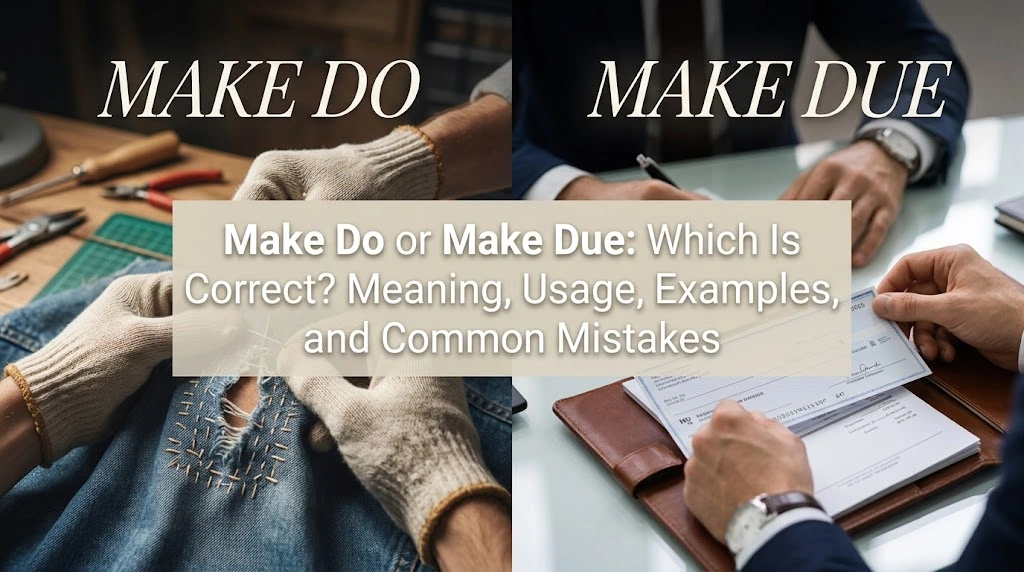
Make do or make due? If you’ve ever hesitated over this phrase while writing an email, article, school assignment, or everyday message, you’re not alone. The two expressions sound almost identical in many varieties of English, but they aren’t interchangeable.
The correct phrase is make do when you mean manage with what you have, cope with a less-than-ideal situation, or use an available substitute.
For example:
We don’t have enough chairs, so we’ll have to make do with stools.
Here, make do means that the stools aren’t the preferred choice, but they’ll work well enough.
By contrast, due has several legitimate meanings involving things such as deadlines, payments, expectations, entitlement, and appropriateness. That’s why due appears in phrases such as due date, payment due, and due process.
The confusion is mostly a spelling problem caused by pronunciation. Once you understand what each word does, the distinction becomes much easier.
Make Do or Make Due: The Quick Answer
If you’re asking “make do or make due?” because you want to say manage with what is available, choose make do.
| Expression | Correct for “manage with what you have”? | Meaning |
| make do | Yes | Manage with available resources |
| make do with | Yes | Use an imperfect or substitute option |
| make do without | Yes | Manage despite lacking something |
| made do | Yes | Past tense of make do |
| making do | Yes | Ongoing form of make do |
| make due | No | Not the standard modern idiom for this meaning |
Consider these examples:
- Correct: We had to make do with an old computer.
- Incorrect: We had to make due with an old computer.
And in the past tense:
- Correct: We made do with what we had.
- Incorrect: We made due with what we had.
The easiest rule is simple:
If you mean “manage with what you have,” use “make do.”
That one rule solves most cases.
What Does “Make Do” Mean?
Make do is an established English idiom meaning to manage with something that is available, even though it may not be ideal.
The phrase often appears when someone has limited choices. Perhaps the right tool isn’t available. Maybe the preferred ingredient is missing. You might have to use an older device because the new one hasn’t arrived.
In each case, you make do.
For example:
- We don’t have any butter, so we’ll make do with oil.
- The hotel had no extra beds, so the children made do with blankets.
- My laptop is being repaired, so I’m making do with my phone.
- We wanted a larger office, but we’ll make do with this one for now.
Notice an important detail: make do doesn’t necessarily mean the situation is disastrous.
It simply suggests that the available solution isn’t exactly what you wanted. It’s good enough to get the job done.
The Core Idea Behind “Make Do”
Think of make do as the language of improvisation.
Imagine you’re cooking dinner and discover that you’re missing one ingredient. You could abandon the recipe entirely. Or you could look around the kitchen and find a reasonable substitute.
You make do.
The same idea applies to money, travel, work, repairs, education, household situations, and countless ordinary problems.
A useful mental definition is:
Make do = manage successfully despite having less than the ideal option.
That meaning explains why the phrase often carries a subtle sense of resourcefulness.
Make Do or Make Due: Why Do People Confuse Them?
The confusion between make do and make due isn’t surprising. The words do and due can sound extremely similar, particularly in many American English accents.
When people hear a phrase rather than see it written, they may not know which spelling belongs there.
Do and Due Can Sound Alike
In common English pronunciation, do and due may be pronounced identically or nearly identically depending on the speaker and accent.
That creates a classic homophone-style problem.
The spelling, however, still depends on meaning.
Compare:
- Do your homework.
- The bill is due tomorrow.
- We’ll make do with what we have.
Hearing do and due won’t always give you enough information. Context does the heavy lifting.
“Due” Is a Very Common English Word
There’s another reason people write make due: due already belongs in many familiar expressions.
You probably see it regularly in phrases such as:
- due date
- payment due
- due tomorrow
- due process
- due respect
- due diligence
- in due course
Because due is a perfectly legitimate word, writers may assume it can replace do in make do.
It can’t.
A word can be correct by itself while still being incorrect in a particular expression. English is full of fixed phrases where changing one word produces a different meaning—or an expression that standard modern usage doesn’t recognize.
What Is the Difference Between “Make Do” and “Make Due”?
The most important difference is meaning.
Make do is an established idiomatic expression. It means to manage with available resources.
Make due, when someone uses it to express that same idea, is generally a mistaken spelling of make do in modern standard English.
| Phrase | Main function | Example |
| make do | Manage with available resources | We’ll make do with this table |
| make do with | Use a substitute | She made do with an older phone |
| make do without | Manage despite lacking something | We made do without electricity |
| due | Owed, expected, scheduled, appropriate, etc. | The payment is due Friday |
This distinction is especially useful because it prevents a common misunderstanding: due isn’t the “more formal” version of do.
It has a different job.
How to Use “Make Do” Correctly
The phrase make do follows several common grammatical patterns. Once you learn them, using the expression becomes almost automatic.
Make Do With + Noun
The structure make do with + noun means using something available as a substitute.
Examples:
- We’ll make do with the smaller room.
- I can make do with this old phone for a few days.
- They had to make do with limited supplies.
- She made do with a borrowed computer.
- We can make do with two chairs for now.
This construction is probably the most common form you’ll encounter.
The object after with tells the reader what resource is being used.
For example:
We had no printer, so we made do with handwritten copies.
The handwritten copies aren’t necessarily ideal. They simply solve the immediate problem.
Make Do Without + Noun
You can also use make do without when someone manages despite not having something.
Examples:
- We can make do without a car this weekend.
- She had to make do without her usual equipment.
- They learned to make do without air conditioning.
- I’ll make do without coffee this morning.
- The team made do without its regular goalkeeper.
The distinction is easy:
make do with = use something available.
make do without = manage despite not having something.
Make Do Without an Object
You don’t always need to say what someone is making do with.
For example:
The situation isn’t ideal, but we’ll make do.
The missing information is understood from context.
Someone might also say:
It’s not the model I wanted, but it’ll make do.
Here, make do means it will be sufficient for the present purpose.
Make Do in Different Verb Tenses
One of the easiest ways to make a spelling mistake is to assume that the phrase changes to made due in the past tense.
It doesn’t.
The verb make changes tense. The word do stays do.
Present Tense: Make Do
- We make do with what we have.
- They make do when resources are limited.
With a third-person singular subject, make becomes makes:
- She makes do with a small budget.
- He makes do without expensive equipment.
Past Tense: Made Do
The past tense is:
made do
Examples:
- We made do with an old television.
- They made do without a refrigerator.
- She made do with the supplies available.
- I made do until the replacement arrived.
Not:
❌ made due
The phrase may sound as though due belongs there, but the correct spelling remains do.
Present Participle: Making Do
For an ongoing situation, use:
making do
Examples:
- We’re making do until the repairs are finished.
- They’re making do with temporary equipment.
- She’s making do with a much smaller workspace.
Future: Will Make Do
For future situations:
- We’ll make do until payday.
- They will make do with the existing equipment.
- Don’t worry. We’ll make do somehow.
Quick Tense Table
| Tense or form | Correct expression | Example |
| Present | make do | We make do with what we have |
| Third-person present | makes do | She makes do with limited supplies |
| Past | made do | We made do with an old computer |
| Present participle | making do | We’re making do for now |
| Future | will make do | We’ll make do until Friday |
The key point is worth remembering:
The phrase uses “do,” not “due,” regardless of whether you write make do, made do, or making do.
What Does “Due” Actually Mean?
Understanding due makes the make do or make due distinction even clearer.
Due has several meanings in standard English. It can describe something that is owed, expected, scheduled, appropriate, or deserved.
Due Can Mean Owed
When money or another obligation must be paid or fulfilled, it can be described as due.
Examples:
- The rent is due on the first of the month.
- Your payment is due Friday.
- The company has money due from several customers.
Here, due has nothing to do with managing with limited resources.
Due Can Mean Expected
Something expected to arrive or happen can also be due.
Examples:
- The train is due at 8:30.
- The package is due tomorrow.
- Her baby is due in December.
Again, the meaning is completely different from make do.
Due Can Mean Appropriate or Deserved
The word can also describe something that is properly owed or deserved in a broader sense.
Examples include:
- He received his due recognition.
- The issue deserves due consideration.
- The matter received due attention.
Due in Common Expressions
You’ll find due in many established expressions:
- due process
- due diligence
- due date
- due respect
- in due course
- in due time
These examples show why due is familiar to English speakers. Still, none of them changes the spelling of the idiom make do.
For standard dictionary definitions and usage information, useful references include Merriam-Webster, Cambridge Dictionary, and Oxford Learner’s Dictionaries.
Is “Make Due” Ever Correct?
This question deserves a little nuance.
In modern standard English, if you want to say that someone is managing with whatever is available, make do is the established expression.
Therefore:
We had to make do with the materials we had.
is the standard modern construction.
Older English texts can contain unusual or historically distinct combinations involving due. Historical language doesn’t always follow present-day conventions. Words change meaning, spellings shift, and expressions rise or disappear over time.
That historical fact doesn’t make make due the recommended modern spelling of the idiom.
For contemporary US English, the practical rule remains straightforward:
Use “make do” when you mean “manage with what is available.”
If make due appears in modern writing with that meaning, it will generally be interpreted as a mistake or typo rather than as the preferred form.
Make Do vs. Make-Do: Does the Hyphen Matter?
Here’s another wrinkle worth knowing: make do and make-do can have different grammatical roles.
“Make Do” as a Verb Phrase
When someone is performing the action, write make do as two words.
Example:
We’ll make do with the old equipment.
Another example:
They made do until the new supplies arrived.
Here, make do functions as a verb phrase.
“Make-Do” as a Noun or Compound Modifier
The hyphenated form make-do can appear as a noun or compound modifier in certain contexts.
For example:
The temporary arrangement was just a make-do solution.
The exact punctuation can vary with grammatical use and editorial style. Major dictionaries and style references are useful when a particular sentence requires a formal editorial decision.
The crucial point is this:
Don’t add a hyphen simply because you see “make-do” used somewhere else.
If you’re using the ordinary verb phrase, the standard form is:
make do
Common “Make Do or Make Due” Mistakes
A few recurring errors cause most of the confusion.
Mistake: Writing “Make Due”
Incorrect:
We had to make due with the old equipment.
Correct:
We had to make do with the old equipment.
The intended meaning is manage with the old equipment. Therefore, do is the correct word.
Mistake: Writing “Made Due”
Incorrect:
They made due with whatever they could find.
Correct:
They made do with whatever they could find.
Changing make to its past tense made doesn’t change the second word.
Mistake: Assuming “Due” Means “Available”
It doesn’t.
Due can describe something that is owed, expected, scheduled, appropriate, or deserved. It doesn’t mean available, sufficient, or usable as a substitute.
Mistake: Trusting Spellcheck Too Much
A spellchecker may accept due because due is a correctly spelled English word.
That doesn’t mean make due is correct in your sentence.
Spellcheck can recognize words. It doesn’t always understand the idiomatic relationship between them.
This is one reason context remains essential in proofreading.
Real-Life Examples of “Make Do”
The phrase becomes much easier to understand when you see it in situations people actually encounter.
At Home
Suppose the washing machine breaks and the repair technician can’t come until tomorrow.
You might say:
We’ll make do until the machine is fixed.
Or perhaps you’re cooking and discover that you don’t have the exact ingredient:
I don’t have fresh herbs, so I’ll make do with dried ones.
The phrase communicates adaptation rather than defeat.
At Work
A small business might have one computer temporarily out of service.
The staff had to make do with three computers instead of four.
Nobody is saying the missing computer was irrelevant. The point is that the team found a way to continue working.
While Traveling
Imagine arriving at a hotel and discovering that your luggage is delayed.
I had to make do with the clothes in my carry-on bag.
The carry-on isn’t the full wardrobe. Still, it gets the job done.
With Money
Financial constraints often create situations where make do fits naturally.
We can’t replace the car this year, so we’ll make do with the old one.
The phrase can suggest practicality, patience, or simple necessity.
During Repairs
A broken tool doesn’t always stop a project completely.
The proper wrench was missing, so the mechanic made do with another one.
That sentence captures the central idea perfectly: use what’s available and keep moving.
Make Do vs. Similar Expressions
Several English expressions overlap with make do, but each carries a slightly different shade of meaning.
| Expression | Meaning | Example |
| make do | Manage with available resources | We’ll make do with this |
| get by | Manage despite difficulty | We can get by for a few days |
| cope with | Deal with a difficult situation | She coped with the disruption |
| manage with | Function using limited resources | We managed with two workers |
| make the best of | Find value in an imperfect situation | Let’s make the best of the trip |
| improvise | Create a solution from available materials | They improvised a replacement |
These expressions aren’t perfect synonyms.
For example, improvise emphasizes creativity. Get by often emphasizes surviving or functioning despite difficulty. Make the best of suggests adopting a positive attitude toward an imperfect situation.
Make do sits somewhere in the middle. It emphasizes using what is available because the preferred option isn’t available.
A Practical “Make Do or Make Due” Test
When you’re unsure which word to use, don’t stare at the spelling. Test the meaning.
Ask yourself:
Am I talking about managing with what I have?
If yes, use:
make do
If you’re talking about a deadline, obligation, expectation, or something owed, due may be appropriate.
For example:
We don’t have enough money for a new printer, so we’ll make do with the old one.
The meaning is management with limited resources.
Now compare:
The printer payment is due Friday.
Here, due means the payment is expected or owed by a particular time.
The Two-Second Memory Trick
Remember this sentence:
Make do with what you have.
The phrase make do with is so common that it can serve as your mental anchor.
If the sentence means use what you’ve got and manage somehow, choose do.
Make Do or Make Due: Side-by-Side Examples
| Meaning | Correct wording | Example |
| Manage with available resources | make do | We’ll make do with this table |
| Use a substitute | make do with | She made do with an older laptop |
| Manage without something | make do without | We made do without a car |
| Describe a past situation | made do | They made do with fewer supplies |
| Describe an ongoing situation | making do | We’re making do until repairs finish |
| Describe something owed | due | The payment is due Friday |
| Describe an expected arrival | due | The train is due at noon |
| Describe a deadline | due | The report is due tomorrow |
This table reveals the underlying rule: the choice isn’t really about spelling. It’s about meaning.
A Closer Look at “Make Do With”
The phrase make do with deserves special attention because it’s one of the most useful forms.
When you say:
We’ll make do with the smaller room.
you’re implying that the smaller room isn’t necessarily the first choice.
You might have preferred a larger room. However, the smaller one is available and usable.
That implied contrast is important.
Compare:
We used the smaller room.
This is neutral. It simply tells you what happened.
We made do with the smaller room.
This tells you that the smaller room was probably not ideal, yet it was sufficient under the circumstances.
That extra shade of meaning makes make do more expressive than a plain verb such as use.
A Closer Look at “Make Do Without”
The phrase make do without works differently because it highlights absence.
Consider:
We made do without a refrigerator.
The sentence tells us that the refrigerator wasn’t available, yet life continued.
Compare it with:
We lived without a refrigerator.
The second sentence is neutral. The first emphasizes adaptation and inconvenience.
That difference can make make do without especially useful in personal stories, journalism, business writing, and everyday conversation.
Is “Make Do” Formal or Informal?
Make do is a standard, well-established English idiom. It isn’t slang or an error-prone casual expression.
You can use it in ordinary conversation and many forms of professional writing.
For example:
The department will make do with its current equipment until the replacement arrives.
That’s perfectly understandable in a workplace setting.
However, extremely formal or technical writing may sometimes favor a more explicit expression such as:
- manage with available resources
- operate with existing equipment
- use the available alternative
- continue with limited resources
The choice depends on tone.
Make do is often more concise and natural. Formal alternatives can be useful when precision matters more than conversational rhythm.
Case Study: Choosing Between “Make Do” and “Due”
Consider a small business that needs a new printer. The current printer is unreliable, but the replacement won’t arrive for two weeks.
A writer could say:
The office had to make do with its old printer until the replacement arrived.
That’s correct because the employees are managing with an imperfect resource.
Now consider the invoice for that replacement printer:
The invoice is due on September 30.
That’s also correct because due refers to an obligation or payment deadline.
The same situation can contain both words, but they perform completely different jobs.
| Situation | Correct word | Why |
| Employees use the old printer | do | They are managing with what they have |
| The printer invoice must be paid | due | The payment is owed by a deadline |
This is why memorizing one isolated spelling isn’t enough. Understanding the meaning makes the correct choice obvious.
Frequently Asked Questions About Make Do or Make Due
Is it “make do” or “make due”?
Make do is correct when you mean manage with what you have.
Example:
We’ll make do with the supplies already available.
What does “make do” mean?
Make do means to manage with something available even though it isn’t the ideal option.
Example:
We couldn’t find a hotel nearby, so we made do with a guesthouse.
Is “make due” grammatically correct?
Make due isn’t the standard modern English expression when you mean manage with what is available. In that context, use make do.
Is “made do” correct?
Yes.
Made do is the past-tense form of make do.
We made do with the equipment we had.
Is “making do” correct?
Yes.
Making do describes an ongoing situation.
We’re making do until the new equipment arrives.
Can you say “make do with”?
Yes. In fact, make do with is one of the most common constructions.
She had to make do with a borrowed phone.
Can you say “make do without”?
Yes.
Use make do without when someone manages despite lacking something.
They had to make do without electricity for several hours.
Why do people write “make due”?
The most common reason is pronunciation. Do and due sound alike or very similar in many accents.
People may therefore choose the wrong spelling when writing the phrase from memory.
Is “make-do” a word?
Make-do can appear as a hyphenated noun or compound modifier in appropriate contexts. However, the ordinary verb phrase is written make do.
Is “make do” a formal expression?
Yes. It’s a standard English idiom. It works naturally in conversation and many types of professional writing.
Make Do or Make Due: The Final Verdict
The answer is straightforward once the meaning is clear.
Make do is the correct phrase when you mean:
- manage with what you have
- cope with limited resources
- use an imperfect substitute
- continue without the ideal option
- get by under less-than-perfect circumstances
Examples:
We’ll make do with what we have.
She made do with an old laptop.
They’re making do without a car.
By contrast, due belongs in contexts involving things such as payments, deadlines, expectations, schedules, entitlement, or appropriate treatment.
Examples:
The payment is due Friday.
The train is due at noon.
The report is due tomorrow.
So when the choice comes down to make do or make due, ask what the sentence means.
If you’re saying “manage with what you have,” choose make do.
The easiest rule to remember
Make do with what you have.
Not make due.
Once that distinction clicks, this common spelling trap becomes much less troublesome. When you hear the phrase, think about its meaning rather than its sound. The correct spelling will usually follow naturally.
If needed, this can also be adapted into a more SEO-aggressive version with a stronger featured-snippet structure, additional semantic keywords, and a larger FAQ section while keeping the writing natural.
