

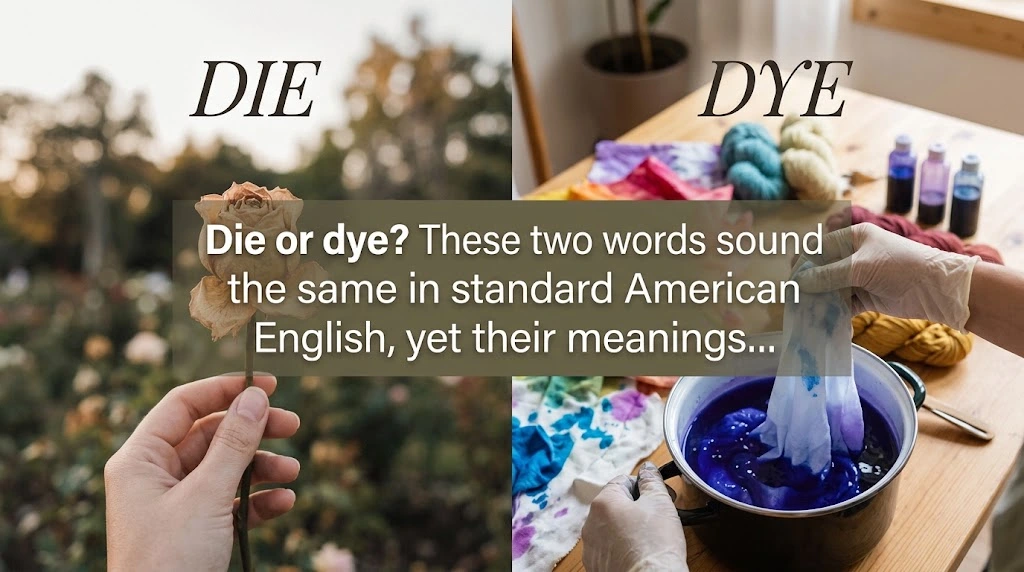
Die or dye? These two words sound the same in standard American English, yet their meanings couldn’t be more different. One can describe death, a gaming object, or a manufacturing tool. The other deals with coloring materials, clothing, hair, and other objects.
That makes this pair especially tricky in writing. You might know exactly what you want to say, yet typing die instead of dye can completely change the meaning.
The good news is that the distinction is straightforward once you connect each spelling with its meaning.
Die is generally used for death, a single gaming cube, or a tool used to cut and shape materials. Dye relates to color. For example, a plant can die, while a shirt can be dyed.
The confusion becomes even more noticeable with dying and dyeing. The first relates to die. The second comes from dye. One letter changes the meaning entirely.
This guide explains die vs. dye, including their definitions, grammatical forms, pronunciation, examples, common mistakes, and the important difference between dying and dyeing.
Die or Dye: Which Word Is Correct?
Both die and dye are correct English words. The right choice depends entirely on what you mean.
| Word | Meaning | Example |
| die | To stop living | Plants may die without water. |
| die | A single cube used in games | Roll one die. |
| die | A tool used to cut, shape, or form material | The factory uses a metal die. |
| dye | A substance that adds color | The fabric needs a blue dye. |
| dye | To change the color of something | They dye the fabric by hand. |
A useful shortcut is remarkably simple:
If you’re talking about color, choose “dye.” If you’re talking about death, choose “die.”
That rule handles most everyday situations.
There are a few additional meanings of die, however. For example, a manufacturer may use a die to stamp metal into a particular shape. A board-game player may roll a die. Neither meaning has anything to do with color.
What Does “Die” Mean?
The word die has several meanings, which explains why it appears in many different kinds of writing.
The most familiar meaning is to stop living. It can describe people, animals, plants, and other living organisms.
- The old tree may die without enough water.
- Some insects die shortly after reproducing.
- The patient eventually died peacefully.
- Wildflowers can die during a severe drought.
The word can also appear in figurative expressions. In those cases, die doesn’t necessarily describe biological death.
For example:
- The tradition may die out.
- Her enthusiasm began to die down.
- The old custom slowly died away.
- The engine finally died.
English also uses die for things that stop functioning.
My phone is about to die.
Here, die means that the battery is about to run out rather than that the phone is literally alive.
Die as a Noun
Die also functions as a noun. This usage has two important meanings.
First, in games, a die is one numbered cube. The plural is generally dice.
- Roll one die.
- Roll two dice.
- The player rolled a six on the die.
Second, manufacturing uses die for a specialized tool or device that shapes, cuts, stamps, extrudes, or otherwise forms material.
For example, a metalworking operation may use a die to create a precise shape in a piece of metal. Plastic manufacturing can also involve dies that shape molten material as it passes through an opening.
That technical meaning has nothing to do with dye.
What Does “Dye” Mean?
Dye is connected to color. That’s the easiest way to remember it.
As a noun, a dye is a substance used to give another material a particular color.
Dyes can be used with many materials, including:
- Clothing
- Cotton
- Wool
- Silk
- Leather
- Hair
- Paper
- Synthetic fabrics
- Other suitable materials
Consider these examples:
- The manufacturer created a deep-blue dye.
- The red dye stained the fabric.
- Natural dyes can come from plants.
- The artist mixed several dyes to achieve the desired shade.
As a verb, dye means to change something’s color by applying a dye or another coloring substance.
- They dye cotton fabric.
- She plans to dye her hair.
- The company dyed the material black.
- Workers are dyeing the cloth today.
The color connection gives dye its practical identity.
Die vs. Dye: What’s the Difference?
The biggest difference between die and dye is meaning, not pronunciation.
In standard American English, the two words are normally pronounced alike. That makes them homophones: words that sound the same but have different meanings and spellings.
The spelling, therefore, carries important information.
| Feature | Die | Dye |
| Pronunciation | /daɪ/ | /daɪ/ |
| Common verb meaning | Stop living | Change color |
| Common noun meanings | Gaming object; manufacturing tool | Coloring substance |
| Past tense | Died | Dyed |
| -ing form | Dying | Dyeing |
| Color-related? | Usually no | Yes |
The distinction becomes much clearer when the words appear in complete sentences.
Correct:
- The leaves are dying.
- She is dyeing the fabric.
- The battery will die soon.
- She wants to dye her hair.
The surrounding context tells you which spelling belongs there.
When to Use “Die”
Use die when the meaning involves death, failure, disappearance, a gaming object, or a manufacturing tool.
Die for Death
This is the most common meaning.
- Animals eventually die.
- Some plants die during extreme heat.
- The character died at the end of the story.
- The flowers are dying.
The related forms follow normal verb patterns:
| Form | Example |
| die | Plants die without water. |
| dies | The plant dies without water. |
| died | The plant died yesterday. |
| dying | The plant is dying. |
Notice something important: dying contains no extra e.
That spelling often causes confusion because dye does contain an e. The two forms come from different base words.
Die for a Battery or Machine
English often uses die informally for something that stops operating.
- My laptop died during the meeting.
- The car engine died at the intersection.
- My phone is dying.
These examples use die figuratively. The object isn’t alive, of course. The expression simply describes a complete loss of function or power.
Die in Games
When referring to one gaming cube, use die.
- Roll the die.
- The red die landed on three.
- Each player gets one die.
When referring to more than one, dice is the standard plural in ordinary modern English.
- Roll the dice.
- The two dice landed beside the board.
Die in Manufacturing
In engineering and manufacturing, a die is a tool used to shape or cut material.
For example, a die can help produce consistent metal parts or shape materials during industrial processes.
A technical sentence might read:
The manufacturer redesigned the die to improve dimensional accuracy.
This meaning is especially useful to recognize because someone unfamiliar with manufacturing might mistakenly assume dye refers to coloring.
It doesn’t.
When to Use “Dye”
Use dye when you’re talking about adding or changing color.
Dye as a Noun
A dye is a coloring substance.
- The fabric absorbed the dye evenly.
- The blue dye produced a rich color.
- The textile company tested several dyes.
- The natural dye came from plant material.
The noun often appears alongside words such as:
- Color
- Pigment
- Fabric
- Textile
- Hair
- Shade
- Cotton
- Wool
However, dye and pigment aren’t always interchangeable in technical contexts. Dyes generally become associated with the material they color through processes that differ from the way insoluble pigments behave.
For everyday writing, though, the key distinction remains simple: dye relates to coloring.
Dye as a Verb
As a verb, dye means to change the color of something.
- I want to dye this shirt blue.
- She dyed her hair brown.
- They dye the fabric in small batches.
- The workers are dyeing the material.
The verb changes form like this:
| Verb form | Example |
| dye | They dye the fabric. |
| dyes | The company dyes wool. |
| dyed | She dyed her shirt black. |
| dyeing | They are dyeing the cloth. |
The spelling dyeing may look unusual, but it follows directly from the word dye.
Dying vs. Dyeing: The Confusion Gets Bigger
If die vs. dye causes confusion, dying vs. dyeing can be even more troublesome.
These words sound different only in context and have completely separate meanings.
Dying comes from die.
Dyeing comes from dye.
| Word | Base word | Meaning | Example |
| dying | die | Approaching death or stopping | The plant is dying. |
| dyeing | dye | Changing color | She is dyeing the fabric. |
This distinction matters because one missing letter can create an unintended meaning.
What Does “Dying” Mean?
Dying means undergoing the process of dying or, in some contexts, gradually disappearing or weakening.
- The injured bird is dying.
- The flowers are dying.
- The old tradition is dying out.
- My phone battery is dying.
It never means “changing color.”
What Does “Dyeing” Mean?
Dyeing means applying dye or changing the color of something.
- She is dyeing her hair.
- They are dyeing the fabric.
- The workers are dyeing cotton.
- He spent the afternoon dyeing clothes.
A quick memory trick helps:
Dying → die → death
Dyeing → dye → color
Think of the extra e in dyeing as staying connected to dye.
“Dye My Hair” or “Die My Hair”?
This is one of the most common real-world mistakes.
The correct expression is:
I want to dye my hair.
Not:
I want to die my hair.
Why? Because the action involves changing the color of your hair.
The same principle applies to past and continuous forms:
- She dyed her hair blonde.
- She is dyeing her hair blonde.
- They want to dye their hair black.
Using die would create a completely different and rather alarming meaning.
“Dying My Hair” or “Dyeing My Hair”?
The correct phrase is:
I’m dyeing my hair.
The word dyeing means changing the hair’s color.
Compare it with:
My hair is dying.
That sentence has a different meaning. It could describe damaged or unhealthy hair in a figurative sense.
The difference is only one letter, yet the meaning changes dramatically.
| Incorrect for coloring | Correct for coloring |
| I want to die my hair. | I want to dye my hair. |
| She is dying her hair. | She is dyeing her hair. |
| He died his hair. | He dyed his hair. |
Die or Dye in Everyday Sentences
Seeing the words in realistic contexts makes the distinction easier to remember.
Examples With “Die”
- The batteries may die overnight.
- The flowers will die without sunlight.
- The old tradition could die out.
- Roll one die to determine your score.
- The machine uses a precision die to shape the metal.
- My phone died before I could call you.
Examples With “Dye”
- She wants to dye her dress.
- The textile factory dyes cotton.
- He bought black dye for the project.
- The fabric was dyed a deep red.
- They are dyeing wool today.
- The dye produced an even finish.
The pattern is hard to miss once the context becomes familiar.
Common Die and Dye Mistakes
Certain errors appear again and again because these words are homophones.
“Die My Shirt Blue”
This is incorrect when you mean changing the shirt’s color.
Correct:
I want to dye my shirt blue.
“The Flowers Are Dyeing”
If the flowers are losing life, use dying.
Correct:
The flowers are dying because they haven’t received enough water.
“She Is Dying Her Hair”
If she is changing her hair color, use dyeing.
Correct:
She is dyeing her hair red.
“A Dye” for a Gaming Cube
This is also incorrect.
Correct:
Roll the die.
A dye is associated with coloring. A die can be a gaming cube.
“Died” for Coloring
The past tense of dye is dyed, not died.
Correct:
They dyed the fabric green.
The distinction is particularly important in professional writing because a spelling mistake can make an otherwise clear sentence look careless.
A Simple Die vs. Dye Memory Trick
When in doubt, ask one question:
Is the sentence about color?
If the answer is yes, choose dye.
If the answer is no, consider die when the context involves death, a game, or a manufacturing tool.
The Color Test
- Dye the fabric.
- Dye your hair.
- Dye the shirt.
- Buy blue dye.
The Death Test
- The plant may die.
- The battery will die.
- The animal is dying.
- The tradition may die out.
The Game Test
- Roll one die.
- The die landed on six.
- Roll the dice again.
The Manufacturing Test
- The machine uses a metal die.
- The engineer redesigned the die.
- The die creates a consistent shape.
This four-part test covers nearly every everyday use you’ll encounter.
Die vs. Dye in American English
In American English, die and dye are normally homophones. Both are pronounced with the long i sound represented by /aɪ/.
That means you generally can’t rely on hearing the word to determine its spelling.
This is a broader feature of English. Many words share pronunciations while differing in spelling and meaning. Writers therefore have to use context to select the correct written form.
For example:
- there / their / they’re
- to / too / two
- brake / break
- flower / flour
- right / write
- die / dye
The lesson is simple: pronunciation isn’t always a reliable spelling guide.
When speaking, die and dye may sound identical. When writing, however, the surrounding meaning tells you which word belongs on the page.
Die and Dye: A Grammar Comparison
Understanding their grammatical behavior makes the distinction even easier.
| Base word | Past tense | -ing form | Main idea |
| die | died | dying | Death or stopping |
| dye | dyed | dyeing | Changing color |
Notice the different vowel patterns:
die → died → dying
dye → dyed → dyeing
The past-tense forms are especially easy to confuse when typing quickly.
- The leaves died.
- The shirt was dyed.
The first describes life. The second describes color.
A Practical Case Study: One Sentence, Two Meanings
Consider this sentence:
The fabric is dying.
At first glance, it sounds strange. Fabric isn’t alive, so dying doesn’t normally make sense unless the writer is being metaphorical.
Now change one letter:
The fabric is dyeing.
This can mean the fabric is undergoing the process of being colored, although “the fabric is being dyed” is usually more natural when the fabric receives color.
That distinction illustrates an important point about grammar: choosing the right root word isn’t enough. The sentence also needs the appropriate grammatical construction.
A more natural comparison would be:
The flowers are dying.
versus:
They are dyeing the fabric.
Now the meanings are unmistakable.
A Practical Case Study: Hair Color
Hair-coloring provides another useful example.
Imagine someone writes:
Maria is dying her hair brown.
The reader can probably infer the intended meaning from context. Still, the spelling is wrong.
The correct sentence is:
Maria is dyeing her hair brown.
The base verb is dye, so its present participle is dyeing.
The same sentence can be rewritten in a form that avoids the potentially confusing word:
Maria is changing her hair color to brown.
That version isn’t necessary, but it shows how context can remove ambiguity.
A Practical Case Study: Games
Imagine a board-game instruction that says:
Roll the dye.
That sentence contains the wrong word.
The correct version is:
Roll the die.
If the instruction involves multiple numbered cubes, use:
Roll the dice.
This example demonstrates why spelling matters even when pronunciation doesn’t change.
In speech, listeners may understand the intended word. In written instructions, however, the reader depends entirely on the spelling and context.
Die or Dye: Frequently Asked Questions
Is “die” a correct word?
Yes. Die is a standard English word with several meanings. Most commonly, it means to stop living. It can also refer to one gaming cube or a manufacturing tool used to shape material.
Is “dye” a correct word?
Yes. Dye is the correct word for a coloring substance and for the action of changing something’s color.
Is it “dye my hair” or “die my hair”?
The correct phrase is “dye my hair.”
You’re changing the color of your hair, so the verb must be dye.
Is it “dying” or “dyeing”?
Both are correct words, but they have different meanings.
- Dying comes from die.
- Dyeing comes from dye.
Use dying for death or figurative decline. Use dyeing for changing color.
Are “die” and “dye” homophones?
Yes. In standard American English pronunciation, die and dye are generally pronounced the same way.
They differ in spelling and meaning.
What is the past tense of “dye”?
The past tense is dyed.
Example:
She dyed the fabric blue.
What is the past tense of “die”?
The past tense is died.
Example:
The plant died during the drought.
What is the present participle of “dye”?
The present participle is dyeing.
Example:
They are dyeing the fabric.
What is the present participle of “die”?
The present participle is dying.
Example:
The plant is dying.
Is “dyeing” the same as “dying”?
No. Dyeing means changing color. Dying relates to death or decline.
Is “dye” a noun or a verb?
It can be both.
As a noun:
The blue dye stained the cloth.
As a verb:
They dye the cloth blue.
Is “die” a noun or a verb?
It can also be both.
As a verb:
Some plants die without water.
As a noun:
Roll one die.
In manufacturing, die is also a noun for a shaping or cutting tool.
Die vs. Dye: Quick Reference Guide
When you need an answer quickly, use this chart.
| If you mean… | Use… | Example |
| Stop living | die | Plants can die. |
| Losing battery power | die | My phone will die. |
| One gaming cube | die | Roll the die. |
| Manufacturing tool | die | The die shapes the metal. |
| Coloring substance | dye | Add blue dye. |
| Change color | dye | Dye the fabric. |
| Approaching death | dying | The plant is dying. |
| Changing color | dyeing | She is dyeing the fabric. |
| Past action involving death | died | The plant died. |
| Past coloring action | dyed | She dyed the shirt. |
Why These Words Are Easy to Confuse
English spelling often preserves distinctions that pronunciation doesn’t reveal.
Die and dye are a perfect example. Their identical pronunciation means that a listener doesn’t receive a spelling clue. The writer has to know the word’s meaning.
The problem gets trickier because the forms dying and dyeing don’t simply look like obvious extensions of the base words.
Compare them side by side:
die → dying
dye → dyeing
The first drops the final e before adding -ing. The second keeps the e because the spelling needs to preserve the connection to dye.
This is why memorizing the two families is more useful than trying to guess from pronunciation.
How to Avoid Die and Dye Errors
A few habits can prevent nearly all mistakes.
Think About Meaning First
Don’t start with pronunciation. Start with the idea.
Ask:
Am I talking about color?
If yes, dye is almost certainly the word you need.
Remember the Word Families
Keep these pairs together:
- die → died → dying
- dye → dyed → dyeing
Once these patterns become familiar, the spelling becomes much easier.
Read the Whole Sentence
A word can look uncertain in isolation but become obvious in context.
Compare:
The leaves are ___.
The natural answer is dying.
Now:
The workers are ___ the fabric.
The answer is dyeing.
The surrounding words provide the clue.
Don’t Trust Spellcheck Alone
Spellcheck can catch misspelled words, but it can’t always identify a correctly spelled word used in the wrong context.
For example, both die and dye are correctly spelled words.
A spellchecker may accept:
I want to die my hair.
The sentence is grammatically possible as a sequence of words, but the writer almost certainly means dye.
That’s a classic wrong-word error, not a simple spelling error.
Die or Dye: The Final Verdict
So, die or dye—which word is correct?
Both are correct. The difference lies in meaning.
Use die when you’re talking about:
- Death
- Something stopping or failing
- A single gaming cube
- A manufacturing or shaping tool
- Related expressions such as die out or die down
Use dye when you’re talking about:
- A coloring substance
- Changing the color of fabric
- Coloring hair
- Coloring other suitable materials
The most important distinction is easy to remember:
Die is not about color. Dye is.
And when the words take their -ing forms, keep the families straight:
die → dying
dye → dyeing
Once that pattern clicks, the confusion largely disappears. Whether you’re writing an email, editing product instructions, describing textile work, or simply trying to spell a sentence correctly, meaning should guide the spelling.
Sources and Further Reading
For authoritative definitions, pronunciation information, and usage guidance, consult:
- Merriam-Webster: Die
- Merriam-Webster: Dye
- Cambridge Dictionary: Die
- Cambridge Dictionary: Dye
- Merriam-Webster: Homophone
- Encyclopaedia Britannica: Dye
Bottom line: If something stops living, it can die. If something changes color, you dye it. That tiny spelling difference carries a completely different meaning.
