

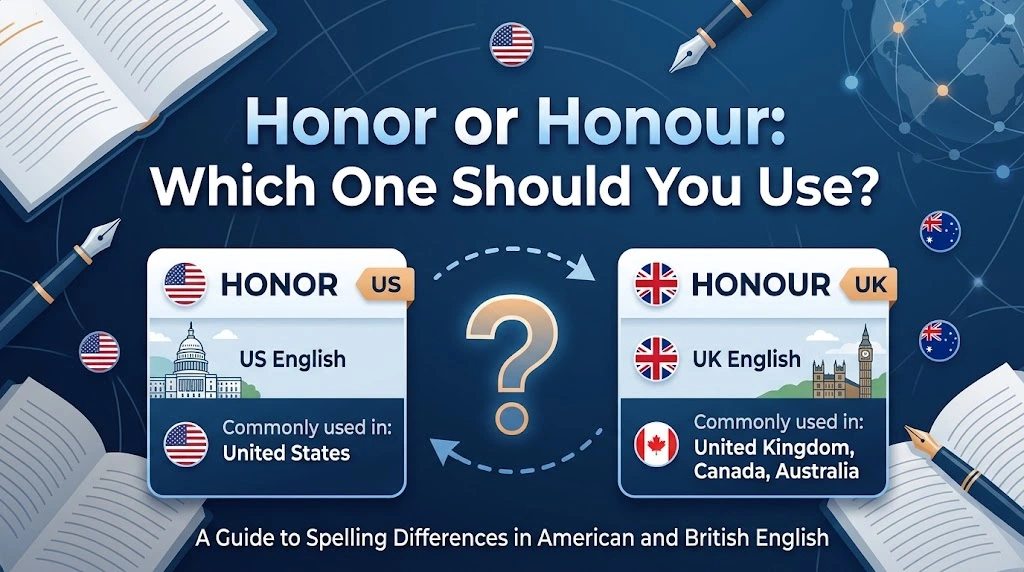
Honor and honour mean the same thing, but they belong to different spelling conventions. If you write American English, use honor. If you write British English, use honour.
That simple rule solves most cases. However, the difference becomes more interesting when you look at related words, regional English varieties, formal writing, proper names, and phrases such as honor roll and honour roll.
The two spellings share the same history and usually have the same pronunciation. Neither one represents a different meaning or a different level of respect. The choice mainly depends on which variety of English you’re using and who will read your writing.
This guide explains the difference clearly, including where each spelling comes from, how it works in sentences, and when you should choose one over the other.
Honor vs. Honour: The Quick Answer
The easiest way to remember the distinction is geographical.
| Spelling | Main English variety | Example |
| honor | American English | It was an honor to meet you. |
| honour | British English | It was an honour to meet you. |
| honor | Often used in other American-influenced contexts | The soldier received an honor. |
| honour | Common in British-influenced varieties | She received the honour of speaking first. |
So, if you’re writing for readers in the United States, honor is normally the right choice.
If you’re following British English, choose honour.
The important point is that both spellings are standard. This isn’t a case where one word is correct and the other is a mistake.
The simplest rule
American English → honor
British English → honour
The same pattern appears in several other words:
- color → colour
- favor → favour
- labor → labour
- neighbor → neighbour
- behavior → behaviour
- valor → valour
There are exceptions and historical details, but the basic spelling pattern is consistent.
What Does Honor or Honour Mean?
Before comparing the spellings, it’s useful to understand the word itself.
Honor and honour can work as both nouns and verbs. Their meanings cover ideas such as respect, dignity, good character, recognition, and fulfilling an obligation.
The exact meaning depends on context.
Honor or Honour as a Noun
As a noun, honor/honour can describe respect or a strong sense of moral worth.
For example:
She earned the respect of her colleagues through her honesty and honor.
Here, the word refers to integrity and moral character.
It can also describe recognition or distinction:
It was a great honor to receive the award.
In this sentence, the word means a privilege or distinction.
The word can also refer to an obligation or commitment:
He gave his word and considered it a matter of honor.
Historically and culturally, honor has also been associated with reputation, social standing, courage, loyalty, and personal conduct.
Honor or Honour as a Verb
As a verb, honor/honour generally means to show respect, recognize someone, or fulfill an obligation.
For example:
The university will honor the professor for her decades of service.
Here, the university plans to recognize her.
The word can also describe keeping an agreement:
The company agreed to honor the original price.
In this context, honoring something means respecting or fulfilling an existing commitment.
The British version simply changes the spelling:
The company agreed to honour the original price.
The meaning doesn’t change.
Why Are There Two Spellings of Honor and Honour?
The difference comes from the long and complicated history of English spelling.
English borrowed many words from French after the Norman Conquest of 1066. Honor/honour ultimately traces through Old French to Latin honor.
French spelling influenced English in different ways over time. The -our form became established in British English for a number of words.
American English later moved toward simpler spellings in several cases.
One person strongly associated with spelling reform in the United States was Noah Webster, whose dictionaries helped establish American spelling preferences during the nineteenth century.
Webster promoted forms that differed from British conventions, including spellings such as color rather than colour.
The result wasn’t a complete redesign of English spelling. Instead, certain groups of words gradually developed recognizable regional patterns.
That’s why modern readers see:
- honor in American English
- honour in British English
The distinction has now become a normal part of English usage.
Honor in American English
Honor is the standard spelling in American English.
You’ll find it throughout US newspapers, books, government documents, school materials, business writing, and everyday communication.
For example:
It was an honor to work with the research team.
The students appeared on the honor roll.
She received the Medal of Honor.
We honor those who served their country.
Notice that American English doesn’t normally add the u.
Common American expressions with honor
Some familiar US expressions include:
- honor roll
- honor system
- honor code
- guest of honor
- on your honor
- honor student
- honor society
- honor guard
- honorary degree
- honor a commitment
These expressions use the American spelling when they’re written as ordinary American English.
However, proper names can follow their own rules.
For example, Medal of Honor is the official name of the highest US military decoration. Its spelling isn’t something a writer should casually change to fit another regional convention.
Honour in British English
Honour is the traditional standard spelling in British English.
A British publication, school, company, or government document will generally use honour rather than honor when following standard British spelling.
For example:
It was an honour to meet the ambassador.
The pupils were placed on the honour roll.
She was given the honour of opening the exhibition.
The organization will honour its commitment.
The extra u doesn’t affect the basic meaning.
It simply signals the spelling convention being used.
Common British expressions with honour
British English commonly uses forms such as:
- honour roll
- honour system
- guest of honour
- on your honour
- honour student
- honour guard
- honour a commitment
- honourable
- honoured
- honouring
The spelling also appears in formal and ceremonial language.
For instance:
The ceremony was held to honour those who contributed to the community.
Honor vs. Honour in Other English-Speaking Countries
The United States and United Kingdom provide the clearest contrast, but English doesn’t stop at those two countries.
Different countries use different spelling traditions.
Canada
Canadian English often uses British-style spellings such as honour, although Canadian English also contains American influences.
In formal Canadian writing, the -our spelling is common.
That doesn’t mean every Canadian publication or organization will use identical style rules. Individual style guides can establish their own preferences.
Australia
Australian English generally follows British spelling conventions.
Therefore, honour is the normal form in Australian English.
New Zealand
New Zealand English also generally follows British spelling patterns, making honour the expected spelling in standard formal writing.
Ireland
Irish English has its own distinctive characteristics, but honour is commonly used in formal writing.
The larger lesson is simple: English spelling varies by region.
You shouldn’t assume that American spelling is automatically the international default.
Honor or Honour in Formal Writing
Choosing between honor and honour becomes especially important when you’re writing something official.
A spelling mistake in a casual text rarely matters much. A spelling inconsistency in a legal document, academic paper, business website, or publication can look careless.
The best approach is to identify your required English variety before writing.
Academic writing
If your school or university requires American English, use honor.
If it requires British English, use honour.
A style guide or institution may specify the preferred variety. Follow that requirement rather than relying on personal preference.
Business writing
Businesses should consider their audience.
A US-based company targeting American customers will normally use honor.
A UK company addressing British customers will normally use honour.
For international companies, the best solution is often a defined editorial style.
Consistency matters.
Resumes and cover letters
Your spelling should match the language conventions expected by the employer and country.
For a US employer:
It was an honor to lead the volunteer team.
For a UK employer:
It was an honour to lead the volunteer team.
Neither sentence changes the underlying achievement.
Only the regional spelling changes.
Government documents
Government agencies typically follow established language conventions and official terminology.
This is particularly important when you’re writing the name of a program, award, law, institution, or government body.
Don’t alter an official name simply to make it match your preferred spelling system.
Honor or Honour in Names and Titles
Proper names require special attention.
Suppose an organization officially calls itself The Honour Society of…. You shouldn’t automatically rewrite its name as The Honor Society of… just because you’re writing American English.
Official names are fixed identifiers.
The same principle applies to:
- awards
- institutions
- organizations
- military decorations
- historical titles
- quoted material
- book titles
- program names
- ceremonial names
Why this matters
Imagine an article discussing a British institution whose official name contains Honour.
Changing it to Honor could make the name inaccurate.
The same problem occurs in reverse.
If an American award officially uses Honor, changing it to Honour alters its official title.
Regional spelling rules matter, but accuracy comes first when reproducing proper names.
Honor or Honour in Common Phrases
Many expressions containing the word have regional spelling differences.
| American English | British English |
| honor roll | honour roll |
| honor system | honour system |
| guest of honor | guest of honour |
| on your honor | on your honour |
| honor guard | honour guard |
| honor student | honour student |
| honor code | honour code |
The meaning remains essentially the same.
However, individual institutions may use specific terminology. Always preserve an official expression when it functions as part of a formal name.
Honor roll vs. honour roll
An honor roll is a list recognizing students for academic achievement in American English.
British English commonly uses honour roll for the corresponding concept.
For example:
Maya earned a place on the honor roll.
British spelling:
Maya earned a place on the honour roll.
The achievement doesn’t change.
Only the spelling convention does.
Honor vs. Honour: Related Words
The regional distinction continues when you add suffixes.
| American English | British English |
| honor | honour |
| honorable | honourable |
| honored | honoured |
| honoring | honouring |
| honorary | honorary |
| honorably | honourably |
The last two examples reveal something useful.
Not every related word contains the -our/-or distinction.
Honor and honour themselves change spelling. So do forms such as honorable/honourable and honored/honoured.
But honorary is spelled honorary in both major varieties.
That’s a good reminder that you shouldn’t apply a spelling rule mechanically to every related word.
Honored vs. honoured
American English:
The organization honored her achievements.
British English:
The organization honoured her achievements.
Honoring vs. honouring
American English:
The ceremony is honoring local volunteers.
British English:
The ceremony is honouring local volunteers.
Notice another difference in the present participle.
American English typically uses honoring.
British English uses honouring.
Honor vs. Honour Pronunciation
For most English speakers, honor and honour have the same pronunciation.
The written u in honour doesn’t normally create an additional sound.
The word is generally pronounced roughly like “ON-er” in ordinary American and British speech, although exact pronunciation varies by accent.
The key point is this:
Don’t choose the spelling based on pronunciation.
Choose it based on the English variety you’re writing.
This is similar to color/colour. The additional letters don’t normally create a completely different spoken word.
Honor or Honour: Common Mistakes
Several mistakes appear repeatedly when writers deal with regional spelling.
Mixing spelling systems
A document can accidentally contain both American and British conventions.
For example:
The organization will honour local teachers and recognize their honors.
That combination may be intentional in some contexts, but it can also signal inconsistent editing.
If the document follows American English, honor should generally appear throughout.
If it follows British English, honour should generally appear throughout.
Assuming one spelling is universally correct
Neither spelling is universally superior.
Honor is correct American English.
Honour is correct British English.
The mistake is usually choosing a regional form that conflicts with the required style.
Changing official names
This is a more serious problem.
If an award is officially called the Medal of Honor, don’t rewrite its name as Medal of Honour because you’re writing British English.
Likewise, don’t automatically change an official British name containing Honour to Honor.
Switching varieties halfway through an article
Imagine an article begins with American spelling:
It was an honor to receive the award.
Later, it says:
The ceremony was held to honour the recipients.
If there’s no contextual reason for the switch, readers may notice the inconsistency.
Honor or Honour: How to Choose the Right Spelling
The decision becomes easy when you identify your audience first.
Use “Honor” When:
Use honor when:
- You’re writing American English.
- Your primary audience is in the United States.
- A US style guide requires American spelling.
- You’re writing for an American school or university.
- You’re describing an American institution using the ordinary word rather than an official name.
- Your publication consistently uses American spelling.
For example:
It was an honor to serve as captain.
Use “Honour” When:
Use honour when:
- You’re writing British English.
- Your audience primarily uses British English.
- A British style guide requires it.
- You’re writing for a British publication.
- You’re following Australian or New Zealand conventions where honour is standard.
- The official name you’re reproducing uses Honour.
For example:
It was an honour to serve as captain.
What if your audience is international?
Choose a clear editorial standard.
For example, an international website can adopt American English throughout its content.
Another publication might deliberately use British English.
There’s no requirement to invent a hybrid spelling system.
Pick a convention and apply it consistently.
Honor or Honour in SEO and Online Writing
SEO adds another practical question: should you use both spellings to capture searches?
The answer depends on your topic.
If your page specifically targets the query “honor or honour,” using both forms naturally makes sense. The article itself discusses the spelling difference.
However, stuffing both spellings repeatedly won’t improve the quality of the page.
Search engines increasingly rely on context, meaning, language patterns, and overall usefulness. A useful article should therefore explain the distinction rather than repeat two keywords mechanically.
A practical SEO approach
Use the main keyword naturally in:
- The H1
- The introduction
- Relevant H2 headings
- One or two H3 headings
- Comparison tables
- Examples
- The conclusion
Use related phrases naturally, such as:
- honor vs. honour
- honor or honour
- American spelling of honor
- British spelling of honour
- honor meaning
- honour meaning
- American English vs. British English
- honor roll vs. honour roll
- honorable vs. honourable
The goal isn’t to force every variation into every paragraph.
The goal is to answer the reader’s actual question completely.
Honor vs. Honour: Real-World Examples
Examples make the distinction much easier to remember.
American English examples
It was an honor to receive the award.
She earned a place on the honor roll.
The president welcomed the guest of honor.
The company promised to honor the agreement.
He served with honor and dedication.
British English examples
It was an honour to receive the award.
She earned a place on the honour roll.
The president welcomed the guest of honour.
The company promised to honour the agreement.
He served with honour and dedication.
The sentence structures remain the same.
The spelling changes because the regional English variety changes.
A Practical Case Study: Writing for Two Audiences
Consider a company that publishes an article about employee recognition.
Its US website might write:
Every year, the company honors employees who demonstrate exceptional service. Each recipient receives an honor at the annual ceremony.
A British version could say:
Every year, the company honours employees who demonstrate exceptional service. Each recipient receives an honour at the annual ceremony.
The information remains identical.
The editorial style changes to match the intended audience.
This approach works far better than randomly switching between the two spellings.
What if the company operates globally?
The company could maintain separate US and UK style sheets.
The US version would use American spelling consistently.
The UK version would use British spelling consistently.
That small editorial decision can prevent dozens of inconsistencies across a large website.
Honor vs. Honour: Side-by-Side Comparison
Here’s the complete distinction at a glance.
| Question | Honor | Honour |
| Standard American spelling? | Yes | No |
| Standard British spelling? | No | Yes |
| Same basic meaning? | Yes | Yes |
| Usually pronounced differently? | No | No |
| Can be a noun? | Yes | Yes |
| Can be a verb? | Yes | Yes |
| American form of “honorable”? | honorable | — |
| British form of “honorable”? | — | honourable |
| American past form? | honored | — |
| British past form? | — | honoured |
| American present participle? | honoring | — |
| British present participle? | — | honouring |
This table captures the core rule without overcomplicating it.
Is Honor or Honour More Correct?
The question itself needs a little clarification.
Honor isn’t more correct than honour. Honour isn’t more correct than honor.
Each spelling belongs to a recognized English spelling system.
Think of them as regional counterparts.
The same principle applies to:
- color and colour
- center and centre
- theater and theatre
- realize and realise
- traveler and traveller
A US editor may correct honour to honor.
A British editor may make the opposite change.
Neither editor has necessarily found a spelling mistake in the original context. They may simply be applying different style conventions.
Honor or Honour in Academic Essays
Students sometimes worry that using the “wrong” spelling will automatically make an essay incorrect.
Usually, the real issue is consistency.
If an instructor requests American English, use honor.
If the assignment requires British English, use honour.
If no specific variety is required, examine the course materials, institution, or established style guide.
For example, an American English essay might say:
The speaker discussed the relationship between honor, reputation, and social responsibility.
A British English essay might say:
The speaker discussed the relationship between honour, reputation, and social responsibility.
The academic argument doesn’t change.
Only the spelling convention does.
Honor or Honour in Professional Communication
Professional writing benefits from consistency because readers notice small details.
Imagine receiving a company brochure that uses color, centre, honour, and organization in the same paragraph without a clear reason.
The mixed system may make the document feel poorly edited.
A professional style guide prevents this.
A simple editorial checklist
Before publishing, ask:
- Which English variety am I using?
- Does my organization have a style guide?
- Is the spelling consistent?
- Am I reproducing an official name?
- Does quoted material need to retain its original spelling?
- Are related words such as honorable/honourable consistent?
- Does the document target a specific country?
These questions take seconds to answer but can prevent unnecessary editing later.
Frequently Asked Questions About Honor or Honour
Is “honor” or “honour” correct?
Both are correct. Honor is the standard American English spelling, while honour is the standard British English spelling and is also common in several other English varieties.
Is “honor” American or British?
Honor is the standard American English spelling.
American publications generally use honor, honorable, honored, and honoring.
Is “honour” American or British?
Honour is the standard British English spelling.
It is also common in other English varieties influenced by British spelling conventions, including Australian and New Zealand English.
Do honor and honour mean the same thing?
Yes.
They have the same basic meanings as nouns and verbs. The difference is primarily regional spelling, not meaning.
Are honor and honour pronounced the same?
They are generally pronounced the same or very similarly.
The written u in honour doesn’t normally produce an extra sound.
Which spelling should I use in an essay?
Follow the English variety required by your instructor, institution, or style guide.
Use honor for American English.
Use honour for British English.
Most importantly, remain consistent.
Should I use honor or honour in a resume?
Match the spelling convention expected by the employer or country.
A US resume would normally use honor.
A UK resume would normally use honour.
What is the difference between honorable and honourable?
Honorable is the American spelling.
Honourable is the British spelling.
Both words have the same basic meaning.
Is “honor” a noun or a verb?
It can be both.
As a noun:
It was an honor to participate.
As a verb:
We honor those who contributed.
British English uses honour in both cases.
Is “honor roll” American or British?
Honor roll is the American spelling.
Honour roll is the British spelling.
The phrase generally refers to a list recognizing achievement, particularly academic achievement.
The Bottom Line: Honor or Honour?
The choice between honor and honour isn’t difficult once you know the regional rule.
Use “honor” for American English.
Use “honour” for British English.
Other English-speaking countries may follow British-style spelling, American-style spelling, or their own established conventions. When in doubt, follow the relevant regional style guide.
There are two important exceptions to remember.
First, official names should retain their official spelling. Don’t change a proper name simply because another spelling convention is more familiar.
Second, consistency matters. Once you’ve selected an English variety, use it throughout your document unless context requires otherwise.
So, whether you write “It was an honor” or “It was an honour,” you’re using a legitimate English spelling. The right choice depends on your audience and the style you’re following.
In short:
American English: honor
British English: honour
That’s the rule worth remembering.
