

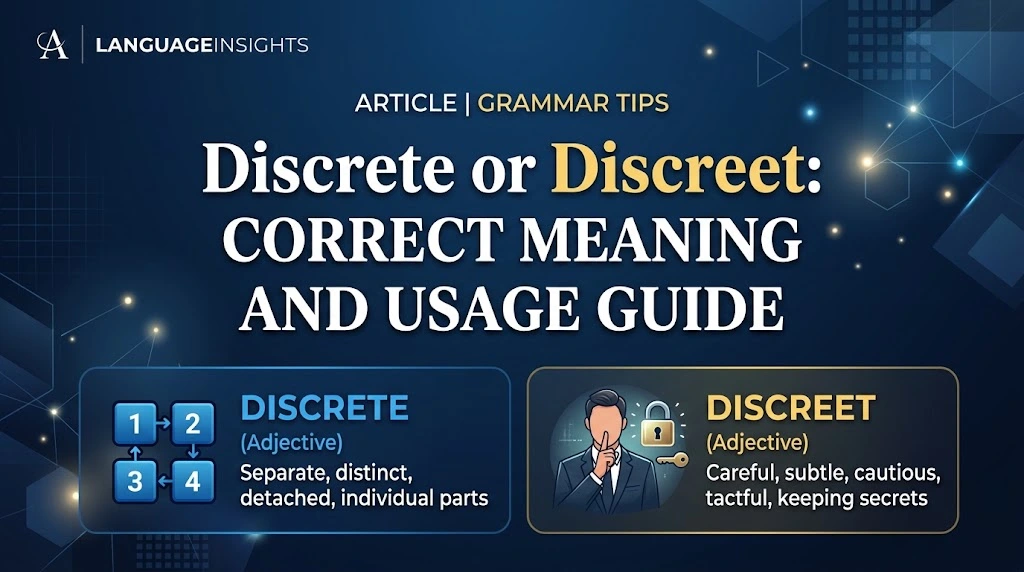
Discrete and discreet are classic English confusables. They look almost identical and sound the same in standard pronunciation, yet they describe very different ideas.
Use discrete when you mean separate, distinct, or individually identifiable. Use discreet when you mean careful, tactful, private, or unobtrusive.
That one distinction solves most usage questions. However, the difference becomes much clearer when you see how each word behaves in real sentences.
This guide explains discrete vs. discreet, including their meanings, examples, pronunciation, related words, technical uses, common mistakes, and practical memory tricks.
Discrete vs. Discreet: Quick Answer
The easiest way to remember the difference is this:
Discrete = separate or distinct.
Discreet = careful, tactful, or private.
Consider these two examples:
- The survey divides participants into discrete groups.
- She made a discreet inquiry about the situation.
The first sentence describes groups that are separate. The second describes an inquiry made carefully and without attracting attention.
| Word | Main meaning | Example |
| Discrete | Separate, distinct, individually identifiable | The machine has several discrete components. |
| Discreet | Tactful, careful, private, unobtrusive | He was discreet about the confidential information. |
The pronunciation doesn’t help much because discrete and discreet are normally pronounced alike: /dɪˈskriːt/.
Their meanings do the real work.
What Does “Discrete” Mean?
Discrete means separate, distinct, or individually distinguishable.
When something consists of discrete parts, those parts don’t form one continuous whole. You can identify one unit and distinguish it from another.
For example:
The report divides the data into five discrete categories.
Each category stands apart from the others.
You could also say:
The device contains several discrete components.
Each component has its own identity within the larger device.
The word often appears when someone wants to emphasize separation or individuality.
Common meanings of discrete
Depending on context, discrete can describe:
- Separate objects
- Distinct categories
- Individual units
- Clearly different stages
- Independent elements
- Separate quantities
- Noncontinuous values
- Distinct events or groups
The underlying idea stays consistent: the things can be distinguished from one another.
Discrete in everyday English
You don’t need a scientific or mathematical context to use discrete.
For example:
The museum organizes its collection into discrete sections.
The sections are separate.
Another example:
The project consists of four discrete stages.
Each stage represents a distinct part of the project.
You could also write:
The app records each purchase as a discrete transaction.
Each transaction is individually identifiable rather than one continuous event.
Discrete Examples in a Sentence
Seeing the word in different contexts makes its meaning easier to recognize.
Everyday examples
- The building contains several discrete offices.
- We divided the project into discrete tasks.
- Each chapter covers a discrete topic.
- The boxes contain discrete items rather than one combined product.
- The program processes each request as a discrete event.
In every case, the word refers to something that can be separated or distinguished.
Business examples
Businesses often use discrete when describing products, processes, transactions, or categories.
The company sells several discrete product lines.
The product lines are distinct from one another.
Each department has a discrete budget.
Each budget is treated as a separate allocation.
The accounting system tracks costs for discrete projects.
Each project has its own identity and financial records.
Technology examples
Technology uses the word frequently.
The system stores each customer interaction as a discrete record.
That means each interaction has an identifiable record.
You might also encounter phrases such as:
- Discrete data
- Discrete variables
- Discrete signals
- Discrete components
- Discrete systems
- Discrete events
These technical meanings still connect to the central idea of separation.
What Does “Discreet” Mean?
Discreet describes someone or something that shows careful judgment about privacy, behavior, speech, or attention.
A discreet person knows when to speak, what to reveal, and when to stay quiet.
For example:
She was discreet when discussing the customer’s private information.
She handled the information carefully.
Another example:
The manager made a discreet inquiry.
The manager asked about something without making the inquiry obvious or embarrassing.
The word can also describe something designed to avoid attracting attention.
The security camera is small and discreet.
Here, discreet suggests that the camera doesn’t stand out.
Common meanings of discreet
Discreet can suggest:
- Tactful behavior
- Careful speech
- Respect for privacy
- Confidential handling
- Avoiding unnecessary attention
- Quiet or unobtrusive behavior
- Good judgment in sensitive situations
The central idea is careful restraint.
Discreet Examples in a Sentence
Here are several natural examples:
- Please be discreet about the announcement.
- She asked a discreet question about his circumstances.
- The receptionist handled the complaint discreetly.
- They found a discreet location for the private meeting.
- He was discreet when discussing the negotiations.
- The store installed a discreet security system.
- She gave him a discreet signal to leave.
- The journalist promised to remain discreet about the source.
Notice that none of these examples means “separate.”
Instead, each involves privacy, tact, restraint, or avoiding attention.
Discrete vs. Discreet: Side-by-Side Comparison
The fastest way to understand discrete vs. discreet is to put them next to each other.
| Feature | Discrete | Discreet |
| Core meaning | Separate or distinct | Careful, tactful, or private |
| Main idea | Separation | Restraint |
| Common contexts | Mathematics, science, technology, categories | Privacy, behavior, conversations |
| Example noun | Discrete units | Discreet conversation |
| Related adverb | Discretely | Discreetly |
| Pronunciation | /dɪˈskriːt/ | /dɪˈskriːt/ |
| Opposite idea | Continuous or combined | Indiscreet or conspicuous |
| Memory association | Distinct things | Tactful behavior |
Here’s a useful shortcut:
Discrete asks: “Are these things separate?”
Discreet asks: “Is this person or action being careful?”
That distinction covers a surprisingly large number of real-world examples.
Discrete vs. Discreet Examples That Show the Difference
Sometimes definitions aren’t enough. Paired examples make the contrast much sharper.
Example: units and behavior
The machine contains several discrete units.
The units are separate.
The technician made a discreet inquiry.
The technician asked carefully.
Example: categories and conversation
The survey uses six discrete categories.
The categories are distinct.
They held a discreet conversation afterward.
They kept the conversation private or unobtrusive.
Example: data and conduct
The software stores discrete data points.
Each point is individually identifiable.
The employee remained discreet about the investigation.
The employee avoided revealing sensitive information.
Example: objects and appearance
The display contains ten discrete objects.
Each object can be distinguished separately.
The designer chose a discreet logo.
The logo doesn’t attract excessive attention.
These examples reveal the basic pattern:
Discrete separates things. Discreet controls attention or information.
What Is the Difference Between Discrete and Discreet?
The difference comes down to the concept each adjective describes.
Discrete concerns the relationship between separate things.
Discreet concerns careful behavior or limited visibility.
Imagine a tray holding ten coins.
The coins are discrete objects because each coin exists separately.
Now imagine someone quietly discussing a confidential matter nearby.
That person is being discreet because they’re handling sensitive information carefully.
The words may sound identical, but their ideas have little overlap.
A simple mental picture
Think of discrete as a collection of separate boxes:
[Box A] [Box B] [Box C] [Box D]
Each box stands apart.
Think of discreet as someone lowering their voice during a private conversation:
“Let’s discuss this somewhere quieter.”
One word deals with separation. The other deals with tact and privacy.
Discrete or Discreet for Privacy?
When you’re talking about privacy, discreet is usually the correct choice.
For example:
Please be discreet about my personal information.
That’s correct because the sentence concerns careful handling of private information.
Similarly:
She wanted a discreet way to ask for help.
The person wants to avoid unnecessary attention.
By contrast:
She wanted a discrete way to ask for help.
This normally suggests a separate or distinct method. It doesn’t naturally communicate privacy.
Correct privacy-related phrases
- Discreet conversation
- Discreet inquiry
- Discreet handling
- Discreet request
- Discreet manner
- Discreet approach
- Discreet location
- Discreet communication
When the subject involves confidentiality or tact, discreet should usually be your first choice.
Discrete or Discreet for Separate Things?
When you mean separate, distinct, or individually identifiable, choose discrete.
For example:
The researchers examined three discrete populations.
The populations are treated as distinct groups.
You could also say:
The system has four discrete operating modes.
Each mode represents a separate state.
Other useful combinations include:
- Discrete categories
- Discrete stages
- Discrete units
- Discrete events
- Discrete values
- Discrete elements
- Discrete groups
- Discrete components
- Discrete choices
If you could reasonably replace the word with separate or distinct, discrete is probably the right choice.
Discrete in Mathematics and Science
The word discrete takes on an especially important meaning in technical fields.
In mathematics, something is discrete when its values are separate rather than continuously varying.
For example, the number of people in a room is generally a discrete quantity.
You can have:
- 10 people
- 11 people
- 12 people
You can’t normally have 10.47 people.
Temperature works differently. Between 20°C and 21°C, countless intermediate values can exist.
That makes temperature a common example of a continuous quantity.
Discrete vs. continuous
| Discrete | Continuous |
| Separate possible values | Values can vary continuously |
| Number of customers | Temperature |
| Number of books | Height |
| Number of calls | Time |
| Number of employees | Distance |
| Number of defective products | Weight |
The exact classification depends on how a variable gets defined and measured, but the distinction is fundamental in statistics and mathematics.
Discrete data
Discrete data consists of countable values.
For example, a store might record the number of orders received each day:
| Day | Orders |
| Monday | 42 |
| Tuesday | 57 |
| Wednesday | 49 |
| Thursday | 63 |
| Friday | 71 |
Those order counts are discrete because they represent separate counts.
You don’t normally record 42.6 completed orders.
Discrete Variables in Statistics
A discrete variable can take distinct, countable values.
Common examples include:
- Number of children in a household
- Number of cars in a parking lot
- Number of products sold
- Number of calls received
- Number of errors in a document
- Number of customers entering a store
A discrete variable can sometimes have many possible values. The important point isn’t that there are only a few values. It’s that the values are distinct and countable.
This technical use explains why you’ll often see discrete in statistics textbooks and data-analysis software.
Discrete Signals and Computing
Engineering and computing also use discrete in technical ways.
A discrete signal uses separate values or samples rather than representing every point continuously.
Digital systems provide an intuitive example.
A digital image, for instance, consists of individual pixels. Digital audio commonly represents sound through discrete samples taken over time.
The technical details can become quite advanced, but the underlying concept remains familiar:
Discrete systems work with distinct units or values.
That’s the same core meaning used in everyday phrases such as discrete categories and discrete components.
Discreet Behavior and Social Situations
Unlike discrete, discreet often describes human conduct.
A discreet person understands social boundaries.
Suppose a coworker tells you something confidential. You don’t repeat it in the break room. You don’t hint about it in front of others. You handle the information carefully.
That’s discreet behavior.
Similarly, someone might make a discreet gesture when they want to communicate without attracting attention.
Discreet behavior might include:
- Lowering your voice during a sensitive discussion
- Avoiding unnecessary questions about someone’s private life
- Keeping confidential information private
- Choosing a private location for a difficult conversation
- Avoiding embarrassing someone in public
- Handling sensitive documents carefully
The word doesn’t necessarily mean secretive.
Someone can be discreet simply because they understand when restraint is appropriate.
Discreet Does Not Always Mean Secret
This distinction matters.
Discreet can involve secrecy, but secrecy isn’t required.
For example:
The hotel has a discreet entrance.
The entrance might simply be unobtrusive.
It doesn’t necessarily hide anything illegal or secret.
Likewise:
She wore a discreet necklace.
That means the necklace wasn’t flashy or attention-grabbing.
So discreet can describe subtle appearance as well as private behavior.
Discreet can mean “not drawing attention”
Consider these examples:
- A discreet sign doesn’t dominate the room.
- A discreet design blends into its surroundings.
- A discreet entrance isn’t immediately noticeable.
- A discreet camera attracts little attention.
- A discreet advertisement avoids being intrusive.
In these cases, privacy isn’t necessarily involved. Unobtrusiveness is the key idea.
Common Mistakes With Discrete and Discreet
The most common mistake happens when writers choose one word based on sound rather than meaning.
Because both words are pronounced the same, spelling alone won’t guide you.
Mistake: using discrete for privacy
Incorrect in the intended sense:
Please be discrete about the matter.
If you mean “don’t reveal it” or “handle it tactfully,” use discreet.
Correct:
Please be discreet about the matter.
Mistake: using discreet for separate categories
Incorrect in the intended sense:
The study divides participants into discreet groups.
If the groups are simply separate or distinct, discrete fits better.
Correct:
The study divides participants into discrete groups.
Mistake: assuming discreet means invisible
Discreet can mean unobtrusive, but it doesn’t necessarily mean invisible.
A discreet design may still be perfectly noticeable. It simply doesn’t demand attention.
Mistake: treating discrete and discreet as interchangeable
They’re not interchangeable in standard usage.
Replacing one with the other can change the meaning of a sentence dramatically.
Discrete vs. Discreet Pronunciation
One reason these words cause so much confusion is their pronunciation.
In standard American English, discrete and discreet are homophones.
They are pronounced approximately:
discrete: dih-SKREET
discreet: dih-SKREET
Both use the same stressed final syllable.
Their spelling tells you which meaning you intend.
That’s why proofreading software may catch some errors through context, but readers often have to rely on the sentence’s meaning.
Why pronunciation causes trouble
If someone says:
“Use a discreet method.”
You can’t determine the intended spelling from sound alone.
You need context.
Is the method separate or distinct?
Then it should be discrete.
Is the method private or unobtrusive?
Then it should be discreet.
Discrete and Discreet as Adjectives
Both words function primarily as adjectives.
They modify nouns.
Discrete
Discrete components
Discrete categories
Discrete events
Discrete variables
Discreet
Discreet behavior
Discreet conversation
Discreet inquiry
Discreet design
The noun following the adjective often provides a useful clue.
If the noun represents things that can be separated or counted, discrete may fit.
If it involves behavior, privacy, attention, or tact, discreet may fit.
That isn’t an absolute grammar rule, but it’s a useful practical clue.
Discretely vs. Discreetly
The difference continues into their adverb forms.
Discretely
Discretely means separately or distinctly.
Example:
The software processes the files discretely.
The files are handled as separate units.
Discreetly
Discreetly means carefully, privately, or without attracting attention.
Example:
She discreetly left the meeting.
The person left without drawing attention.
Compare them:
The system records each event discretely.
Each event is treated separately.
The assistant discreetly informed the manager.
The assistant communicated carefully and privately.
Again, the spelling changes because the meaning changes.
Related Words and Word Families
The two words have related-looking forms, but their derivatives preserve their different meanings.
Words related to discrete
- Discrete
- Discretely
- Discreteness
These forms generally concern separateness or distinctness.
Words related to discreet
- Discreet
- Discreetly
- Discreetness
These forms concern tact, restraint, privacy, or unobtrusiveness.
There is another important word worth knowing:
Discretion
Discretion generally means careful judgment about what to say or do.
For example:
Employees should use discretion when handling confidential information.
This meaning connects with discreet, not with the mathematical sense of discrete.
The phrase at someone’s discretion also means that person has the freedom to decide something according to their judgment.
Discrete vs. Discreet Etymology
The similarity between these words isn’t accidental.
Both ultimately trace back to Latin roots connected with separating, distinguishing, or discerning.
Over time, English developed separate forms and meanings.
The historical connection helps explain why the words look so similar today. However, modern English treats them as distinct words.
You don’t need to memorize their entire linguistic history.
For everyday writing, remember the modern distinction:
Discrete describes things that are distinct. Discreet describes people or actions that show restraint.
A Practical Memory Trick for Discrete vs. Discreet
Here’s one of the easiest ways to remember the difference.
Think of the “t” in discrete
Discrete = distinct.
Both words begin with dis-, and the idea of separation is useful here.
Discrete things are distinct things.
Think of the double “e” in discreet
You can associate discreet with being careful and keeping something low-key.
Discreet = tactful and private.
Another quick trick:
Discrete = divide.
Discreet = don’t reveal.
It’s not a formal linguistic rule. It’s simply a memory aid.
How to Choose Between Discrete and Discreet
When you’re unsure, ask one question.
Does the sentence mean “separate”?
If yes, choose discrete.
The report contains five discrete sections.
Does it mean “careful or private”?
If yes, choose discreet.
She was discreet about the client’s situation.
Does it mean “unobtrusive”?
Choose discreet.
The restaurant has a discreet entrance.
Does it mean “individually identifiable”?
Choose discrete.
The database contains discrete records for each transaction.
This simple test works in most everyday situations.
Common Collocations With “Discrete”
Learning common word combinations can make the distinction easier to remember.
Here are useful examples:
- Discrete units
- Discrete categories
- Discrete variables
- Discrete values
- Discrete events
- Discrete components
- Discrete stages
- Discrete groups
- Discrete data
- Discrete choices
- Discrete elements
- Discrete systems
- Discrete quantities
These combinations often appear in academic, technical, business, and professional writing.
Common Collocations With “Discreet”
These combinations tend to involve privacy, restraint, or appearance:
- Discreet conversation
- Discreet inquiry
- Discreet manner
- Discreet behavior
- Discreet approach
- Discreet request
- Discreet location
- Discreet handling
- Discreet design
- Discreet entrance
- Discreet signal
- Discreet communication
Knowing these common pairings can help you recognize the correct spelling almost automatically.
Case Study: A Business Meeting
Imagine a company preparing for a sensitive negotiation.
The manager divides the negotiation process into discrete stages:
- Initial contact
- Information exchange
- Proposal
- Review
- Final agreement
Each stage is distinct. Therefore, discrete is appropriate.
Now imagine the manager tells employees not to discuss the negotiation publicly.
The manager asks everyone to remain discreet.
Here, the concern involves confidentiality and careful behavior.
One meeting contains both words because the concepts are completely different.
The negotiation has discrete stages, and employees must remain discreet about its details.
That’s an excellent sentence for remembering the distinction.
Case Study: Data Analysis
Suppose a retailer records the number of products sold each day.
The daily sales counts are discrete data because the company counts individual products.
Now imagine the retailer has a confidential pricing strategy.
Employees should be discreet when discussing that strategy.
So you might write:
The analyst studied discrete sales data while employees remained discreet about the company’s pricing strategy.
The two words sit naturally together because each carries a different meaning.
Quotes and Usage Wisdom
A useful principle for confusing word pairs is simple:
Similar spelling doesn’t guarantee similar meaning.
That principle applies especially well to discrete and discreet.
Another useful way to frame the distinction is:
Discrete concerns separation; discreet concerns restraint.
Once you connect each word with its central concept, the spelling becomes much easier to remember.
Mini Quiz: Discrete or Discreet?
Choose discrete or discreet for each sentence.
Questions
1. The researchers divided the population into five ______ groups.
2. Please be ______ when discussing the customer’s personal information.
3. The machine consists of several ______ components.
4. She made a ______ inquiry about the job opening.
5. The dataset contains ______ values rather than a continuous measurement.
6. The hotel provides a ______ entrance for guests seeking additional privacy.
7. The study examines the number of accidents as a ______ variable.
8. He was careful to remain ______ during the confidential meeting.
Answers
1. Discrete — The groups are separate or distinct.
2. Discreet — The sentence concerns privacy and careful behavior.
3. Discrete — The components are separate units.
4. Discreet — The inquiry is made carefully and without unnecessary attention.
5. Discrete — The values are treated as distinct rather than continuous.
6. Discreet — The entrance is designed to be unobtrusive or private.
7. Discrete — The number of accidents represents countable values.
8. Discreet — The person is exercising restraint around sensitive information.
Quick Reference: Discrete vs. Discreet
When you’re in a hurry, use this cheat sheet.
| If you mean… | Use… | Example |
| Separate | Discrete | Discrete sections |
| Distinct | Discrete | Discrete categories |
| Individually identifiable | Discrete | Discrete records |
| Countable values | Discrete | Discrete data |
| Tactful | Discreet | A discreet response |
| Private | Discreet | A discreet conversation |
| Careful with information | Discreet | Be discreet about it |
| Unobtrusive | Discreet | A discreet entrance |
| Not attention-grabbing | Discreet | A discreet design |
The shortest possible rule
Discrete = separate.
Discreet = careful.
Discrete or Discreet in Professional Writing
Choosing the right word matters more in professional writing because small errors can affect clarity.
Consider:
The report contains discreet categories.
A reader may wonder whether you mean categories handled privately.
If you mean separate categories, write:
The report contains discrete categories.
Now consider:
The manager was discrete about the investigation.
That suggests the manager was somehow separate from the investigation. If you mean the manager kept information private, write:
The manager was discreet about the investigation.
The spelling isn’t merely cosmetic. It communicates the intended meaning.
Discrete or Discreet in Academic Writing
Academic writing frequently uses discrete because researchers discuss categories, variables, groups, measurements, and separate observations.
Examples include:
- Discrete variables
- Discrete observations
- Discrete categories
- Discrete outcomes
- Discrete probability distributions
- Discrete measurements
Discreet appears less frequently in technical academic writing, but it still works when the subject involves privacy or conduct.
For example:
Researchers should be discreet when discussing identifiable participant information.
Here, the word relates to ethical handling and privacy.
Discrete or Discreet in Everyday Conversation
In ordinary conversation, discreet tends to appear more often when people discuss behavior or privacy.
You might say:
Can you be discreet about this?
You wouldn’t normally say:
Can you be discrete about this?
Unless you genuinely mean something separate or distinct.
Similarly:
We created three discrete groups.
That sounds natural when you’re describing separate groups.
Understanding the context matters more than memorizing isolated definitions.
Why “Discrete” and “Discreet” Are So Easy to Confuse
Several factors make this pair particularly troublesome.
They look almost identical
The only spelling difference is the position of the final letters.
discrete
discreet
They sound the same
Both are pronounced /dɪˈskriːt/ in standard American English.
Their historical relationship is close
Their shared linguistic background contributes to their similar appearance.
Both are adjectives
They often appear in similar grammatical positions.
That combination creates a perfect recipe for spelling mistakes.
The good news? Their meanings are actually quite far apart.
A Final Test Before You Choose the Word
Before typing either word, replace it mentally with a simpler phrase.
If separate, distinct, or individual works, choose discrete.
The program has five discrete modules.
Think:
The program has five separate modules.
The meaning remains intact.
If careful, private, tactful, or unobtrusive works, choose discreet.
She gave a discreet response.
Think:
She gave a tactful response.
Again, the meaning remains intact.
This substitution test is fast and reliable for most ordinary writing.
Final Takeaway: Discrete vs. Discreet
The difference between discrete and discreet becomes simple once you focus on meaning rather than spelling.
Discrete means separate, distinct, or individually identifiable. You’ll see it frequently in phrases such as discrete categories, discrete units, discrete data, and discrete variables.
Discreet means careful, tactful, private, or unobtrusive. Common phrases include discreet conversation, discreet inquiry, discreet behavior, and discreet handling of information.
Both words sound the same, so pronunciation won’t help you choose. Instead, ask what the sentence actually means.
If things are separate, use discrete.
If someone is being careful or private, use discreet.
Once that distinction becomes familiar, this commonly confused pair becomes much easier to handle.
