

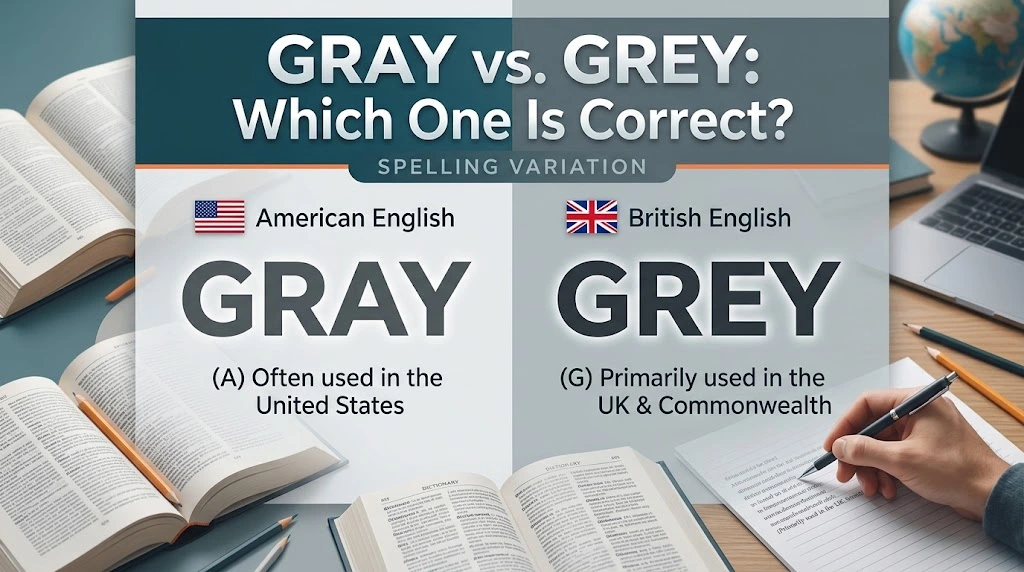
If gray vs. grey has ever made you pause while writing, you’re not alone. The two spellings look almost identical, sound exactly the same, and carry the same basic meaning. That raises an obvious question: Is one spelling correct and the other wrong?
The short answer is no. Both gray and grey are correct English spellings.
The important difference is where and how they’re used. Gray is the standard spelling in American English. Grey is the traditional and more common spelling in British English and several other varieties influenced by British usage.
So, if you’re writing for a US audience, gray is normally the right choice. If you’re following British English conventions, grey is generally the preferred form.
The distinction becomes more interesting when you look at related words, expressions, pronunciation, history, scientific terminology, and style consistency. Let’s break it all down.
Gray vs. Grey: What’s the Difference?
The central difference between gray and grey is regional spelling.
Both words describe a color positioned between black and white. Neither spelling represents a fundamentally different color. In ordinary English, they can be used interchangeably in meaning.
Here’s the basic comparison:
| Feature | Gray | Grey |
| Main variety | American English | British English |
| Meaning | A color between black and white | A color between black and white |
| Pronunciation | /ɡreɪ/ | /ɡreɪ/ |
| Basic adjective | gray | grey |
| Noun | gray | grey |
| Verb | gray | grey |
| Common present participle | graying | greying |
| Related adjective | grayish | greyish |
| Correct spelling? | Yes | Yes |
The difference works much like color and colour. American English generally prefers the shorter form, while British English often preserves the spelling associated with colour.
The same pattern appears with center/centre, theater/theatre, and several other regional pairs.
Gray vs. Grey in One Sentence
Consider these two sentences:
The gray clouds covered the city.
The grey clouds covered the city.
Both sentences mean the same thing. The spelling simply signals a different English convention.
That’s the key point to remember.
Is Gray or Grey Correct?
Both gray and grey are correct.
There isn’t a universal rule saying that one spelling is right and the other is wrong. Instead, English has developed different spelling conventions in different regions.
For standard American English, use gray.
For standard British English, use grey.
For example:
- US: The house has a gray roof.
- UK: The house has a grey roof.
Neither sentence contains a spelling error.
The problem usually appears when a writer mixes conventions without realizing it. A document might use gray in one paragraph and grey in another. That isn’t necessarily incomprehensible, but it can make the writing look inconsistent.
Consistency matters more than choosing one spelling as universally correct.
Is Gray American or British?
Gray is the standard American English spelling.
If you’re writing an article, essay, business document, website, or email for readers in the United States, gray is generally the form to choose.
For example:
- gray hair
- gray eyes
- gray jacket
- gray walls
- gray clouds
- gray paint
- gray suit
- gray matter
- gray area
American English also commonly uses related forms such as graying and grayish.
Gray Examples in American English
Here are several natural examples:
His gray hair has become noticeably lighter.
She painted the bedroom a soft gray.
The sky turned gray before the rain arrived.
That’s a gray area in the current policy.
The artist used several shades of gray.
A gray wolf crossed the trail ahead of them.
Notice that the spelling remains consistent throughout these examples.
If the rest of your writing follows American English, there’s little reason to switch to grey unless you’re quoting someone or referring to a proper name.
Is Grey British or American?
Grey is primarily associated with British English.
British writers commonly use grey in everyday writing, journalism, literature, education, and professional communication.
For example:
The grey sky made the afternoon feel unusually dark.
He bought a grey coat for the winter.
Her hair was beginning to turn grey.
The building has a grey stone exterior.
British English generally carries this spelling into related forms too.
That means you’ll often see:
- grey
- greying
- greyish
- grey-haired
- grey-green
This doesn’t mean every British writer must use grey in every situation. Proper names, trademarks, quotations, and specialized terminology can create exceptions.
Do Gray and Grey Mean the Same Thing?
Yes. In ordinary usage, gray and grey mean the same thing.
Both describe a color or range of colors between black and white.
The words can also describe things that have that color:
- gray hair
- grey hair
- gray clouds
- grey clouds
- gray fabric
- grey fabric
- gray eyes
- grey eyes
The spelling doesn’t normally indicate a different shade.
For example, gray isn’t automatically darker than grey. A designer choosing between the two spellings isn’t choosing between two color values.
That’s an important distinction because digital colors can have precise values. A color such as #808080 can be represented mathematically in a specific color system. The words gray and grey, however, are ordinary language terms rather than precise universal color specifications.
How Do You Pronounce Gray and Grey?
Here’s another easy part: gray and grey have the same pronunciation.
Both are pronounced:
/ɡreɪ/
The vowel sound is the same one heard in words such as:
- day
- say
- way
- play
- stay
So changing the a to an e doesn’t change how you say the word.
Gray vs. Grey Pronunciation
| Word | IPA | Approximate sound |
| gray | /ɡreɪ/ | gray |
| grey | /ɡreɪ/ | gray |
This makes the spelling difference especially interesting. You can hear no distinction in normal pronunciation.
If someone says gray and someone else says grey, there’s no reliable pronunciation clue telling you which spelling they use.
Why Are There Two Spellings of Gray and Grey?
English didn’t develop as one perfectly uniform system.
Its vocabulary and spelling conventions evolved through centuries of linguistic change. Different regions eventually developed their own preferences, dictionaries, educational traditions, and editorial standards.
The spellings gray and grey both have a long history in English.
Over time, gray became strongly associated with American English, while grey remained especially common in British English.
This regional split resembles many other spelling differences.
| American English | British English |
| gray | grey |
| color | colour |
| center | centre |
| theater | theatre |
| meter | metre |
| traveling | travelling |
| canceled | cancelled |
These aren’t cases where one country simply learned the “correct” spelling while another learned the “incorrect” one.
They’re examples of English spelling variation.
Modern English has multiple standardized varieties. American and British English are two of the most prominent.
Gray vs. Grey Around the World
Regional usage isn’t limited to the United States and United Kingdom.
Different English-speaking communities have their own conventions. Some follow British patterns closely, while others blend British and American usage.
Gray vs. Grey in the United States
Gray is the normal American spelling.
American dictionaries, style guides, publishers, schools, and websites generally use gray when following standard US English.
If you’re writing for an American audience, gray should usually be your default.
Gray vs. Grey in the United Kingdom
Grey is the conventional British spelling.
You’ll commonly encounter:
- grey hair
- grey sky
- grey stone
- grey area
- grey suit
- greyhound
British English therefore generally favors grey in ordinary writing.
Gray vs. Grey in Canada
Canadian English can be less straightforward.
Canadian usage incorporates features from both British and American English. You may encounter grey and gray, depending on the context, publication, institution, or established terminology.
That’s why a Canadian writer shouldn’t assume that every English spelling follows a simple US-versus-UK formula.
When a particular Canadian organization has a style guide, that guide should take priority.
Gray vs. Grey in Australia and New Zealand
Australian and New Zealand English generally retain many British spelling conventions.
As a result, grey is commonly encountered.
However, individual organizations can establish their own editorial preferences. Proper names and brand names can also preserve a particular spelling regardless of regional convention.
The safest approach is simple: follow the style guide used by the publication or organization you’re writing for.
Gray and Grey as a Noun
The word can function as a noun when you use it to identify the color itself.
For example:
Gray is one of the most versatile neutral colors.
In British English, the same sentence would normally use grey:
Grey is one of the most versatile neutral colors.
The grammatical function doesn’t change the regional spelling.
Examples
American English:
She chose gray for the living room.
British English:
She chose grey for the living room.
Both sentences are grammatically correct.
Gray and Grey as an Adjective
Most people encounter gray or grey as an adjective.
An adjective modifies a noun by describing it.
For example:
- gray shirt
- gray building
- gray hair
- gray eyes
- gray sky
- grey shirt
- grey building
- grey hair
- grey eyes
- grey sky
Again, the meaning remains the same.
American Examples
He wore a gray jacket to work.
The gray walls made the room feel calm.
British Examples
He wore a grey jacket to work.
The grey walls made the room feel calm.
The regional spelling changes. The grammar and meaning don’t.
Gray vs. Grey as a Verb
The word can also function as a verb, particularly when describing hair becoming gray or grey.
American English generally uses gray:
His hair is graying.
British English generally uses grey:
His hair is greying.
This is where the spelling distinction becomes more noticeable.
| American English | British English |
| gray | grey |
| graying | greying |
| gray-haired | grey-haired |
| grayish | greyish |
The same regional principle continues into related forms.
Graying vs. Greying: Which Is Correct?
Both graying and greying are established spellings.
The choice depends primarily on your English variety.
Graying
Graying is the usual American English form.
Example:
His hair started graying in his late thirties.
Greying
Greying is the usual British English form.
Example:
His hair started greying in his late thirties.
Neither spelling needs to be treated as an error when used within its appropriate regional convention.
Grayish vs. Greyish
The same pattern applies to grayish and greyish.
- grayish → American English
- greyish → British English
For example:
The fabric has a grayish blue tone.
The fabric has a greyish blue tone.
Both describe a color that has some gray or grey in it.
Common Expressions With Gray and Grey
The color word appears in many familiar expressions. Some of these expressions have literal meanings while others have become figurative.
Gray Area vs. Grey Area
A gray area or grey area describes something unclear, uncertain, or open to interpretation.
American English:
The issue remains a gray area under the current rules.
British English:
The issue remains a grey area under the current rules.
The figurative meaning is the same.
Gray Matter vs. Grey Matter
Gray matter refers to a type of tissue in the brain and spinal cord.
American English generally writes:
gray matter
British English commonly writes:
grey matter
The term also appears figuratively in expressions about intelligence or thinking.
For instance:
This puzzle will really test your gray matter.
The regional spelling still depends on the variety of English being used.
Shades of Gray vs. Shades of Grey
The expression shades of gray or shades of grey can describe literal colors.
It can also describe situations that aren’t simply black or white.
In that figurative sense, the phrase suggests complexity, uncertainty, or multiple possible positions.
For example:
Real-world decisions often involve shades of gray.
British English would typically use:
Real-world decisions often involve shades of grey.
Gray vs. Grey in Scientific and Technical Writing
Scientific writing adds an important wrinkle because gray also appears as the name of an SI-derived unit.
The gray, symbolized by Gy, is the SI unit of absorbed dose of ionizing radiation. One gray corresponds to one joule of radiation energy absorbed per kilogram of matter.
In equation form:
1 Gy = 1 J/kg
This scientific unit is named after British physicist Louis Harold Gray, whose work contributed significantly to radiation physics.
Here, gray is not simply an American spelling preference.
It is the internationally established unit name.
That’s a useful distinction. A technical term can have its own standardized spelling even when ordinary English uses regional variants.
Why Context Matters
Compare these examples:
The wall is gray.
Here, gray refers to a color.
The absorbed dose was measured in gray (Gy).
Here, gray refers to a scientific measurement unit.
The words look identical, but the meanings come from different contexts.
When writing scientific material, always follow the terminology and conventions established for that field.
Gray vs. Grey in Proper Names
Proper names create another exception to the simple regional rule.
Suppose a person, company, organization, publication, product, or fictional character officially uses Grey.
Don’t automatically change it to Gray just because the surrounding article uses American English.
For example, if a person’s legal or professional name contains Grey, preserve that spelling.
The same applies to established names such as titles and brands.
Why Proper Names Matter
Changing someone’s name isn’t the same as adapting ordinary spelling.
A sentence might correctly contain both forms:
The Gray family visited Grey House.
There’s no contradiction if those are the actual names involved.
Proper names should retain their established spelling.
Should You Use Gray or Grey in American English?
If you’re writing standard American English, gray is the straightforward choice.
Use it in:
- Blog posts
- Newsletters
- School assignments
- Business documents
- Product descriptions
- Website copy
- Marketing content
- Emails
- General correspondence
For example:
The gray sofa works well with the white walls.
Using grey isn’t likely to confuse an American reader. However, gray fits the expected American spelling convention more closely.
Should You Use Grey or Gray in British English?
If you’re writing standard British English, grey is generally the natural choice.
For example:
The grey sofa works well with the white walls.
The same principle applies to related forms:
- greying
- greyish
- grey-haired
If a British publication has its own style guide, follow that guide rather than relying solely on general conventions.
Should You Mix Gray and Grey?
Usually, no.
A polished piece of writing should normally maintain one regional spelling system.
For example, this sentence looks inconsistent:
The grey clouds appeared as his hair started graying.
It combines a British spelling with an American-derived form.
A consistent American version would be:
The gray clouds appeared as his hair started graying.
A consistent British version would be:
The grey clouds appeared as his hair started greying.
There are legitimate reasons to mix the spellings, though.
You might quote a source exactly. You might discuss differences between American and British English. You might preserve a proper name.
Outside those situations, consistency makes the writing cleaner.
Gray vs. Grey in SEO Content
Writers sometimes wonder whether using both spellings can help capture more search traffic.
The better approach is to write naturally for the intended audience.
If the article targets US readers, make gray the primary spelling. You can mention grey naturally because readers may search for the alternative spelling.
For example, an American-focused article can explain:
Gray is the standard American spelling, while grey is mainly used in British English.
That single explanation addresses both search variants without awkward repetition.
A Practical SEO Approach
For US-focused content:
- Use gray naturally throughout the article.
- Mention grey when explaining the British variant.
- Include the phrase gray vs. grey where it fits naturally.
- Address related searches such as gray or grey, is gray or grey correct, and gray vs grey.
- Don’t stuff every paragraph with both spellings.
- Keep headings useful rather than creating artificial keyword variations.
Search engines can understand related forms and search intent. Readers can certainly tell when an article has been written for a keyword counter rather than a human being.
Gray vs. Grey: Side-by-Side Examples
A comparison table makes the distinction easy to remember.
| Meaning | American English | British English |
| Color | gray | grey |
| Hair | gray hair | grey hair |
| Becoming gray | graying | greying |
| Slightly gray | grayish | greyish |
| Colorful phrase | shades of gray | shades of grey |
| Brain tissue | gray matter | grey matter |
| Unclear situation | gray area | grey area |
| Person with gray hair | gray-haired | grey-haired |
The important pattern is simple: American English generally favors A, while British English generally favors E.
Common Mistakes With Gray and Grey
The spelling itself isn’t difficult once the regional distinction becomes clear. Most mistakes happen because writers misunderstand what the difference represents.
Assuming Grey Is Wrong
Some American writers see grey and assume it’s misspelled.
That’s incorrect.
Grey is an established English spelling, especially in British English.
Assuming Gray Is Wrong
The reverse mistake happens too.
British readers may be more accustomed to grey, but gray is also an established spelling, particularly in American English.
Switching Spelling Mid-Article
A writer might begin with gray and later use grey without noticing.
That creates an unnecessary inconsistency.
Choose the convention that fits your audience and stick with it.
Treating Gray and Grey as Different Colors
They’re not normally different colors.
A designer might distinguish shades using technical color specifications. Ordinary spelling doesn’t do that.
Mixing Graying and Greying
This is another common inconsistency.
If your document follows American English, use:
gray → graying
If it follows British English, use:
grey → greying
Changing a Proper Name
Don’t “correct” someone’s name from Grey to Gray or vice versa.
A proper name has its own established spelling.
A Simple Gray vs. Grey Decision Guide
When you’re unsure, ask three questions.
Who Is Reading the Content?
If the primary audience lives in the United States, gray is usually the natural choice.
If the audience primarily uses British English, grey is generally appropriate.
What Style Guide Are You Following?
A style guide can settle the question immediately.
Academic institutions, newspapers, publishers, businesses, and government organizations may have specific language standards.
If the style guide says gray, use gray.
If it says grey, use grey.
What English Variety Does the Rest of the Document Use?
Look at nearby words.
If your document uses:
- color
- center
- theater
- organize
then gray will generally fit the same American convention.
If it uses:
- colour
- centre
- theatre
- organise
then grey will generally fit the British convention.
This isn’t a perfect diagnostic because English varieties can mix features. Still, it’s a useful practical clue.
Case Study: Choosing the Right Spelling for a US Website
Imagine a clothing company based in New York creates a product page for a gray wool coat.
The page uses American English throughout:
Our gray wool coat features a classic cut and soft lining. The gray fabric pairs easily with black, navy, and brown clothing.
Using gray makes sense because the company’s audience and language convention are American.
Now imagine the same product is marketed by a British retailer:
Our grey wool coat features a classic cut and soft lining. The grey fabric pairs easily with black, navy, and brown clothing.
The product itself hasn’t changed.
Only the regional spelling has.
That’s the heart of gray vs. grey.
Case Study: Academic Writing
Consider a student writing an American university paper.
The paper repeatedly uses American spellings such as:
- color
- behavior
- center
- organization
The student writes:
The grey buildings created a contrast with the surrounding landscape.
The sentence is understandable. Yet gray would normally fit the document’s established American spelling system better:
The gray buildings created a contrast with the surrounding landscape.
Now consider a British academic paper using colour, behaviour, and centre. In that context, grey naturally fits the broader spelling convention.
The lesson isn’t “one spelling wins.”
The lesson is match the spelling to the English variety required by the assignment or publication.
Does Gray Mean the Same Thing as Grey in Dictionaries?
Major English dictionaries recognize the relationship between the two spellings.
For example, Cambridge Dictionary’s entry for gray identifies gray as the US spelling while also connecting it with grey. Its grey entry reflects the British spelling.
Oxford English Dictionary also documents the historical development and usage of the word and its variants.
Dictionary treatment is useful because it shows that this isn’t a casual internet spelling dispute. Both forms have established places within English.
Gray vs. Grey: Quick Facts
Here are the facts worth remembering:
- Gray and grey are both correct.
- Gray is the standard American spelling.
- Grey is mainly the British spelling.
- Both words have the same ordinary meaning.
- Both are pronounced /ɡreɪ/.
- Neither spelling normally identifies a different shade.
- American English commonly uses graying.
- British English commonly uses greying.
- American English commonly uses grayish.
- British English commonly uses greyish.
- Proper names may use either spelling regardless of regional convention.
- The SI radiation unit is gray (Gy).
Gray vs. Grey FAQ
Is gray or grey correct?
Both are correct. Gray is the standard American English spelling, while grey is mainly the British English spelling.
Is gray American or British?
Gray is American English. It’s the standard spelling used in the United States.
Is grey American or British?
Grey is mainly British English. It’s also common in other English varieties influenced by British spelling conventions.
Are gray and grey pronounced differently?
No. Both are normally pronounced /ɡreɪ/.
Does gray mean a different color than grey?
No. In ordinary English, gray and grey refer to the same color range.
Should Americans use gray or grey?
For standard American English, gray is generally the preferred spelling.
Should British writers use grey or gray?
For standard British English, grey is generally the preferred spelling.
Is it graying or greying?
Graying is the standard American form. Greying is the standard British form.
Is grayish or greyish correct?
Both are correct regional forms. Grayish fits American English, while greyish fits British English.
Can gray and grey appear in the same article?
Yes, but normally only when there’s a reason. For example, you might compare American and British spelling or quote a source. Otherwise, consistency is preferable.
Is gray a color?
Yes. Gray is a color term describing a range between black and white.
Is grey a color?
Yes. Grey is the British spelling of the same ordinary color term.
Which spelling should US websites use?
US websites should generally use gray when following standard American English.
Which spelling should a British website use?
A British website will generally use grey, assuming it follows conventional British English spelling.
Is the gray radiation unit the same as the color?
The spelling is the same, but the meanings differ. The gray (Gy) is an SI-derived unit of absorbed radiation dose. The color gray is an ordinary color term.
Gray vs. Grey: The Final Answer
So, gray vs. grey: which one is correct?
Both.
The difference is primarily regional:
Gray = American English
Grey = British English
They have the same basic meaning and pronunciation. They also appear in the same grammatical roles as nouns, adjectives, and verbs.
The important thing is to match your spelling to your audience and maintain consistency.
If you’re writing in US English, choose gray.
If you’re writing in British English, choose grey.
And if you’re discussing the two spellings themselves, feel free to use both. That’s precisely where the distinction matters.
Quick Reference
| If you’re writing for… | Use… |
| United States | gray |
| United Kingdom | grey |
| American English audience | gray |
| British English audience | grey |
| American English verb | graying |
| British English verb | greying |
| American English adjective | grayish |
| British English adjective | greyish |
The easiest rule is also the one you’ll remember: American English uses gray. British English uses grey. Both are correct.
