

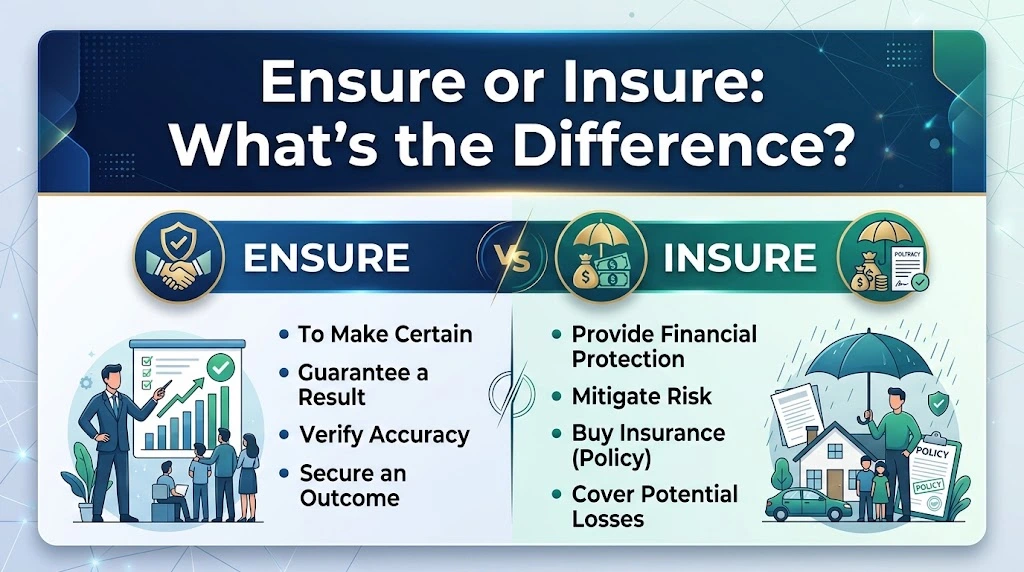
Ensure or insure? These two words look and sound remarkably similar, but they don’t mean the same thing. Choosing the wrong one can make an otherwise polished sentence confusing.
The simplest distinction is easy to remember:
- Ensure means to make certain that something happens or remains true.
- Insure means to protect someone or something financially against a specified risk.
- Assure means to give someone confidence or remove their doubts.
For example, you might ensure that your car is locked, insure the car against theft, and assure your family that everything is taken care of.
The three words overlap in history and pronunciation, which explains some of the confusion. Their modern uses, however, are different enough that you should choose carefully, especially in professional writing.
Ensure vs. Insure: The Quick Difference
Here’s the distinction at a glance:
| Word | Meaning | Typical context | Example |
| Ensure | Make certain | Results, actions, conditions, requirements | “Please ensure the door is locked.” |
| Insure | Protect financially against risk | Insurance, property, vehicles, businesses | “They insure their home against fire.” |
| Assure | Give confidence or reassurance | People, promises, statements | “I assure you that everything is ready.” |
Think of the words as three different jobs.
Ensure deals with making something certain. Insure deals with financial protection. Assure deals with people and confidence.
That simple framework handles most everyday situations.
What Does “Ensure” Mean?
Ensure means to make certain that something happens, exists, or remains true.
It commonly appears when someone takes an action intended to produce a particular result. The result might involve safety, accuracy, quality, compliance, timing, or completion.
For example:
“Check the settings to ensure the machine operates correctly.”
The sentence isn’t talking about an insurance policy. It means the person should check the settings to make certain the machine works correctly.
Similarly:
“Please ensure that all documents are signed.”
Here, ensure means make certain. The writer wants the documents to have signatures before the process continues.
Examples of “Ensure”
Consider these examples:
- “Please ensure the windows are closed.”
- “The checklist helps ensure accuracy.”
- “Back up your files to ensure you don’t lose important data.”
- “Arrive early to ensure you have enough time.”
- “The manager reviewed the order to ensure everything was correct.”
- “These controls help ensure customer safety.”
- “Double-check the address to ensure the package reaches the right location.”
In each sentence, the word concerns certainty or an intended result.
Common Uses of “Ensure”
You’ll often see ensure in writing about:
- Safety
- Accuracy
- Quality
- Compliance
- Reliability
- Security
- Deadlines
- Procedures
- Customer service
- Workplace standards
- Product performance
For example, a company might say:
“Employees must follow the procedure to ensure workplace safety.”
The procedure doesn’t provide financial coverage. Instead, following it helps make a safer outcome more certain.
What Does “Insure” Mean?
Insure generally means to provide or obtain insurance protection against a potential loss, damage, liability, or other covered risk.
Unlike ensure, this word has a strong connection to insurance.
For example:
“The homeowner insured the property against fire.”
The homeowner isn’t simply making the property safe. The homeowner has arranged financial protection through an insurance policy.
Another example:
“The company insures its delivery vehicles.”
That sentence means the company has insurance coverage for those vehicles.
Examples of “Insure”
Here are several natural examples:
- “They insured the house against fire.”
- “The business insures its company vehicles.”
- “She insured the equipment against theft.”
- “The policy insures the property against certain risks.”
- “The company requires contractors to insure their vehicles.”
- “He decided to insure the valuable equipment.”
The surrounding vocabulary often makes the meaning obvious.
Words such as policy, premium, coverage, claim, deductible, liability, vehicle, property, and risk strongly suggest the insurance sense.
Ensure vs. Insure in Everyday Sentences
Seeing the words side by side makes the difference much easier to understand.
Safety and Certainty
“The technician checked the system to ensure safety.”
The technician is taking action to make safety more certain.
Now compare it with:
“The company insured the equipment against accidental damage.”
This sentence deals with financial protection. That’s why insured works.
The two ideas can appear in the same situation without meaning the same thing.
A business might ensure that its equipment receives proper maintenance while also insuring that equipment against certain losses.
Business Operations
Consider this sentence:
“Managers review the process to ensure quality.”
The managers aren’t purchasing insurance for quality. They’re taking steps intended to make the quality standard more certain.
Now consider:
“The company insures its manufacturing equipment.”
This involves insurance coverage.
The distinction is subtle only until you identify what the sentence is actually describing.
Ensure vs. Insure: Grammar and Sentence Patterns
Understanding common sentence structures can make the choice almost automatic.
How to Use “Ensure”
One common construction is:
ensure + that-clause
Example:
“Ensure that all employees receive the updated instructions.”
Another pattern is:
ensure + noun
Example:
“The system ensures reliable performance.”
You can also use ensure with an infinitive phrase:
“She arrived early to ensure that she had enough time.”
The basic idea remains the same: make something certain.
How to Use “Insure”
Insure commonly takes a person, property, vehicle, business, or another insurable interest as its object.
For example:
“They insured the building.”
You can also see:
insure + something + against + risk
For example:
“The owner insured the warehouse against fire.”
You might also encounter:
“The policy insures the company against certain liabilities.”
The exact coverage depends on the policy. Insurance doesn’t automatically protect against every possible loss.
Ensure, Insure, and Assure: The Three-Way Difference
The word assure creates another layer of confusion.
Its meaning differs from both ensure and insure.
Assure generally means to tell someone something confidently so that the person feels certain or less worried.
For example:
“I assure you that the package will arrive tomorrow.”
The speaker is giving another person confidence.
Compare these three sentences:
- Ensure: “Please ensure the package is properly labeled.”
- Insure: “The company insures the package against certain losses.”
- Assure: “I assure you that the package is on its way.”
Now the distinction becomes clear.
A Simple Three-Word Formula
Ensure → make certain
Insure → provide financial protection
Assure → give someone confidence
This formula won’t solve every specialized usage question, but it works extremely well for ordinary American English.
Is “Ensure” the Same as “Guarantee”?
Ensure and guarantee often have similar meanings, but they aren’t identical in every context.
To ensure something means to take steps that make a particular result certain or more certain.
To guarantee something can mean to make a firm promise that a particular result will occur.
Consider:
“Regular maintenance helps ensure reliable performance.”
This focuses on an action intended to produce a result.
Now:
“The manufacturer guarantees the product for two years.”
This expresses a formal promise or commitment.
The distinction becomes particularly important in business writing. A company shouldn’t casually use guarantee when it only intends to describe an effort or procedure.
For example:
“The inspection ensures that the equipment meets the required specifications.”
This describes the purpose of an inspection.
By contrast:
“The manufacturer guarantees that the equipment will meet the stated specifications.”
That makes a much stronger claim.
Is “Insure” Always Related to Insurance?
In modern everyday US English, insure is strongly associated with insurance.
If you’re talking about a policy, premium, coverage, claim, property protection, or financial risk, insure is usually the natural choice.
For example:
“The restaurant insures its property against fire.”
However, English dictionaries may record historical or less common uses that overlap with ensure. Language doesn’t always follow neat mathematical rules.
For practical writing, there’s little reason to create confusion.
If you mean make certain, choose ensure.
If you mean protect financially through insurance, choose insure.
That distinction keeps your writing clear.
Common Mistakes With Ensure and Insure
Even experienced writers occasionally mix these words up. The mistakes usually happen because their meanings are closely related.
Mistake: Using “Insure” to Mean “Make Certain”
Incorrect:
“Please insure that everyone signs the form.”
Standard US English normally uses:
“Please ensure that everyone signs the form.”
The sentence describes making certain that an action occurs. It doesn’t involve insurance.
Mistake: Using “Ensure” for Insurance
Incorrect:
“The company ensures the vehicle against theft.”
Better:
“The company insures the vehicle against theft.”
The sentence concerns financial protection against a risk.
Mistake: Confusing “Assure” With “Ensure”
Incorrect:
“The manager ensured the customer that everything was fine.”
Better:
“The manager assured the customer that everything was fine.”
Why?
Because the manager is speaking to a person and providing reassurance.
You could also say:
“The manager ensured that everything was fine.”
That version has a different structure and meaning. It says the manager made certain that the situation was fine.
Mistake: Treating the Words as Interchangeable
Although ensure and insure share historical connections, replacing one with the other can change the meaning.
Compare:
“The company ensured employee safety.”
with:
“The company insured its employees.”
The first sentence describes making safety certain or taking measures intended to protect safety.
The second can refer to providing insurance coverage for employees.
One letter changes the practical meaning dramatically.
Ensure vs. Insure in American English
In US English, the distinction between ensure and insure is especially useful because insure has a well-established connection to insurance.
Professional writers commonly use:
- Ensure for certainty and outcomes.
- Insure for insurance coverage.
- Assure for reassurance.
For example, workplace instructions often say:
“Ensure all equipment is switched off before leaving.”
An insurance document might say:
“The policy insures the property against covered losses.”
A customer-service representative might say:
“I assure you that your request has been received.”
Each word performs a different job.
Ensure vs. Insure in Professional and Business Writing
Word choice matters more in professional documents because small ambiguities can create unnecessary confusion.
Workplace Policies
A workplace policy might state:
“Employees must follow these procedures to ensure compliance with company standards.”
Here, ensure describes the intended result.
Insurance Documents
An insurance document might state:
“The policy insures the vehicle against covered collision losses.”
Here, insure identifies the financial protection.
Customer Service
A customer-service representative might write:
“I assure you that your request has been forwarded to the appropriate department.”
The representative is reassuring the customer.
Legal and Contractual Writing
Legal documents require even more care because individual words can carry significant meaning.
Consider:
“The contractor shall ensure that all required permits are obtained.”
This places responsibility on the contractor to make certain the permits are obtained.
Now compare:
“The contractor shall insure the vehicle used for the project.”
This concerns insurance coverage.
The words aren’t interchangeable because the obligations differ.
Ensure or Insure: Real-World Examples
Imagine a small delivery company preparing a new vehicle for work.
The manager might ensure that:
- The brakes work properly.
- The registration documents are available.
- The driver has the required paperwork.
- The vehicle passes the company’s safety checks.
The company might also insure the vehicle against covered risks.
Finally, the manager might assure the driver that everything has been checked.
One situation can contain all three words.
Case Study: A Small Business
Suppose a bakery purchases a commercial oven.
The owner takes several steps before using it.
First, the owner follows the manufacturer’s instructions to ensure the oven operates safely.
Next, the owner may insure the business property against covered risks.
Then the owner assures employees that the required safety checks have been completed.
Notice how each verb answers a different question:
| Question | Word |
| What are you making certain? | Ensure |
| What are you protecting financially? | Insure |
| Who are you reassuring? | Assure |
This is the distinction in action.
Ensure or Insure: A Simple Memory Trick
When you’re stuck between ensure and insure, look at the first few letters of insure.
INSURE → INSURANCE
That connection provides a useful memory hook.
If the sentence involves a policy, coverage, premium, claim, or financial protection, insure probably belongs there.
If you’re talking about making an outcome certain, choose ensure.
The Three-Word Memory Trick
Ensure = certain
Insure = insurance
Assure = reassure
It’s short enough to remember and broad enough to handle most everyday situations.
Ensure or Insure: A Decision Guide
Use this quick decision tree when writing:
Are you talking about insurance or financial protection?
|
YES
↓
INSURE
NO
↓
Are you making something certain or securing an outcome?
|
YES
↓
ENSURE
Are you giving a person confidence or reassurance?
|
YES
↓
ASSURE
A few seconds of context checking can prevent an awkward word choice.
Ensure or Insure in Common Phrases
Certain combinations appear frequently in everyday writing.
Common “Ensure” Phrases
- Ensure safety
- Ensure accuracy
- Ensure quality
- Ensure compliance
- Ensure consistency
- Ensure reliability
- Ensure availability
- Ensure completion
- Ensure that something happens
- Ensure that something remains available
Examples:
“The audit helps ensure accuracy.”
“Please ensure that the information is correct.”
Common “Insure” Phrases
- Insure a vehicle
- Insure a home
- Insure property
- Insure a business
- Insure equipment
- Insure against theft
- Insure against fire
- Insure against damage
- Insure against liability
Examples:
“The company insures its fleet.”
“The homeowner insured the property against fire.”
Common “Assure” Phrases
- Assure someone
- Assure the customer
- Assure the reader
- Assure the public
- Assure someone that something is true
Examples:
“She assured him that the meeting was still scheduled.”
“The representative assured the customer that the issue was being handled.”
Ensure vs. Insure vs. Assure: Comparison Table
| Feature | Ensure | Insure | Assure |
| Basic meaning | Make certain | Protect financially | Give confidence |
| Main focus | Outcome or condition | Risk and coverage | Person’s confidence |
| Common context | Procedures and results | Insurance | Reassurance |
| Often followed by “that” | Yes | Less typical | Yes |
| Related noun | Ensuring | Insurance | Assurance |
| Example | “Ensure accuracy.” | “Insure the property.” | “Assure the customer.” |
The table highlights the key difference without requiring complicated grammar rules.
Quick Practice: Choose Ensure, Insure, or Assure
Test yourself with these examples.
Practice Sentences
Please ___ that all doors are locked before leaving.
The homeowner decided to ___ the property against fire.
I ___ you that the information is accurate.
The checklist helps ___ consistency.
The business needs to ___ its delivery vehicles.
The manager ___ the customer that the issue would be addressed.
These procedures help ___ compliance with company requirements.
The company ___ its equipment against certain covered risks.
Answer Key
- Ensure — The sentence means make certain.
- Insure — The property receives financial protection.
- Assure — Someone is receiving reassurance.
- Ensure — The checklist helps make consistency more certain.
- Insure — The vehicles receive insurance coverage.
- Assured — The manager gave the customer confidence.
- Ensure — The procedures support a desired outcome.
- Insures — The sentence describes insurance protection.
If you can identify the underlying purpose, these choices become much easier.
Why These Words Cause So Much Confusion
The confusion isn’t random.
Ensure, insure, and assure have related histories and similar sounds. They also share ideas involving certainty and security.
That’s where the trap appears.
Insurance itself can make someone feel more secure. Ensuring an outcome can also involve reducing risk. Assuring someone can make that person feel certain.
The concepts overlap, but the grammatical jobs remain distinct.
Think of three overlapping circles:
CERTAINTY
/ \
ENSURE ASSURE
\ /
\ /
SECURITY
|
INSURE
financial risk
The diagram isn’t a dictionary definition. It’s simply a way to visualize why the words feel related while still serving different purposes.
Does “Ensure” Mean the Same as “Make Sure”?
In many ordinary sentences, ensure and make sure express nearly the same idea.
For example:
“Please ensure that the door is locked.”
and:
“Please make sure that the door is locked.”
Both tell someone to verify or establish that the door is locked.
The difference is mainly one of style and register.
Make sure sounds more conversational.
Ensure often sounds more formal or concise.
For a casual message, you might write:
“Make sure you bring your ID.”
For a workplace policy, you might write:
“Employees must ensure that valid identification is provided.”
Neither version is inherently better. The appropriate choice depends on context.
Can “Insure” Mean “Ensure”?
You may encounter insure used with a broader sense of making something certain, particularly in older writing or specialized contexts.
However, that doesn’t mean the words are freely interchangeable in modern everyday US English.
If you mean make certain, ensure is the clear practical choice.
If you mean provide insurance protection, insure is the appropriate choice.
Using the specialized insurance sense for insure helps readers understand your meaning immediately.
Ensure or Insure in Formal Writing
Formal writing rewards precision.
Instead of writing:
“The organization will insure that all requirements are met.”
Use:
“The organization will ensure that all requirements are met.”
If the sentence actually concerns insurance, however, use insure:
“The organization will insure its property against covered losses.”
The surrounding nouns often provide a strong clue.
Words such as requirements, accuracy, safety, standards, procedures, and completion usually point toward ensure.
Words such as policy, premium, coverage, property, vehicle, liability, and claim usually point toward insure.
Frequently Asked Questions About Ensure or Insure
Is “ensure” or “insure” correct when you mean “make certain”?
Ensure is the usual choice in modern US English.
For example:
“Please ensure that the report is complete.”
It means “Please make certain that the report is complete.”
Is “insure” only used for insurance?
In modern standard US usage, insure is primarily associated with insurance and financial protection against risk.
That makes it the natural choice when discussing insurance coverage.
Can “ensure” and “insure” be used interchangeably?
Generally, no.
Although the words are historically related, modern usage gives them different common meanings.
Use ensure for making something certain.
Use insure for insurance protection.
What is the difference between ensure and assure?
Ensure means to make something certain.
Assure means to give someone confidence.
Compare:
“Ensure that the payment is received.”
with:
“Assure the customer that the payment was received.”
The first focuses on an outcome. The second focuses on a person.
What is the difference between insure and assure?
Insure concerns insurance or financial protection.
Assure concerns reassurance.
For example:
“The company insures its vehicles.”
“The manager assured the driver that the vehicle was ready.”
Is “ensure” more common than “insure”?
Frequency depends on the subject and context.
Ensure appears across many types of general writing because writers frequently discuss making conditions or outcomes certain.
Insure appears especially often in writing about insurance, financial risk, property, vehicles, and liability.
Comparing raw frequency without considering context can therefore be misleading.
Is “insure” a verb?
Yes.
Examples include:
“They insure commercial properties.”
“She insured her vehicle.”
“The company insures against certain risks.”
The related noun insurance refers to the protection itself or the system that provides it.
What is the noun related to “ensure”?
English doesn’t use ensure as a straightforward noun counterpart in the way that insure relates to insurance.
Depending on the intended meaning, writers may use nouns such as certainty, assurance, guarantee, or ensuring.
The right noun depends on the sentence.
Ensure or Insure: Cheat Sheet
When you need a quick answer, use this table:
| If you mean… | Choose |
| Make certain | Ensure |
| Make an outcome certain | Ensure |
| Make sure something happens | Ensure |
| Protect against financial risk | Insure |
| Obtain insurance coverage | Insure |
| Cover property or a vehicle | Insure |
| Give someone confidence | Assure |
| Reassure a person | Assure |
Here’s the shortest version:
Ensure = make certain.
Insure = provide insurance.
Assure = give confidence.
Final Takeaway: Ensure or Insure?
The difference between ensure and insure becomes straightforward once you focus on the purpose of the word.
Use ensure when you mean make certain.
“Check the details to ensure accuracy.”
Use insure when you mean provide financial protection through insurance.
“The company insures its commercial vehicles.”
Use assure when you mean give someone confidence or reassurance.
“She assured the customer that the issue would be resolved.”
The words may look like close cousins, but they have different jobs. When you identify whether you’re talking about certainty, insurance, or reassurance, the correct choice usually becomes obvious.
Ensure the outcome.
Insure against the risk.
Assure the person.
This version can also be adapted into a more heavily SEO-focused article with a meta title, meta description, URL slug, featured-snippet answers, and additional semantic keyword coverage.
