

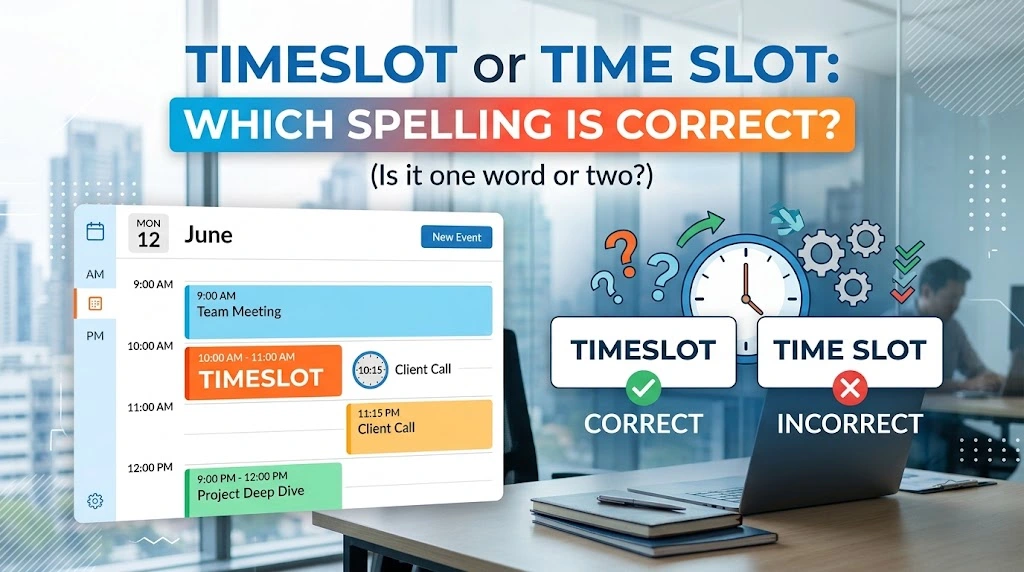
Timeslot or time slot? If you’ve ever written an appointment reminder, scheduling email, business document, or article, you’ve probably paused over these two forms.
The difference looks tiny. One has a space. The other doesn’t. Yet that small gap raises a surprisingly common English-usage question: Should “time slot” be written as two words, one word, or with a hyphen?
For most standard writing, the answer is straightforward: use “time slot.”
The two-word form is the safest choice for professional, academic, editorial, and everyday English. “Timeslot” also appears in real-world usage, particularly in some technical, digital, scheduling, and broadcasting contexts. However, its existence doesn’t make it the best default for every piece of writing.
This distinction matters because English compounds don’t always follow a neat mathematical formula. Words that frequently appear together can eventually become hyphenated or closed compounds. Others remain open for decades.
So, if you’re deciding between timeslot or time slot, don’t rely solely on what looks familiar on a website or inside an app. Consider the context, audience, and accepted editorial convention.
Timeslot or Time Slot: The Quick Answer
If you need the answer before reading the rest of the article, here’s the practical rule:
Use “time slot” as the default spelling.
A time slot is a specific period allocated for an appointment, activity, event, broadcast, meeting, delivery, or another scheduled task.
For example:
- “Please choose a time slot for your appointment.”
- “The interview is scheduled for the 2 p.m. time slot.”
- “Several time slots remain available.”
- “The television program moved to a later time slot.”
You may encounter “timeslot” in software, websites, technical documentation, broadcasting discussions, or informal writing. That doesn’t mean the word is meaningless or automatically incorrect. It means the closed form has developed as a variant in some areas of usage.
Here’s the simplest comparison:
| Form | Typical status | Best general choice | Example |
| time slot | Open compound | Yes | Choose a time slot. |
| timeslot | Closed variant found in actual usage | Sometimes | The show received a new timeslot. |
| time-slot | Hyphenated form | Context-dependent | A time-slot booking system |
When there is no special reason to choose another form, time slot keeps your writing clear and conventional.
What Does Time Slot Mean?
A time slot is a designated period of time reserved for a particular purpose.
Think of a schedule as a row of empty spaces. Each space represents a period during which something can happen. That allocated space is a time slot.
For example, a doctor’s office might divide an afternoon into appointments:
| Time | Schedule |
| 1:00 p.m. | Patient A |
| 1:30 p.m. | Patient B |
| 2:00 p.m. | Patient C |
| 2:30 p.m. | Patient D |
Each appointment occupies a particular time slot.
The expression works in much broader situations, too. A television network can assign a show a time slot. A university can assign a class a time slot. A delivery company can offer customers a two-hour time slot.
The underlying idea remains the same: a particular period has been allocated for something.
Common Uses of Time Slot
You’ll find time slot in many everyday and professional situations, including:
- Doctor appointments
- Dental appointments
- Job interviews
- Business meetings
- Classes
- Tutoring sessions
- Delivery services
- Restaurant bookings
- Customer-service calls
- Airport operations
- Television programming
- Radio programming
- Conferences
- Events
- Online consultations
- Work schedules
- Examination schedules
For example, a booking page might say:
Select an available time slot below.
A university might write:
Students must choose a time slot for their laboratory session.
A television executive might say:
The program has been moved to a later time slot.
The expression remains useful because it describes both the period itself and its position within a schedule.
Read More “See” vs. “Look” vs. “Watch” – Unraveling the Mystery of These Common Verbs (with Examples
Why Is It “Time Slot” Instead of “Timeslot”?
The answer lies in how English handles compound nouns.
English frequently combines two words to create a new concept. Sometimes the resulting compound stays open. Sometimes it becomes hyphenated. Sometimes it eventually closes into one word.
Consider a few familiar examples:
- ice cream
- high school
- post office
- notebook
- bedroom
- website
There’s no universal rule saying every frequently used compound must eventually become one word.
Time slot functions as an open compound noun. The words work together to express a single concept, but they remain visually separate.
This is completely normal in English.
Open, Hyphenated, and Closed Compounds
Compound expressions generally appear in three forms:
Open compound:
time slot
Hyphenated compound:
time-slot
Closed compound:
timeslot
The important point is that these forms aren’t interchangeable simply because all three can be understood.
Usage develops over time. Dictionaries, publishers, style guides, industries, and ordinary speakers all influence whether a compound remains open or becomes closed.
That’s why English contains apparently inconsistent pairs such as:
- health care / healthcare
- email / e-mail
- website / web site
- online / on-line
The same historical process can affect other compounds.
However, frequency alone doesn’t determine the standard spelling. A word appearing thousands of times online doesn’t automatically make it the preferred form in edited English.
Is “Timeslot” a Correct Word?
This question deserves a more careful answer than simply saying “timeslot is wrong.”
The closed spelling timeslot does occur in English. It appears in dictionaries, user interfaces, technical materials, online publications, and other forms of real-world writing.
Wiktionary, for example, documents timeslot as an alternative form of time slot. You can review its current entry at Wiktionary.
That evidence matters because language isn’t governed by a single authority that instantly determines whether every spelling is right or wrong.
At the same time, being attested doesn’t necessarily mean being the preferred choice everywhere.
That’s the distinction worth remembering.
“Used” Does Not Always Mean “Best Default”
Imagine encountering a company website that consistently uses timeslot.
That tells you something about that company’s terminology. It doesn’t necessarily establish the spelling you should use in an academic paper or formal business document.
This happens constantly in English.
Organizations create terminology for products, software, services, and internal processes. A company might label a scheduling feature “Timeslot Manager.” If you’re documenting that specific product, preserving its official terminology may make sense.
For general prose, however, time slot remains the safer choice.
Why “Timeslot” Looks Natural
There is a good reason people write timeslot.
The two words form a tightly connected concept. When people encounter a compound repeatedly, they often begin treating it as one lexical unit.
Digital interfaces can reinforce that tendency. Software developers often prefer short labels because screen space is limited. Internal database fields may also use forms such as:
- timeslot
- start_time
- appointment_slot
Those technical conventions can influence what people see and eventually reproduce in ordinary writing.
So the closed spelling isn’t mysterious. It’s a natural result of compound-word formation and modern usage.
Time Slot vs. Timeslot: Which One Should You Use?
The safest approach is to match the spelling to your purpose.
For general writing, choose time slot.
That recommendation works particularly well for:
- Business correspondence
- Academic writing
- Articles
- Reports
- Customer-facing websites
- Marketing content
- Professional emails
- School assignments
- Formal documentation
- General editorial writing
For example:
Please select a time slot that works for your schedule.
This version is immediately familiar and easy to read.
When “Timeslot” May Be Appropriate
There are situations where timeslot can appear naturally.
You might use it when:
- A product officially calls the feature “timeslot.”
- A company has adopted the closed spelling in its style guide.
- You’re quoting a source.
- You’re discussing terminology used by a particular software system.
- You’re maintaining consistency with established technical documentation.
- A publication’s house style specifically prefers the closed form.
Consistency matters here.
If a software platform calls a feature Timeslot, changing its name to Time Slot throughout your documentation could create confusion. Product names and interface labels aren’t always governed by general spelling preferences.
Is “Time-Slot” Correct?
The hyphenated form time-slot deserves separate attention because it occupies a middle ground between the open and closed forms.
In ordinary noun usage, time slot is generally the natural choice:
I booked a time slot.
Several time slots are available.
The hyphen isn’t needed simply because the two words work together.
However, compounds used before another noun can sometimes be hyphenated to make the relationship between words clearer.
For example:
The company introduced a time-slot booking system.
Here, time-slot works as part of a compound modifier describing the booking system.
The exact treatment can vary according to the style guide and editorial context. The important lesson is not to insert hyphens automatically.
Don’t Hyphenate Every Compound
A common mistake is assuming that words must be hyphenated whenever they appear together.
That’s not how English works.
Compare:
Choose a time slot.
with:
We offer same-day appointments.
The second expression contains a compound modifier where the hyphen helps show that same-day functions together before appointments.
In the first sentence, time slot simply functions as a noun.
This distinction keeps punctuation from becoming cluttered.
Time Slots or Timeslots: What’s the Plural?
If you use the standard open form, the plural is simple:
time slots
Examples:
- “Three time slots are available.”
- “Morning time slots fill quickly.”
- “Customers can select from five time slots.”
- “All interview time slots have been booked.”
If a source or system uses timeslot as a closed compound, you’ll naturally see timeslots as its plural.
Again, context matters.
For general professional writing, stick with:
time slot → time slots
It’s clean, familiar, and easy to understand.
Time Slot in Appointment Scheduling
Appointment scheduling is probably the most familiar modern use of the expression.
A clinic might divide a working day into 30-minute intervals. Each interval represents an available time slot.
For example:
| Time Slot | Status |
| 9:00–9:30 a.m. | Available |
| 9:30–10:00 a.m. | Booked |
| 10:00–10:30 a.m. | Available |
| 10:30–11:00 a.m. | Booked |
A customer doesn’t simply need to choose a time. They need to choose an allocated position in the schedule.
That’s exactly what time slot communicates.
This usage appears across healthcare, professional services, education, transportation, and online platforms.
Appointment Time Slot Examples
Natural examples include:
Please select an available appointment time slot.
Your time slot is confirmed for 11:30 a.m.
The next available time slot is Thursday afternoon.
You can reschedule your appointment if another time slot becomes available.
Notice that time slot remains two words in each sentence.
Time Slot in Television and Broadcasting
The expression has another well-established meaning in broadcasting.
A television or radio time slot refers to a particular period assigned to a program.
For instance, a program could air from 8:00 to 9:00 p.m. on weekdays. That period represents the show’s scheduled time slot.
Broadcasters often care deeply about time slots because audience behavior changes throughout the day.
Morning, afternoon, early evening, and late evening can attract different audiences. A program’s performance can therefore depend partly on when it airs.
For example:
The network moved the drama to a later time slot.
This usage also explains why timeslot sometimes appears frequently in broadcasting-related writing.
You’ll encounter both forms in the wider ecosystem of media terminology. Still, time slot remains the safest general spelling.
Time Slot vs. Time Frame
These expressions sound similar, but they describe different ideas.
A time slot is a designated place within a schedule.
A time frame is a broader period during which something is expected to happen.
Compare these examples:
“Your interview time slot is 2:30 p.m.”
“The hiring time frame is approximately two weeks.”
The first sentence identifies a specific scheduled appointment.
The second describes the broader duration of a process.
Quick Comparison
| Term | Meaning | Example |
| Time slot | An allocated period in a schedule | Book a 3 p.m. time slot. |
| Time frame | A broader period for an activity or result | The project has a six-week time frame. |
| Time period | A stretch or duration of time | During that time period, sales increased. |
Understanding this distinction prevents awkward substitutions.
You wouldn’t normally say:
“Book a time frame for your doctor’s appointment.”
You’d say:
“Book a time slot for your doctor’s appointment.”
Time Slot vs. Time Period
A time period simply refers to a stretch of time. It doesn’t necessarily involve scheduling.
A time slot, by contrast, usually implies allocation or assignment.
Consider a school timetable.
“The class has a 10 a.m. time slot.”
That tells students when the class has been scheduled.
Now consider this sentence:
“During this time period, enrollment increased.”
That describes when something happened. It doesn’t suggest that someone reserved or assigned the period.
The distinction may seem subtle, but it becomes important in precise writing.
Common Mistakes With Time Slot and Timeslot
The spelling itself isn’t the only potential problem. Writers also make mistakes with consistency, hyphenation, and meaning.
Automatically Assuming “Timeslot” Is Wrong
Calling timeslot completely invalid is too absolute.
The closed form exists in actual English usage. Some dictionaries and reference sources document it, while certain industries and organizations use it routinely.
A better conclusion is:
“Time slot” is the safest standard form for general writing, while “timeslot” appears as a variant in some contexts.
That statement recognizes actual usage without confusing readers about the preferred default.
Switching Between Forms
Avoid this:
“Choose a time slot, then confirm your timeslot.”
The reader understands the meaning, but the inconsistent spelling looks careless.
Pick one form and use it consistently unless you’re deliberately discussing the alternatives.
Adding an Unnecessary Hyphen
Avoid writing:
“Please select a time-slot.”
When time slot functions as an ordinary noun, the hyphen usually serves no purpose.
Use:
“Please select a time slot.”
Confusing a Time Slot With a Duration
A time slot can represent a duration, but the expression emphasizes its scheduled position.
For example:
“The appointment has a 30-minute time slot.”
Here, 30 minutes describes the duration while time slot identifies the scheduled allocation.
That’s more precise than treating the two concepts as identical.
A Practical Style Guide for Time Slot
When editing content, a simple decision table can settle most cases.
| Writing situation | Recommended form |
| General English | time slot |
| Business email | time slot |
| Blog article | time slot |
| Academic paper | time slot |
| Customer instructions | time slot |
| Appointment booking | time slot |
| Professional report | time slot |
| Product’s official feature name | Follow the product’s terminology |
| Quoted material | Preserve the original spelling |
| Closed technical compound | Follow the relevant style guide |
This approach avoids unnecessary arguments about whether one spelling is universally “right.”
English usage is contextual. A strong editor chooses the form that best fits the audience and convention.
Real-World Examples of Time Slot
Seeing the phrase in different contexts makes its meaning easier to recognize.
Business Meeting
“Please let me know which time slot works best for you.”
Job Interview
“Candidates can select an interview time slot through the scheduling portal.”
Medical Appointment
“The 4:30 p.m. time slot is no longer available.”
Delivery
“Customers can select a two-hour delivery time slot.”
Education
“Students must register for one laboratory time slot.”
Television
“The series received a new evening time slot.”
Conference
“Each speaker has a 45-minute time slot.”
Customer Service
“Choose a convenient time slot for your callback.”
These examples demonstrate why the expression remains useful. It works wherever a schedule divides time into assigned portions.
Case Study: Why Consistency Matters in Scheduling Content
Consider a fictional online booking platform that uses three different forms across its website:
- “Choose a time slot.”
- “Your timeslot has been confirmed.”
- “Available time-slots are shown below.”
None of these forms makes the underlying service impossible to understand. Yet the inconsistency creates friction.
A customer may wonder whether the terms describe different types of appointments.
A cleaner interface would choose one convention:
Choose a time slot.
Your time slot has been confirmed.
Available time slots are shown below.
This small editorial decision improves clarity without changing the underlying product.
That’s an important lesson for businesses: terminology consistency is part of user experience.
Why Dictionary Evidence Matters
When a spelling dispute arises, random search results aren’t the strongest evidence.
Search engines can show:
- User-generated content
- Company-specific terminology
- Automatically generated pages
- Outdated material
- Regional usage
- Informal writing
- Typographical errors
A dictionary or established style resource provides a more useful starting point.
For time slot, dictionary evidence supports the open form. Merriam-Webster’s dictionary material provides examples involving slot and scheduling contexts. Its current dictionary resources are available at Merriam-Webster.
For the closed variant, Wiktionary’s “timeslot” entry documents timeslot as an alternative form.
The takeaway isn’t that one website has absolute authority over English. Instead, these references show an important fact: “timeslot” exists in usage, while “time slot” remains the safer conventional form for broad writing.
How to Remember the Correct Spelling
Here’s a simple memory trick:
A schedule has slots. A particular slot belongs to a time. Therefore: time slot.
Imagine a calendar divided into boxes.
Each box represents a slot in time.
That mental picture makes the two-word form easy to remember.
When writing an email, article, report, or instruction, simply use:
time slot
And when you need the plural:
time slots
No complicated rule is necessary.
Frequently Asked Questions About Timeslot or Time Slot
Is it “time slot” or “timeslot”?
Time slot is the safest standard choice for general, professional, and formal writing. Timeslot also appears as a closed variant in real-world English usage.
Is “timeslot” grammatically wrong?
Not necessarily. It is an established variant in some sources and contexts. However, time slot is generally the better default when you’re writing for a broad audience.
Is “time-slot” correct?
It can be used in certain compound constructions, particularly when a hyphen improves clarity before another noun. As an ordinary noun, time slot is normally preferable.
Is “time slot” one word?
No. The standard form is written as two words: time slot.
What is the plural of time slot?
The standard plural is time slots.
Is “timeslots” a word?
Yes, timeslots appears as the plural of the closed form timeslot. However, time slots is the safer plural for general professional writing.
Should I write “available time slot” or “available timeslot”?
Use available time slot when following the conventional open form.
For example:
“Please select an available time slot.”
Is “time slot” formal English?
Yes. Time slot works comfortably in formal, professional, academic, and everyday English.
What is the difference between a time slot and a time frame?
A time slot is a designated period on a schedule. A time frame is a broader period during which something is expected to happen.
Should a time slot have a hyphen?
Usually not when it functions as a noun.
Write:
“Book a time slot.”
A hyphen may be appropriate when the expression functions as part of a compound modifier, depending on context and style.
Timeslot or Time Slot: Final Verdict
When you’re stuck between timeslot or time slot, choose time slot unless your specific context calls for something different.
It’s clear. It’s familiar. It works in professional and everyday writing.
Time slot is especially appropriate for:
- Appointment scheduling
- Business communication
- Academic writing
- Website content
- Customer instructions
- Reports
- Emails
- General editorial writing
The closed form timeslot isn’t simply a spelling invented by careless writers. It appears in genuine English usage and has become established in certain contexts. Some software products, organizations, technical systems, and publications may prefer it.
That distinction is important.
English isn’t a filing cabinet where every compound has one permanently assigned spelling. Language changes, terminology evolves, and different communities develop different conventions.
Still, when no specific house style or product terminology tells you otherwise, there’s little reason to complicate the choice.
Write “time slot.”
So the next time you type, “Please select your preferred ___,” you can confidently fill in the blank:
Please select your preferred time slot.
Simple, natural, and clear.
Quick Reference
| Question | Answer |
| Preferred general spelling? | time slot |
| Closed variant used in English? | timeslot |
| Standard plural? | time slots |
| Closed plural variant? | timeslots |
| Usually hyphenated as a noun? | No |
| Meaning? | A designated period in a schedule |
| Best choice for professional writing? | time slot |
| Can “timeslot” appear in real usage? | Yes |
| Should you switch between forms randomly? | No |
Bottom line: “Time slot” is the best all-purpose spelling. Use it for clear, polished writing unless you’re following an established terminology or style that specifically uses “timeslot.”
