

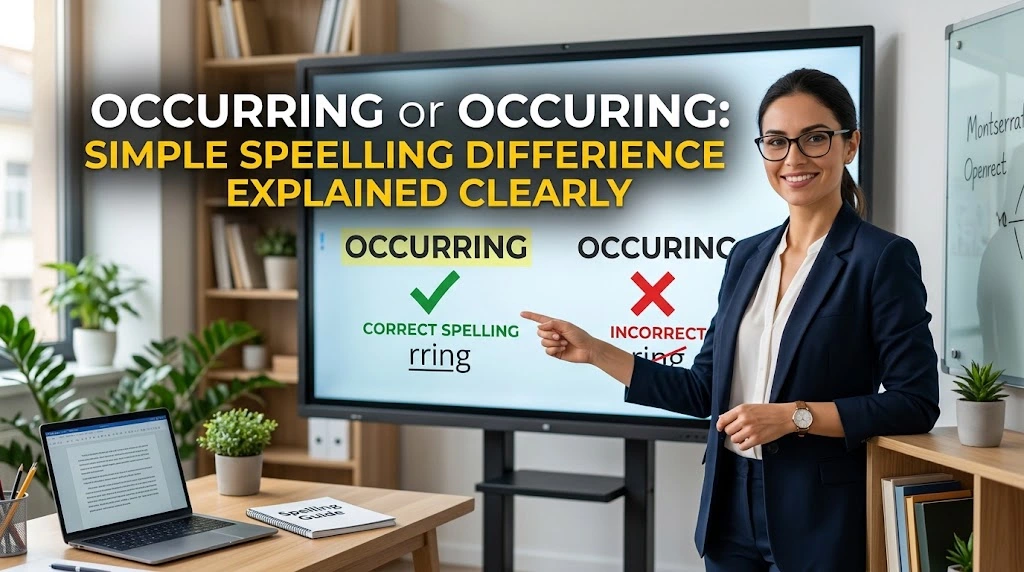
If you’ve ever stopped while typing the word occurring, you’ve probably wondered whether it needs one r or two. The confusion is understandable. English has plenty of words where adding -ing changes the spelling, and occur already contains a double r.
The correct spelling is occurring.
The spelling occuring is incorrect in standard English. The difference comes down to retaining the two r’s in the base verb occur when forming its present participle.
That tiny extra letter matters. It separates a standard English word from a common spelling mistake.
This guide explains occurring vs. occuring, why occurring has two r’s, how to use it grammatically, and how to remember the spelling without second-guessing yourself.
Occurring vs. Occuring: The Quick Answer
Here’s the answer in its simplest form:
- Occurring = correct
- Occuring = incorrect
- Occur = the base verb
- Occurring = the present participle and -ing form of occur
- Occurred = the past tense and past participle
- Occurrence = the noun form
| Spelling | Correct? | What it means |
| occurring | ✅ Yes | Happening or taking place |
| occuring | ❌ No | Incorrect spelling of occurring |
| occur | ✅ Yes | To happen or take place |
| occurred | ✅ Yes | Happened or took place |
| occurrence | ✅ Yes | An event or instance of something happening |
So if you’re writing a sentence such as:
Several errors are occurring during the update.
The double r belongs there.
Writing “Several errors are occuring” drops one of the original r’s, making the spelling incorrect.
What Does “Occurring” Mean?
Occurring means happening, taking place, or existing at a particular time or under particular circumstances.
It’s the present participle of the verb occur.
For example:
A strange noise is occurring outside.
In this sentence, occurring describes something that is happening now.
You can also use it for events that happen repeatedly or naturally:
Power outages are occurring more frequently this summer.
The word doesn’t necessarily mean something is happening at this exact second. Context determines the time frame.
Consider these examples:
- “The problem is occurring again.”
- “Several changes are occurring simultaneously.”
- “The reaction is occurring inside the container.”
- “Similar mistakes are occurring across the report.”
- “The event is occurring later this month.”
In each case, occurring communicates the idea of something happening or taking place.
The Core Meaning of Occurring
The word usually answers a simple question:
What is happening?
Depending on the sentence, occurring can describe:
- An event taking place
- A problem developing
- A change happening
- A process taking place
- A pattern appearing
- An error happening
- A phenomenon taking place
- Something existing in a particular location or condition
For example:
The chemical reaction is occurring at a higher temperature.
Here, occurring describes a process.
In another sentence:
The festival is occurring downtown this weekend.
Here, it describes an event.
The meaning stays closely connected to happening or taking place.
Why Is “Occurring” Spelled With Two Rs?
The easiest way to understand the spelling is to start with the base word:
occur
The word already ends with two r’s.
When you form the present participle by adding -ing, the standard spelling becomes:
occur + ing = occurring
The two r’s remain.
So the spelling develops like this:
O C C U R
↓
Add -ING
↓
O C C U R R I N G
↓
OCCURRING
The important point is that occurring does not become occuring by removing an r.
The original spelling of occur remains visible.
Occur → Occurring
Compare the two forms:
| Base word | -ing form |
| occur | occurring |
| run | running |
| stop | stopping |
| begin | beginning |
English spelling sometimes doubles a final consonant when adding -ing. However, occur deserves special attention because the base word already ends in rr.
You don’t need to reinvent its spelling when you add the suffix.
Think of the transformation as:
occur + ing = occurring
not:
occu + ring = occuring
That distinction makes the spelling much easier to remember.
Why “Occuring” Looks Correct to Many People
There’s a reason occuring feels plausible at first glance.
When people write quickly, they often focus on pronunciation rather than spelling. The word sounds roughly like uh-KUR-ing. The two r’s don’t sound like two separate letters.
That’s where the trap lies.
English spelling and pronunciation don’t always line up neatly. A speaker hears one /r/ sound but sees rr in the written word.
The same problem appears in other words.
For example:
- occurring
- occurred
- occurrence
All contain the spelling pattern occur-.
A writer who remembers only the sound may accidentally produce occuring.
The Visual Problem
Compare these:
occurring
occuring
At a quick glance, they look almost identical.
Only one letter separates them.
That’s why this error can survive a quick proofreading pass. Your brain often recognizes the word as a whole rather than checking every character.
A useful proofreading trick is to look specifically at the base word.
Ask:
What is the base verb?
The answer is occur.
Now attach -ing:
occur + ing = occurring
The spelling becomes much harder to miss.
Occurring as the Present Participle of “Occur”
Grammatically, occurring is the present participle of occur.
You commonly see it after forms of the verb be:
The problem is occurring again.
Several changes are occurring at once.
A similar event was occurring nearby.
The form can also appear in participial phrases:
Changes occurring during the experiment were recorded carefully.
Here, occurring during the experiment describes changes.
Occurring in Continuous Verb Forms
The most familiar grammatical pattern is:
be + occurring
Examples include:
- is occurring
- am occurring
- are occurring
- was occurring
- were occurring
- has been occurring
- have been occurring
- had been occurring
For example:
The issue is occurring on multiple devices.
Similar problems have been occurring for several weeks.
The disturbance was occurring when the technician arrived.
The auxiliary verb changes according to the tense and subject. The spelling of occurring doesn’t change.
Common Uses of “Occurring”
The word appears across everyday, professional, academic, and technical writing.
Occurring in Everyday Writing
In ordinary conversation, happening often sounds more natural.
For example:
What’s happening here?
That sounds casual and direct.
However, occurring works perfectly well when the context calls for slightly more formal wording:
Several unusual events are occurring in the area.
The word often feels more detached or descriptive than happening.
Occurring in Academic Writing
Academic writing frequently uses occurring to describe processes, patterns, observations, and events.
For example:
The changes occurring during the study were documented.
Or:
Researchers observed several reactions occurring at different temperatures.
The word works particularly well when describing something as part of an ongoing process.
Occurring in Business and Professional Writing
You may see occurring in reports, technical documents, workplace emails, and incident descriptions.
Examples include:
System errors are occurring during login.
Delays are occurring because of supply shortages.
The issue is occurring across multiple locations.
This usage makes the writing precise without becoming overly complicated.
Occurring in Scientific and Technical Contexts
Scientific writing uses the word frequently because researchers need to describe processes objectively.
For example:
The reaction is occurring under controlled conditions.
Or:
Changes occurring within the material were measured over time.
In these sentences, occurring describes a process rather than a casual event.
Occurring vs. Happening
Occurring and happening often have similar meanings, but they don’t always sound equally natural.
Happening is usually more conversational.
Occurring tends to sound more formal, technical, or observational.
| Occurring | Happening |
| More formal | More conversational |
| Common in technical writing | Common in everyday speech |
| Often describes processes or events | Broad and flexible |
| Can sound more detached | Usually sounds more direct |
Consider this pair:
What’s occurring in the building?
What’s happening in the building?
Both are grammatically correct. The second sounds more natural in everyday conversation.
Now consider:
The reaction occurring inside the chamber was monitored continuously.
Replacing occurring with happening would make the sentence sound much less appropriate for a technical context.
So occurring isn’t simply a fancy replacement for happening. Context matters.
Examples of “Occurring” in Sentences
Seeing the word in real sentences makes the spelling and usage easier to recognize.
Everyday Examples
Something unusual is occurring outside.
The same problem keeps occurring every morning.
Several changes are occurring at the same time.
The event is occurring near the town center.
Professional Examples
The software error is occurring after installation.
Similar delays are occurring across several departments.
The problem has been occurring intermittently.
Technical failures are occurring during peak usage.
Academic Examples
The researchers studied changes occurring during the experiment.
Several reactions were occurring simultaneously.
The observed pattern is occurring under specific conditions.
Scientific Examples
The reaction is occurring at a constant rate.
Changes occurring within the sample were measured.
The process begins after a specific chemical reaction starts occurring.
Questions
Why is this error occurring?
When is the event occurring?
Where is the reaction occurring?
How frequently is the problem occurring?
Notice that the spelling never changes.
Occurring always keeps the two r’s.
Occurring vs. Occurred vs. Occurrence
These three words belong to the same word family, but they serve different grammatical purposes.
Occur
Occur is the base verb.
Accidents can occur without warning.
Occurring
Occurring is the present participle.
Accidents are occurring more frequently.
Occurred
Occurred is the past tense and past participle.
The accident occurred yesterday.
Occurrence
Occurrence is a noun.
The accident was an unusual occurrence.
Here’s the complete comparison:
| Word | Part of speech | Basic function | Example |
| occur | Verb | To happen | Problems may occur. |
| occurring | Present participle | Happening | Problems are occurring. |
| occurred | Past tense/past participle | Happened | Problems occurred yesterday. |
| occurrence | Noun | An event or instance | The problem was an unusual occurrence. |
Understanding the word family helps prevent spelling mistakes because you begin recognizing the shared occur- structure.
Common Mistakes With “Occurring”
The biggest mistake is obvious:
❌ The error is occuring again.
The corrected version is:
✅ The error is occurring again.
However, writers make several related mistakes.
Dropping One R
❌ The issue is occuring frequently.
✅ The issue is occurring frequently.
The solution is simple: remember the base verb occur.
Confusing Occurring With Occurred
These words refer to different grammatical situations.
❌ The accident is occurred yesterday.
✅ The accident occurred yesterday.
For an ongoing situation:
✅ The accident is occurring now.
The key difference is time and grammatical structure.
Confusing Occurring With Occurrence
An occurrence is a noun.
The event was a rare occurrence.
Occurring is a verb form.
The event is occurring now.
You can’t freely swap the two.
A Simple Trick to Remember the Spelling
Here’s one of the easiest memory tricks:
Start With “Occur”
Don’t try to memorize occurring as an isolated word.
Memorize this chain:
occur → occurring
The base word contains rr.
When you add -ing, keep that spelling:
occur + ing = occurring
Another useful visual trick is to mentally divide the word:
occur + ring
The first part is occur. The second part resembles ring.
That gives you:
occur + ring = occurring
This isn’t the actual morphological breakdown of the suffix. It’s simply a memory device. The real formation is occur + -ing.
The Fastest Spelling Check
When you’re unsure, remove -ing.
If the remaining word should be occur, you know the answer:
occurring → occur
Since occur has two r’s, occurring retains them.
That’s faster than trying to recall an abstract spelling rule every time.
Related Words and Their Spellings
Learning related forms provides another useful way to lock in the spelling.
Occur
Problems can occur without warning.
Occurs
The problem occurs during startup.
Occurring
The problem is occurring during startup.
Occurred
The problem occurred yesterday.
Occurrence
The problem was an unusual occurrence.
Occurrences
Several similar occurrences were reported.
The common spelling pattern is easy to spot:
occur
occurs
occurring
occurred
occurrence
occurrences
Once you recognize occur as the root, the spelling becomes much more predictable.
Why “Occurred” Also Has Two Rs
The same base-word spelling explains occurred.
Start with:
occur
Then add the past-tense ending:
occur + ed = occurred
The result contains two r’s:
occurred
Compare it with the common mistake:
❌ occured
✅ occurred
This creates a useful memory pattern:
occur → occurred → occurring
Both occurred and occurring preserve the double r.
That makes the word family easier to learn as a group.
Occurring or Occuring in American English
For standard US English, the correct spelling is:
occurring
The same spelling is also standard in British English.
There isn’t an American-versus-British spelling difference here.
Some English words do have regional spelling differences. For example, American English generally uses color, while British English commonly uses colour.
That doesn’t happen with occurring.
| Variety | Correct spelling |
| US English | occurring |
| British English | occurring |
| Canadian English | occurring |
| Australian English | occurring |
So switching between English varieties won’t make occuring correct.
It’s still a misspelling.
How to Avoid the Mistake When Writing
A few practical habits can prevent the error.
Check the Base Word
Before adding a suffix, identify the base word.
For occurring, that word is:
occur
Then add -ing.
Learn Word Families
Instead of memorizing one word at a time, learn:
occur → occurring → occurred → occurrence
This approach gives your brain a spelling pattern to follow.
Watch for Double Consonants
Words containing repeated consonants deserve a quick visual check.
For occur, the important sequence is:
rr
Don’t let the pronunciation trick you into removing one.
Use Spell-Checking as a Safety Net
Modern word processors and browsers usually flag occuring as a spelling error.
However, spell-checking shouldn’t replace understanding. Some software may miss errors depending on context, language settings, or custom dictionaries.
Knowing the correct spelling remains the safest approach.
Proofread the Word Family
If you’re proofreading a report, essay, or article, search for:
occuring
That simple search can catch every instance of the common misspelling.
A Practical Comparison: Occurring vs. Occuring
Imagine writing a workplace report about recurring technical problems.
The draft says:
Several login errors are occuring throughout the day.
The problem isn’t the meaning. Readers can understand the sentence immediately.
The spelling is still wrong.
The corrected sentence is:
Several login errors are occurring throughout the day.
Now compare another sentence:
Similar errors occurred last month.
And another:
The repeated occurrence of these errors concerns the support team.
These three sentences demonstrate the word family clearly:
- occurring = happening now or as an ongoing process
- occurred = happened in the past
- occurrence = an event or instance
That distinction is more useful than simply memorizing that one spelling has an extra letter.
A Closer Look at the Spelling Pattern
English spelling becomes easier when you recognize patterns instead of treating every word as an isolated puzzle.
With occur, the important base is:
occurr-
Several related forms preserve that internal sequence.
| Form | Spelling |
| Base verb | occur |
| Third-person singular | occurs |
| Present participle | occurring |
| Past tense | occurred |
| Noun | occurrence |
| Plural noun | occurrences |
The double r is particularly visible in:
If you frequently use these words in professional or academic writing, learning the entire family can prevent repeated mistakes.
Is “Occuring” Ever Correct?
In standard modern English, occuring is not the accepted spelling of the present participle of occur.
If a spell-checker, dictionary, editor, or style guide asks you to choose between the two, use:
occurring
There isn’t a standard US English context where dropping the second r makes occuring the correct form.
That’s why the choice is straightforward.
When Should You Use “Occurring”?
Use occurring when you need the -ing form of occur.
It works especially well when describing:
- Ongoing events
- Processes
- Repeated problems
- Changes
- Scientific reactions
- Technical operations
- Patterns
- Incidents
- Situations taking place at a particular time
For example:
Changes are occurring throughout the organization.
A chemical reaction is occurring inside the container.
Similar errors keep occurring after each update.
The word is versatile. Its formal tone simply makes it more common in certain types of writing.
When “Happening” May Be Better
Although occurring is correct, that doesn’t mean it’s always the best stylistic choice.
If you’re writing casual dialogue, happening often sounds warmer and more natural.
Compare:
What’s occurring with your computer?
What’s happening with your computer?
The second version sounds more conversational.
In a formal report, however:
Several system failures are occurring during the update process.
That sentence fits the setting well.
Good writing isn’t just about grammatical correctness. Word choice should match the audience and context.
Frequently Asked Questions About Occurring or Occuring
Is “occurring” or “occuring” correct?
Occurring is correct. Occuring is a misspelling.
Why does occurring have two Rs?
The base verb occur already ends with two r’s. Adding -ing produces occurring.
What is the correct spelling of occurring?
The correct spelling is:
O-C-C-U-R-R-I-N-G
There are two c’s and two r’s.
What does occurring mean?
Occurring means happening, taking place, or existing under particular circumstances.
Is “occuring” acceptable in US English?
No. Standard US English uses occurring.
Is occurring the present tense of occur?
More precisely, occurring is the present participle of occur. It commonly appears with forms of be in progressive constructions.
For example:
The problem is occurring again.
Is “occurred” related to “occurring”?
Yes. Both forms come from the verb occur.
occur → occurred
occur → occurring
Both retain the double r.
What’s an easy way to remember occurring?
Remember:
occur + ing = occurring
Start with the correctly spelled base word occur. Then add -ing without dropping an r.
Quick Reference: Occurring or Occuring?
When you’re in a hurry, this table gives you the answer immediately.
| Question | Answer |
| Correct spelling | occurring |
| Incorrect spelling | occuring |
| Base verb | occur |
| Meaning | Happening or taking place |
| Present participle | occurring |
| Past tense | occurred |
| Noun | occurrence |
| US spelling | occurring |
| British spelling | occurring |
| Main spelling reminder | occur + ing = occurring |
Final Takeaway: Occurring or Occuring?
The difference between occurring and occuring is only one letter, but the correct choice is clear.
Occurring is the standard spelling.
Occuring is a misspelling.
The easiest way to remember the difference is to return to the base verb:
occur + -ing = occurring
The word occur contains two r’s, and occurring keeps them.
Once you connect occurring with its word family—occur, occurred, occurrence, and occurring—the spelling becomes much easier to remember. You won’t need to stare at the word wondering whether that second r belongs there.
It does.
Correct: The problem is occurring again.
Incorrect: The problem is occuring again.
When in doubt, think occur → occurring. That tiny spelling check can save you from one of English’s most common little errors.
