

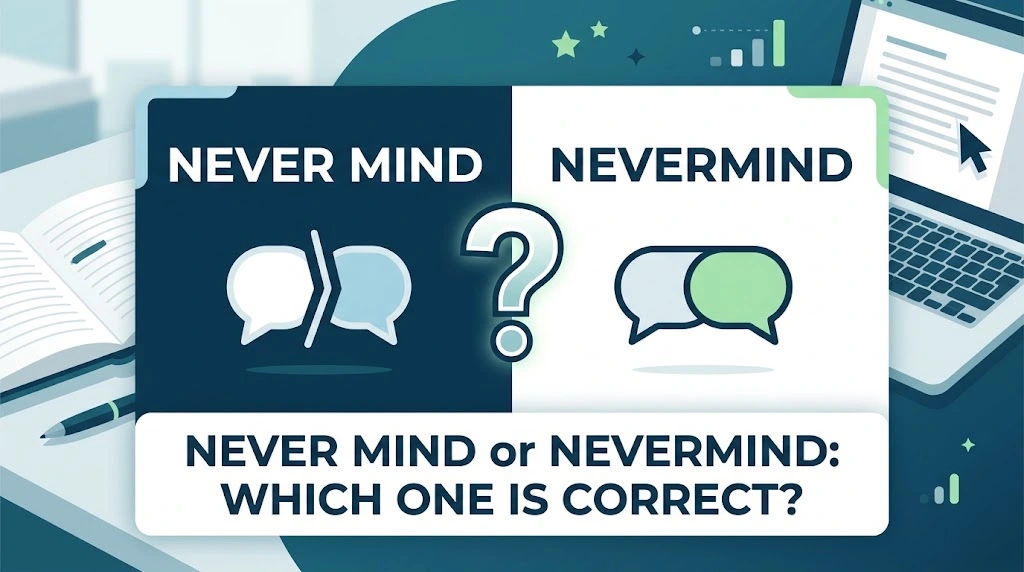
If you’ve ever paused before typing “Never mind” or “Nevermind,” you’re not alone. Both forms appear across the internet, in text messages, books, song titles, and everyday conversation. That makes the spelling question surprisingly tricky.
The short answer is simple:
Use “never mind” as two words for the ordinary expression meaning “forget it,” “don’t worry about it,” or “it doesn’t matter.”
The one-word form “nevermind” has a narrower history and use. It can function as a noun in certain expressions, and it also appears as an informal spelling of the two-word phrase. In standard edited American English, however, never mind remains the safer choice for the everyday expression.
That small space between the words actually matters.
Consider these examples:
- Never mind. I found my wallet.
- Never mind what I said earlier.
- Never mind the cost for now.
- Nevermind can appear as an informal spelling or in specific noun usage.
The difference becomes much easier once you understand what the phrase is doing in a sentence. So, rather than memorizing a spelling rule with no context, let’s look at the grammar, meanings, history, examples, and real-world usage behind never mind vs. nevermind.
Never Mind or Nevermind: The Quick Answer
For most everyday situations, never mind is the correct choice.
When you want to tell someone to forget something, stop worrying about it, or disregard a previous remark, write never mind as two words.
Use “never mind” in sentences like these
- Never mind. I’ll do it myself.
- Never mind what happened yesterday.
- Never mind the mistake. We can fix it.
- Never mind. I just remembered the answer.
- Never mind about the meeting. It was canceled.
The two-word form works naturally in both casual and formal writing.
What about “nevermind”?
Nevermind does appear in English. However, its uses aren’t identical to the standard everyday phrase.
It can function as a noun in expressions such as:
“Pay it no nevermind.”
It can also appear as a closed-up, informal spelling of the phrase in casual writing. You may see it in texts, social media posts, online comments, or stylized writing.
That doesn’t mean the two forms are interchangeable in every sentence.
| Form | Main use | Example |
| never mind | Standard phrase | “Never mind. I found it.” |
| nevermind | Noun in certain expressions | “He paid it no nevermind.” |
| nevermind | Informal closed spelling | “Nevermind, I figured it out.” |
If you’re writing an article, essay, business email, report, or other edited content, never mind is usually the form to choose for the familiar expression.
What Does “Never Mind” Mean?
The phrase never mind has several closely related meanings. The exact meaning depends on the context.
At its core, it tells someone that a particular matter should no longer receive attention.
That idea can take several forms.
“Never Mind” Can Mean “Forget It”
Someone might begin explaining a problem, then realize the explanation isn’t necessary.
For example:
“Can you help me find the—never mind. I found it.”
Here, never mind means forget what I was about to ask.
The speaker has effectively canceled the request.
“Never Mind” Can Mean “Don’t Worry About It”
The phrase can also reassure someone.
“Sorry, I spilled some water.”
“Never mind. It’s only water.”
In this situation, the speaker isn’t saying that the spill literally doesn’t exist. Instead, they’re saying that the mistake isn’t important enough to worry about.
“Never Mind” Can Mean “It Doesn’t Matter”
Consider this example:
“Why did Sarah leave early?”
“Never mind. It isn’t important.”
Here, never mind dismisses the subject because the speaker doesn’t want to discuss it further.
“Never Mind” Can Mean “Ignore That”
You might also use the phrase to withdraw information.
“Never mind that message. I sent it to the wrong person.”
The speaker wants the listener to disregard the message.
So, while the phrase has several meanings, they all circle around the same basic idea: stop giving attention to this particular matter.
Why Is “Never Mind” Usually Two Words?
The everyday expression never mind functions as a phrase rather than as one ordinary compound word.
The word never acts as an adverb. Mind is the important lexical element connected with attention, concern, or consideration.
Compare:
- Never mind the noise.
- Never mind what they said.
- Never mind about the delay.
The structure becomes especially obvious when another phrase follows mind.
For example:
Never mind the cost.
Here, the cost functions as the thing being dismissed or disregarded.
Likewise:
Never mind what happened.
The phrase what happened identifies what the speaker wants the listener to disregard.
This grammatical structure helps explain why simply removing the space isn’t always appropriate.
Nevermind: Is It Actually a Word?
Yes, nevermind has documented uses as a single word. The important point is that those uses don’t make it a universal replacement for never mind.
English contains many words whose spelling and grammatical role have changed over time. Some expressions remain open compounds while others become closed compounds.
Think about words such as:
- a lot
- already
- altogether
- maybe
- perhaps
English spelling doesn’t always follow a perfectly predictable pattern.
With never mind, however, the standard everyday phrase remains two words.
“Nevermind” as a Noun
One established use of nevermind is as a noun.
A familiar example is:
Pay it no nevermind.
This means roughly:
Pay no attention to it.
The construction is especially associated with informal and regional English.
Here, nevermind isn’t simply replacing the phrase in:
“Never mind. I don’t care.”
It’s functioning differently within the sentence.
That’s the key distinction.
Never Mind vs. Nevermind: The Grammatical Difference
The easiest way to understand never mind vs. nevermind is to look at their grammatical roles.
“Never Mind” as a Phrase
Consider:
Never mind. I can handle it.
The phrase stands alone as a conversational expression.
Now consider:
Never mind the noise.
Again, it functions as a phrase telling someone to disregard something.
“Nevermind” as a Noun
Now look at:
She paid it no nevermind.
Here, nevermind operates as a noun.
The sentence doesn’t mean that the speaker used the ordinary phrase never mind and simply forgot the space. The word has a different grammatical role.
That distinction matters more than the visual difference between one word and two.
Never Mind or Nevermind in American English
For standard American English, the practical rule is straightforward.
Use never mind when you’re using the familiar expression meaning:
- forget it
- don’t worry
- it doesn’t matter
- ignore that
- disregard what I said
For example:
Never mind. We already solved the problem.
This is the form most readers will expect in edited writing.
The closed form can still appear in informal communication, quotations, creative writing, or specific noun constructions.
Why Informal Usage Creates Confusion
The internet has made written language much more conversational.
People type quickly. They shorten expressions. They imitate speech. They also remove spaces from phrases simply because the result feels natural.
That’s how forms such as nevermind can become common in informal settings.
A text message might say:
“Nevermind 😂 I found my phone.”
Most readers understand the meaning immediately.
That doesn’t necessarily make it the preferred form for formal prose.
This distinction appears throughout English. Common online usage and standard edited usage aren’t always identical.
Never Mind in Formal and Professional Writing
When you’re writing for school, work, publishing, or professional communication, clarity should win.
Use never mind when you mean the ordinary expression.
Examples in professional writing
Never mind the earlier version. Please use the revised document.
Never mind the previous request. The issue has already been resolved.
Never mind that attachment. I sent the wrong file.
These sentences don’t need the closed spelling.
In fact, never mind makes the intended construction immediately recognizable.
In Academic Writing
Academic prose tends to favor precise and conventional forms.
For example:
Never mind the original estimate; the final figure is based on updated data.
That said, academic writing often benefits from avoiding conversational expressions altogether when a more precise alternative exists.
Instead of:
“Never mind the previous assumption.”
You might write:
“The previous assumption is no longer relevant.”
The best choice depends on your sentence and audience.
Never Mind in Casual Conversation
The phrase sounds completely natural in ordinary speech.
Imagine this exchange:
“Did you bring the charger?”
“No, wait. Never mind. I found one in my bag.”
Nobody hearing that conversation thinks about whether never mind contains a space.
Speech doesn’t display spelling.
That’s one reason the written form can cause confusion. People learn expressions by hearing them first. When they eventually write those expressions, they may naturally guess the spelling.
The same thing happens with many English expressions that sound like single units when spoken.
Never Mind in Text Messages and Social Media
Informal digital writing is more flexible.
You may encounter:
Nevermind, I got it.
or:
Never mind, I got it.
Both will usually be understood without difficulty.
Still, if the goal is standard written American English, the two-word form is the safer option.
Informal doesn’t always mean wrong
Language users regularly bend conventions in casual settings.
A friend might write:
“gonna”
instead of:
“going to”
That doesn’t mean gonna belongs in every formal document.
The same principle applies here. Informal usage can be understandable and widespread without becoming the preferred form for edited prose.
Never Mind or Nevermind: Examples Compared
Seeing the forms side by side makes the distinction clearer.
| Sentence | Form | Explanation |
| Never mind. I found my keys. | Two words | Standard conversational phrase |
| Never mind what I said. | Two words | Tells someone to disregard something |
| Never mind the delay. | Two words | Means the delay isn’t important |
| Pay it no nevermind. | One word | Noun use |
| Nevermind, I’ll do it later. | One word | Informal closed spelling |
| Never mind about the mistake. | Two words | Standard phrase |
The first, second, third, and sixth examples use the ordinary phrase.
The fourth example uses the noun nevermind.
The fifth represents the informal spelling you’ll encounter in casual digital communication.
Common Meanings of “Never Mind”
Understanding the phrase’s meanings helps you choose the correct form naturally.
Never Mind Means “Forget What I Said”
Suppose you ask:
“What time does the store close?”
Then you check the website.
“Never mind. I just saw the hours.”
You’re withdrawing your question because you’ve already found the answer.
Never Mind Means “Don’t Bother”
You might tell someone:
“Never mind getting the extra chairs. We don’t need them.”
Here, you’re canceling a task.
The listener no longer needs to do it.
Never Mind Means “Don’t Worry”
Imagine a friend apologizes for a small mistake.
“I’m sorry I forgot to call.”
“Never mind. It’s okay.”
This usage softens the situation.
Never Mind Means “Ignore That”
A person might send a correction after making a mistake:
“Never mind my last message. I gave you the wrong address.”
The instruction is clear: disregard the earlier information.
Never Mind vs. “Forget It”
These expressions overlap, but their tone can differ.
Never Mind
“Never mind. I found the file.”
This often sounds neutral or reassuring.
Forget It
“Forget it. I don’t want to talk about it.”
This can sound much sharper.
Depending on the speaker’s tone, forget it may communicate frustration, rejection, or annoyance.
That’s why never mind often feels softer.
However, tone always matters. Someone can say “Never mind” in an irritated way too.
Words don’t live in dictionaries alone. Context gives them their emotional temperature.
Never Mind vs. “It Doesn’t Matter”
These expressions are similar but aren’t always interchangeable.
Consider:
Never mind. I already solved it.
This means the previous request or concern can be dropped.
Now compare:
It doesn’t matter. We can choose another date.
That sentence evaluates the importance of something rather than simply withdrawing it.
In many conversations, either phrase could work. But the emphasis differs.
Never mind often tells someone to stop pursuing a subject.
It doesn’t matter more directly says that the subject has little or no importance.
Never Mind vs. “Don’t Worry”
The distinction becomes clearer in reassuring situations.
“I’m sorry I’m late.”
“Never mind.”
This can mean:
“Don’t worry about being late.”
You could also say:
“Don’t worry about it.”
The second version makes the reassurance more explicit.
Never mind can do several jobs at once. That’s one reason it remains such a useful expression.
Never Mind vs. “Ignore It”
These expressions can also overlap.
Compare:
Never mind that comment.
with:
Ignore that comment.
The second sounds more direct and commanding.
The first can sound softer or more conversational.
If you’re speaking to a colleague, friend, or family member, never mind may feel less forceful.
If you’re giving a clear instruction, ignore it may be more precise.
Common Mistakes With “Never Mind” and “Nevermind”
Mistake: Using “Nevermind” Everywhere
The most common mistake is treating nevermind and never mind as completely interchangeable.
They aren’t.
For the everyday phrase, choose:
Never mind.
Not:
Nevermind.
Mistake: Assuming Frequency Equals Standard Usage
You may see nevermind thousands of times online.
That doesn’t automatically establish it as the preferred spelling in formal English.
Online writing contains abbreviations, slang, unconventional punctuation, and deliberately altered spellings.
Frequency and editorial standard are different things.
Mistake: Assuming Dictionary Inclusion Makes Every Use Equivalent
A dictionary may document a word or variant without saying that every possible use is equally appropriate.
That’s an important point for English learners.
Dictionary recognition and recommended usage aren’t always the same thing.
Mistake: Ignoring Grammar
Instead of asking only:
“Does this look right?”
ask:
“What role is this expression playing in my sentence?”
If you’re saying “forget it” or “don’t worry about it,” you’re almost certainly looking for never mind.
A Simple Test for Choosing “Never Mind”
Here’s an easy practical test.
If you can replace the expression with “forget it,” “don’t worry,” or “it doesn’t matter,” use never mind.
Example
Never mind. I found the keys.
Replace it:
Forget it. I found the keys.
The meaning works.
Therefore:
Never mind is appropriate.
Another example:
Never mind the noise.
Try:
Ignore the noise.
Again, the meaning works.
Use the two-word form.
When the test doesn’t apply
Consider:
He paid it no nevermind.
You aren’t using nevermind to say “forget it” as a standalone phrase.
It’s functioning as a noun.
That’s a different construction.
“Never Mind” in Different Types of Writing
| Context | Recommended form | Example |
| Academic writing | never mind | “Never mind the earlier assumption.” |
| Business writing | never mind | “Never mind the previous request.” |
| News or edited prose | never mind | “Never mind the minor error.” |
| Everyday conversation | never mind | “Never mind. I figured it out.” |
| Text messages | never mind | “Never mind, I got it.” |
| Social media | Either may appear informally | “Nevermind, solved it!” |
| Literary dialogue | Depends on character voice | “Never mind. Let’s go.” |
| Noun expression | nevermind | “Pay it no nevermind.” |
The key isn’t to panic when you see the one-word version.
Instead, identify how the writer is using it.
A Brief Look at the History of “Never Mind”
The expression has a long history in English.
The word mind has historically carried meanings connected to thought, attention, concern, care, and consideration.
That older sense still appears in expressions such as:
- Mind your manners.
- Mind the gap.
- Mind the children.
- Never mind.
In these constructions, mind isn’t simply about having thoughts inside your head.
It can mean pay attention to, take notice of, or concern yourself with something.
That older meaning makes the phrase never mind easier to understand.
When someone says:
Never mind the noise.
the basic idea is:
Don’t concern yourself with the noise.
Over time, the expression developed into the flexible conversational phrase used today.
Why “Never Mind” Can Sound Like One Word
Spoken English often blurs word boundaries.
When someone quickly says:
“Never mind.”
the two words can flow together almost like a single unit.
That pronunciation may encourage people to write nevermind.
The same phenomenon affects countless expressions.
Speech is continuous. Writing separates language into conventional units.
English spelling doesn’t always reproduce the exact rhythm of speech.
That’s why hearing a phrase isn’t enough to determine its standard written form.
Is “Nevermind” Wrong?
Calling nevermind simply “wrong” would be too broad.
The better answer depends on how you’re using it.
For the ordinary expression
Use:
Never mind.
This is the standard choice.
For certain noun uses
Nevermind can be legitimate.
For example:
Pay it no nevermind.
For informal writing
You may encounter:
Nevermind, I don’t need it anymore.
This is understandable and common in casual digital communication. However, if you’re aiming for conventional edited American English, never mind remains the better choice.
So the most accurate rule isn’t:
“Nevermind is never a word.”
Instead, it’s:
“Never mind” is the standard form for the everyday expression. “Nevermind” has narrower uses and appears informally as a closed spelling.
That distinction gives you a much more useful rule.
Case Study: Choosing the Right Form in Context
Imagine you’re writing three different sentences.
Situation One: A casual text
“Can you send me the address? Never mind, I found it.”
The two-word form works perfectly.
Situation Two: A business email
“Never mind the previous attachment. Please review the revised file.”
Again, never mind is the natural standard choice.
Situation Three: A noun construction
“He paid it no nevermind.”
Here, nevermind is functioning differently.
The three sentences look similar on the surface. Grammatically, however, they aren’t doing the same job.
That’s why memorizing a simple “one word versus two words” rule doesn’t tell the whole story.
Style Tip: “Never Mind” Can Change the Tone
One small phrase can carry several emotional shades.
Compare these sentences:
Never mind.
Oh, never mind.
Never mind about that.
Never mind. It’s fine.
Never mind what he said.
The wording stays nearly identical, but the context changes the tone.
A reassuring tone
“Never mind. Everyone makes mistakes.”
A dismissive tone
“Never mind. I don’t want to discuss it.”
A self-correcting tone
“Never mind. I just remembered.”
A directive tone
“Never mind the details for now.”
This flexibility explains why never mind appears so often in natural conversation.
Can “Never Mind” Start a Sentence?
Absolutely.
In fact, starting a sentence with never mind is one of its most common uses.
Examples include:
Never mind. I’ll take care of it.
Never mind what they think.
Never mind the weather. We’re leaving.
Never mind. We have another option.
When it appears as a standalone expression, punctuation usually helps communicate the intended rhythm.
A period works well when the speaker stops and then begins another thought:
Never mind. I found the answer.
A comma can work when the phrase connects closely to the rest of the sentence:
Never mind the extra cost.
Can You Say “Never Mind About That”?
Yes.
The construction is natural:
Never mind about that.
It tells someone not to concern themselves with the subject.
You can also say:
Never mind about the delay.
Never mind about what happened.
Never mind about yesterday’s mistake.
Again, the standard spelling is never mind, not nevermind, for this ordinary phrase.
Can “Never Mind” Be Used With a Noun?
Yes.
For example:
Never mind the mess.
Never mind the expense.
Never mind the weather.
Never mind the details.
In these sentences, mind takes a noun phrase as its complement.
The construction means something like:
Don’t concern yourself with this thing.
This is another useful clue that the expression is functioning as a phrase.
Can “Never Mind” Be Used With a Clause?
Yes.
For example:
Never mind what they said.
Never mind why he left.
Never mind whether they agree.
These examples contain longer grammatical units after mind.
The phrase still means that the following subject shouldn’t receive attention or concern.
Never Mind or Nevermind: What Should You Use?
If you’re still unsure, use this practical guide.
Choose never mind when:
- You mean forget it.
- You mean don’t worry about it.
- You mean it doesn’t matter.
- You want someone to ignore something.
- You’re writing formal or professional English.
- You’re writing an article, essay, report, or school assignment.
- You’re unsure which form to choose.
Choose nevermind when:
- You’re using the established noun construction.
- You’re intentionally reproducing an informal spelling.
- You’re writing dialogue where the spelling reflects a character’s style.
- A proper title or quoted source specifically uses Nevermind.
For ordinary writing, however, the two-word version is the dependable choice.
Frequently Asked Questions About Never Mind vs. Nevermind
Is “never mind” two words?
Yes. When it means “forget it,” “don’t worry,” “it doesn’t matter,” or “ignore that,” the standard form is never mind.
Is “nevermind” a real word?
Yes, in specific uses. It can function as a noun in expressions such as “pay it no nevermind.” It also appears as an informal closed spelling of the everyday phrase.
Is “nevermind” acceptable in texting?
It can appear in casual texting and is widely understood. However, never mind remains the standard spelling when you want conventional written English.
Which is correct: “Never mind” or “nevermind”?
For the ordinary expression, never mind is the standard choice.
Is “Nevermind, I found it” correct?
In standard edited English, write:
Never mind, I found it.
The one-word version may appear in informal digital writing, but the two-word form is preferable for standard usage.
Is “never mind” formal?
The phrase works in many settings, from casual conversation to professional writing. However, some formal contexts may favor a more precise expression such as “disregard the previous information.”
Can “never mind” be followed by a noun?
Yes.
Never mind the cost.
Never mind the noise.
Never mind the details.
Can “never mind” be followed by “about”?
Yes.
Never mind about the mistake.
Never mind about what happened.
What’s the easiest way to remember the spelling?
Remember this simple rule:
If you mean “forget it,” write “never mind.”
That one sentence will handle most situations.
Never Mind or Nevermind: Final Verdict
The never mind vs. nevermind question looks like a tiny spelling problem, but grammar and usage make the distinction more interesting.
For the familiar expression meaning “forget it,” “don’t worry,” “it doesn’t matter,” or “ignore that,” use never mind as two words.
For example:
Never mind. I found my phone.
Never mind what I said earlier.
Never mind the extra details.
The one-word nevermind isn’t simply meaningless or nonexistent. It has established noun usage and appears frequently as an informal spelling in modern digital communication. Context matters.
Still, when you’re writing standard American English and don’t want to second-guess yourself, there’s an easy rule to follow:
If you mean “forget it,” choose never mind.
That little space is doing more work than it looks.
