

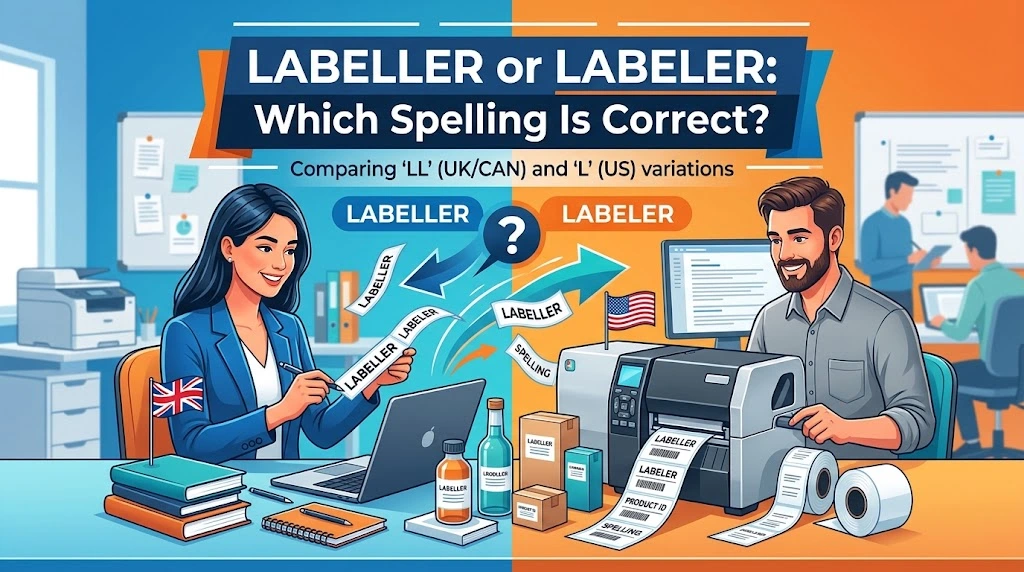
Labeller or labeler? If you’ve ever written product documentation, packaging copy, technical instructions, or an English-language article, you may have paused over these two spellings.
The good news is that the choice is straightforward once you know which variety of English you’re using.
Labeler is the standard spelling in American English, while labeller is the standard spelling in British English. Both words carry essentially the same meaning. They describe a person, machine, or device that labels something, depending on the context.
The difference comes from a broader spelling pattern between American and British English. American English often keeps a single l before certain suffixes, while British English frequently doubles the l.
That small difference can matter when you’re writing for a specific audience. A US product manual, for example, will normally use labeler, while UK technical documentation may use labeller.
This guide explains the difference in detail, including spelling rules, examples, related forms such as labeling and labelling, and the best choice for professional writing.
Labeller or Labeler: Which Spelling Is Correct?
Both labeller and labeler are legitimate English spellings. The preferred form depends on regional spelling conventions.
| Spelling | Main variety of English | Typical use |
| Labeler | American English | US writing, products, manuals, websites |
| Labeller | British English | UK writing, manuals, product descriptions |
| Labeler | Canadian English and other contexts | Can appear depending on house style |
| Labeller | Other Commonwealth varieties | Often follows British conventions |
For American readers, labeler is generally the better choice.
For British readers, labeller is generally the better choice.
Neither spelling changes the basic meaning. The extra l simply reflects a regional spelling convention.
What does “labeler” mean?
A labeler is someone or something that applies labels.
The word can describe a person:
“The labeler inspected each package before shipping.”
It can also describe equipment:
“The automatic labeler applies a barcode to every carton.”
The exact meaning depends on the surrounding sentence. In manufacturing, packaging, and logistics, labeler often refers to machinery. In ordinary writing, it can refer to a person who labels objects.
What does “labeller” mean?
Labeller has the same basic meaning as labeler.
The main difference is spelling.
For example, British English might use:
“The labeller applies labels to bottles at high speed.”
American English would normally write:
“The labeler applies labels to bottles at high speed.”
The pronunciation and fundamental meaning remain essentially unchanged.
Labeler vs. Labeller in American and British English
The difference becomes clearer when you compare several related words.
| Meaning | American English | British English |
| Verb | label | label |
| Present participle | labeling | labelling |
| Past tense | labeled | labelled |
| Person or machine that labels | labeler | labeller |
| Noun for the process | labeling | labelling |
This pattern is important because the spelling difference doesn’t appear only in labeler.
You’ll often see the same regional distinction in:
- labeling / labelling
- labeled / labelled
- labeler / labeller
So if your article uses American English, you would normally write:
“The labeler is labeling the newly labeled products.”
A British English version would typically read:
“The labeller is labelling the newly labelled products.”
Neither sentence is inherently more correct. Each follows a different regional convention.
Why Is It “Labeler” in American English but “Labeller” in British English?
The answer lies in how American and British English handle a final l before certain suffixes.
British English commonly doubles the final consonant in words such as label when adding endings that begin with a vowel.
That produces:
- label → labelling
- label → labelled
- label → labeller
American English generally doesn’t double the final l in these forms:
- label → labeling
- label → labeled
- label → labeler
This is part of a larger spelling difference between the two varieties.
However, spelling rules aren’t perfectly uniform across every word. English has plenty of historical exceptions and variations. That’s why it’s better to learn the established spelling of each word rather than assume that one rule explains every example.
A quick spelling comparison
Consider the word travel.
American English commonly uses:
- traveling
- traveled
- traveler
British English commonly uses:
- travelling
- travelled
- traveller
The pattern looks remarkably similar to:
- labeling / labelling
- labeled / labelled
- labeler / labeller
That comparison makes the distinction easier to remember.
Simple rule: If you’re writing in American English, use labeler. If you’re writing in British English, use labeller.
Is “Labeller” Wrong in American English?
Not necessarily.
Labeller is recognizable to American readers and may appear in US publications, especially when a writer, company, product, or source follows British English conventions.
Still, if the goal is standard American English, labeler is normally the cleaner choice.
For example, an American product page would generally say:
“This labeler handles high-volume packaging applications.”
A British-oriented product page might say:
“This labeller handles high-volume packaging applications.”
The difference doesn’t make the equipment itself different. It reflects the spelling style used by the publication or manufacturer.
Why consistency matters
Imagine an American website that uses these forms:
- labeler
- labelling
- labeled
- labeller
Readers will understand the text. However, the inconsistent spelling can make the content look poorly edited.
A better US-style version would use:
- labeler
- labeling
- labeled
Likewise, a British publication should normally maintain:
- labeller
- labelling
- labelled
Consistency gives professional writing a smoother finish.
Is “Labeler” Wrong in British English?
Again, not necessarily.
British readers will understand labeler, and the spelling can appear in international material. However, labeller generally fits British spelling conventions better.
If you’re preparing content specifically for a UK audience, use labeller unless a particular organization’s style guide requires otherwise.
For example:
British style:
“The labeller automatically places a label on each container.”
American style:
“The labeler automatically places a label on each container.”
The underlying action remains the same.
Labeler or Labeller: Examples in Real Sentences
Seeing the words in context makes the distinction much easier.
American English examples
- “The labeler applies shipping labels automatically.”
- “Operators cleaned the labeler at the end of the production shift.”
- “The company purchased a high-speed bottle labeler.”
- “The technician adjusted the labeler to accommodate smaller containers.”
- “The automatic labeler reduced manual packaging work.”
British English examples
- “The labeller applies shipping labels automatically.”
- “Operators cleaned the labeller after the production shift.”
- “The company purchased a high-speed bottle labeller.”
- “The technician adjusted the labeller for smaller containers.”
- “The automatic labeller reduced manual packaging work.”
Notice something important: the sentence structure and meaning don’t need to change.
Only the regional spelling changes.
Labeler vs. Label Maker: Are They the Same Thing?
Here’s where terminology can become confusing.
A labeler and a label maker can perform related jobs, but they aren’t necessarily the same type of equipment.
A label maker usually creates or prints labels. A labeler, especially in industrial settings, often applies already printed labels to products or packages.
For example, a small office might use a label maker to print:
“Accounting — File Storage”
A beverage manufacturer might use an automated labeler to attach printed labels to thousands of bottles.
The distinction at a glance
| Term | Typical function |
| Label maker | Creates or prints labels |
| Label printer | Prints labels from digital information |
| Labeler | Applies labels to products or packages |
| Label applicator | Applies labels to a specific surface |
| Labeling machine | General term for automated labeling equipment |
These terms can overlap in product descriptions. Manufacturers sometimes use different terminology depending on the machine’s design and application.
That’s why context matters more than the word alone.
What Is an Industrial Labeler?
In manufacturing, labeler often refers to an automated machine used to apply labels at scale.
These machines appear in many industries, including:
- Food and beverage
- Pharmaceuticals
- Cosmetics
- Chemical manufacturing
- Consumer goods
- Logistics
- Warehousing
- Retail packaging
An industrial labeler may apply:
- Product labels
- Barcode labels
- Shipping labels
- Regulatory information
- Batch information
- Identification labels
- Promotional labels
The machine may work with bottles, boxes, cartons, containers, bags, or other packaging formats.
Why automated labelers matter
Manual labeling can become slow and inconsistent when production volumes rise.
An automated system can improve:
- Label placement consistency
- Production speed
- Repeatability
- Packaging efficiency
- Labor utilization
- Product identification
For example, a factory processing thousands of containers per hour can’t rely on an employee placing every label by hand. Automated equipment can integrate labeling into the production line.
Labeler vs. Label Applicator
These terms often appear together in industrial packaging.
A label applicator specifically emphasizes the mechanism that puts the label onto a surface.
A labeler can be a broader term for the complete machine.
For example:
“The labeler includes an integrated label applicator.”
Here, labeler describes the overall equipment, while label applicator identifies a particular component or function.
Technical documentation may therefore use both terms without treating them as exact synonyms.
Labeler vs. Labeling Machine
Labeling machine is another common industry term.
In many contexts, a labeler and labeling machine perform the same general function. However, labeling machine can sound more descriptive when explaining equipment to a general audience.
For example:
“The labeling machine applies adhesive labels to cardboard cartons.”
A product manufacturer might instead write:
“The automatic carton labeler applies adhesive labels at production-line speeds.”
Both descriptions can be accurate.
The best term depends on the machine’s capabilities and the audience’s expectations.
Is “Labeling” or “Labelling” Correct?
This question follows naturally from the labeler-versus-labeller debate.
The standard American spelling is labeling.
The standard British spelling is labelling.
| American English | British English |
| labeling | labelling |
| labeled | labelled |
| labeler | labeller |
American English
“The company is labeling each package with a barcode.”
British English
“The company is labelling each package with a barcode.”
Both forms are correct within their respective spelling systems.
Why does the difference matter for SEO?
If you’re creating content for a specific market, regional spelling can affect how naturally the article matches that audience’s search behavior.
A US-focused website will generally benefit from using labeler and labeling consistently.
A UK-focused website may prefer labeller and labelling.
However, it’s useful to mention the alternative spelling naturally when the article specifically addresses the difference. That way, readers searching for either term can find the answer without forcing awkward keyword repetition.
Is “Labeled” or “Labelled” Correct?
Once again, both spellings are established.
Labeled is the standard American English form.
Labelled is the standard British English form.
Consider these examples:
US:
“The products were labeled before shipment.”
UK:
“The products were labelled before shipment.”
The pronunciation is generally the same. The spelling reflects the regional variety of English.
This distinction appears frequently in international business documents. A company operating in both countries may therefore maintain separate style guides for US and UK content.
Why American English Uses Fewer Doubled Letters
The spelling differences between American and British English developed through centuries of language change, printing practices, and deliberate standardization.
American spelling became more standardized during the 18th and 19th centuries. Lexicographers such as Noah Webster promoted spelling conventions that sometimes differed from British forms.
Common examples include:
| American English | British English |
| color | colour |
| center | centre |
| traveled | travelled |
| labeled | labelled |
| labeling | labelling |
The differences don’t mean that American English is simply “shortened British English.” The two varieties developed through a complex history involving pronunciation, regional usage, dictionaries, education, publishing, and cultural change.
For labeler, the important practical point is simpler: US English normally uses one l, while British English normally uses two.
A Practical Case Study: Choosing a Spelling for Packaging Software
Imagine a company launches packaging software for customers in the United States.
Its product documentation contains this sentence:
“The labeller automatically adjusts its settings while labeling each package.”
The wording isn’t incomprehensible. American customers will understand it immediately.
However, the document mixes British and American conventions.
A consistent US version would read:
“The labeler automatically adjusts its settings while labeling each package.”
Now consider a UK version:
“The labeller automatically adjusts its settings while labelling each package.”
What does this case show?
The issue isn’t whether readers can understand the original sentence. They can.
The issue is style consistency.
Professional technical writing should match the spelling conventions of its intended audience whenever possible.
A Second Case Study: International E-Commerce
Consider an online store that sells industrial labeling equipment worldwide.
Its product page targets both US and UK customers.
Instead of pretending that one spelling doesn’t exist, the page can address both naturally:
“This automatic labeler, also called a labeller in British English, applies adhesive labels to bottles and containers.”
That sentence solves two problems at once.
It introduces the US term while acknowledging the British variant. The terminology becomes clearer for international buyers without cluttering the page with repetitive keywords.
For a website with separate regional versions, an even cleaner approach is possible:
- US page: automatic labeler
- UK page: automatic labeller
The product itself remains the same. The wording simply matches the intended market.
Common Mistakes With Labeler and Labeller
Several mistakes appear repeatedly when writers handle regional spelling.
Mixing regional forms
One paragraph uses labeler, while the next uses labeller without any reason.
Better: Pick the appropriate regional spelling and stick with it.
Assuming the double “l” is a typo
A British writer may use labeller, while an American editor changes it automatically.
That can create unnecessary edits.
Better: Check the target audience before correcting the spelling.
Treating the words as different concepts
The extra l doesn’t create a separate meaning.
Labeler and labeller refer to the same basic concept.
Confusing a labeler with a label printer
A label printer typically prints labels.
A labeler commonly applies labels.
Some machines combine both functions, but the terms describe different functions in many industrial contexts.
Switching between American and British spelling
Using labeler alongside labelling can make a document look inconsistent.
Choose a style guide or regional convention before writing the final copy.
How to Choose Between Labeler and Labeller
The easiest method is to identify your primary audience.
Choose labeler if you’re writing for:
- United States customers
- US businesses
- American product documentation
- US educational material
- American English websites
- US packaging or manufacturing content
Choose labeller if you’re writing for:
- United Kingdom readers
- UK businesses
- British English publications
- UK product documentation
- British manufacturing audiences
- Organizations that follow British spelling
What if the audience is international?
Choose the spelling used by your primary market.
Then mention the alternative naturally when useful.
For example:
“The automatic labeler, known as a labeller in British English, applies labels to packaged products.”
This approach keeps the writing clear without sacrificing regional accuracy.
Labeler or Labeller: Quick Reference Table
| Question | Answer |
| Which spelling is standard in US English? | Labeler |
| Which spelling is standard in UK English? | Labeller |
| Do the words have different meanings? | No |
| Is labeler one word? | Yes |
| Is labeller one word? | Yes |
| American spelling of labeling | Labeling |
| British spelling of labeling | Labelling |
| American spelling of labeled | Labeled |
| British spelling of labeled | Labelled |
| Which spelling should US writers normally choose? | Labeler |
| Which spelling should UK writers normally choose? | Labeller |
Frequently Asked Questions About Labeller or Labeler
Is “labeler” grammatically correct?
Yes. Labeler is a standard English noun and is the preferred spelling in American English.
It can describe a person who labels things or equipment that applies labels, depending on context.
Is “labeller” grammatically correct?
Yes. Labeller is a standard British English spelling.
It has essentially the same meaning as labeler.
Which is correct in the United States: labeler or labeller?
Labeler is the standard American English spelling.
For US-focused content, product descriptions, manuals, and articles, labeler is usually the better choice.
Which is correct in the United Kingdom: labeler or labeller?
Labeller is the standard British English spelling.
British English commonly doubles the final l in this form.
What is the British spelling of “labeler”?
The British spelling is labeller.
The spelling difference is caused by regional conventions rather than a difference in meaning.
What is the American spelling of “labeller”?
The American spelling is labeler.
American English normally uses a single l in this form.
Is “labeler” one word?
Yes. Labeler is normally written as one word.
Likewise, labeller is written as one word.
Is “labeling” or “labelling” correct?
Both are correct.
- Labeling = American English
- Labelling = British English
Use the form that matches the variety of English you’re writing.
Is “labeled” or “labelled” correct?
Both are established spellings.
- Labeled = American English
- Labelled = British English
Does “labeler” mean the same thing as “label maker”?
Not always.
A label maker generally creates or prints labels. A labeler often applies labels to products or packaging, particularly in industrial contexts.
The terms can overlap when equipment performs multiple functions.
Does the pronunciation change between “labeler” and “labeller”?
Generally, no meaningful pronunciation difference exists simply because of the extra l.
The distinction is primarily orthographic, meaning it concerns spelling.
The Bottom Line: Labeler or Labeller?
The answer is simple once the regional context is clear.
Labeler is the preferred spelling in American English.
Labeller is the preferred spelling in British English.
Both forms describe a person or machine that labels something. The additional l doesn’t change the core meaning.
The same regional pattern appears in related words:
So if you’re writing for a US audience, choose labeler. If you’re writing for a UK audience, choose labeller.
Most importantly, don’t mix the two spelling systems without a reason. Consistent language feels cleaner, reads more professionally, and helps your audience trust the content.
Quick answer: Use labeler in American English and labeller in British English.
