

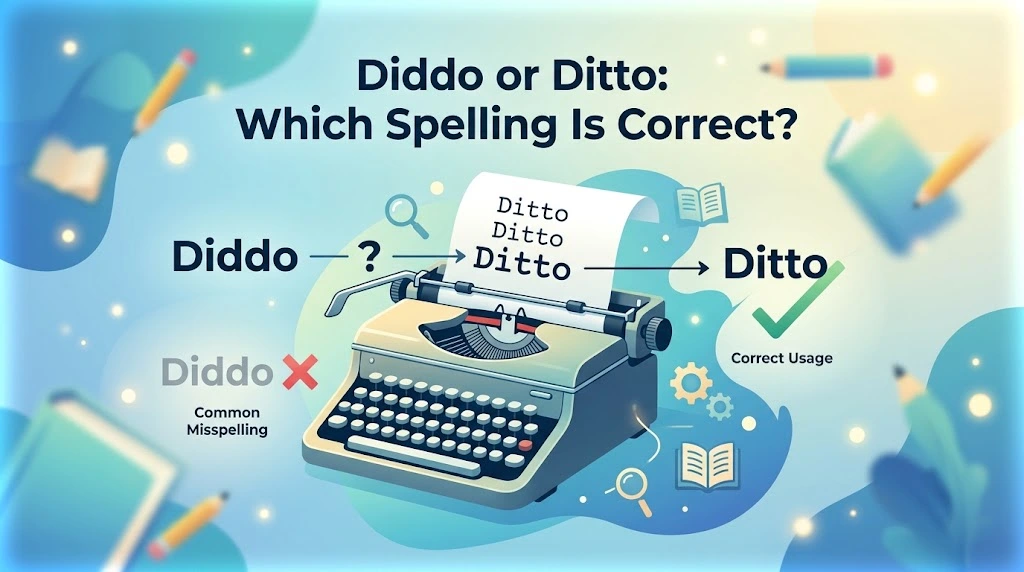
If you’ve ever written “diddo” when you meant “ditto,” you’re not alone. The two spellings look remarkably similar, and the word’s pronunciation can make the extra d seem reasonable.
However, standard English has a clear answer.
Ditto is the correct spelling. Diddo is generally a misspelling of ditto when you intend the English word meaning “the same,” “likewise,” or “repeat what was just said.”
The word appears in everyday conversation, informal writing, lists, historical records, and even business documents. It can also function as a noun, adverb, and verb.
So, if you’re deciding between diddo or ditto, choose ditto.
Quick answer: The standard spelling is ditto, not diddo.
Understanding why the spelling is ditto becomes easier once you look at the word’s meaning, pronunciation, history, and different grammatical uses.
Diddo or Ditto: Which Spelling Is Correct?
Ditto is the standard English spelling.
The spelling diddo isn’t the standard form of the word. People may use it informally because they hear the word as something like “dit-oh” and associate the repeated sound with another d.
Here’s the basic distinction:
| Spelling | Standard English? | Meaning |
| Ditto | Yes | The same, likewise, or a repetition |
| Diddo | No, when intended as ditto | Usually a misspelling of ditto |
For example:
“I love this restaurant.”
“Ditto.”
The second speaker means:
“I feel the same way.”
Another example appears in a written list:
| Name | Address |
| Sarah | 125 Main Street |
| Michael | Ditto |
Here, ditto tells the reader that Michael has the same address as Sarah.
That simple function explains much of the word’s usefulness.
What Does Ditto Mean?
Ditto means “the same” or “likewise.”
It can also mean that something should be repeated because it applies to the current situation or entry.
In conversation, ditto often expresses agreement.
For example:
“That was the best movie I’ve seen this year.”
“Ditto.”
The response means:
“I agree. I feel the same way.”
The word can also refer to repetition in written material.
Imagine a form containing this information:
| Employee | Department |
| James | Accounting |
| Maria | Ditto |
| Robert | Ditto |
In this context, ditto means that Maria and Robert belong to the same department listed immediately above.
The exact meaning depends on context, but the central idea remains sameness or repetition.
Common meanings of ditto
You’ll usually encounter ditto in these senses:
- The same
- Likewise
- I agree
- Repeat the information above
- A duplicate or copy
- To repeat or reproduce something
The conversational meaning is especially common today.
Diddo: Is It a Word?
When people ask “Is diddo a word?”, the answer requires a little context.
If you mean the standard English word meaning “the same” or “likewise,” the correct spelling is ditto.
Diddo is not the standard spelling of that word.
A person might type diddo because of a spelling mistake, pronunciation-based spelling, or simple unfamiliarity with the word. Informal internet communication creates plenty of such variations.
That doesn’t make the spelling standard.
Consider these examples:
❌ “I agree with you. Diddo.”
✅ “I agree with you. Ditto.”
The second sentence uses the standard English spelling.
Why the mistake happens
The confusion isn’t particularly surprising.
Ditto contains a repeated syllable-like pattern:
dit-to
When spoken quickly, someone who hasn’t seen the word written may reconstruct its spelling incorrectly.
English has many words whose spellings don’t perfectly reveal their pronunciation. That gap between sound and spelling creates countless spelling mistakes.
In this case, however, the dictionary form is straightforward:
ditto.
Why Do People Spell Ditto as Diddo?
The diddo vs. ditto confusion mainly comes from sound and memory.
People often spell unfamiliar words according to how they think the words sound. That’s called phonetic or sound-based spelling.
Suppose someone hears:
“Ditto.”
They might mentally interpret the ending as another d sound. That can lead to:
“Diddo.”
The problem is that pronunciation doesn’t always provide enough information to reconstruct English spelling accurately.
Similar spelling confusion happens elsewhere
English contains many examples of words that invite spelling mistakes because their sounds can suggest multiple spellings.
For example:
- definitely is often misspelled as definately
- separate is often misspelled as seperate
- receive is sometimes written as recieve
- necessary can be confused with neccessary
Diddo belongs to the same general category of spelling error when someone intends ditto.
The easiest solution is simple: remember the standard spelling visually.
D-I-T-T-O.
Ditto vs. Diddo: Side-by-Side Comparison
A quick comparison makes the distinction clear.
| Feature | Ditto | Diddo |
| Standard spelling | Yes | No, when intended as ditto |
| Meaning “the same” | Yes | No |
| Meaning “likewise” | Yes | No |
| Common dictionary word | Yes | Not as the standard form of this word |
| Appropriate in formal writing | Yes, when suitable | No |
| Common spelling mistake | No | Yes |
| Example | “Ditto.” | “Diddo.” ❌ |
If you’re writing an article, email, report, text, or social media post, ditto is the form to use.
How to Use Ditto in a Sentence
The simplest way to use ditto is as a short expression of agreement.
For example:
“I’m exhausted after that flight.”
“Ditto.”
Here, ditto means “I’m exhausted too.”
You can also use it after a statement:
“The new restaurant has excellent food.”
“Ditto for the desserts.”
In this example, ditto carries the idea that the same positive assessment applies to the desserts.
Another possibility appears in lists:
John: Chicago
Maria: Ditto
That means Maria’s location is the same as John’s.
More examples
- “I need a vacation.” “Ditto.”
- “She loves classic novels, and ditto for her brother.”
- “The first item costs $20; the next item is ditto.”
- “He praised the service, and I ditto his comments.”
- “The same rules apply to the second group. Ditto for the third.”
Not every construction sounds equally natural in modern conversation. When a clearer word such as same, likewise, or also works better, use it.
Examples of Ditto in Everyday Writing
Ditto often works as a compact shortcut.
Imagine two friends discussing a long workweek:
“I could sleep for twelve hours tonight.”
“Ditto.”
There’s no need to repeat the entire thought.
The word does the heavy lifting.
In a text message
“That meeting was way too long.”
“Ditto.”
In an email
“I agree with the changes suggested below. Ditto for the revised deadline.”
In a list
| Product | Color |
| Shirt | Black |
| Pants | Ditto |
| Jacket | Ditto |
The reader understands that the pants and jacket are also black.
In casual conversation
“I’m ready for the weekend.”
“Ditto.”
This use feels natural because ditto quickly communicates agreement.
Ditto as a Noun
Ditto can function as a noun.
In noun use, it can refer to something that is the same as something previously mentioned.
For example:
“The first report was approved, and the second was a ditto.”
This use is less common in everyday modern conversation than the familiar conversational ditto.
Another important noun-related expression is ditto mark.
Historically, ditto marks indicated that information in a previous line should be repeated.
For example:
| Item | Quantity |
| Apples | 10 |
| Oranges | ″ |
| Pears | ″ |
The repeated marks tell the reader that the quantities are the same as the value above.
Modern documents generally use clearer formatting or repeat the actual information instead.
Ditto as an Adverb
The most familiar modern use of ditto is adverbial.
It can mean:
- likewise
- similarly
- the same
- to the same extent
For example:
“I enjoyed the first book.”
“Ditto.”
The second speaker means:
“I enjoyed it too.”
Another example:
“The hotel was comfortable, and the restaurant was excellent.”
“Ditto the breakfast.”
Here, the writer uses ditto to indicate that the same favorable assessment applies.
Why this use is useful
Repetition can make writing clunky.
Instead of saying:
“I agree with your first point, and I agree with your second point, and I agree with your third point.”
A conversational response might simply say:
“Ditto.”
It’s concise and immediately understandable when the context is obvious.
Ditto as a Verb
Ditto can also function as a verb.
As a verb, ditto means to repeat or duplicate something.
For example:
“The editor approved the first paragraph and dittoed the format for the second.”
The verb form dittoed is possible because English commonly turns nouns into verbs.
Another example:
“The company dittoed the design across several product labels.”
This usage exists, but it’s considerably less common than using ditto to mean “likewise.”
For most everyday writing, you won’t need the verb form.
If the meaning can be expressed more clearly with repeat, copy, or duplicate, those words may be better choices.
The Origin of the Word Ditto
The history of ditto explains why its spelling looks unusual.
The word entered English from Italian.
It comes from the Italian word detto, meaning “said” or “the said.”
The historical idea was essentially:
“the same as what was said above.”
That meaning fits perfectly with the word’s later use for repeating information.
Over time, ditto became established in English as a term for repeated information.
Its history also explains why trying to spell it as diddo doesn’t reflect its original form.
A simplified history
| Stage | Form or concept | Meaning |
| Italian | detto | Said; the said |
| Historical use | Ditto | Same as previously stated |
| Modern English | ditto | Same, likewise, repeat |
The spelling ditto is now firmly established in standard English.
How Ditto Became Common in English
The word became particularly useful in contexts where people had to record repeated information.
Before modern spreadsheets and digital forms, clerks frequently copied information by hand. Repeating the same words again and again wasted time and increased the chance of errors.
A shorthand solution helped.
Ditto could signal that the information above should be repeated.
This practice became associated with ditto marks, which served a similar purpose.
That historical role gave the word a practical function beyond ordinary conversation.
Today, digital tools make copying information much easier. As a result, the traditional written use has declined.
The conversational use remains familiar, however.
Ditto Marks: What Are They?
Ditto marks are symbols historically used to show that information should be repeated from a preceding line.
They’re often represented by quotation-like marks.
For example:
| Name | City |
| Alice | Boston |
| Ben | ″ |
| Clara | ″ |
The marks under Boston mean:
“Boston, same as above.”
Ditto marks appeared in many kinds of records, including tables, lists, accounting documents, and handwritten forms.
Why did people use ditto marks?
The reason was practical.
If ten consecutive entries had the same value, writing the same word ten times took unnecessary effort.
A repetition mark saved space and time.
It also created a visual connection between the repeated entries.
Today, modern software can duplicate values instantly. Therefore, ditto marks have become much less important in ordinary documents.
Ditto vs. “Same”
In casual conversation, ditto and same can communicate nearly identical ideas.
Compare:
“I’m hungry.”
“Ditto.”
with:
“I’m hungry.”
“Same.”
Both responses communicate agreement.
However, the tone differs slightly.
Same feels extremely casual and contemporary. Ditto can sound playful, concise, or slightly old-fashioned depending on the context.
For example:
“I can’t believe how cold it is today.”
“Same.”
That sounds completely natural in casual texting.
“I can’t believe how cold it is today.”
“Ditto.”
That works too, but it has a different flavor.
Which should you choose?
Use same when you want a very casual response.
Use ditto when you want a concise expression that specifically means “the same applies.”
Neither word is automatically better. Context matters.
Ditto vs. Likewise
Likewise is another close alternative.
Compare these examples:
“Have a great weekend!”
“Likewise!”
Here, likewise means “the same to you.”
Now consider:
“I think the new policy is confusing.”
“Ditto.”
The second speaker means:
“I think the same thing.”
The two words overlap, but they don’t always fit the same situations.
| Word | Typical sense | Tone |
| Ditto | The same; repeat the previous idea | Casual, concise, sometimes playful |
| Likewise | In the same way; the same applies | Neutral to conversational |
| Same | I agree; me too | Very casual |
Choosing among them depends on the sentence and desired tone.
Ditto vs. Same Here
“Same here” is another common alternative to ditto.
For example:
“I love pizza.”
“Same here.”
That means:
“I love pizza too.”
You could also say:
“Ditto.”
The meaning is similar.
However, same here explicitly communicates that the speaker shares the previous experience or opinion. Ditto can sometimes refer more broadly to repeated information.
For that reason, ditto has a wider historical and written function.
Common Mistakes With Ditto
The biggest mistake is obvious:
❌ Diddo
✅ Ditto
But spelling isn’t the only possible problem.
Mistake: Adding another “d”
The word has two t’s, not two d’s.
Correct:
D-I-T-T-O
Incorrect:
D-I-D-D-O
Mistake: Assuming pronunciation determines spelling
English spelling doesn’t always follow pronunciation perfectly.
Hearing a word isn’t enough to determine every letter.
When you’re unsure, check the written form rather than guessing from sound.
Mistake: Using ditto when the reference isn’t clear
Ditto depends heavily on context.
If the reader can’t tell what you’re repeating, the sentence becomes confusing.
For example:
“The price is $50. Ditto.”
What does ditto refer to?
The price? The product? The entire sentence?
A clearer version might be:
“The second item also costs $50.”
The longer sentence wins because it removes ambiguity.
Diddo or Ditto in Formal Writing
When deciding between diddo or ditto in professional writing, the answer is straightforward:
Use ditto.
However, whether ditto itself is the best word depends on the context.
In a formal report, repeating the actual information may be clearer.
For example:
“The first department reported 12 cases. The second department reported 12 cases.”
That may be preferable to:
“The first department reported 12 cases. The second department reported ditto.”
The second construction can sound awkward.
Where ditto can work
You may see ditto in:
- Informal business communication
- Conversation
- Personal writing
- Historical documents
- Tables and lists
- Literary dialogue
- Casual emails
- Notes
Formal writing generally benefits from precision. If ditto creates ambiguity, repeat the information instead.
Diddo or Ditto in Texting and Casual Conversation
Texting makes short expressions especially useful.
Someone might write:
“I’m ready to go home.”
A friend can respond:
“Ditto 😂”
The message is short but perfectly understandable.
You may also see:
“Ditto!”
“Ditto that.”
“Ditto here.”
These expressions communicate agreement without repeating the original sentence.
Informal communication sometimes produces nonstandard spellings. That doesn’t change the standard form.
So even if you encounter diddo online, the standard spelling remains ditto.
Pronunciation of Ditto
The standard pronunciation of ditto is commonly represented as:
/ˈdɪtoʊ/ in American English.
A simple approximation is:
DIT-oh
The first syllable sounds like the vowel in sit or bit.
The second syllable sounds roughly like oh.
Breaking it apart:
dit + oh
The pronunciation helps explain why spelling the word correctly can be tricky for someone encountering it only through speech.
However, pronunciation doesn’t add a second d.
The written form remains:
ditto
A Simple Memory Trick for Ditto
Here’s an easy way to remember the spelling.
Think:
Two T’s in ditto.
The word is:
DI + TTO
Not:
DI + DDO
You can also connect the word with its meaning:
Ditto = the same thing again.
The repeated idea doesn’t mean you need repeated d’s.
If you remember the phrase “ditto has two T’s,” the spelling becomes much easier.
Real-World Examples of Ditto
Seeing the word in context makes its function easier to understand.
Example: Expressing agreement
“I could really use a vacation.”
“Ditto.”
Meaning:
“I could really use one too.”
Example: Repeating information
“The first shipment goes to Dallas.”
“The second shipment is ditto.”
Meaning:
“The second shipment also goes to Dallas.”
Example: Casual writing
“That was the funniest scene in the movie.”
“Ditto!”
Meaning:
“I completely agree.”
Example: A historical-style list
| Employee | Office |
| James | New York |
| Linda | Ditto |
| Mark | Ditto |
Here, ditto means the same office listed above.
Example: Repeating an opinion
“The new design looks much cleaner.”
“Ditto for the mobile version.”
The writer means the mobile version looks much cleaner too.
A Quick Grammar Guide to Ditto
Understanding the basic grammar makes ditto easier to use correctly.
| Use | Meaning | Example |
| Adverb | Likewise; the same | “I agree. Ditto.” |
| Noun | A duplicate or repetition | “The second entry is a ditto.” |
| Verb | Repeat or duplicate | “They dittoed the entry.” |
| Repetition marker | Same as above | “Boston / ″ / ″” |
The adverbial use is the one most people encounter today.
The noun and verb forms are legitimate but less common in everyday speech.
Punctuation with ditto
When ditto stands alone as a response, treat it like a normal sentence.
For example:
“I enjoyed the concert.”
“Ditto.”
An exclamation point can work in casual writing:
“Ditto!”
You don’t need special quotation marks simply because the word refers to something previously stated.
When Should You Use Ditto?
Use ditto when the intended reference is obvious.
It works especially well when you want to avoid unnecessary repetition.
Good contexts include:
- Quick agreement
- Informal conversation
- Casual emails
- Repeated information in lists
- Notes
- Dialogue
- Historical or stylistic writing
Avoid it when readers could misunderstand what information you’re repeating.
In technical, legal, medical, financial, or highly formal writing, explicit wording often provides better precision.
That’s not because ditto is grammatically wrong. It’s because clarity matters more than brevity in those contexts.
Is Ditto Formal or Informal?
Ditto sits somewhere between formal and informal depending on how you use it.
The word itself is established English. It isn’t slang.
However, using it as a one-word response can sound casual.
For example:
“I agree with your assessment.”
“Ditto.”
That sounds conversational.
In a formal report, you might instead write:
“The same conclusion applies to the second analysis.”
Both communicate a similar idea, but the second version gives more explicit information.
The context determines the tone
| Situation | Use of “ditto” |
| Text message | Very natural |
| Casual conversation | Natural |
| Informal email | Usually fine |
| General article | Fine when context is clear |
| Academic paper | Use selectively |
| Legal document | Usually prefer precise wording |
| Technical documentation | Prefer explicit wording when ambiguity matters |
The key isn’t simply whether the word is “formal.” The real question is whether it makes your meaning clearer.
Diddo or Ditto: A Practical Editing Test
When proofreading, ask yourself two questions.
First: Am I using the standard spelling?
If you wrote diddo, change it to ditto when you mean “the same.”
Second: Will the reader immediately know what ditto refers to?
If the answer is no, replace it with specific wording.
For example:
“The first package weighs 10 pounds. The second is ditto.”
A clearer sentence would be:
“The second package also weighs 10 pounds.”
That’s a small change, but it removes all doubt.
Diddo or Ditto: What Dictionaries Tell Us
Major English dictionaries recognize ditto as an established English word.
For authoritative definitions and usage information, consult resources such as:
These references document ditto as the standard word.
That dictionary evidence also reinforces the practical spelling rule:
Write “ditto,” not “diddo,” when you mean “the same.”
Frequently Asked Questions About Diddo and Ditto
Is “diddo” correct?
No, not when you’re trying to write the standard English word ditto.
The correct spelling is ditto.
What does “ditto” mean?
Ditto means “the same,” “likewise,” or “repeat the information previously given.”
Its exact meaning depends on context.
Is “ditto” a real word?
Yes. Ditto is a well-established English word.
It can function as a noun, adverb, and verb.
Is “diddo” another spelling of “ditto”?
No. Diddo isn’t the standard spelling of ditto.
If you intend the word meaning “the same,” write ditto.
How do you pronounce ditto?
In American English, it’s commonly pronounced roughly “DIT-oh.”
What is another word for ditto?
Depending on context, alternatives include:
- Same
- Likewise
- Similarly
- Me too
- The same
- Also
- Likewise here
The best alternative depends on the sentence.
Is ditto appropriate in formal writing?
It can be grammatically appropriate, but context matters.
In highly formal or technical writing, repeating the exact information may provide greater clarity.
What are ditto marks?
Ditto marks are historical repetition marks used to indicate that information should be repeated from a previous line.
They helped people avoid writing the same information repeatedly.
Can ditto be a verb?
Yes.
The verb ditto means to repeat or duplicate something. Forms such as dittoed and dittoing can occur.
This verb use is much less common than the conversational use.
Why do people write “diddo”?
The spelling usually results from confusion about pronunciation or unfamiliarity with the written word.
The standard spelling remains ditto.
Final Answer: Diddo or Ditto?
When choosing between diddo or ditto, the correct spelling is ditto.
Ditto means “the same,” “likewise,” or “repeat what was previously stated.” It can express agreement in conversation or indicate repeated information in writing.
The spelling diddo is generally a misspelling when the intended word is ditto.
Remember the easiest rule:
Ditto has two T’s: D-I-T-T-O.
Use ditto when you want a concise way to say that something is the same. If the reference isn’t obvious, choose clearer wording instead.
In everyday conversation, “Ditto” can be a quick and friendly way to agree. In formal writing, use it only when the meaning remains unmistakable.
So the answer is simple:
Diddo ❌
Ditto ✅
If needed, this article can also be adapted into a more SEO-focused version with a stronger featured-snippet section, semantic keyword coverage, and an FAQ schema-ready structure.
