

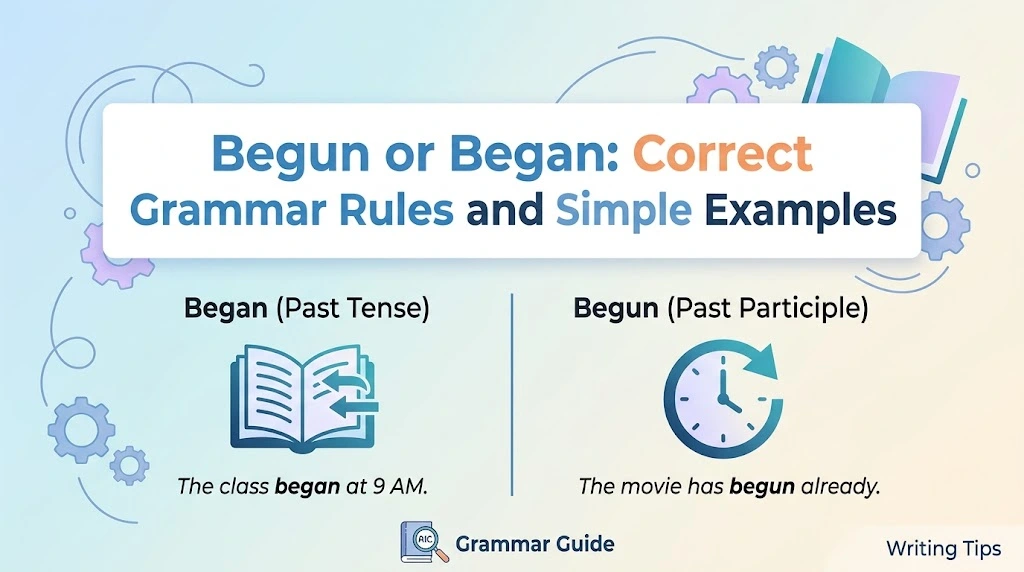
Begun or began? If these two forms of begin keep getting mixed up, you’re not alone. They look similar, sound related, and both describe something starting. The important difference is grammatical.
The simplest rule is this:
Begin = present/base form
Began = simple past
Begun = past participle
So you write:
- I begin work at 8 a.m.
- I began work at 8 a.m. yesterday.
- I have begun work on the project.
The tricky part comes when auxiliary verbs such as has, have, had, and did enter the sentence. That’s where many otherwise clear sentences go off track.
This guide explains began vs. begun from the ground up. You’ll see the correct grammar rules, common mistakes, tense patterns, examples, comparisons, and a quick test you can use whenever you’re unsure.
Began vs. Begun: The Quick Answer
Began is the simple past form of begin. Begun is the past participle.
Here’s the essential comparison:
| Form | Grammatical role | Example |
| begin | Base/present form | I begin work early. |
| began | Simple past | I began work early yesterday. |
| begun | Past participle | I have begun work early today. |
The biggest clue is the word before the verb.
When you have did, use the base form:
- Did the meeting begin?
- Not: Did the meeting began?
When you have has, have, or had, use begun:
- The meeting has begun.
- The meeting had begun.
Without an auxiliary verb, a past-tense statement normally uses began:
- The meeting began at noon.
That three-way distinction solves most began or begun questions.
What Does “Began” Mean?
Began means that something started at a point in the past. It is the simple past tense of begin.
You use it when you’re talking about a past event without making the past participle structure necessary.
For example:
- The concert began at 7 p.m.
- She began reading the book yesterday.
- The rain began after midnight.
- We began the meeting on time.
- He began learning Spanish in college.
Notice that began can stand as the main verb by itself.
Examples of “Began” in Context
Work:
The manager began the meeting at nine.
Education:
Maria began college in 2022.
Weather:
Heavy rain began during the afternoon.
Personal activities:
I began exercising regularly last month.
Events:
The ceremony began shortly after sunset.
In each example, the sentence uses the simple past.
What Does “Begun” Mean?
Begun is the past participle of begin. It doesn’t normally work as the simple past tense by itself.
Instead, it appears in constructions involving auxiliary verbs.
The most common pattern is:
has/have/had + begun
Examples include:
- The class has begun.
- We have begun the project.
- She had begun cooking before I arrived.
- They have begun discussing the issue.
The difference becomes especially clear when you compare these sentences:
The show began at eight.
The show has begun.
The first sentence simply places the beginning in the past. The second uses the present perfect and connects the completed beginning to the present situation.
Begin, Began, Begun: The Three Verb Forms
The verb begin is irregular. It doesn’t form its past tense by simply adding -ed.
| Verb form | Name | Example |
| begin | Base form | We begin at noon. |
| began | Simple past | We began at noon yesterday. |
| begun | Past participle | We have begun already. |
This pattern resembles other irregular verbs:
| Base | Simple past | Past participle |
| begin | began | begun |
| drink | drank | drunk |
| sing | sang | sung |
| ring | rang | rung |
| swim | swam | swum |
A useful memory trick is to notice the vowel movement:
begin → began → begun
The forms aren’t interchangeable. Each one has a specific grammatical job.
When to Use Began
Use began when you need the simple past tense.
This usually happens when an action started at a definite or understood time in the past.
With a Specific Past Time
- The movie began at 6:30.
- The company began operations in 1998.
- She began the course last Monday.
- We began dinner at seven.
Words such as yesterday, last week, in 2020, two hours ago, and when I was young often point toward the simple past.
For example:
The construction began in March.
You wouldn’t normally write:
The construction begun in March.
That second version lacks the auxiliary structure required for begun.
With a Sequence of Past Events
The simple past also works naturally when several past events happen in sequence.
The alarm rang. I woke up. I began getting ready for work.
Each verb describes a past event.
When to Use Begun
Use begun when the grammar calls for a past participle.
The most common situation involves the perfect tenses.
Present Perfect
Use:
has/have + begun
Examples:
- The meeting has begun.
- Classes have begun.
- She has begun a new project.
- We have begun planning the trip.
The present perfect often connects a past action with the present.
For example:
The sale has begun, so customers can now place orders.
The beginning happened before the moment of speaking. Its effect or relevance continues now.
Past Perfect
Use:
had + begun
Examples:
- The meeting had begun before we arrived.
- She had begun cooking when the phone rang.
- The storm had begun before sunset.
- They had begun negotiations before the announcement.
The past perfect establishes an earlier past event in relation to another past event.
When I arrived, the movie had begun.
First, the movie started. Later, I arrived.
That time relationship is exactly why had begun works.
Began vs. Begun in Different Tenses
Understanding the tense often makes the correct choice obvious.
| Tense | Correct structure | Example |
| Simple present | begin/begins | The class begins at nine. |
| Simple past | began | The class began at nine. |
| Present perfect | has/have begun | The class has begun. |
| Past perfect | had begun | The class had begun before I arrived. |
| Future | will begin | The class will begin tomorrow. |
| Modal | can/may/must begin | The class will begin soon. |
| Infinitive | to begin | It’s time to begin. |
There’s an important pattern here.
Began belongs to the simple past.
Begun belongs to perfect constructions and other structures that require a past participle.
Why “Has Began” Is Incorrect
One of the most common mistakes is writing:
❌ The meeting has began.
The correct sentence is:
✅ The meeting has begun.
Why?
Because has creates a present perfect construction. The verb following has needs to be the past participle.
The formula is:
has + past participle
Since begun is the past participle, we get:
has begun
The same rule applies to have:
❌ They have began the work.
✅ They have begun the work.
This isn’t a matter of style. It’s a matter of verb form.
Why “I Have Began” Is Incorrect
The same principle applies to have.
❌ I have began reading the book.
✅ I have begun reading the book.
Compare that with the simple past:
✅ I began reading the book yesterday.
The first sentence uses the present perfect. The second uses the simple past.
A Simple Test
Look at the word before the verb.
If it’s have or has, ask:
Do I need a past participle?
Yes.
Therefore:
have begun
not:
have began
Can You Say “Had Began”?
No, not in standard English.
The correct form is:
had begun
For example:
❌ The game had began before we arrived.
✅ The game had begun before we arrived.
The formula is:
had + past participle
Since begun is the past participle:
had begun
This structure is especially useful when one past event happened before another.
The storm had begun before the travelers reached the hotel.
The storm started first. The travelers arrived later.
Can You Use “Begun” Without Has, Have, or Had?
Not every use of begun has to involve has, have, or had. The important point is that begun still functions as a past participle, not as an ordinary simple past verb.
For example:
The work is begun.
This passive construction uses a form of be with the past participle.
However, this construction is less common in everyday American English than active alternatives such as:
We have begun the work.
You may also encounter forms involving other auxiliaries or participial constructions.
The key lesson remains unchanged:
Begun isn’t the standalone simple past form.
Began vs. Begun in Questions
Questions create another common trap.
After did, use the base form begin, not began.
Correct:
Did the meeting begin?
Incorrect:
❌ Did the meeting began?
Why?
Because did already marks the past tense. The main verb returns to its base form.
The same rule applies to other verbs:
- Did she go?
- Not: Did she went?
- Did he eat?
- Not: Did he ate?
- Did they begin?
- Not: Did they began?
Questions With “Has” and “Have”
When using present perfect questions, use begun:
Has the meeting begun?
Have the classes begun?
These sentences follow the structure:
has/have + subject + past participle
So:
Has the meeting begun?
is correct.
Began vs. Begun in Negative Sentences
Negative sentences follow the same basic rules.
With didn’t, use begin:
The meeting didn’t begin on time.
Not:
❌ The meeting didn’t began on time.
Again, did carries the past-tense marking.
With hasn’t or haven’t, use begun:
The meeting hasn’t begun yet.
The classes haven’t begun yet.
With hadn’t, use begun:
The meeting hadn’t begun when we arrived.
These patterns become much easier once you identify the auxiliary verb.
Common Mistakes With Began and Begun
Here are the errors you’ll see most often.
| Incorrect | Correct | Why |
| She has began. | She has begun. | Has requires the past participle. |
| They have began. | They have begun. | Have requires the past participle. |
| It had began. | It had begun. | Had requires the past participle. |
| Did it began? | Did it begin? | Did takes the base form. |
| It didn’t began. | It didn’t begin. | Didn’t takes the base form. |
| It begun yesterday. | It began yesterday. | Simple past requires began. |
A useful shortcut is to identify the helper verb before choosing the form.
Began or Begun: Simple Examples
Sometimes the best grammar lesson is a collection of ordinary sentences.
Everyday Examples
- I began my homework after dinner.
- I have begun my homework already.
- The store began business at nine.
- The store has begun accepting orders.
- The movie began at eight.
- The movie has begun.
- She began learning French last year.
- She has begun learning French.
- The rain began suddenly.
- The rain has begun again.
Notice how small changes in the sentence can change the correct verb form.
Began or Begun in Questions and Answers
Real conversations make the difference easier to see.
Q: When did the movie begin?
A: It began at eight.
Here, did appears in the question, so begin follows it. The answer uses simple past, so began works.
Now compare:
Q: Has the movie begun?
A: Yes, it has begun.
Here, the present perfect requires begun.
Another example:
Q: Did the meeting begin on time?
A: Yes, it began at nine.
But:
Q: Has the meeting begun?
A: Yes, it has begun.
The underlying idea is similar. The grammar changes because the tense structure changes.
Began or Begun With “Since” and “For”
Words such as since and for often appear with perfect constructions, although the exact grammar depends on the meaning.
Consider:
The project began in January.
This tells you when the project started.
Now compare:
The project has been underway since January.
This emphasizes the continuing state.
You can also say:
The project has begun.
That means the project has started.
However, don’t automatically pair begun with every sentence containing since or for. The construction depends on what you want to express.
For example:
She began working here in 2021.
She has worked here since 2021.
The first sentence focuses on the starting event. The second emphasizes the continuing situation.
“The Movie Began” vs. “The Movie Has Begun”
These sentences look nearly identical, but their grammatical perspective differs.
The Movie Began
The movie began at 7:30.
This is simple past. You’re describing a past event.
The Movie Has Begun
The movie has begun.
This is present perfect. You’re saying the movie has started, with that fact relevant now.
Imagine someone running into the theater and asking:
“Has the movie begun?”
A natural answer is:
“Yes, it has begun.”
But if someone asks:
“When did the movie begin?”
you answer:
“It began at 7:30.”
The question often gives you a strong clue about the correct form.
“It Began” vs. “It Has Begun” vs. “It Had Begun”
These three forms are worth mastering because they show the entire distinction in one place.
| Sentence | Tense | Main idea |
| It began. | Simple past | It started in the past. |
| It has begun. | Present perfect | It has started, and that fact matters now. |
| It had begun. | Past perfect | It started before another past event. |
Consider this short timeline:
Movie begins → You arrive → Present
If you’re describing the starting event:
The movie began at 7 p.m.
If you’re speaking after it has started:
The movie has begun.
If you’re describing what happened before your arrival:
The movie had begun when I arrived.
The timeline makes the difference much easier to remember.
Began and Begun With “To”
Both forms can appear around an infinitive, but the surrounding grammar determines which one belongs.
Simple past:
She began to laugh.
Present perfect:
She has begun to laugh.
Past perfect:
She had begun to laugh.
The pattern is clear:
began + to + verb
or:
has/had begun + to + verb
You can also use a gerund:
She began laughing.
She has begun laughing.
Both to laugh and laughing can follow begin in many contexts.
Began and Begun With Gerunds
The verb begin commonly works with an -ing form.
For example:
He began working at six.
He has begun working at six.
The first sentence uses began because it’s simple past.
The second uses begun because has requires the past participle.
This gives you another useful comparison:
| Simple past | Present perfect |
| She began studying. | She has begun studying. |
| They began working. | They have begun working. |
| We began planning. | We have begun planning. |
The word after begin doesn’t determine the form. The tense does.
Began vs. Begun in American English
In standard American English, began and begun have clearly different grammatical functions.
American English doesn’t treat them as interchangeable variants.
You use began for simple past:
He began the job last year.
You use begun as a past participle:
He has begun the job.
However, the second sentence can sound less natural depending on context because speakers may choose started or another construction. That doesn’t change the grammar of begun.
The distinction remains straightforward:
began = simple past
begun = past participle
Began vs. Begun vs. Started
The word started often overlaps with began.
For example:
The meeting began at nine.
The meeting started at nine.
Both are grammatical.
But that doesn’t mean started explains the difference between began and begun. The forms still behave differently.
Compare:
The meeting began.
The meeting has begun.
With start:
The meeting started.
The meeting has started.
The parallel is useful because start uses the same form for its simple past and past participle, while begin does not.
| Verb | Base | Past | Past participle |
| begin | begin | began | begun |
| start | start | started | started |
That’s one reason begin causes more confusion.
Began vs. Begun vs. Commenced
Commenced is another word that can mean began or started, but it tends to sound more formal.
For example:
The ceremony began at noon.
The ceremony commenced at noon.
Both are grammatical, but began sounds more natural in ordinary conversation.
In most everyday writing, begin and start are more useful choices.
The key grammatical issue remains unchanged. If you choose begin, you still need the correct form:
began for simple past
begun for the past participle
How to Remember Began vs. Begun
Here’s an easy memory trick:
Began stands alone. Begun needs a helper.
That’s not a complete description of every possible grammatical construction, but it’s an excellent practical shortcut.
Think:
I began.
But:
I have begun.
I had begun.
The auxiliary verbs act like a grammatical signal.
Another memory pattern is:
begin → began → begun
Think of it as three stages:
Now → Past → Participial form
- I begin today.
- I began yesterday.
- I have begun already.
The “Helper Verb” Test
When you’re unsure, scan the sentence.
If you see:
- has
- have
- had
you’ll usually need begun.
If you see:
- did
- didn’t
use begin.
If you’re simply describing a completed past event, use began.
Began or Begun? A Quick Decision Guide
Use this checklist when you’re editing a sentence.
If the sentence uses simple past
Use began.
She began the lesson at ten.
If the sentence uses has or have
Use begun.
She has begun the lesson.
If the sentence uses had
Use begun.
She had begun the lesson before I arrived.
If the sentence uses did
Use begin.
Did she begin the lesson?
If the sentence uses didn’t
Use begin.
She didn’t begin the lesson on time.
If the sentence uses the infinitive
Use begin.
She wants to begin the lesson.
This quick test catches most common errors.
A Timeline for Began and Begun
A simple timeline can make the difference visual.
PAST PRESENT
|—————————–|
|
| The meeting BEGAN.
|
|——–> The meeting HAS BEGUN.
|
| It had begun before another
| past event happened.
Think of began as reporting a past starting event.
Think of has begun as connecting that starting event with the present.
Think of had begun as placing the start before another past event.
Mini Quiz: Began or Begun?
Choose begin, began, or begun for each sentence.
- The show ___ at eight last night.
- The show has ___.
- Did the show ___ on time?
- The show had ___ before we arrived.
- She ___ learning Spanish last year.
- She has ___ learning Spanish.
- They didn’t ___ the project yesterday.
- We have ___ preparing the report.
- When did the meeting ___?
- The meeting ___ at noon.
- The meeting hasn’t ___ yet.
- The class had ___ before the teacher arrived.
Answer Key
- began
- begun
- begin
- begun
- began
- begun
- begin
- begun
- begin
- began
- begun
- begun
Why the Answers Work
1. The show began at eight last night.
The phrase last night identifies a completed past time. Use the simple past.
2. The show has begun.
Has requires the past participle. Therefore, use begun.
3. Did the show begin on time?
Did already marks the past tense. The main verb returns to its base form.
4. The show had begun before we arrived.
Had requires the past participle. The sentence also establishes an earlier past event.
5. She began learning Spanish last year.
This is a simple past statement.
6. She has begun learning Spanish.
The present perfect requires begun.
7. They didn’t begin the project yesterday.
After didn’t, use the base form.
8. We have begun preparing the report.
Have requires the past participle.
9. When did the meeting begin?
Again, did requires the base form.
10. The meeting began at noon.
There’s no auxiliary verb. The sentence uses simple past.
11. The meeting hasn’t begun yet.
Hasn’t is short for has not, so the past participle follows.
12. The class had begun before the teacher arrived.
Had requires begun, and the sentence describes two past events in sequence.
Common Sentence Patterns to Memorize
Rather than memorizing dozens of isolated examples, learn these patterns.
| Pattern | Example |
| begin + present context | We begin at nine. |
| began + past time | We began at nine yesterday. |
| has begun | The meeting has begun. |
| have begun | The students have begun. |
| had begun | The meeting had begun before noon. |
| did + begin | Did the meeting begin? |
| didn’t + begin | The meeting didn’t begin. |
| to + begin | It’s time to begin. |
If these patterns become familiar, you won’t need to stop and analyze every sentence.
A Practical Case Study: One Event, Three Tenses
Imagine a conference starts at 9 a.m.
At 8:55, someone says:
The conference will begin at nine.
At 9:05, someone says:
The conference began at nine.
At 9:10, someone asks whether it has started:
The conference has begun.
Later, someone describes arriving at 9:15:
The conference had begun when I arrived.
The event hasn’t changed. The speaker’s relationship to the event has.
That’s the heart of the distinction.
Another Case Study: Starting a Project
Suppose a company starts a new marketing project.
Simple past:
The team began the project Monday.
Present perfect:
The team has begun the project.
Past perfect:
The team had begun the project before the new manager joined.
Question:
When did the team begin the project?
Negative:
The team didn’t begin the project Monday.
Six sentences. Five different verb structures. Once you recognize the auxiliary verbs, the choices become predictable.
A Quote Worth Remembering
“Began” tells you something started in the past. “Begun” tells you the grammar needs a past participle.
That’s the practical distinction to carry into everyday writing.
Don’t think of the words as competing synonyms. They aren’t two interchangeable versions of the same verb.
They’re different grammatical forms of the same irregular verb.
Frequently Asked Questions About Began or Begun
Is “began” past tense?
Yes. Began is the simple past tense of begin.
She began working yesterday.
Is “begun” past tense?
No. Begun is the past participle of begin.
It commonly appears after has, have, or had.
She has begun working.
Which is correct: “has began” or “has begun”?
Has begun is correct.
The meeting has begun.
The present perfect requires the past participle.
Which is correct: “had began” or “had begun”?
Had begun is correct.
The meeting had begun before we arrived.
Can you say “did began”?
No. After did, use the base form.
Did the meeting begin?
Is “didn’t began” correct?
No.
The correct form is:
The meeting didn’t begin.
Is “began” a regular verb form?
No. Begin is an irregular verb.
Its principal forms are:
begin → began → begun
Can “begun” start a sentence?
Yes, depending on the construction.
For example:
Begun as a small family business, the company eventually expanded nationwide.
Here, begun appears as a participial form rather than as the main simple past verb.
Is “began” or “begun” more correct?
Neither is universally “more correct.” Each is correct in its proper grammatical position.
Use began for simple past.
Use begun when the construction requires the past participle.
Can “began” follow “to”?
No. After to, use the base form:
It’s time to begin.
Not:
❌ It’s time to began.
Can “begun” follow “to”?
Not when to introduces the ordinary infinitive.
Use:
to begin
not:
to begun
However, begun can appear elsewhere in a sentence involving to when another construction supplies the auxiliary:
She has begun to understand the problem.
Here, begun follows has, while to understand is a separate infinitive.
Began or Begun: The Final Rule
The entire distinction can be reduced to three forms:
| Form | Use | Example |
| begin | Base form | We begin at nine. |
| began | Simple past | We began at nine yesterday. |
| begun | Past participle | We have begun already. |
Remember these three sentences:
I begin my work every morning.
I began my work yesterday.
I have begun my work today.
Then remember the auxiliary rule:
did + begin
has/have/had + begun
Once you spot those helper verbs, choosing between began and begun becomes much easier.
The most common mistakes are easy to avoid, too. Don’t write “has began,” “had began,” “did began,” or “didn’t began.” Instead, use “has begun,” “had begun,” “did begin,” and “didn’t begin.”
If you remember only one thing, make it this:
Begin → Began → Begun
Present/base → Simple past → Past participle
That’s the grammar rule that keeps began and begun in their proper lanes.
